Our Exercise Of The Month: ITB Foam Roller

ITB – Foam Roller
  • Lie on your side with your affected thigh over a foam roll.
  • Lift your shoulders off of the floor with your arm and roll the fleshy part your mid & lower thigh back and forth over the foam roller.
  • Avoid rolling over the bony point of your hip unless specifically directed.
  • Perform this exercise for one minute twice per day or as directed.

Hip or Low Back?

Lumbar and Pelvis

Technically, the hip is the ball-and-socket joint between the long bone of the thigh and the pelvis; but more often than not, many people will point to a number of different places on their back or pelvis and say, “My hip is killing me” when it’s not really “the hip” at all!
Hip pain can be located in the front (groin area), the side, the back, or in the buttocks. The “classic sign” of hip pain is reproduced most consistently when you try to cross your legs—put your ankle on the far end of the thigh and then push down on your knee. This may feel tight and cause pain in the groin area. For many people, hip pain is also reproduced when they cross their legs and then pull their knee towards the opposite shoulder.
The hip is a VERY strong joint due to the deep receiving cup of the pelvis and the round ball that fits nicely into it. Because it’s a freely moving joint, there is a joint capsule. The capsule is lined with tissue that produces an oily substance that lubricates the joint (called synovial fluid), and when hip pain occurs, this can be caused by a capsulitis (inflammation of the capsule) with a buildup of synovial fluid (called synovitis).
When the smooth, shiny surface of the ball starts to wear thin (which can eventually wear away down to the bone), that’s a condition called “osteoarthritis.” This occurs over time for many and may eventually result in the need for a hip replacement. This usually isn’t needed until an individual is in their late 60s or older (if at all), but for those who injure a hip earlier in life, the “wearing out” process may accelerate and a hip replacement may be needed well before old age.
There are many studies that report low back and hip arthritis often occur together, and differentiating between the two can sometimes be a challenge. For example, pain can radiate from the hip to the knee, which many doctors will diagnose as “sciatic nerve.” But hip pain can present exactly the same, making it hard to determine if it’s low back-generated pain or hip-generated pain.
This is why it’s SO IMPORTANT that your doctor of chiropractic conduct a careful history and examination. There are specific tests that he or she will perform that help determine which of the two is causing the pain. There are times when they may find BOTH problems co-existing together, making it necessary to manage two problems, rather than just one.
There are many mobilization, manipulation, soft tissue therapies, modalities, and exercises available to patients with both hip and low back pain. So if you’re not sure what is bothering you and you don’t know what to do, visit your doctor of chiropractic and he or she will help you through this.

Exercise Of The Month: Pike On A Ball

Pike on a Ball

Begin in a push-up position with your knees resting on an exercise ball. Maintain a neutral spine, and do not allow your back to arch down towards the floor. Roll the ball from your thighs to your ankles by bending your knees and bringing them towards your chest. Slowly return to the start position. Perform three sets of 10 repetitions daily or as directed.

What is Facet Syndrome?

As stated in last week’s article, low back pain (LBP) can arise from many different structures. Lumbar facet syndrome is one that involves the facet joint and includes both acute (new) and chronic (old) varieties. The facet joint is synonymous with the zygapophyseal joint, so if you hear that word, don’t let it throw you off! Approximately 45% of patients with chronic low back pain suffer from “facet syndrome” (FS) in which the facets are the low back pain generator.
There are many conditions that give rise to FS. Some of these include the straining of the surrounding joint capsule (the capsule holds the joint securely together), joint hypomobility (reduced motion in the joint), a synovial cyst (similar to a ganglion on the back of the wrist but its located inside the joint), and degeneration (also called osteoarthritis—the wearing out type of arthritis).
Because facet syndrome can accompany other conditions, a doctor of chiropractic must evaluate each patient individually and manage each person appropriately. In “pure” facet syndrome, pain rarely ever passes the level of the knee and does not cause neurological loss (weakness, loss of reflex, etc.). It can create numbness but usually NOT beyond the knee. Pain is usually not worsened by hip movements such as straight leg raise or hip rotation.
The facet joint’s “job” (at least in part) is to limit or guard twisting movements in the upper lumbar/low back region, and the lower lumbar facets are shaped to limit motion when bending forwards and backwards. Facet joints are unique because they are innervated by specific nerves that can be blocked by injecting an anesthetic agent to determine if the facet (and its innervating nerve) is the main source of pain. The surrounding capsule around the facet joint contains mechanoreceptors (cells that detect movement) and nociceptors (cells that detect pain) that fire when the facet joint is compressed/jammed or over-stretched. These nociceptors can become “hypersensitized” (very irritable) when they remain inflamed over time.
In many patients, injury to a facet joint is the result of many microtraumas over a period of time and not one single isolated event. For example, repeatedly bending backwards, twisting, and leaning to one side can stretch the joint capsule and fatigue it until some capsular tissues finally “give” and it inflames which generates pain.
These joints commonly become arthritic with age, which is one reason people over 50-60 years old commonly present with FS. Osteoarthritis results in a narrowing of the joint space and causes a more permanently “jammed” joint. This is one reason many elderly people walk partially bent over—as bending forwards opens the facet joints and “feels good!”
facet joint
The good news is that chiropractic manipulation is a highly effective treatment for facet syndrome, and most patients feel much better within the first or second week of care (often within three to five visits).

Hamstring Problems?

Glute Ham Raise.gif

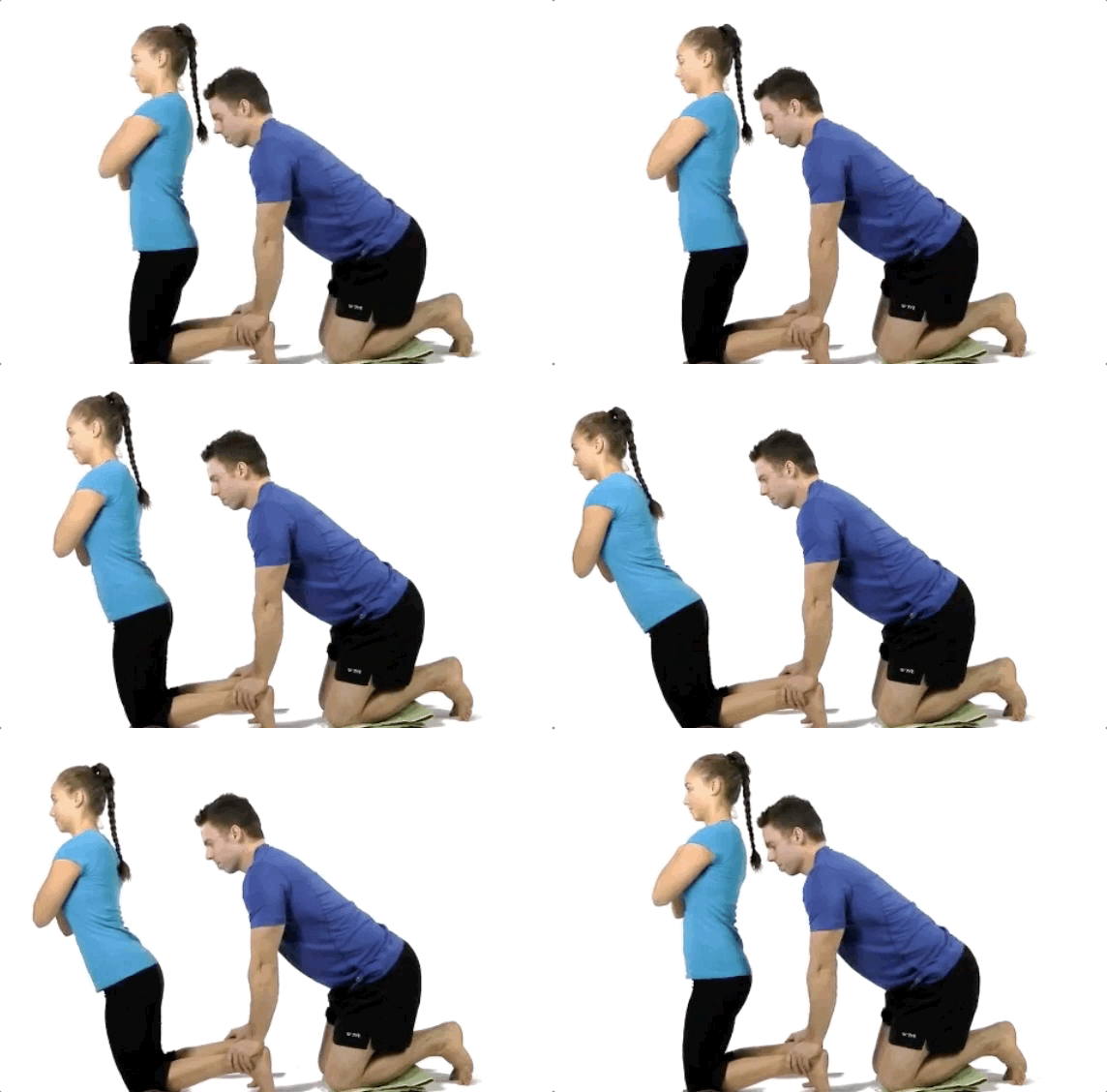
A great injury prevention movement is the glute-ham raise. Done after a warm up and prior to competition it will significantly reduce the odds of hamstring strains in running athletes in sports like Soccer, Football and Sprinting.

To perform the movement:

Begin in a tall kneeling position on a cushion or pillow.

Partner grabs and holds ankles to ground or hook your feet under a stable surface.

Keeping your torso neutral and your thighs in line with your body, bend forward at the knees, using your hamstrings to control the speed of your forward bend.

Go as far as you can without cramping, pain or falling to the ground.


What Causes Low Back Pain?

236

Low back pain (LBP) can arise from disks, nerves, joints, and the surrounding soft tissues.
To simplify the task of determining “What is causing my LBP?” the Quebec Task Force recommends that LBP be divided into three main categories: 1) Mechanical LBP; 2) Nerve root related back pain; and 3) Pathology or fracture. We will address the first two, as they are most commonly managed by chiropractors.
Making the proper diagnosis points your doctor in the right direction regarding treatment. It avoids time wasted by treating an unrelated condition, which runs the risk of increased chances of a poor and/or prolonged recovery. Low back pain is no exception! The “correct” diagnosis allows treatment to be focused and specific so that it will yield the best results.
Mechanical low back pain is the most commonly seen type of back pain, and it encompasses pain that arises from sprains, strains, facet and sacroiliac (SI) syndromes, and more. The main difference between this and nerve root-related LBP is the ABSENCE of a pinched nerve. Hence, pain typically does NOT radiate, and if it does, it rarely goes beyond the knee and normally does not cause weakness in the leg.
The mechanism of injury for both types of LBP can occur when a person does too much, maintains an awkward position for too long, or over bends, lifts, and/or twists. However, LBP can also occur “insidiously” or for seemingly no reason at all. However, in most cases, if one thinks hard enough, they can identify an event or a series of “micro-traumas” extending back in time that may be the “cause” of their current low back pain issues.
Nerve root-related LBP is less common but it is often more severe—as the pain associated with a pinched nerve is often very sharp, can radiate down a leg often to the foot, and cause numbness, tingling, and muscle weakness. The location of the weakness depends on which nerve is pinched. Think of the nerve as a wire to a light and the switch of the nerve is located in the back where it exits the spine. When the switch is turned on (the nerve is pinched), and the “light” turns on—possibly in the outer foot, middle foot, inner foot, or front, back or side of the thigh. In fact, there are seven nerves that innervate or “run” into our leg, so usually, a very specific location “lights up” in the limb.
Determining the cause of your low back pain helps your doctor of chiropractic determine which treatments may work best to alleviate your pain as well as where such treatments can be focused.


I have Low Back Pain. Why?

265

Low back pain (LBP) can arise from disks, nerves, joints, and the surrounding soft tissues. To simplify the task of determining “What is causing my LBP?” the Quebec Task Force recommends that LBP be divided into three main categories: 1) Mechanical LBP; 2) Nerve root related back pain; and 3) Pathology or fracture. We will address the first two, as they are most commonly managed by chiropractors.
Making the proper diagnosis points your doctor in the right direction regarding treatment. It avoids time wasted by treating an unrelated condition, which runs the risk of increased chances of a poor and/or prolonged recovery. Low back pain is no exception! The “correct” diagnosis allows treatment to be focused and specific so that it will yield the best results.
Mechanical low back pain is the most commonly seen type of back pain, and it encompasses pain that arises from sprains, strains, facet and sacroiliac (SI) syndromes, and more. The main difference between this and nerve root-related LBP is the ABSENCE of a pinched nerve. Hence, pain typically does NOT radiate, and if it does, it rarely goes beyond the knee and normally does not cause weakness in the leg.
The mechanism of injury for both types of LBP can occur when a person does too much, maintains an awkward position for too long, or over bends, lifts, and/or twists. However, LBP can also occur “insidiously” or for seemingly no reason at all. However, in most cases, if one thinks hard enough, they can identify an event or a series of “micro-traumas” extending back in time that may be the “cause” of their current low back pain issues.
Nerve root-related LBP is less common but it is often more severe—as the pain associated with a pinched nerve is often very sharp, can radiate down a leg often to the foot, and cause numbness, tingling, and muscle weakness. The location of the weakness depends on which nerve is pinched. Think of the nerve as a wire to a light and the switch of the nerve is located in the back where it exits the spine. When the switch is turned on (the nerve is pinched), and the “light” turns on—possibly in the outer foot, middle foot, inner foot, or front, back or side of the thigh. In fact, there are seven nerves that innervate or “run” into our leg, so usually, a very specific location “lights up” in the limb.
Determining the cause of your low back pain helps your doctor of chiropractic determine which treatments may work best to alleviate your pain as well as where such treatments can be focused.

My Hip Hurts….

hip FAI

​Is it a labral tear? 

One of the structures that is frequently blamed for hip pain is called the labrum—the rubbery tissue that surrounds the socket helping to stabilize the hip joint. This tissue often wears and tears with age, but it can also be torn as a result of a trauma or sports-related injury.

The clinical significance of a labral tear of the hip is controversial, as these can be found in people who don’t have any pain at all. We know from studies of the intervertebral disks located in the lower back that disk herniation is often found in pain-free subjects—between 20-50% of the normal population.  In other words, the presence of abnormalities on an MRI is often poorly associated with patient symptoms, and the presence of a labral tear of the hip appears to be quite similar.

For instance, in a study of 45 volunteers (average age 38, range: 15–66 years old; 60% males) with no history of hip pain, symptoms, injury, or prior surgery, MRIs reviewed by three board-certified radiologists revealed a total of 73% of the hips had abnormalities, of which more than two-thirds were labral tears.

Another interesting study found an equal number of labral tears in a group of professional ballet dancers (both with and without hip pain) and in non-dancer control subjects of similar age and gender.

Another study showed that diagnostic blocks—a pain killer injected into the hip for diagnostic purposes to determine if it’s a pain generator—failed to offer relief for those with labral tears.

Doctors of chiropractic are trained to identify the origins of pain arising from the low back, pelvis, hip, and knee, all of which can mimic or produce hip symptoms.  Utilizing information derived from a careful history, examination, imaging (when appropriate), and functional tests, chiropractors can offer a nonsurgical, noninvasive, safe method of managing hip pain.

“Other” Causes of Low Back Pain

316046269_1280x720

Between 80% and 90% of the general population will experience an episode of lower back pain (LBP) at least once during their lives. When it affects the young to middle-aged, we often use the term “non-specific LBP” to describe the condition. The geriatric population suffers from the “aging effects” of the spine—things like degenerative joint disease, degenerative disk disease, and spinal stenosis. Fractures caused by osteoporosis can also result in back pain.

The “good news” is that there are rare times when your doctor must consider a serious cause of LBP. That’s why he or she will ask about or check the following during your initial consultation: 1) Have you had bowel or bladder control problems? (This is to make sure a patient doesn’t have “cauda equina syndrome”—a very severely pinched nerve.) 2) Take a patient’s temperature and ask about any recent urinary or respiratory tract infections to rule out spinal infections. 3) To rule out cancer, a doctor may ask about a family or personal history of cancer, recent unexplained weight loss, LBP that won’t go away with time, or sleep interruptions that are out of the ordinary. 4) To rule out fractures, a doctor may also take x-rays if a patient is over age 70 regardless of trauma due to osteoporosis, over age 50 with minor trauma, and at any age with major trauma.
Once a doctor of chiropractic can rule out the “dangerous” causes of LBP, the “KEY” form of treatment is giving reassurance that LBP is manageable and advise LBP sufferers of ALL ages (especially the elderly) to KEEP MOVING! Of course, the speed at which we move depends on many things—first is safety, but perhaps more importantly is to NOT BECOME AFRAID to do things! As we age, we gradually fall out of shape and end up blaming our age for the inability to do simple normal activities. Regardless of age, we must GRADUALLY increase our activities to avoid the trap of sedentary habits resulting in deconditioning followed “fear avoidant behavior!”
Here are a few “surprising” reasons your back may be “killing you”: 1) You’re feeling down – That’s right, having “the blues” and more serious mood disorders, like depression, can make it more difficult to cope with pain. Also, depression often reduces the drive to exercise, may disturb sleep, and can affect dietary decisions—all of which are LBP contributors. 2) Your phone – Poor posture caused by holding a phone between your bent head and shoulder (get a headset!) or prolonged mobile phone use can increase your risk for spinal pain. 3) Your feet hurt, which makes you walk with an altered gait pattern, forcing compensatory movements up the “kinetic chain” leading to LBP. 4) Core muscle weakness, especially if you add to that a “pendulous abdomen” from being overweight—this is a recipe for disaster for LBP. 5) Tight short muscles such as hamstrings, hip rotator muscles, and/or tight hip joint capsules are common problems that contribute to LBP. Stretching exercises can REALLY help!