
These muscles are located in the groin. The longus originates on the pubic body just below the pubic crest and inserts on the middle third of the linea aspera.The brevis muscle originates on the inferior ramus and body of the pubis and has its attachment to the lesser trochanter and linea aspera of the femur. Trigger points in these muscles are the most common muscular cause of groin pain. Distal trigger points refer pain to the upper medial knee and down the tibia. Proximal trigger points refer into the anterior hip area.
Health
Diet & Exercise Tip Of The Month

Have you ever started a new exercise program and then suddenly gained a few
pounds? Don’t fret. It’s normal! Exercise is a stress on your body, which creates micro
tears in your muscles, and the inflammation from those tears will cause you to retain
more water. Your body will also start to store more glycogen in your muscles to make
sure you have plenty of fuel to burn during your next workout. Those two things will
cause a temporary weight gain when you first start working out. A better way to track
your progress will always be to take measurements. If you’re losing inches, you’re
winning!
Bryan Cobb RMT.
Since 2005, Bryan has been dedicated to helping all people with chronic and acute pain caused by soft-tissue damage.
His training and experience make him uniquely qualified to treat a wide variety of pain and dysfunction and to give instruction on prevention and self-care.
Bryan is the only Massage Therapist in Manitoba — and one of the few in Canada — to be certified by the Certification Board for Myofascial Trigger Point Therapists (CBMTPT).
Bryan holds a degree as an Advanced Remedial Massage Therapist (ARMT) from the Massage Therapy College of Manitoba. Course work at MTCM includes
• over 2,000 hours of practice, as well as
• intensive course work,
• a supervised clinical practicum, and
• community outreach placements.MTCM has a credit transfer affiliation with the University of Winnipeg, ensuring that its courses are held to the highest level. When Bryan studied at MTCM, the college was the only massage therapy college in western Canada accredited by the Commission on Massage Therapy Accreditation. Today, the college is a member of the Canadian Council of Massage Therapy Schools.
Bryan is a member in good standing of the Natural Health Practitioners of Canada.
Bryan also has a background in Anatomy, Exercise Physiology, and Sport Sciences from the University of Manitoba, and he has worked as a personal trainer and fitness leader.
He is an avid natural bodybuilder and fitness enthusiast, and has a blue belt in Brazilian jiu-jitsu.
Avoiding Back Pain At Sedentary Jobs
Some great tips on how to prevent back pain when working a sedentary job from our friends at Silicon Republic. Check out the article below.
1. Take regular breaks to stretch and walk around
Try to walk around for between three and five minutes every half hour.
2. Make sure not to hunch over while working
Everyone intuitively understands that hunching over the computer is bad for them, but it’s easy to fall into the most natural and comfortable – albeit unhealthy – sitting position while you’re in the flow of things.
3. Consider a standing desk
A standing desk offers you the opportunity to alternate your position throughout the day.
Trigger points in the Quadratus Lumborum muscle.
The quadratus lumborum muscle is a commonly overlooked source of low back pain and is often responsible for “pseudo disc syndrome”. This muscle originates on the inferior border of the 12th rib and lumbar transverse processes. It inserts on the iliac crest and iliolumbar ligament. The q.l.’s main actions are extension and lateral flexion of the spine. It also acts as a stabilizer of the lumbar spine. Trigger points in this muscle refer pain into the sacroiliac joint and the lower buttock. Pain can also spread anteriorly along the crest of the ilium into the lower abdomen and groin and to the greater trochanter. 
Why Posture Is So Important For Fitness
Why Posture Is So Important For Exercise & Fitness
Great article from http://www.brit.co on posture and fitness.
If you’ve ever rolled your eyes when your mom told you to “sit up straighter,” listen up! Turns out she was on to something. Good posture is important for more reasons than physical presentation. And for fitness fanatics, it’s actually critical. “Good posture impacts how you walk, jump, and lift,” says Aaptiv trainer Ackeem Emmons. “Proper alignment also eases strain or pain on your spinal cord.”

For runners and gym-goers, the impacts are even more specific. “When you’re running, having good posture allows you to breathe better,” Emmons says. “The more air in your diaphragm, the further you can go. The better your posture, the more fluid your form.” All of this translates to more efficient and successful running. In the gym, proper form and alignment help you isolate certain muscle groups and execute heavy compound movements, he adds.
Beyond the obvious physical gains, your posture can also impact you mentally as well. “Standing tall with proper posture gives the immediate impression of confidence and courage,” says Aaptiv trainer Ceasar F. Barajas. “You’re mentally setting the tone for success when you straighten up a bit.”
If you’re suddenly feeling hyper-aware of your spinal column, don’t worry. According to Aaptiv trainers Jaime McFaden and Benjamin Green, you can work every day to gradually correct limp posture. “Sit up straight and gently pull your shoulders back and down, stretching the neck. Press both feet firmly into the ground and lift your chest,” McFaden says.
“I’m on a bike anywhere from three to six days per week, hunched over with a rounded back,” explains Green. “Throughout the day, if I catch myself not standing up straight, I open up my shoulders.” If it helps, imagine a string attached to the top of your head, pulling you up, he adds.
For those looking for a more intense posture intervention, our Aaptiv trainers shared five exercises and poses that will help open up your chest, align your spine, and gradually correct poor posture. Keep reading for more moves and be sure to check out all of Aaptiv’s yoga and stretching classes in-app to support (pun intended) your good posture journey.

1. Planks — Aaptiv Trainer Kelly Chase: Lie on your stomach with your legs straight behind you. Bring your arms forward and rest your weight on your forearms. Your elbows should be directly below your shoulders. Your arms can rest straight and flat with your palms facing the ground or you can bring your hands together to form a triangular shape. Engage your core and keep your body as straight as possible, careful not to create any dip or arch in your lower back. Hold for 30 seconds. As you become stronger, you can increase your hold time.

2. Band Scapular Retraction Rows — Aaptiv Trainer Candice Cunningham: You’ll need a resistance band for this exercise. Sit upright on the floor with both feet extended in front of you. Keeping your legs straight together, wrap the band around the bottoms of your feet, holding the ends in your hands. Focus on holding your back completely straight as you gradually pull the ends of the band into your chest in a row-style movement. Your elbows should bend out to the sides at chest height. Straighten your arms and repeat.
Complete 10 reps.

3. Supermans — Aaptiv Trainer Benjamin Green: Lie straight and face down on your mat. Extend your arms in front of you with your biceps next to your ears. Exhale and simultaneously, raise your legs, arms, and chest off the mat, creating a U-shape in your body. Squeeze your lower back and hold for two deep breaths. Inhale and lower your limbs back to the mat.
Complete 10 reps.

4. Bird Dogs — Aaptiv trainer Ackeem Emmons: Start on your hands and knees with your palms directly below your shoulders and your knees below your hips. Put your weight on your left knee and left hand as you slowly lift your right leg and straighten it behind you, keeping it in line with your flat back. Lift your right arm and extend it forward in line with your back. Reach with your fingers, careful to maintain a straight line through your body from fingertips to toes. Flex your right foot so your toes are pointed toward the ground and hold for five deep breaths. Repeat on the other side.
Complete 10 reps on each side.

5. Tadasana (Mountain Pose) — Aaptiv trainer Ceasar Barajas: You can perform this pose standing or sitting (at your desk perhaps?). Take a deep breath in and roll your shoulders up towards your ears. Exhale and roll them back down. Continue consciously breathing deeply and engage your core. Imagine someone poured cold water down your back to further engage your core and move deeper in the stretch.
Perform this move as often as you need.
Trigger points in the temporalis muscle
The temporalis muscle is located in the temple area of the skull. It originates on the temporal lines on the parietal bone of the skull, and inserts on the coronoid process of the mandible. It’s main action is to close the jaw. The posterior and middle fibres bilaterally retrude the mandible. Acting individually, this muscle will deviate the mandible to the same side. Trigger points in this muscle refer into the teeth causing hypersensitivity, and into and above the eye and temple, causing headaches.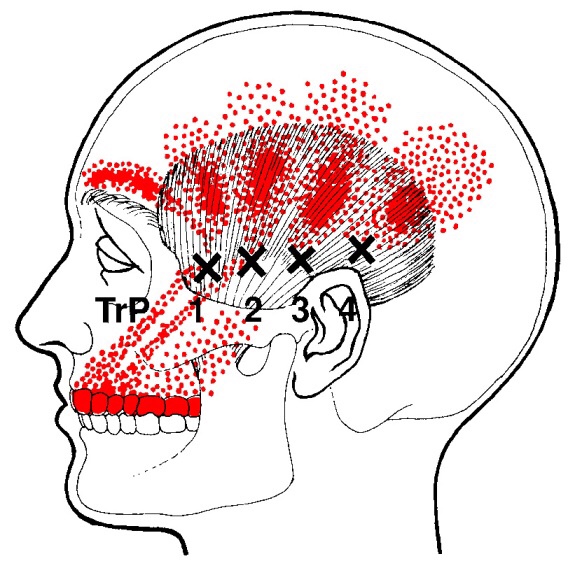
Exercise of the Month
Here is a great exercise that targets those upper back and shoulder muscles.
Reverse Butterfly’s – Keep in mind that all of the work in this exercise is done by your shoulder blades. Your arms are just along for the ride.
Do you wake up with numb fingers?
The term “thoracic outlet” describes an area at the base of your neck, just above your collarbone. Some important nerves and vessels pass through this outlet on their way into your arm. Compression of these tissues causes a condition called “thoracic outlet syndrome” which results in pain, numbness or tingling in your arm.
Several different factors can cause Thoracic Outlet Syndrome,

commonly referred to as TOS. Sometimes TOS is caused from tightness in the muscles of your neck and chest, other times the space between your first rib and collarbone is too small. People who have an extra rib (cervical rib) and people who have recently suffered a neck injury may have a greater chance of having this problem.
The condition is aggravated by poor posture and by occupations that promote “slouching,” i.e., computer users, assembly line workers, supermarket checkers and students. Swimmers, volleyball players, tennis players, baseball pitchers and occupations requiring prolonged overhead activity. i.e., electricians and painters are also prime candidates for TOS.
Symptoms of TOS include arm pain, numbness, tingling and possible weakness. Neck, arm and hand pain may begin slowly and are often aggravated by elevation of the arms or excessive head movement. Loss of grip strength is possible.
Conservative treatment, like the kind we provide, has been shown to be effective at treating TOS. Through our careful exam we have identified your specific sites of compression and will use some of the following treatment to help:
You should avoid carrying heavy loads, especially on your shoulder i.e., carpet rolls. Briefcases, laptop cases or heavy shoulder bags should be lightened. Bra straps may need additional padding or consideration of replacement with a sports bra.
The all too common knee cartilage tear.
The meniscus is a piece of tough, smooth, rubbery cartilage in the middle of your knee. Each of your knees have a meniscus on the inside (medial meniscus) and another on the outside (lateral meniscus). Each meniscus attaches to the top of your shin bone (tibia) and acts as a shock absorbent guide for your thigh bone (femur), which rests above.

Damage or tears to the meniscus are common. Males are affected three or four times more often than females. Tears may occur at any age. In children and adolescents, the menisci are more durable and rubbery, so most injures are “traumatic” as a result of a forceful twisting injury. As we age, our meniscus grows weaker, and “degenerative” tears become more likely, often resulting from simple or even unrecognized injuries.
Symptoms of meniscus injury depend on the type and severity of damage. Patients sometimes hear a pop or snap at the time of initial injury. Patients with acute injuries may have difficulty bearing weight and may develop a limp. Stiffness is a common complaint. Clicking, catching, locking or giving-way is possible. Meniscus injuries are usually aggravated by movement and become particularly uncomfortable with deep squatting.
Although some meniscus injuries may require surgery, most can be treated conservatively with the type of treatments provided in our office. Your age roughly correlates with the need for surgery. Approximately 2/3 of acute meniscal tears in children and adolescents will require surgery, but only about 1 in 20 patients over the age of 40 will require knee arthroscopy. Surgery is necessary more often in patients who cannot fully bend or straighten their leg, or whose knee locks and gets stuck in one place.
Home management includes rest, ice, compression and elevation (RICE). You should apply ice over your knee for 15 minutes at a time, three or four times a day. Wrapping an ACE bandage around your knee will provide compression to help minimize swelling. You may elevate your leg by placing a pillow beneath your knee to help reduce swelling.
You may need to limit your activity to prevent further damage while you are recovering from injury. Activities that involve twisting on a weight-bearing flexed knee are the most harmful. You may need to temporarily or permanently discontinue some high energy sports activity. Other activities, like water walking, may be substituted for higher energy sports, like soccer and tennis. Ice or ice massage should be used following activity.
Patients who have undergone surgical repair of their meniscus are more likely to develop arthritis. These patients will also benefit from a well-planned home exercise program.
 Aberdeen Chiropractic