
Diagnosis of trigger points typically takes into account symptoms, pain patterns, and manual palpation. When palpating the therapist will feel for a taut band of muscle with a hard nodule within it. Often a local twitch response will be elicited by running a finger perpendicular to the muscle fibres direction. Pressure applied to the trigger point will often reproduce the pain complaint of the patient and the referral pattern of the trigger point. Often there is a heat differential in the local area of the trigger point. 
Sports
What is a trigger point
Dr Janet travel coined the term trigger point in 1942 to describe clinical findings with characteristics of pain related a discrete irritable point in muscle or fascia that was not caused by acute trauma, inflammation, degeneration, neoplasm or infection. The painful point can be palpated as a nodule or tight band in the muscle that can produce a local twitch response when stimulated. Palpation of the trigger point reproduces the pain and symptoms of the patient and the pain radiates in a predictable referral pattern specific to the muscle harbouring the trigger point.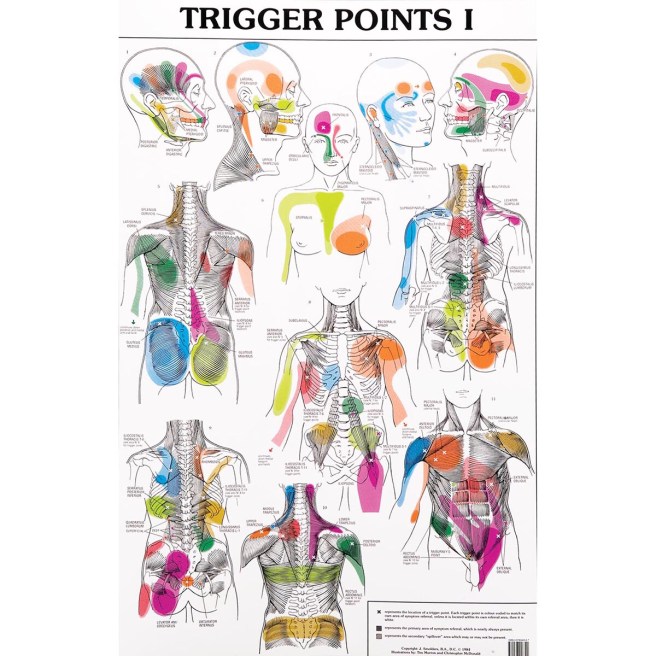
Biceps Tendon Injury. The “suns out, guns out” injury.

Your biceps muscle attaches to your shoulder through two strong fibrous bands called “tendons.” The term “biceps tendinitis” means that one of these bands has become painfully irritated from strain or degeneration. Sometimes the tendon may be strained by an accident or lifting injury. Biceps tendinitis more often results from repeated pinching of the tendon beneath the bony part of your shoulder

from a condition called “impingement.” Repeated overhead activity, like throwing, swimming, gymnastics, and racquet sports are known culprits. Biceps tendinitis is often accompanied by other conditions, like rotator cuff tears or injuries to the cartilage around the rim of your shoulder joint. Factors that make you more likely to develop biceps tendinitis include: improper lifting techniques, inflexibility, poor posture, or repetitive overloading.
Your symptoms likely include a deep, throbbing ache over the front of your shoulder. The pain often refers toward the outside of your arm. The main job of your biceps muscle is to flex your elbow and turn your palm up, so overhead movements or activities that require flexion of your elbow may cause pain. Patients often report increased discomfort when initiating activity. Night time symptoms are common, especially if you lie on your affected shoulder. Be sure to tell your doctor if you notice popping, catching, or locking during movements, as this may suggest an additional problem. A painful, loud “pop” followed by relief with a visible bulge in your biceps (Popeye deformity) suggests that your tendon has ruptured.
Surgery is rarely required for biceps tendon problems unless you are a young athlete or worker who performs exceptionally heavy physical activity and have completely ruptured your tendon. The most effective treatment for the majority of biceps tendinitis patients is conservative care, like the type provided in our office. Initially, you may need to avoid heavy or repetitive activity, (especially overhead activity and elbow flexion) as returning to activity too soon may prolog your recovery. You should specifically avoid military presses, upright rows, and wide grip bench presses until cleared by your doctor. You may use ice over your shoulder for 10-15 minutes at a time each hour. The exercises described below will be a very important part of your recovery and should be performed consistently.
What to expect with a trigger point massage.
A treatment with Bryan is very user friendly. And, no, you don’t have to remove any clothing. However, bringing a t-shirt and a pair of shorts or sweats is recommended.
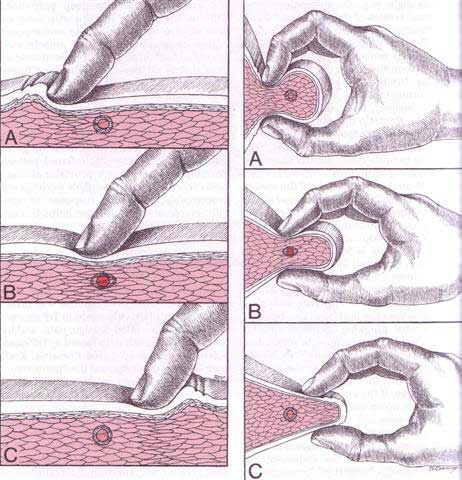
The first time you come for a treatment you will be asked to fill out a Client History form. Bryan will go over the information you provide, asking for more detail and discussing the type of pain you are having and its location.
The treatment itself involves locating the Trigger Points in the muscle or soft tissue and applying a deep focused pressure to the Point. This will reproduce the pain and the referral pattern that is characteristic of that pain.
The treatment will be uncomfortable at first, but as the Trigger Points release, the pain will decrease. The pressure will always be adjusted to your tolerance level. If, at any time, you feel too uncomfortable you can ask Bryan to ease off a bit.
Depending on your specific problem, Bryan may also use some stretching and / or range-of-motion techniques, as needed.
After treatment, it is usually recommended that the client apply moist heat to the area treated.
Trigger points in the deltoid muscle.
The deltoid is the the muscle that is most often thought of as the “shoulder.” It is the diamond shaped muscle that caps the shoulder joint. It originates on the clavicle, the acromion, and the spine of the scapula. It inserts on the deltoid tuberosity of the humerus. As a whole unit the deltoid laterally abducts the humerus at the glenohumeral joint. The anterior portion of the delt forward flexes the arm, as well as horizontally flexing the arm across the chest. Since the deltoid is involved in almost all shoulder movements it is especially prone to trigger points. Points in the anterior deltoid refer into the anterior and lateral shoulder. Trigger points in the posterior deltoid refer pain into the posterior shoulder with spillover down the lateral arm. 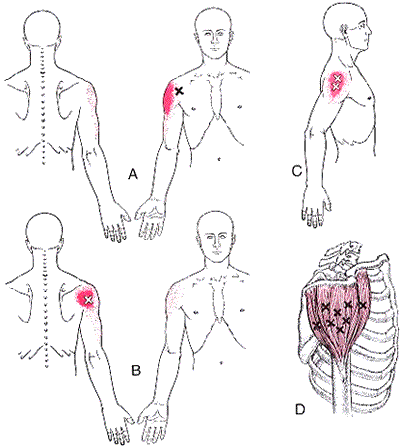
Home Gym Essentials
So you want to build your own home gym but you have no idea what kind of equipment to buy. There are two main limiting factors in outfitting a workout area in your house or apartment—space and budget—but with proper planning, you can design an exercise studio perfectly tailored to your needs. Simply start with the essentials, and then branch out to more specialized equipment as you need it. Below are a few of the essentials that can get your started on your home gym journey.
Quality Mats
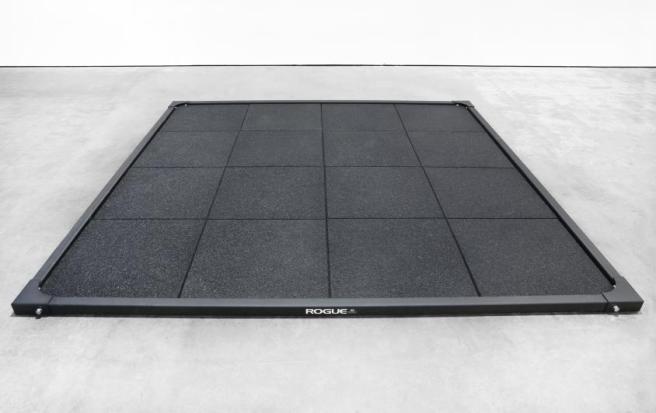
No matter what your plans are for your home gym a good quality floor mat is key. You can opt for the single mat for stretching and floor work or go shoe hog with an entire flooring system but be sure to go with a high quality, durable product. Rogue Canada has some great products in this (and most) category from floor mats to olympic lifting platforms, as do spots from Fitness Experience to Home Depot.
Suspension Trainer
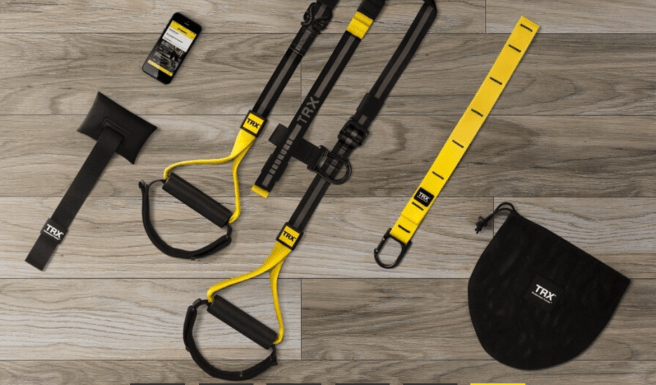
Maximizing use of space and finding tools with multiple uses are keys when designing your home gym. One of the best pieces of equipment for both those concerns are suspension trainers. The TRX Home2 System is one of the best purchases you can make for your home gym. It includes the latest TRX Suspension Trainer for homes, as well access to the TRX app. (With more than 80 workouts designed by world-class trainers, the app will keep you busy.) While the Home2 System costs less than $200, it is one of the bigger purchases on this list. What makes it worthwhile is that Suspension Training offers a full-body workout that can be modified for any fitness level.
Resistance Bands
Easy to store, easy to use, easy to afford and easy to scale. Resistance bands are a great addition to any home gym. From stands of tubing to elastic loops and heavy resistance with handles, resistance bands come in many shapes and sizes and can be used to add to any fitness routine. Depending on your fitness goals, resistance tubing can be your main source of muscle building or an add oil that enhances lifts. They are a rehab essential as well when working through those nagging injuries that we all get from time to time and a key part of training for pliability as shown in the TB12 method. Every major fitness retailer has dozens of options for you and can help you decide on what you need based on your goals.
![brady-12967[1]](https://aberdeenchiropracticblog.com/wp-content/uploads/2017/11/brady-129671.jpg?w=656)
This list is a great start for your home fitness journey but isn’t all inclusive by any means. Everyone’s goals are different, require different levels of equipment and different levels of motivation. The key with any of them is to get committed, get started and get moving!
The Bird Dog

Today we are going to look at one of the most effective exercises to protect your lumbar spine from discogenic injury, the bird dog. A great way to work on both posterior chain and rotational stability, the bird dog is safe, effective and simple.
- Get on your hands and knees (four point position) with your knees and hands, hip and shoulders width apart.
- Your back is in neutral position (slightly arched) and your chin must be tucked in.
- Activate your lower abdominals (transversus abdomini) by bringing your belly button inward and by activating your pelvic floor muscles 20 to 30% of maximal contraction.
- Maintain a steady abdominal breathing while you simultaneously lift one leg backwards and the opposite arm overhead keeping your back in neutral position.
- Return to the initial position and repeat with the other leg and arm.
2 sets of 10 reps as part of your regular core/stability routine will have you well on your way to a life-proof low back!
Image and instructions from physiotec.ca
The Best Piece Of Fitness Gear?
For my money I still believe that the classic TRX suspension trainer is the best piece of fitness equipment out there. Easy to use, super effective, safe, compact and scalable. All fitting into a little bag you can throw in your backpack or purse to take with you.
We have kids as young as 7 using it (my kids want to “work out” with us but are too young for weights, kettlebells and treadmills. The TRX is a great way to have them as part of your fitness routine in a safe way) and adults in their 70’s too (both my parents use the TRX to stay strong and limber in the retirement years).
With dozens of exercises and workouts at your disposal online you’ll never get bored and never find it “too easy”.
Check out the original TRX and all their cool accessories here:
Lumbar Spine Stabilization

This is a great way to increase the stability of your lower back.
- Lie with your stomach over a therapeutic ball while stabilizing yourself with your feet and arms and keep your head in line with your body.
- Tighten your abdominal muscles to flatten the spine by pulling your belly button towards your back and hold the contraction throughout the exercise.
- Bend one knee and lift it up towards the ceiling.
- Lower the leg and repeat on the other side.
When Are My Shoes “Done”?

Running shoes need to be replaced every 250 miles. There are three basic options:
✓ Motion Control Shoes – Designed for people with low or no arches, these shoes are for runners who strike the ground on the outer edge of their foot. Avoid overly stiff shoes as these decrease you perception of ground strike and lead to new injuries.
✓ Stability or Neutral Shoes – Designed for people with normal or average arches and running mechanics. The shoe contains some cushioning to absorb shock and prevent injuries and some rigidity to avoid pronation.
✓ Cushioned Shoes – Designed for people with high arched feet. Their footprint will typically leave a thin band along the foot’s edge. As they run weight is distributed from heel strike to the outer edge of the foot and small toes that bear the brunt of “lift off.” This shoe is more flexible and absorbs the shock created by the lack or rotation (under-pronation) created by their running style.
 Aberdeen Chiropractic