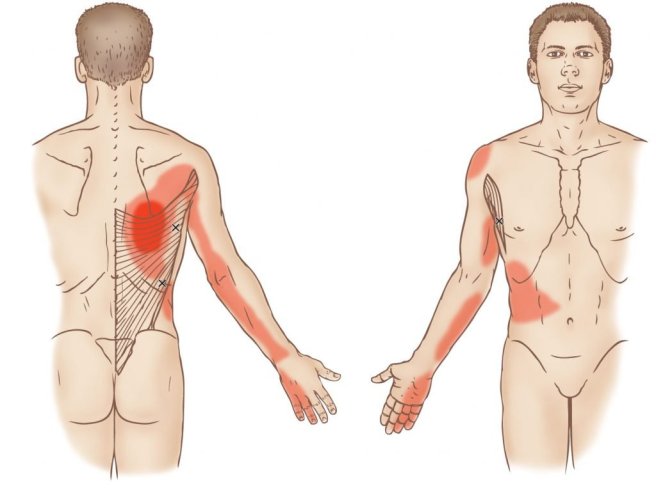
the rhomboids are muscles located in your upper back. They lie underneath the trapezius muscle. These muscles are responsible for retracting your scapula, or pulling your shoulder blades back. Since poor posture causes the shoulders to round forward, the rhomboids are often strained. When this happens trigger points will form. These points cause deep achy pain to be felt along the shoulder blade. Once trigger points have formed they will not release on there own. A manual release such as trigger point massage is required.
Your lats, or your latissimus dorsi muscles are the largest muscles of the back. They are responsible for adducting and medially rotating the arm. This muscle also produces extension at the shoulder joint. When trigger points for In this muscle, they can refer pain into the back, down the inside of the arm into the hand. These trigger points can also cause pain to be felt into the front of the shoulder. Once formed trigger points will not release on there own. They require a manual release technique like trigger point massage.
A pulled hamstring or strain is an injury to one or more of the muscles at the back of the thigh. Hamstring muscle injuries occur most frequently in athletes. They are especially common in athletes who participate in sports that require sprinting, such as track, soccer, and basketball.
Risk Factors
Several factors can make it more likely you will have a muscle strain, including:
Muscle tightness. Tight muscles are vulnerable to strain. Athletes should follow a year-round program of daily stretching exercises. Muscle imbalance.When one muscle group is much stronger than its opposing muscle group, the imbalance can lead to a strain. This frequently happens with the hamstring muscles. The quadriceps muscles at the front of the thigh are usually more powerful. During high-speed activities, the hamstring may become fatigued faster than the quadriceps. This fatigue can lead to a strain. Poor conditioning. If your muscles are weak, they are less able to cope with the stress of exercise and are more likely to be injured. Muscle fatigue. Fatigue reduces the energy-absorbing capabilities of muscle, making them more susceptible to injury.
Those especially at risk:
Anyone can experience hamstring strain, but those especially at risk are:
Athletes who participate in sports like football, soccer, basketball
Runners or sprinters
Dancers
Older athletes whose exercise program is primarily walking
Adolescent athletes who are still growing
Hamstring strains occur more often in adolescents because bones and muscles do not grow at the same rate. During a growth spurt, a child’s bones may grow faster than the muscles. The growing bone pulls the muscle tight. A sudden jump, stretch, or impact can tear the muscle away from its connection to the bone.
Severity of a Pulled Hamstring
Strains are graded 1, 2 or 3 depending on severity.
Grade 1 consists of minor tears within the muscle. A grade 2 is a partial tear in the muscle and grade 3 is a severe or complete rupture of the muscle.
Grade 1
May have tightness in the posterior thigh.
Probably able to walk normally however will be aware of some discomfort.
Minimal swelling.
Lying on front and trying to bend the knee against resistance probably won’t produce much pain.
Over all pain is mild and usually heals readily.
May require 3 weeks rest from sports
Grade 2
Gait will be affected – limp may be present.
May be associated with occasional sudden twinges of pain during activity.
May notice swelling.
Pressure increases pain.
Flexing the knee against resistance causes pain.
Might be unable to fully straighten the knee.
May bruise after a few days
Typically requires 4 to 6 weeks for recovery
Grade 3
Walking severely affected – may need walking aids such as crutches.
Severe pain – particularly during activity such as knee flexion.
Noticeable swelling visible immediately.
There may be a large lump of muscle tissue above a depression where the tear is.
A grade three hamstring strain is a severe injury.
May require an MRI scan to ascertain the amount of damage sustained.
In severe ruptures surgery may be needed to repair the damage and may require 3-6 months after repair to resume sports
Treatment of a Pulled Hamstring
What can the athlete do?
It is important that treatment for a pulled hamstring starts immediately following injury. The most important phase for treatment is the first 48 hours post-injury. In this time the following can be carried out by the athlete themselves:
Use Most hamstring strains heal very well with simple, nonsurgical treatment.
RICE. The RICE protocol is effective for most sports-related injuries. RICE stands for Rest, Ice, Compression, and Elevation.
Use a compression bandage to minimize intra muscular bleeding.
Early mobilization of the injured lower limb is vital for the correct rehabilitation of the muscle. This includes stretching and strengthening exercises throughout the pain free range. These can aid with decreasing the swelling in the area. In addition, exercise will ensure that any new material will be laid down in correct orientation thus reducing the risk of subsequent injuries.
Class IV Laser Hamstring Injury Program
The Class IV Laser is at the heart of our treatment program. It provides a safe, effective, non-invasive, painless solution for hamstring pain and injury. Patients respond exceptionally well to treatments and usually notice significant pain relief after just a few treatments. Our program utilizes the latest FDA Cleared Lasers, and combines them with other therapies to help reduce the pain, strengthen the muscles and increase range of motion. Most importantly these treatments help reduce inflammation/swelling, which helps improve overall function.
Trigger points are hyper irritable knots found in muscle tissue. These points form in a muscle due to overload stress. Trigger points can form anywhere, in any muscle. Once formed they irritate sensory nerves and produce pain, refered pain, weakness, and stiffness. Trigger points will also mimic symptoms of other conditions such as “sciatica” or Carple tunnel syndrome. Trigger points will not go away on there own, they must be manually released with hands on techniques like trigger point massage.
Trigger point massage therapy is specifically designed to alleviate the source of the pain through cycles of isolated pressure and release. In this type of massage for trigger point therapy, the recipient actively participates through deep breathing as well as identifying the exact location and intensity of the discomfort.
The results and benefits of trigger point massage are releasing constricted areas in the muscles thus alleviating pain. You can experience a significant decrease in pain after just one treatment. Receiving massage with trigger point therapy on a regular basis can help naturally manage pain and stress from chronic injuries.
Trigger points form only in muscles. They form as a local contraction in a small number of muscle fibers in a larger muscle or muscle bundle. These in turn can pull on tendons and ligaments associated with the muscle and can cause pain deep within a joint where there are no muscles. The integrated hypothesis theory states that trigger points form from excessive release of acetylcholine which produces sustained depolarization of muscle fibers. Indeed, the trigger point has an abnormal biochemical composition with elevated concentrations of acetylcholine, noradrenaline and serotonin and a lower pH.[5] These sustained contractions of muscle sarcomeres compresses local blood supply restricting the energy needs of the local region. This crisis of energy produces sensitizing substances that interact with some nociceptive (pain) nerves traversing in the local region which in turn can produce localized pain within the muscle at the neuromuscular junction (Travell and Simons 1999). When trigger points are present in muscles there is often pain and weakness in the associated structures. These pain patterns in muscles follow specific nerve pathways and have been readily mapped to allow for identification of the causative pain factor. Many trigger points have pain patterns that overlap, and some create reciprocal cyclic relationships that need to be treated extensively to remove them.
Activation of trigger points may be caused by a number of factors, including acute or chronic muscle overload, activation by other trigger points (key/satellite, primary/secondary), disease, psychological distress (via systemic inflammation), homeostatic imbalances, direct trauma to the region, collision trauma (such as a car crash which stresses many muscles and causes instant trigger points) radiculopathy, infections and health issues such as smoking.
Pain related to a discrete, irritable point in skeletal muscle or fascia, not caused by acute local trauma, inflammation, degeneration, neoplasm or infection.
The painful point can be felt as a nodule or band in the muscle, and a twitch response can be elicited on stimulation of the trigger point.
Palpation of the trigger point reproduces the patient’s complaint of pain, and the pain radiates in a distribution typical of the specific muscle harboring the trigger point.
the suboccipital muscles are a group of small muscles located at the base of the skull. These muscles are responsible for small movements of the head and the first two vertebrae. They also play a roll in postural stability of the skull. Trigger points are common in people with poor neck posture. these points will refer pain deep into the skull and behind the eye. They are a common source of headache pain.
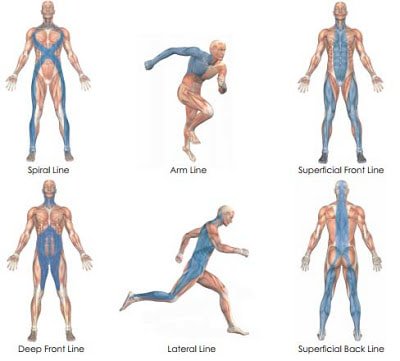
fascial connective tissue runs throughout all the bodies layers. It gives the body shape and function. Fascial litterally connects every part of your together. During movement when one part of the body moves, the body as a whole responds. Functionally the only tissue that can facilitate such responsiveness is the connective tissue. When one area of the body gets restricted or damaged, the body as a whole can become dysfunctional by setting up compensation patterns.