A treatment with Bryan Cobb RMT.

Session Description

A treatment with Bryan is very user friendly. And, no, you don’t have to remove any clothing. However, bringing a t-shirt and a pair of shorts or sweats is recommended.

The first time you come for a treatment you will be asked to fill out a Client History form. Bryan will go over the information you provide, asking for more detail and discussing the type of pain you are having and its location.

The treatment itself involves locating the Trigger Points in the muscle or soft tissue and applying a deep focused pressure to the Point. This will reproduce the pain and the referral pattern that is characteristic of that pain.

The treatment will be uncomfortable at first, but as the Trigger Points release, the pain will decrease. The pressure will always be adjusted to your tolerance level. If, at any time, you feel too uncomfortable you can ask Bryan to ease off a bit.

Depending on your specific problem, Bryan may also use some stretching and / or range-of-motion techniques, as needed.

After treatment, it is usually recommended that the client apply moist heat to the area treated.


What the Heck Is a Trigger Point?

By Bryan Cobb, Advanced Remedial Massage Therapist

What is a Trigger Point?

Trigger Points (TP’s) are defined as a “hyper-irritable spot within a taut band of skeletal muscle. The spot is painful on compression and can evoke characteristic referred pain and autonomic phenomena.”1

Put into plain language, a TP is a painful knot in muscle tissue that can refer pain to other areas of the body. You have probably felt the characteristic achy pain and stiffness that TP’s produce, at some time in your life.

TP’s were first brought to the attention of the medical world by Dr. Janet G. Travell. Dr. Travell, physician to President John F. Kennedy, is the acknowledged Mother of Myofascial Trigger Points.  In fact, “Trigger Point massage, the most effective modality used by massage therapists for the relief of pain, is based almost entirely on Dr. Travell’s insights.”2  Dr. Travell’s partner in her research was Dr. David G. Simons, a research scientist and aerospace physician.

Trigger Points are very common. In fact, Travell and Simons state that TP’s are responsible for, or associated with, 75% of pain complaints or conditions.1 With this kind of prevalence, it’s no wonder that TP’s are often referred to as the “scourge of mankind”.

Trigger Points can produce a wide variety of pain complaints. Some of the most common are migraine headaches, back pain, and pain and tingling into the extremities. They are usually responsible for most cases of achy deep pain that is hard to localize.

A TP will refer pain in a predictable pattern, based on its location in a given muscle. Also, since these spots are bundles of contracted muscle fibres, they can cause stiffness and a decreased range of motion.  Chronic conditions with many TP’s can also cause general fatigue and malaise, as well as muscle weakness.

Trigger Points are remarkably easy to get, but the most common causes are

TP’s (black dots) can refer pain to other areas (red)

Sudden overload of a muscle

• Poor posture

• Chronic frozen posture (e.g., from a desk job),  and

• Repetitive strain

Once in place, a TP can remain there for the remainder of your life unless an intervention takes place.

Trigger Points Not Well Known

With thousands of people dealing with chronic pain, and with TP’s being responsible for — or associated with — a high percentage of chronic pain, it is very disappointing to find that a large portion of doctors and other health care practitioners don’t know about TP’s and their symptoms.

Scientific research on TP’s dates back to the 1700’s.  There are numerous medical texts and papers written on the subject.

But, it still has been largely overlooked by the health care field.  This has led to needless frustration and suffering, as well as thousands of lost work hours and a poorer quality of life.

How Are Trigger Points Treated?

As nasty and troublesome as TP’s are, the treatment for them is surely straight-forward.  A skilled practitioner will assess the individual’s pain complaint to determine the most likely location of the TP’s and then apply one of several therapeutic modalities, the most effective of which is a massage technique called “ischemic compression”.

Basically, the therapist will apply a firm, steady pressure to the TP, strong enough to reproduce the symptoms.  The pressure will remain until the tissue softens and then the pressure will increase appropriately until the next barrier is felt.  This pressure is continued until the referral pain has subsided and the TP is released. (Note:  a full release of TP’s could take several sessions.) 

Other effective modalities include dry needling (needle placed into the belly of the TP) or wet needling (injection into the TP).  The use of moist heat and stretching prove effective, as well. The best practitioners for TP release are Massage Therapists, Physiotherapists, and Athletic Therapists.  An educated individual can also apply ischemic compression to themselves, but should start out seeing one of the above therapists to become familiar with

the modality and how to apply pressure safely.

1 Simons, D.G., Travell, D.G., & Simons, L.S. Travell and Simons’ Myofascial Pain and Dysfunction: the Trigger Point Manual.

Vol. 1.  2nd ed. Lippincott, Williams, and Wilkins, 1999.

2http://www.muscletherapyworks.com/MTW%20Biography%20T%20&%20S%2001.htm 

Positive Expectations in Whiplash Patients Help with Recovery

443


“High expectations are the key to everything”

– Sam Walton

Now a new study found that this belief may apply to your health as well: Whiplash patients who have a positive expectation to improve tend to recover better and report less pain than those who harbor negative beliefs like fearing movement and re-injury.

If you or someone you know has been involved in accident, call our office today. Check out THIS VIDEO to learn more about resolving neck pain from auto accidents.

Advice for headache sufferers….

187

Get Moving.

A new study of 573 office workers found that “one hour weekly of strength training reduced headache frequency and intensity.” Timing and spacing of session times did not affect the positive outcome, but participants whose training was supervised used fewer medications.

So, if you or someone you know suffers from headaches, call us today. Our doctors have powerful natural tools for treating headaches and can help design an exercise plan to stay healthy. Learn more about headaches here:

Headache Info Video

Source:

page1image3519546256

Andersen, CH et al. Effect of resistance training on headache symptoms in adults: Secondary analysis of a RCT. Musculoskeletal Science and Practice, Volume 32, 2017, Pages 38-43 ”

TMJ dysfunction

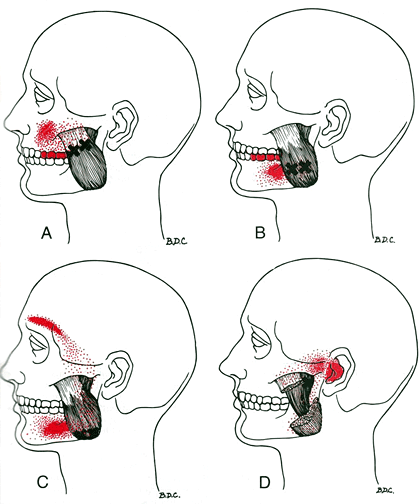
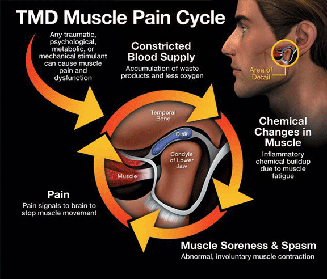
Temporomandibular joint dysfunction is a blanket term that refers to pain and dysfunction of the jaw muscles and the tempomandibular joints which connect the mandible to the skull. The most common symptoms are pain and restricted mandibular movement as well as grinding noises coming from the joint. This condition is more common in women then in men, and affects a large portion of patients suffering from fibromyalgia. Trigger points in the muscles of mastication are frequently involved in TMJ dysfunction. Trigger points in the pterygoid and masseter muscles for example will not only refer pain into the tempomandibular joints, but will also cause a dysfunctional movement pattern that can restrict range of motion. Trigger point therapy can be an effective modality to treat TMJ dysfunction.

I smoke and I sit; does that matter?

Your thoracic spine is made up of 12 individual vertebrae stacked on top of each other. To allow for flexibility and movement, there is a cushion or “disc” in between each level. As we age, these discs can wear and become thinner over time. This leads to additional changes, including bone spurs and narrowing of the opening where your nerves exit your spine. This process is called “thoracic spondylosis”, or simply, “arthritis”.

How quickly you develop back arthritis is largely a trait you inherited from your parents. Other factors may play a role, including a history of trauma, smoking, operating motorized vehicles, being overweight and/ or performing repetitive movements (i.e. lifting, twisting, bending or sitting). Men seem to be affected slightly more often than women.

Symptoms often begin as back pain that gradually worsens over time. Stiffness may be present upon arising in the morning. Pain is relieved by rest or light activity and aggravated by strenuous work. Sometimes your nerves can become “pinched” in narrowed openings where they exit your spine. This can cause pain, numbness, or tingling radiating around your trunk along the path of the irritated nerve. Be sure to tell your doctor if you notice any weakness or if you have a rash (running along your rib), fever, abdominal pain, change in bowel or bladder function, or pain in your groin crease.

Arthritic changes can be seen on x-rays, but interestingly, the amount of wearing does not seem to correlate directly with the severity of your symptoms. People with the same degree of arthritis may have symptoms ranging from none to severe. Most researchers believe that the symptoms of osteoarthritis are not the direct result of the disease, but rather, from the conditions that preceded the disease and those that develop after it, like joint restrictions and muscle tightness. Fortunately, those conditions are treatable and our office has a variety of tools to help relieve your pain.

In general, you should avoid repeated lifting and twisting and take frequent breaks from prolonged sitting, especially in motorized vehicles. Avoid any position that causes an increase in radiating pain. Light exercise, like walking, stationary cycling, water aerobics, and yoga may be helpful. Smokers should find a program to help them quit and overweight patients will benefit from a diet and exercise program.

“I Popped A Rib”

You have 12 pair of ribs that attach to the “thoracic” region of your spine. The ribs serve to protect your heart, lungs, and other vital organs. Each rib is shaped much like a “bucket handle” arching from your spine to your breastbone (sternum) in front. Your ribs must move freely when you breathe, bend, twist, and reach. The term “costovertebral dysfunction” means that one or more of your ribs has become restricted or slightly malpositioned from it’s attachment to the spine.

You can visualize this as imagining one of your bucket handles is misaligned and not moving in sync with the others.

Rib problems can develop in many ways. Sometimes they are brought on by an accident or injury; other times, they develop from repetitive strains or poor posture. Rib malpositions are common during pregnancy or after a whiplash injury.

Symptoms sometimes begin following a sudden or explosive movement, like coughing or sneezing, reaching, pushing, or pulling. Other times, a specific cause cannot be recalled. Rib dysfunction may cause pain near or slightly to the side of your spine with possible radiation of symptoms along your rib, sometimes all the way to the front. Some patients feel as though they were “shot by an arrow.” Rib problems are a frequently overlooked source of chest and abdominal pain.

Be sure to tell your chiropractor if your symptoms include any unusual cough, indigestion, nausea, vomiting, fever, flu-like complaints or if you notice a rash developing along the border of your rib. Seek immediate medical treatment if you notice chest “pressure” or “squeezing”, symptoms that radiate into your arm and jaw, or if you have chest pain or shortness of breath with exertion, as these are possible symptoms of heart problems and must be addressed immediately.

Most patients report rapid relief following chiropractic care. Our office can provide several tools to help ease your pain. To speed your recovery, you should avoid activities that increase your pain. Initially, you may need to limit reaching, pushing, and pulling. Women may benefit by temporarily switching to a sports bra to help better diffuse pressure over irritated ribs. Some patients report relief by using sports creams, NSAIDs, or applying ice for 15-20 minutes directly over the painful area.

What is a “Mild” traumatic Brain Injury?

A concussion is a blow or jolt to the head that disrupts normal brain function. Concussions, also known as Mild Traumatic Brain Injuries, most often result from falls, sports injuries, and auto accidents.
Concussion symptoms may begin immediately after an injury, but sometimes take hours or days to appear. The most common symptoms of a concussion include; headaches, light-headedness, dizziness, visual disturbances, ringing in the ears, confusion, fatigue, difficulty sleeping, irritability, and difficulty remembering or learning new things. Patients sometimes struggle to understand conversations or make simple calculations like determining a restaurant tip. Patients often feel as if they are “in a fog”. Symptoms can range from subtle to debilitating.

Patients and their attendants should be particularly alert for signs or symptoms that could indicate a more threatening injury like; worsening headache, growing irritability, repeated vomiting, difficulty speaking or swallowing, shortness of breath, unequal pupils, fever, visual disturbances, seizures, clear discharge from the nose or ears, loss of consciousness, or increasing light-headedness, numbness, or confusion. These symptoms warrant immediate emergency medical attention.

Recovery times are quite variable and are dependent upon a number of factors. It is critical that you allow your brain to recover completely before returning to physical activity. A concussion can be likened to dropping a computer – you will need to allow time to reboot before trying to use it. Suffering a second concussion before the first has completely resolved can lead to significantly worse symptoms and long-term impairments.

Athletes who have suffered a concussion must not return to activity before being evaluated by a healthcare professional that is very familiar with concussion management.

Meditation goes mainstream!

meditate-1851165_960_720

With growing evidence that meditation has significant health benefits, a 2016 study by a team of researchers from the United States, Spain, and France sought to explain how and why meditation actually works.

The study investigated the difference between “mindful meditation” in a group of experienced meditators vs. “quiet non-meditative activity” in a group of untrained control subjects. After eight hours of mindfulness practice, the meditation group showed a range of genetic and molecular differences, which in turn correlated with faster physical recovery from a stressful situation.

According to researchers, this is the first time a study has documented a rapid alteration in gene expression within meditating subjects. Interestingly, the researchers observed these changes in the SAME genes that anti-inflammatory and pain-killing drugs target! Thus, they speculate that mindful-based training may benefit patients with inflammatory conditions! This and prior studies have prompted the American Heart Association to endorse meditation as an effective cardiac preventative intervention.

Meditation has been found to be helpful for many conditions including stress management, lowering high blood pressure, heart disease, and depression. You can incorporate meditation into your life with three simple meditation exercises! The initial advice is “…go slow and be compassionate and gentle with yourself.” Your mind will try to wander (called our “default mode”) which consumes about half of our day, so try to focus (called “focus mode”)!

1)  WALKING MEDITATION: At a slow to medium pace, focus on your feet. Notice how your heel hits the ground and then feel the roll of your foot followed by the big toe pushing off prior to the swing phase. Feel for stones under the foot and other interesting sensations. If your mind starts to wander (default mode), gently bring your attention back to your foot (focus mode). You WILL get better with practice, and you’ll soon find it much easier to “focus” during stressful situations!

2)  NOVEL EXPERIENCES: It’s much easier to lose focus on the people you see everyday vs. those seen only one time a month. The next time you arrive home from work, pretend you haven’t seen your spouse/friend in 30 days. Give them your undivided attention. Then, try this on co-workers and other people you see every day. Believe me, they WILL notice a difference!

3)  GRATITUDE EXERCISES: When you’re not in their presence, focus on a person’s face and send them a “silent gratitude” for being in your life. Try this on family members, friends, co-workers, and others!

Where should you turn when back pain strikes?

Shrug

Where should you turn when back pain strikes?

https://tribunecontentagency.com/article/where-to-turn-for-low-back-pain-relief/

Chiropractic should be a first line defence when back pain strikes. We are special trained to recognize the cause of back pain and treat when appropriate. When the cause is outside the scope of our practice, we are able to educate you on where you should go next.

Is there an actual cure all?

Exercise Tip

No; but exercise seems to be as close as we will ever get! 

Some of you may have heard about how a modified form of boxing is helping patients with Parkinson’s disease (PD). If you haven’t, it’s been observed that people with Parkinson’s disease (PD) who engage in this boxing-like exercise routine can enhance their quality of life and even build impressive gains in posture, strength, flexibility, and speed. Proponents of the program report that regardless the degree of severity of PD, participants have a happier, healthier, and higher quality of life.

But must it be boxing? Maybe not. A report presented at the International Congress of Parkinson’s Disease and Movement Disorders in San Diego in June 2015 found that patients with Parkinson’s disease who began regular exercise early into the PD process had a much slower decline in their quality of life when compared with those who started exercising later. The researchers found just 2.5 hours per week of exercise is needed to improve quality of life scores. According to the report, it didn’t matter what exercise the participants did — simply getting up and moving for a total of 2.5 hours/week was reportedly enough (that’s only 20-25 minutes / day)!

Looking beyond Parkinson’s, other chronic conditions also benefit from adding exercise into a person’s lifestyle. Studies show that regular exercise as simple as walking helps reduce one’s risk for memory loss, and it slows down functional decline in the elderly. Incorporating aerobic exercise into one’s lifestyle can also improve reaction time in people at ALL AGES. Exercise has also been shown to improve both physical and emotional well-being in those afflicted with Alzheimer’s disease with as little as 60 minutes/week of moderate exercise! Patients with multiple sclerosis (MS) have also reported less stiffness and less muscle wasting when using exercise machines, aquatic exercise, and/or walking.

Research has shown just 30 minutes of brisk exercise three times a week can help reduce depressive symptoms in patients with mild-to-moderate depression. In a study involving teenagers, those who engaged in sports reported a greater level of well-being than their sedentary peers, and the more vigorous the exercise, the better their emotion health! In kids 8-12 years old, physical inactivity is strongly linked to depression.

Even anxiety, stress, and depression associated with menopause are less severe in those who exercise! So LET’S ALL GET OUT THERE AND EXERCISE!!!