Mind = Blown

Carpal tunnel syndrome (CTS) is a very common condition. According to a report by the Bureau of Labor Statistics (BLS), CTS ranks SECOND among the major disabling diseases and illnesses in ALL private industries. The BLS states that workers with CTS may eventually have to give up their livelihood. They cite one study in which almost half of all CTS patients changed their jobs within 30 months following their diagnosis. Due to the controversy surrounding the issue of CTS and worker’s compensation, workers do not always receive compensation benefits.

The KEY to long-term cost containment associated with CTS is EARLY DIAGNOSIS and PREVENTION! The challenge is getting the worker to identify early symptoms and NOT feel intimidated to report them, which could then lead to prompt care and possibly job modifications, resulting in the best chance of preventing a more complicated and far more costly problem.

Because of the many factors that contribute to and/or cause CTS, there is similarly no one way to prevent it from happening. Treating any/all underlying medical condition(s) is important. Using simple common sense can go a long way to help minimize some of the risk factors that predispose a person to work-related CTS and other cumulative trauma disorders (CTDs).

For example, watching and mimicking veteran workers can be a great guide as to how to maximize efficient work methods while minimizing unnecessary stresses and strains. Other preventative “tricks” include learning how to adjust the work area, handle tools, or perform tasks that minimize hand/wrist strain. Maintaining proper posture and exercise programs to strengthen the fingers, hands, wrists, forearms, shoulders, and neck may also help prevent CTS.

Many companies have taken action to help prevent repetitive stress injuries. In one study, 84% of the companies surveyed reported that they were modifying equipment, tasks, and processes as part of a prevention effort; nearly 85% analyzed their workstations and jobs; and 79% purchased more ergonomic equipment. Unfortunately, there is NO EVIDENCE that any of these methods can completely protect a worker against CTS. Often, the best approach is to relocate the worker to a less repetitive job, but this is not always an option.

Doctors of chiropractic can observe the worker through a video or during a factory tour/visit and often identify ergonomic problems that can result in a low-cost, easy modification. Simple modifications coupled with quality care, patient education, and cooperation from BOTH the worker and the employer can typically help yield the best outcome for the CTS patient.

fireworks

Plantar Fasciitis In A Nutshell

The “Plantar fascia” is a fibrous band running from the under surface of your heel to the ball of your foot. “Plantar fasciitis” is a painful inflammation of this tissue caused by chronic over stretching and mild tearing.

Plantar fasciitis is commonly associated with fallen arches of the foot. To understand how this happens, cup your hand to make a “C” shape. This represents a foot with a high arch.

Imagine a band running from your fingertips to your wrist. This represents the plantar fascia. Now, straighten your fingers to simulate what happens when the arch “falls.” When this happens in your foot, the plantar fascia is stretched and can begin to tear away from your heel.

Plantar fasciitis affects 10% of the population and is more common in women. Approximately one fourth of patients have the problem in both feet at the same time. People who place excessive stress on their feet by being overweight, standing for long periods, or participating in endurance sports are more likely to develop the condition as well. Shoes without adequate arch supports, including sandals or going barefoot, increase your chances of developing plantar fasciitis. Wearing high-heeled shoes or boots may contribute to the problem.

The most common symptom of plantar fasciitis is pain in the heel or arch when standing up after a period of inactivity, particularly first thing in the morning. When you are sleeping, the arch is in a relaxed or shortened state, and the plantar fascia is able to heal. When you stand up first thing in the morning, you stretch the fascia, once again tearing it away from its attachment on the heel. The condition may progress to the point that you experience pain throughout the day, even while resting. The pain often eases after you walk for a period of time, only to redevelop. You may notice some tenderness when you touch your heel, and you probably have tight calf and hamstring muscles as well.

Plantar fasciitis can be a frustrating condition, often lasting 18 months or more if left untreated. Fortunately, you may recover more quickly with proper treatment. One of the most important things that you can do is to make sure that you are wearing shoes with good arch supports on a consistent basis. A period of rest may be necessary to help you recover. Runners may need to temporarily decrease mileage or switch to less stressful activities like swimming, cycling, or using an elliptical machine. A splint or “Strassburg sock” worn at night will help to keep your plantar fascia in a stretched position while it is healing.

Headache & Dizzy. When To Be Concerned.

Last week, we discussed some startling new research that found that lightheadedness upon standing up (orthostatic hypotension) may be more serious than previously thought. This month, we’ll look specifically at headache AND dizziness and if we should we be concerned about this combination of complaints and if so, when?

A team of researchers from Johns Hopkins University reviewed past medical records of 187,188 patients presenting to over 1,000 emergency departments (EDs) between 2008 and 2009. They found the combination of headache and dizziness—especially in women, minorities, and young patients—was a potential signal of an impending stroke!

Specifically, they reported that 12.7% of people complaining of headache and dizziness were later admitted for stroke and had been misdiagnosed and inappropriately sent home from the ED within the previous 30 days. Patients were told they had a “benign condition” such as inner ear infection or migraine, and in some cases, they weren’t given a diagnosis at all. Slightly less than half of this population had a stroke within seven days and over half had a stoke within the first 48 hours of the initial pre-stroke ED presentation!

The study reported that women were 33% and minorities 20-30% more likely to be misdiagnosed, suggesting gender and racial disparities may play a role. The researchers estimate that doctors miss 15,000 to 165,000 strokes that result in harm to the patient each year.

Studies have found that the early diagnosis and quick treatment of strokes is critical in reducing serious residuals in patients having a transient ischemic attach (TIA), sometimes referred to as a “mini-stroke” or “pre-stroke.” TIAs are often pre-cursors to a more catastrophic stroke leading to death or permanent disability without appropriate treatment.

Again, to put this in perspective, MANY people present to healthcare providers with headaches and dizziness with NO relationship to stroke—about 87%—though it is sometimes not possible to know whether a potentially dangerous problem may arise in the near future. The good news is that it usually does not!

The importance of this study is to alert both healthcare providers AND patients of the potential risk. When in doubt, it’s ALWAYS best to seek out multiple opinions. An MRI may be the best way to confirm the most common type of stroke (according the study reviewed above), as a CT scan may not show the brain changes early on and could lead to false reassurance.

Doctors of chiropractic commonly see patients presenting with headaches and dizziness. When this occurs suddenly, out of the ordinary, and/or at a relatively young age (women > men), it’s better to be safe than sorry and obtain multiple opinions, especially WHEN IN DOUBT!

Carpal Tunnel Basics

Here it is: carpal tunnel syndrome (CTS) in a nutshell!

WHAT: CTS is caused by an injury to the median nerve (MN) as it travels through the wrist.

WHERE: The eight small carpal bones and a ligament form a tunnel in which tendons and nerves pass through to reach the hand.

HOW: The MN gets pinched/irritated from repetitive stress.

WHY: The tunnel is tight as it includes the MN and nine rapidly moving muscle tendons!

PROGRESS: CTS usually starts slow and often progresses over weeks, months, even years.

SYMPTOMS: Pain, numbness, tingling, and/or weakness of the hand, sparing the little finger.

PROGNOSIS: CTS is easier to treat shortly after it starts, and waiting too long to seek care may lead to worse outcomes.

RISK FACTORS: 1) family history (genetics); 2) women are more likely to suffer from CTS than men; 3) age over 50; 4) manual jobs; 5) pregnancy; 6) conditions like diabetes, hypothyroid, rheumatoid arthritis (RA), osteoarthritis, autoimmune diseases (includes RA, certain types of thyroid disease), gout, kidney disease (especially dialysis patients), Down syndrome, amyloidosis, acromegaly, tumors on the median nerve; 7) medications (those that affect the immune system such as interleukin-2, possibly corticosteroids), anti-clotting drugs such as warfarin, hormone replacement, BCPs; 8) obesity; 9) smoking; 10) alcohol abuse; and 11) trauma/injuries (fractures, tendonitis).

TREATMENT: Ideally, treatment should begin as soon as possible after symptoms first start, but this RARELY occurs due its slow and gradual onset. Non-surgical care includes anti-inflammatory care (ice, anti-inflammatory nutrients—ginger, turmeric, bioflavonoids; NSAIDs like ibuprofen), wrist splinting (primarily at night), corticosteroid injections, job/ergonomic modifications, exercises (yoga, stretching, strengthening, and aerobic fitness), low level laser therapy, ice, acupuncture, and chiropractic care. Chiropractic care includes MANY of the above PLUS manual therapies applied to the neck, shoulder, arm, wrist, and hand.

Nutshell

Hip or Low Back?

Lumbar and Pelvis

Technically, the hip is the ball-and-socket joint between the long bone of the thigh and the pelvis; but more often than not, many people will point to a number of different places on their back or pelvis and say, “My hip is killing me” when it’s not really “the hip” at all!
Hip pain can be located in the front (groin area), the side, the back, or in the buttocks. The “classic sign” of hip pain is reproduced most consistently when you try to cross your legs—put your ankle on the far end of the thigh and then push down on your knee. This may feel tight and cause pain in the groin area. For many people, hip pain is also reproduced when they cross their legs and then pull their knee towards the opposite shoulder.
The hip is a VERY strong joint due to the deep receiving cup of the pelvis and the round ball that fits nicely into it. Because it’s a freely moving joint, there is a joint capsule. The capsule is lined with tissue that produces an oily substance that lubricates the joint (called synovial fluid), and when hip pain occurs, this can be caused by a capsulitis (inflammation of the capsule) with a buildup of synovial fluid (called synovitis).
When the smooth, shiny surface of the ball starts to wear thin (which can eventually wear away down to the bone), that’s a condition called “osteoarthritis.” This occurs over time for many and may eventually result in the need for a hip replacement. This usually isn’t needed until an individual is in their late 60s or older (if at all), but for those who injure a hip earlier in life, the “wearing out” process may accelerate and a hip replacement may be needed well before old age.
There are many studies that report low back and hip arthritis often occur together, and differentiating between the two can sometimes be a challenge. For example, pain can radiate from the hip to the knee, which many doctors will diagnose as “sciatic nerve.” But hip pain can present exactly the same, making it hard to determine if it’s low back-generated pain or hip-generated pain.
This is why it’s SO IMPORTANT that your doctor of chiropractic conduct a careful history and examination. There are specific tests that he or she will perform that help determine which of the two is causing the pain. There are times when they may find BOTH problems co-existing together, making it necessary to manage two problems, rather than just one.
There are many mobilization, manipulation, soft tissue therapies, modalities, and exercises available to patients with both hip and low back pain. So if you’re not sure what is bothering you and you don’t know what to do, visit your doctor of chiropractic and he or she will help you through this.

5 ways to cure that hangover

5 Ways To Cure Your Hangover – worldhab.com

5-Ways-to-Cure-a-New-Year-Hangover-Used-and-Proven-Tips

New Year Hangover and How to Come over it: You might have enjoyed a lot this New Year with Partying, Roaming with Craziness and of course, Drinking to the peaks. How can a Party finish without a Drink? That’s the best part of the evening. But with Drinking, Hangover joins you in the morning for many people. We at WORLDHAB, are sharing the best and proved tips to Hangover. Hangover caused by New Year easily from the homemade recipe and daily used materials. Follow the steps mentioned below and get back to your original state. Here is 5 Ways to Cure a New Year Hangover.

5 Proven Tips/Ways to Cure a New Year Hangover

You might have gone convince to go beyond your limits as a part of celebration yesterday evening for which you to pay now. Is your Head is aching? Or you are struggling to get over from Hangover? Here we have collected some of the expert suggestions and ways which can help you a lot with the nasty symptoms such as a severe headache, diarrhea, fatigue, nausea, and shakiness. Mixing your drinks with water or any another non-alcoholic beverage can help you stay regular and being hydrated. If you are still in a hangover, you should try one of the below-mentioned tried-and-true ways.

  1. Take Milk and Potatoes Together: Consuming Alcohol may reduce the potassium(K) and calcium(Ca) levels in the body. Eating Potatoes with milk will give rich minerals more than Banana or any tablets.
  2. Skip Regular Coffee.: People will be habitual of drinking bed coffee or regular coffee which you might be common across non-drinkers. But for People especially during Hangover should skip drinking coffee until they are back to normal.
  3. Refill your Body with Water: Hangover is mainy because of Dehydration. The best and most important way to get away from Hangover is by rehydrating yourself. It is very very important to refill yourselfs with fluids if you are vomiting. Hence, first and foremost thing which you can do to get rid of Hangover is to drink alot of water. Which rehydrates your body. Most common rehydrating methods inclues Drinking Water, Coconut water which are rich in electrolytes. Most headaches secondary to alcohol consumption are caused by both dehydration and also because of an imbalance of electrolytes. Avoid taking Coffee or Tea which have caffeine content which in turn make your Hangover a little more.
  4. Drink Boiled Water with Lemon and Honey: Lemons refills the vitamins you need for you body and honey helps balance your blood sugar levels which might have fluctuated due to alcohol consumption.
  5. Tablet like Pain Killer.: It is often suggested to take a pain killer pills when you have a hangover or you are not stable. If you have head ache which you think you can not withstand then you should take a painkiller. Aspirin or ibuprofen are both good if you have a headache. Be sure to read the instructions and take only the recommended dose.

The Best Diet For Fibromyalgia?

Anti-Inflam

Fibromyalgia (FM) and its cause remains a mystery, but most studies suggest that FM is NOT the result of a single event but rather a combination of many physical, chemical, and emotional stressors.

The question of the month regarding the BEST FM diet is intriguing since one might assume that the many causes should mean that there isn’t one dietary solution. But is that true? Could there be a “best diet” to help ease the symptoms from such a multi-faceted disorder?

Certainly, healthy eating is VERY important for ALL of us regardless of our current ailment(s). Obesity is rampant largely due to the fact that 60% of the calories consumed by the “typical” American center around eating highly inflaming food that include those rich in Sugar, Omega-6 oil, Flour, and Trans fats (“SOFT” foods, if you will!). Obesity has been cited as “an epidemic” largely due to kids and adults becoming too sedentary (watching TV, playing on electronic devices, etc.) and eating poorly.

Perhaps the BEST way to manage the pain associated with FM and to maintain a healthy BMI (Body Mass Index, or ratio between height and weight) is to substitute ANTI-INFLAMING foods for those that inflame (or SOFT foods).

You can simplify your diet by substituting OUT “fast foods” for fruits, vegetables, and lean meats. So there you have it. It’s that simple. The problem is making up your mind to change and then actually doing it. Once these two things take place, most everyone can easily “recalibrate” their caloric intake and easily adapt.

Not only have studies shown that chronic illnesses like heart disease, stroke, and diabetes significantly benefit by following this simple dietary shift, but so does pain arising from the musculoskeletal system! This is because the human body is made up largely of chemicals, and chemical shifts are constantly taking place when it moves. If you reach for an anti-inflammatory drug like ibuprofen or naproxen and it helps, it’s because you ARE inflamed and the drug reduces the pain associated with that inflammation. This is an indication that an anti-inflammatory diet WILL HELP as well (but without the negative side effects)!

The list of chronic conditions that result in muscle pain not only includes FM but also obesity, metabolic syndrome, and type II diabetes. Conditions like tension-type and migraine headaches, neck and back pain, disk herniation, and tendonopathies and MANY more ALL respond WELL to making this SIMPLE change in the diet. For more information on how to “DEFLAME,” visit http://www.deflame.com! It could be a potential “lifesaver!”

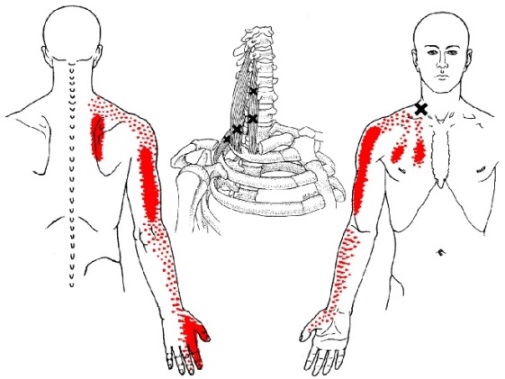
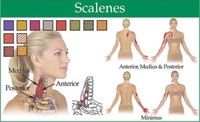
Trigger points in the scalene muscles.

The scalene muscles are located in the neck and originate on c3-c6 and insert on the first and second rib. These muscles act to laterally flex the neck, and assist in respiration by helping to elevate the ribs. Trigger points can form in this muscle from acute injuries such as whiplash, or from chronic injury such as poor posture or shallow nervous breathing. Trigger points in these muscles can refer pain in two finger like projections into the chest. Other common patterns are into the shoulder, scapula and down the lateral arm, and into the thumb and index finger. The scalene muscle can impinge on the brachial plexus, causing nerve pain or numbness down the arm. This is called thoracic outlet syndrome.