What are trigger points.

What is a Trigger Point?

Trigger Points (TP’s) are defined as a “hyper-irritable spot within a taut band of skeletal muscle. The spot is painful on compression and can evoke characteristic referred pain and autonomic phenomena.”1

Put into plain language, a TP is a painful knot in muscle tissue that can refer pain to other areas of the body. You have probably felt the characteristic achy pain and stiffness that TP’s produce at some time in your life.

Causes of a stiff neck.

The levator scapulae muscle is located in your neck. It is responsible for raising your shoulder blade up to your ear, as well as side flexion of the neck. Trigger points develop in this muscle commonly due to poor posture, and stress holding patterns. Once developed these trigger points will cause a deep achy pain and stiffness in the neck.

Myofascial pain syndrome

Myofascial pain syndrome is caused by a stimulus, such as muscle tightness, that sets off trigger points in your muscles. Factors that may increase your risk of muscle

trigger points include:

  • Muscle injury. An acute muscle injury or continual muscle stress may lead to the development of trigger points. For example, a spot within or near a strained muscle may become a trigger point. Repetitive motions and poor posture also may increase your risk.
  • Stress and anxiety. People who frequently experience stress and anxiety may be more likely to develop trigger points in their muscles. One theory holds that these people may be more likely to clench their muscles, a form of repeated strain that leaves muscles susceptible to trigger point

Trigger points and headaches

Trigger points in a number of muscles can refer pain into the head causing headaches. One of the most common muscles is the trapezius. This is a large diamond shaped muscle in the upper back and neck. Trigger points in the upper portion of this muscle are the most common trigger points in the body. These points will refer pain into the head, behind the ear and into the temple. Trigger points usually won’t resolve on their own, a therapeutic intervention is required to release the point.

Trapezius trigger points.

The trapezius muscle is a large diamond shaped muscle in your upper and middle back and neck. It it responsible for both shoulder and neck movements. Trigger points in the upper portion of this muscle are the most common points to develop in the body. These trigger points most often occur due to poor posture, such as a slumped sitting posture. Trigger points in the upper portion of the traps will cause pain to refer into the neck, head, and into the temple. These points are one of the most common causes of headaches.

Trigger points in the multifidus muscle.

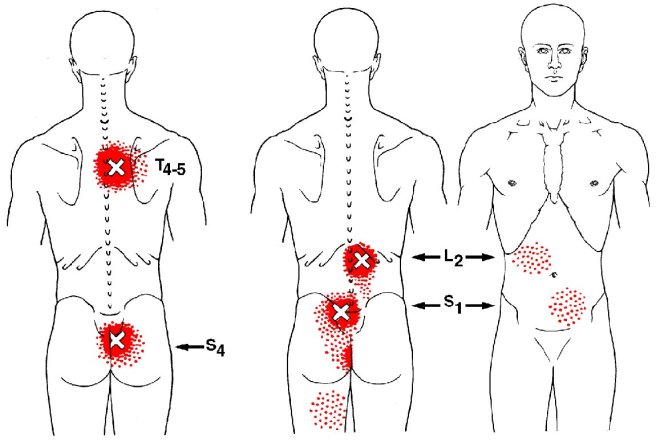
The multifidus muscle is a long muscle that travels the length of the spine. It has different actions on different parts of the spine. It extends and laterally flexes the cervical and lumbar spine, and rotates the thoracic spine. Trigger points in this muscle are common due to poor posture and bad movement mechanics. Trigger points in the lumbar area area are a common cause of low back pain. These lower points can also refer into the abdomen. Points that form in the cervical region will refer pain down the neck into the shoulder blade area.

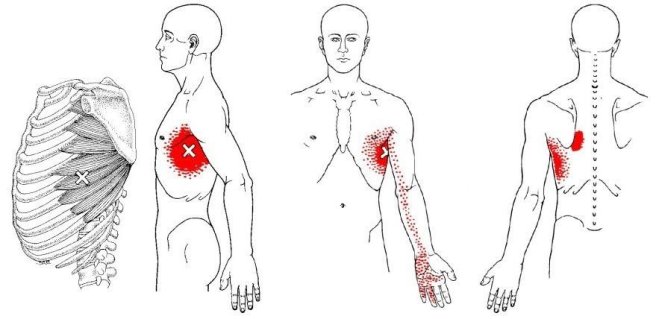
the serratus anterior muscle is located on the side of the trunk. It attaches onto the ribs and the scapulae. This muscle assists in scapular motion and stability as well as assisting the movement of the ribs. Trigger points can form in this muscle due to poor shoulder posture. Once formed, these points will cause pain to be felt in the side, under the armpit, and down the inside of the arm. Once formed trigger points will not release on their own, they require a manual technique such as trigger point massage.