Repetitive Stress Injury
10 signs your workout is actually hurting you
From Discover on Google https://www.insider.com/signs-your-workout-is-hurting-you-2018-5
Treating neck and shoulder pain.

How to treat neck pain

Neck pain and massage therapy.

Poor neck posture and pain.
One of the most common causes of neck pain and headaches that I see in the clinic is poor neck posture. This posture presents itself as a neck forward head up posture. The neck is usually rounded forward and down but the head has to be tilted up in order to see what’s in front of you. This posture will cause all types of imbalances with a combination of strained and contracted muscles. This can lead to not only a stiff achy neck, but also headache pain as well. Trigger points often develop in muscles subjected to this type of chronic strain. These points will cause pain, refered pain, stiffness, and weakness. These points will also mimick numerous other symptoms. Trigger points are difficult to deal with as rest and stretching usually aren’t enough to treat them. Trigger point massage therapy is one of the proven methods of treating trigger points.

Strength Training and Pain Rehabilitation
The best hand and finger stretches for pain relief | Well+Good
Achy burning pain behind in the shoulder blade??
Achy burning pain felt along the length of the shoulder blade is very common these days. The Rhomboids are the muscles that retract the shoulder blade and help maintain good posture by keeping you shoulders from rounding forward. These muscles are often overworked and become chronically strained. As a result trigger points can form in the muscles. It’s these points that are responsible for the persistent achy restless pain felt along the shoulders. Trigger points are stubborn and won’t go away on there own. A theraputic approach like trigger point massage is required to treat the issue.

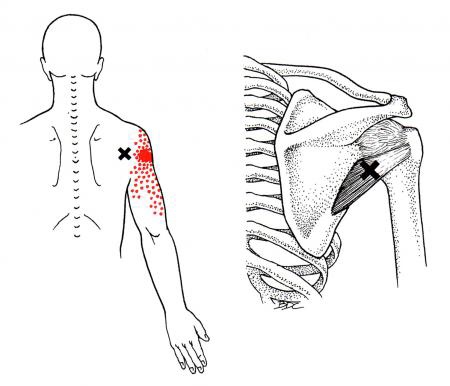
Trigger points in the Teres minor muscle
The Teres minor muscle is on of the rotator cuff muscles. It originates on the lateral border of the scapula, and inserts on the inferior facet of the greater tubercle of the humerus. This muscle assists with external rotation of the humerus as well as shoulder stability. This muscle is often damaged with a shoulder injury. Trigger points will refer into the posterior deltoid and down the back of the arm.