Pulled Hammie! Man Down!

stantonhurt_medium.gif

Your hamstring is the group of muscles in the back of your thigh that flex your knee, i.e., moving your heel toward your buttock. The term “strain” means that a muscle or its tendon has been stressed beyond its limit and has frayed, much like a rope that has been pulled too hard. Your hamstring may be “pulled” or “strained” when it is forced to contract beyond its capacity, like during running or from excessive stretch. This tearing leads to bleeding, bruising, swelling, pain and loss of function.

The symptoms of a hamstring strain may vary from mild discomfort to severe pain, depending upon the amount of tissue that has been torn. Over 90% of hamstring strains occur abruptly with a tearing, burning or popping feeling accompanied by immediate pain below your buttock. Your symptoms will likely increase when straightening your leg, walking or flexing forward. You may notice some bruising that starts near the site of injury. Be sure to tell your doctor if you have notable pain in your lower back, if your pain extends into your calf, if your pain worsens with coughing or sneezing, or if you have a rash on the back of your thigh.

Hamstring injuries are more common when your muscles are tired from activity and happen more frequently as we age. Having excessive tightness or weakness in your hamstring, having quadriceps that are significantly stronger than your hamstring, having too little core strength or poor running form also predispose you to injury.

Nearly all hamstring strains can be successfully managed with conservative care, like the type provided in our office. Your healing period will vary based on several factors, including the specific region of your hamstring that has been injured. Tears that involve the part of the muscle closest to your ischial tuberosity (the bones you sit on) take longer to heal than those that occur further down the muscle.

Initially, you should use ice or ice massage over the injured area for 15 minutes at a time, up to once per hour. Our office may advise you to use an ACE wrap or compression bandage to help limit swelling. The use of NSAIDs for hamstring strains is controversial, as some research suggests this may delay healing. Patients who have more severe injuries may need to use crutches. While you are recovering, you may need to limit some activities, like running and jumping and instead, cross train by stationary cycling or swimming. You are more likely to strain your hamstring in the future and recurrent injuries may take twice as long to heal as the initial injury, so be sure to allow yourself adequate healing time, consistently perform your exercises and warm-up properly prior to activity.
Exercise of the Month: Dead Bug

Dead Bug

Begin lying on your back with your right arm reaching overhead and your left leg flat on the table. Your right knee should be bent 90 degrees and your hip 45 degrees. Place your left wrist beneath your back to prevent your back from flattening against the ground. Slowly begin by raising your left knee and right arm at the same time until your hand touches your knee. Be sure not to lift your head or allow your spine to flatten against the floor. Return to the start position and repeat for three sets of 10 repetitions on each side, twice per day or as directed.

Trigger points in the piriformis muscle

The piriformis muscle is a small muscle deep to glute max and lies over top of the sciatic nerve. It originates on the anterior sacrum, and inserts on the greater trochanter of the femur. It’s main action is to laterally rotate the femur. When trigger points developed in this muscle they will refer pain into the sacro-iliac region, across the posterior hip and down the leg. This muscle can also be a cause of sciatic nerve irritation if it gets tight, causing “sciatica” symptoms.

Did you know that you can breathe “wrong”?

Your “diaphragm” is the dome shaped muscle beneath your lungs. When it contracts and flattens, you breathe in. When it relaxes, you breathe out. But do you know your diaphragm plays an important secondary role in protecting your trunk and spine by controlling abdominal pressure?

The muscles that support your trunk form a “canister.” The front and sides of the canister are created by your abdominal and rib muscles. The back of the canister includes those muscles attached to your spine. The bottom of the canister is formed by the muscles of your pelvic floor, while your diaphragm serves as the roof. Together, these muscles control your abdominal pressure and core stability.


A well-braced core provides a stable foundation for moving your arms, legs, and head – in much the same way that when firing a canon, a large ship serves as a better platform than a rowboat.

During normal breathing, your upper chest should remain relatively still. Patients with “dysfunctional” patterns frequently overuse their upper chest muscles instead of their abdomen and lower rib cage. This depressurizes and destabilizes your core, leading to other problems like back pain.

You should not need to always think about proper breathing – this should happen subconsciously. Unfortunately, many of us have “learned” poor mechanics and need to re-learn proper breathing. One of the easiest ways to re-train proper breathing is to sit or lie still with one head on your breastbone and the other hand on your abdomen. When you breathe in, only the hand on your abdomen should move, while the hand on your chest remains still. Your normal breathing rhythm should be about there seconds of inhalation followed by six seconds of exhalation. If you find that you are exhaling too quickly, you may try “pursing” your lips to gradually increase the length of your exhalation.

The exercises that follow are essential for your recovery. Once you have restored normal breathing mechanics, you will enjoy increased core stability and your treatment will be much more successful. It is important to perform your breathing exercises consistently, as repetitive exercise will allow your body “re-learn” to subconsciously move in a safe and a coordinated fashion- thereby reducing your risk of injury.

Trigger points in the gluteus minimus

The gluteus minimus is a small but important muscle that lies deep to the gluteus medius. It originates on the gluteal surface of the ilium, and attaches on the greater trochanter of the femur. It’s main actions are to abduct and medically rotate the hip. Trigger points in this muscle refer pain into the buttock and down the lateral and posterior leg, mimicking sciatica. This muscle should be the first to be examined if a straight leg test turns out negative.

Osgood Schlatter’s Disease

Children and adolescents have soft “growth plates,” which are areas where their bone is still growing. In children, this growth plate is much weaker than in adults. This means that children are more likely to suffer growth plate injuries than adults, especially during periods of rapid growth.

Osgood Schlatter’s disease, also called tibial epiphysitis, is a painful irritation of the growth plate near the insertion of your quadriceps muscle on your knee. The powerful thigh muscles attach onto your knee through the patellar tendon. When your thigh muscle contracts- like during running or jumping, they place a sheer force on the growth plate of your knee.
Osgood Schlatter’s disease is more common in athletes, particularly those who participate in soccer, gymnastics, basketball, running or track. It is most common between the ages of 10 and 15 and is relatively equally common between boys and girls. Excessively tight thigh or calf muscles may contribute to this problem.

You may experience pain with activity that requires running or jumping. You will often feel tenderness or even bony enlargement of your “tibial tuberosity”, just below your knee. Kneeling or prolonged squatting may be painful.

Some athletes with mild cases may continue activity as long as it does not increase your symptoms. Most cases may require a period of rest to allow the condition to heal. Depending on the severity of your condition, you may need to limit activities that require running and jumping for a while, usually two to eight weeks. You can often cross train in the pool or on a stationary bike.

You should avoid running with a narrow stride “on a line,” as this may increase your symptoms. Our office may recommend use of a patellar tendon strap to assist with your healing. Osgood Schlatter’s disease can temporarily limit your activity, but most of the time, it can be successfully managed, allowing your return to pain-free activity in a relatively short period of time.

What Is Upper Crossed Syndrome?

Your posture plays an important role in your overall health. Poor posture leads to chronic strain and discomfort. “Upper crossed syndrome” describes poor posture that results from excessive tightness in your shoulders and chest with weakness in your neck and mid-back. This combination forces your shoulders to roll inward and your head to project forward.

To help understand how upper crossed syndrome causes trouble, think of your spine as a telephone pole and your head as a bowling ball that sits on top. When the bowling ball is positioned directly over the top of the upright post, very little effort is required to keep it in place. If you tip the post forward and the ball begins to roll over the edge of the post, significantly more effort would be required from the muscles trying to hold it there. This effort results in chronic strain of the muscles of your neck and upper back.

The chronic strain is uncomfortable and may also lead to neck pain, upper back pain, headaches, TMJ pain, and ultimately- arthritis. This postural problem is exceptionally common in computer workstation users. Correction of this problem is accomplished by stretching the tight muscles, strengthening weak muscles, and modifying your workstation.

Trigger points in the gluteus medius muscle

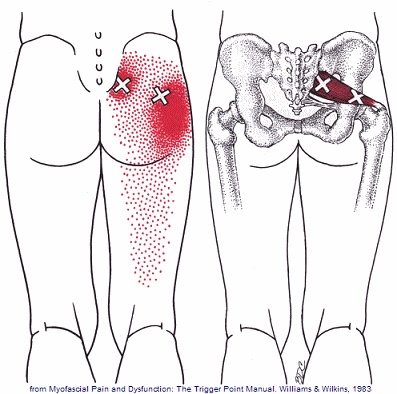
The gluteus medius muscle plays an important role in hip and pelvic stability. It originates on the gluteal surface of the ilium, deep to the gluteus Maximus. It inserts on the greater trochanter of the femur. It’s main actions are to abduct the hip and to assist in internal rotation of the hip. It also maintains pelvic stability during walking and running. Trigger points in this muscle will refer pain into the sacrum, the iliac crest, and down the lateral hip and into the thigh. This muscle is often a cause of lower pack pain.

Posterior Tibial Tendon Dysfunction

The posterior tibialis muscle begins deep in your calf. The muscle is connected to the arch of your foot by a tendon that runs along the inside of your ankle, just behind the large bump called the medial malleolus. When you walk, the posterior tibialis muscle lifts the arch of your foot.

Posterior tibial tendon dysfunction is one of the most common foot and ankle problems. The tendon may be damaged from an acute injury, like an accident or fall. More commonly, problems arise from overuse or repeated strain. Ongoing irritation slowly damages the tendon’s fibers and eventually leads to weakening and degeneration. This decreases the tendon’s ability to support your foot when you walk. As the tendon becomes less effective, the arch of your foot is allowed to collapse, which further increases the strain on the muscle and tendon.

The condition is often triggered from overuse and/or training on excessively hard surfaces. Other factors that can contribute to posterior tibial tendon dysfunction include: obesity, diabetes, hypertension, prior surgery or steroid injections.

Symptoms include pain or swelling along the course of the tendon, particularly behind your inner ankle bone. Symptoms often begin following an increase in training intensity or duration. Standing, walking, or running will likely increase your discomfort. Your pain may be aggravated by spending prolonged periods of time on your feet, especially, when standing tiptoe and walking stairs or uneven surfaces.

Early diagnosis and treatment is important to slow progression of the disorder. You may need to temporarily limit weight-bearing activity to allow your tendon to heal. Using a stationary cycle, elliptical machine, or swimming can be good alternatives to walking and running. Your doctor will likely prescribe arch supports or orthotics to help support your foot. You will be given exercises to strengthen the posterior tibialis muscle. These exercises should be performed while wearing shoes with good arch supports. In certain instances, a walking cast or boot may be needed to temporarily protect your foot.

Here is a brief description of the treatments we may use to help manage your problem.

Joint Manipulation
Your chiropractor has found joints in your body that are not moving freely. This can cause tightness and discomfort and can accelerate unwanted degeneration i.e. arthritis. Your chiropractor will apply a gentle force with their hands, or with hand held instruments, in order to restore motion to any “restricted” joints. Sometimes a specialized table will be used to assist with these safe and effective “adjustments”. Joint manipulation improves flexibility, relieves pain and helps maintain healthy joints.
Therapy Modalities
We may apply electrotherapy modalities that produce light electrical pulses transmitted through electrodes placed over your specific sites of concern. These comfortable modalities work to decrease your pain, limit inflammation and ease muscle spasm. Hot or cold packs are often used in conjunction, to enhance the effect of these modalities. Another available option is therapeutic ultrasound. Ultrasound pushes sound vibrations into tissues. When these vibrations reach your deep tissues, heat develops and unwanted waste products are dispersed.
Myofascial Release
Overworked muscles often become tight and develop knots or “trigger points”. Chronic tightness produces inflammation and swelling that ultimately leads to the formation of “adhesions” between tissues. Your chiropractor will apply pressure with their hands, or with specialized tools, in order to release muscle tightness and soft-tissue adhesions. This will help to improve your circulation, relieve pain and restore flexibility.
Therapeutic Exercise
Muscle tightness or weakness causes discomfort and alters normal joint function, leading to additional problems. Your chiropractor will target tight or weak muscles with specific therapeutic stretching and strengthening to help increase tissue flexibility, build strength, and ease pain. Healthy, strong, and flexible muscles may help prevent re-injury.
Elastic Therapeutic Tape
Your chiropractor may apply a special elastic therapeutic tape in order to support injured areas or encourage better movement. This tape is thought to decrease pain and swelling, improve circulation and limit muscle soreness.
Foot Evaluation
Fallen arches and faulty foot mechanics are common problems that can perpetuate your condition. Our office will carefully evaluate your feet and consider the need for a change in shoe style, arch supports or even custom orthotics.
Ankle Brace
Our office may recommend using a support brace to protect your ankle from further injury. Your doctor will discuss the specific type of brace and provide instructions for use.
After this initial course of treatment we will reassess your progress. We will determine the need for any additional care after your reassessment.

Sleep Posture
Your mattress and the position you sleep in may affect your condition.
Choose a mattress that provides medium or firm support, such as a traditional coil spring or adjustable airbed. Avoid waterbeds, thick pillow tops and soft, sagging mattresses.
Always sleep on your back with a pillow either underneath your knees or on your side with a pillow between your knees. Avoid sleeping on your stomach.
Keep your neck and back covered while sleeping to avoid drafts that could cause potential muscle spasms.
RICE
The acronym RICE can help you remember what to do after a new injury:
Rest – Limit stress to the injured area for at least the first 48 hours.
Ice – Apply for 10-15 minutes. Break for 30 minutes. Reapply. (Alternatives to the ice pack include Ziploc bags filled with ice, or a bag of frozen vegetables.)
Compression – Wrap the injured area with an elastic ACE bandage if possible.
Elevation – Elevate the injured area to limit swelling.
Standing
To avoid extra stress on your spine while standing:
Avoid high-heeled shoes or boots
Use a footrest
If excessive standing can’t be avoided, consider shock absorbent shoes or an anti-fatigue mat.
Footwear
Improperly supported feet can affect the alignment of all of the structures above. To improve your overall comfort:
Choose shoes with good arch support.
Avoid going barefoot or wearing shoes that lack support (i.e. flip-flops). The following brands of sandals provide better than average arch support: Naot, Fit Flops, Orthoheels, Abeo, Vionic and Yellow box.
Avoid high-heeled shoes or boots (keep heels to a maximum of 1½ inches, especially if you are going to be doing a lot of walking).
“Cross-trainer” athletic shoes tend to provide the best all around support and shock absorption for daily activities.
Patients with fallen arches should consider adding arch supports or orthotics.
Repair or replace shoes with worn soles or heels.
Running Shoes
Running shoes need to be replaced every 250 miles. There are three basic options:
Motion Control Shoes – Designed for people with low or no arches, these shoes are for runners who strike the ground on the outer edge of their foot. Avoid overly stiff shoes as these decrease you perception of ground strike and lead to new injuries.
Stability or Neutral Shoes – Designed for people with normal or average arches and running mechanics. The shoe contains some cushioning to absorb shock and prevent injuries and some rigidity to avoid pronation.
Cushioned Shoes – Designed for people with high arched feet. Their footprint will typically leave a thin band along the foot’s edge. As they run weight is distributed from heel strike to the outer edge of the foot and small toes that bear the brunt of “lift off.” This shoe is more flexible and absorbs the shock created by the lack or rotation (under-pronation) created by their running style.

Knee Arthritis; Who, Where, Why and How?

The bones in your knee have a slick protective covering called “cartilage” on the joint surfaces that touch each other. This cartilage serves as a friction reducer and shock absorber, thereby helping to extend the life of your joints. “Arthritis” means that your cartilage has begun to thin or crack and may eventually wear away, leading to a painful “bone on bone” situation.

Knee arthritis is very common, affecting more than 1/3 of adults over age 65. People who are overweight or have a history of knee injury or surgery are more likely to develop arthritis. Jobs and activities that require repetitive squatting, kneeling, pivoting or stair climbing may cause increased wear. Contrary to popular opinion, runners have no increased risk of developing knee arthritis. Women are two to three times more likely to develop knee arthritis as compared to men.

The pain of knee arthritis is often described as a “deep ache” that is aggravated by activity and relieved by rest. You probably notice morning stiffness that goes away after a short period of activity, but returns after sitting for long periods of time. Some patients have difficulty squatting, bending and walking stairs. You may notice that your knees pop and crack. Eventually, knee arthritis can cause you to walk slower, lose your balance and even fall more often. Many patients notice that their symptoms increase with weather changes.

Although there is no cure for the irreversible wearing associated with arthritis, there is help for your symptoms. Performing your home exercises is very important. The way that your knee is aligned (and wears) is largely based upon how your hip and foot function, so many of your home exercises will target those regions. Our office may prescribe arch supports or orthotics, since people with flat feet are almost twice as likely to suffer from knee arthritis.

Overweight patients should begin or increase low-impact aerobic exercises like walking, stationary cycling, elliptical exercising, water walking or swimming. Be sure to take frequent breaks from prolonged sitting and avoid overly painful activities.