
Myofascial pain syndrome (trigger points) and fibromyalgia are often confused to be the same condition and while there is a lot of interrelatedness between the two they are not quite identical. The clinical definition of a trigger point is “a hyper irritable spot associated within a taut band of skeletal muscle that is painful on compression or muscle contraction, and usually responds with a referred pain pattern distant from the spot”. Trigger points form from an overload trauma to the muscle tissue. This is contrasted with fibromyalgia which is defined as “a medical condition characterized by chronic widespread pain and a heightened pain response to pressure. Other symptoms include tiredness to a degree that normal activities are affected, sleep problems and troubles with memory. Some people also report restless leg syndrome, bowel and bladder problems, numbness and tingling and sensitivity to noise, lights and temperature. It is also associated with depression, anxiety, and post traumatic stress disorder”. Fibromyalgia will also present with localized tender points which are often mistaken for trigger points. Where these two conditions become somewhat interrelated is via the nervous system. Fibromyalgia patients suffer from a super-sensitization of the nervous system causing hyperirritability and pain. Myofascial trigger points can be caused by,or be the cause of, super sensitization. An active trigger point will irritate the sensory nerves around it eventually leading to super-sensitization. Trigger points have also been showed to form of become active due to super-sensitization. Both of these conditions can perpetuate the other, leading to layers of pain and symptoms. This being the case, trigger point therapy can have a very positive effect on decreasing the severity of pain and symptoms in patients suffering from fibromyalgia.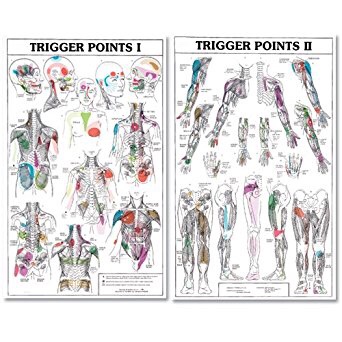

Neck Pain
The Thoracic Disc Lesion
Your spine consists of 24 individual vertebrae stacked on top of each other. Flexible cushions called “discs” live between each set of vertebra. A disc is made up of two basic parts. The inner disc, called the “nucleus” is like a ball of jelly about the size of a marble. This jelly is held in place by the outer part of the disc called the “annulus,” which is wrapped around the inner nucleus,

much like a ribbon wrapping around your finger. The term “thoracic disc lesion” means that one or more of the 12 discs in the center section of your spine has been damaged.
Disc problems start when the outer fibers of the disc become strained or frayed. If enough fibers become frayed, the disc weakens and when compressed, may “bulge” like a weak spot on an inner tube. If more fibers are damaged, the nucleus of the disc may “herniate” out of the disc.
Surprisingly, thoracic disc bulges are present without any symptoms in almost half of the adult population. Disc bulges that cause pain commonly occur in the neck or lower back but are relatively infrequent in the thoracic spine – accounting for less than 1% of all symptomatic disc problems. The condition is most common between the ages of 40 and 60. Certain occupations or activities place you at greater risk, especially physically demanding activities that involve repetitive twisting, awkward postures.
Pain can range from dull, localized discomfort to sharp, radiating pain. Your symptoms may change unpredictably. If the disc bulge is bad enough to compress your nerve, you could experience sharp, burning, or shooting pain in a band-like distribution around your rib cage. Thoracic disc herniations commonly mimick other conditions like heart or lung problems. Be sure to let our office know if you notice chest pressure; shortness of breath; pain radiating into your arm, face, or jaw; pain with deep breathing; clumsiness; loss of bowel or bladder control; unexplained weight loss; night sweats; pain that awakens you at night; fever; indigestion; nausea; flu-like symptoms or if you notice a rash following the margin of one of your ribs.
You should avoid excessive bed rest while recovering. Researchers have shown that disc bulges may be successfully managed with exercise and conservative care, like the type we will provide.
What does a shoulder separation actually mean?

The term “acromioclavicular sprain” means that you have damaged the strong fibrous bands (ligaments) that hold the end of your collarbone (clavicle) to the tip of your shoulder blade (scapula). Another term sometimes used to describe this injury is “shoulder separation.” 40-50% of all athletic shoulder injuries involve the acromioclavicular (AC) joint. AC injuries are common in adolescents and young adults who participate in contact sports, like hockey and football. Males are affected five times more often than females.
Injuries may range from mild fraying of a single ligament to complete rupture of all of the supporting ligaments. Significant tears can allow your collarbone to move upward, out of its normal position, creating a raised bump under your skin. AC joint injuries are categorized (Grade 1-Grade 6) based upon the amount of damage. Grade 1 injuries are tender without joint separation. Grade 2 injuries may be accompanied by a slight separation of the joint. Grade 3 and above will show significant joint separation.
Injuries typically occur following a fall onto the point of your shoulder, while your arm is at your side, or by falling onto your outstretched hand. You will most likely feel pain and swelling on the very top of your shoulder. More significant injuries may produce bruising or a visible “bump” beneath the skin. Moving your shoulder will likely be painfully limited for a while.
Your treatment will vary, depending upon the severity of your injury. Grade 1, 2, and most Grade 3 injuries are best managed conservatively. A sling may be used only when needed to control painful movements. Initially, you will need to limit activity, especially reaching overhead, behind your back, or across your body. The exercises described below are an important part of your rehab and should be performed consistently to avoid long-term problems. Using an ice pack for 10-15 minutes each hour may help to limit swelling and pain.
Some mild separations will heal by themselves within a week or two. More significant injuries can take longer, and disabilities typically range between one and eight weeks. Patients who have suffered a significant amount of ligament damage may have a permanent bump on their shoulder, regardless of treatment. This bump does not usually cause ongoing problems.
If you or someone you know suffers from this condition, call our office today. Our doctors are experts at relieving many types of pain including shoulder injuries.

“I Popped A Rib”
You have 12 pair of ribs that attach to the “thoracic” region of your spine. The ribs serve to protect your heart, lungs, and other vital organs. Each rib is shaped much like a “bucket handle” arching from your spine to your breastbone (sternum) in front. Your ribs must move freely when you breathe, bend, twist, and reach. The term “costovertebral dysfunction” means that one or more of your ribs has become restricted or slightly malpositioned from it’s attachment to the spine.
 You can visualize this as imagining one of your bucket handles is misaligned and not moving in sync with the others.
Rib problems can develop in many ways. Sometimes they are brought on by an accident or injury; other times, they develop from repetitive strains or poor posture. Rib malpositions are common during pregnancy or after a whiplash injury.
Symptoms sometimes begin following a sudden or explosive movement, like coughing or sneezing, reaching, pushing, or pulling. Other times, a specific cause cannot be recalled. Rib dysfunction may cause pain near or slightly to the side of your spine with possible radiation of symptoms along your rib, sometimes all the way to the front. Some patients feel as though they were “shot by an arrow.” Rib problems are a frequently overlooked source of chest and abdominal pain.
Be sure to tell your chiropractor if your symptoms include any unusual cough, indigestion, nausea, vomiting, fever, flu-like complaints or if you notice a rash developing along the border of your rib. Seek immediate medical treatment if you notice chest “pressure” or “squeezing”, symptoms that radiate into your arm and jaw, or if you have chest pain or shortness of breath with exertion, as these are possible symptoms of heart problems and must be addressed immediately.
Most patients report rapid relief following chiropractic care. Our office can provide several tools to help ease your pain. To speed your recovery, you should avoid activities that increase your pain. Initially, you may need to limit reaching, pushing, and pulling. Women may benefit by temporarily switching to a sports bra to help better diffuse pressure over irritated ribs. Some patients report relief by using sports creams, NSAIDs, or applying ice for 15-20 minutes directly over the painful area.
Avoiding Back Pain At Sedentary Jobs
Some great tips on how to prevent back pain when working a sedentary job from our friends at Silicon Republic. Check out the article below.
1. Take regular breaks to stretch and walk around
Try to walk around for between three and five minutes every half hour.
2. Make sure not to hunch over while working
Everyone intuitively understands that hunching over the computer is bad for them, but it’s easy to fall into the most natural and comfortable – albeit unhealthy – sitting position while you’re in the flow of things.
3. Consider a standing desk
A standing desk offers you the opportunity to alternate your position throughout the day.
Do you wake up with numb fingers?
The term “thoracic outlet” describes an area at the base of your neck, just above your collarbone. Some important nerves and vessels pass through this outlet on their way into your arm. Compression of these tissues causes a condition called “thoracic outlet syndrome” which results in pain, numbness or tingling in your arm.
Several different factors can cause Thoracic Outlet Syndrome,

commonly referred to as TOS. Sometimes TOS is caused from tightness in the muscles of your neck and chest, other times the space between your first rib and collarbone is too small. People who have an extra rib (cervical rib) and people who have recently suffered a neck injury may have a greater chance of having this problem.
The condition is aggravated by poor posture and by occupations that promote “slouching,” i.e., computer users, assembly line workers, supermarket checkers and students. Swimmers, volleyball players, tennis players, baseball pitchers and occupations requiring prolonged overhead activity. i.e., electricians and painters are also prime candidates for TOS.
Symptoms of TOS include arm pain, numbness, tingling and possible weakness. Neck, arm and hand pain may begin slowly and are often aggravated by elevation of the arms or excessive head movement. Loss of grip strength is possible.
Conservative treatment, like the kind we provide, has been shown to be effective at treating TOS. Through our careful exam we have identified your specific sites of compression and will use some of the following treatment to help:
You should avoid carrying heavy loads, especially on your shoulder i.e., carpet rolls. Briefcases, laptop cases or heavy shoulder bags should be lightened. Bra straps may need additional padding or consideration of replacement with a sports bra.
Trigger points in the lateral pterygoid
The lateral pterygoid muscle plays an important role in prober jaw function. It originates on the greater wing of the sphenoid bone and the lateral pterygoid plate, and inserts on the condyloid process of the mandible. It’s action is to pull the head of the mandibular condyle out of the mandibular fossa while opening the jaw. When trigger points develop they refer pain into the temporal mandibular joint and maxillary sinus. This referral is commonly mistaken for TM arthritis. In addition to the referral pain, trigger points in this muscle can also effect proper movement of the jaw.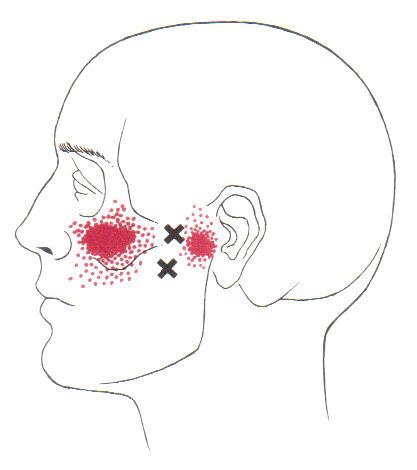

What is a “Mild” traumatic Brain Injury?
A concussion is a blow or jolt to the head that disrupts normal brain function. Concussions, also known as Mild Traumatic Brain Injuries, most often result from falls, sports injuries, and auto accidents.
 Concussion symptoms may begin immediately after an injury, but sometimes take hours or days to appear. The most common symptoms of a concussion include; headaches, light-headedness, dizziness, visual disturbances, ringing in the ears, confusion, fatigue, difficulty sleeping, irritability, and difficulty remembering or learning new things. Patients sometimes struggle to understand conversations or make simple calculations like determining a restaurant tip. Patients often feel as if they are “in a fog”. Symptoms can range from subtle to debilitating.
Patients and their attendants should be particularly alert for signs or symptoms that could indicate a more threatening injury like; worsening headache, growing irritability, repeated vomiting, difficulty speaking or swallowing, shortness of breath, unequal pupils, fever, visual disturbances, seizures, clear discharge from the nose or ears, loss of consciousness, or increasing light-headedness, numbness, or confusion. These symptoms warrant immediate emergency medical attention.
Recovery times are quite variable and are dependent upon a number of factors. It is critical that you allow your brain to recover completely before returning to physical activity. A concussion can be likened to dropping a computer – you will need to allow time to reboot before trying to use it. Suffering a second concussion before the first has completely resolved can lead to significantly worse symptoms and long-term impairments.
Athletes who have suffered a concussion must not return to activity before being evaluated by a healthcare professional that is very familiar with concussion management.
What Is Upper Crossed Syndrome?
Your posture plays an important role in your overall health. Poor posture leads to chronic strain and discomfort. “Upper crossed syndrome” describes poor posture that results from excessive tightness in your shoulders and chest with weakness in your neck and mid-back. This combination forces your shoulders to roll inward and your head to project forward.

To help understand how upper crossed syndrome causes trouble, think of your spine as a telephone pole and your head as a bowling ball that sits on top. When the bowling ball is positioned directly over the top of the upright post, very little effort is required to keep it in place. If you tip the post forward and the ball begins to roll over the edge of the post, significantly more effort would be required from the muscles trying to hold it there. This effort results in chronic strain of the muscles of your neck and upper back.
The chronic strain is uncomfortable and may also lead to neck pain, upper back pain, headaches, TMJ pain, and ultimately- arthritis. This postural problem is exceptionally common in computer workstation users. Correction of this problem is accomplished by stretching the tight muscles, strengthening weak muscles, and modifying your workstation.
Can Chiro help me?

Chiropractic is the most widely accepted and most frequently used type of “alternative” healthcare in the United States. This is largely due to the fact that it works, and because of that, there has been a steady increase in acceptance by the public, third-party payers, and the Federal government. Since the mid-1990s, a number of outside (non-chiropractic) observers have suggested that chiropractic has now entered mainstream healthcare.
One can position chiropractic as being BOTH alternative and mainstream. It is “alternative” since it approaches healthcare from an entirely different direction compared to the primary care medical profession. Chiropractic is non-surgical and promotes diet and nutritional approaches vs. drugs and surgery. Chiropractic is also arguably “mainstream” as it has evolved into a strongly utilized form of primary care through popular acceptance and utilization by the public.
So, what role does chiropractic play in today’s health delivery system? This question is still being debated, but there appears to be three camps: 1) Specialist—limited to musculoskeletal (MSK) complaints on an interdisciplinary primary healthcare team; 2) Primary healthcare “gatekeepers” that focus on ambulatory MSK complaints; 3) Generalist primary healthcare provider of “alternative or complementary” medicine that manage and/or co-manage both MSK AND non-MSK conditions.
Looking at this from the patient or “consumer” perspective, chiropractic already plays an important role in the healthcare delivery for many patients. In 1993, a report claimed 7% of American adults had received chiropractic care during the prior year. According to a 2015 Gallup poll (that included 5,442 adults, aged 18+, surveyed between 2/16/15 and 5/6/15) entitled, Majority in U.S. Say Chiropractic Works for Neck, Back Pain, “Chiropractic care has a positive reputation among many US adults for effective treatment of neck and back pain, with about six in 10 adults either strongly agreeing (23%) or agreeing somewhat (38%) that chiropractors are effective at treating these types of pain.”
The “highlights” from this Gallup poll include: 1) Two-thirds say chiropractic is effective for neck and back pain. 2) Many adults say chiropractors think of the patient’s best interest. 3) More than 33 million adults in the United States (US) saw a chiropractor in the twelve months before the survey was conducted. That means roughly 14% of U.S. adults saw a chiropractor in the 12 months prior to the survey (vs. 7% in 1993). An additional 12% who responded to the Gallup pollsters saw a chiropractor in the last five years but not in the last 12 months. Overall, 51% of those polled had previously seen a chiropractor.
Whether or not you have personally utilized chiropractic, the educational process, licensing requirements, public interest, third-party payer systems, and interprofessional cooperation ALL support firm ground for which you can comfortably and confidently seek chiropractic care for your complaints.
We realize you have a choice in whom you consider for your health care provision and we sincerely appreciate your trust in choosing our service for those needs. If you, a friend, or family member requires care, we would be honored to render our services.
 Aberdeen Chiropractic