What does a shoulder separation actually mean?

Impingement

The term “acromioclavicular sprain” means that you have damaged the strong fibrous bands (ligaments) that hold the end of your collarbone (clavicle) to the tip of your shoulder blade (scapula). Another term sometimes used to describe this injury is “shoulder separation.” 40-50% of all athletic shoulder injuries involve the acromioclavicular (AC) joint. AC injuries are common in adolescents and young adults who participate in contact sports, like hockey and football. Males are affected five times more often than females.

Injuries may range from mild fraying of a single ligament to complete rupture of all of the supporting ligaments. Significant tears can allow your collarbone to move upward, out of its normal position, creating a raised bump under your skin. AC joint injuries are categorized (Grade 1-Grade 6) based upon the amount of damage. Grade 1 injuries are tender without joint separation. Grade 2 injuries may be accompanied by a slight separation of the joint. Grade 3 and above will show significant joint separation.

Injuries typically occur following a fall onto the point of your shoulder, while your arm is at your side, or by falling onto your outstretched hand. You will most likely feel pain and swelling on the very top of your shoulder. More significant injuries may produce bruising or a visible “bump” beneath the skin. Moving your shoulder will likely be painfully limited for a while.

Your treatment will vary, depending upon the severity of your injury. Grade 1, 2, and most Grade 3 injuries are best managed conservatively. A sling may be used only when needed to control painful movements. Initially, you will need to limit activity, especially reaching overhead, behind your back, or across your body. The exercises described below are an important part of your rehab and should be performed consistently to avoid long-term problems. Using an ice pack for 10-15 minutes each hour may help to limit swelling and pain.

Some mild separations will heal by themselves within a week or two. More significant injuries can take longer, and disabilities typically range between one and eight weeks. Patients who have suffered a significant amount of ligament damage may have a permanent bump on their shoulder, regardless of treatment. This bump does not usually cause ongoing problems.

If you or someone you know suffers from this condition, call our office today. Our doctors are experts at relieving many types of pain including shoulder injuries.

AC Joint

Avoiding Back Pain At Sedentary Jobs

Some great tips on how to prevent back pain when working a sedentary job from our friends at Silicon Republic. Check out the article below.

How to prevent back pain in the workplace

1. Take regular breaks to stretch and walk around

Try to walk around for between three and five minutes every half hour.

2. Make sure not to hunch over while working

Everyone intuitively understands that hunching over the computer is bad for them, but it’s easy to fall into the most natural and comfortable – albeit unhealthy – sitting position while you’re in the flow of things.

3. Consider a standing desk

A standing desk offers you the opportunity to alternate your position throughout the day.

Trigger points in the Quadratus Lumborum muscle.

The quadratus lumborum muscle is a commonly overlooked source of low back pain and is often responsible for “pseudo disc syndrome”. This muscle originates on the inferior border of the 12th rib and lumbar transverse processes. It inserts on the iliac crest and iliolumbar ligament. The q.l.’s main actions are extension and lateral flexion of the spine. It also acts as a stabilizer of the lumbar spine. Trigger points in this muscle refer pain into the sacroiliac joint and the lower buttock. Pain can also spread anteriorly along the crest of the ilium into the lower abdomen and groin and to the greater trochanter.

Why Posture Is So Important For Fitness

Why Posture Is So Important For Exercise & Fitness

Great article from http://www.brit.co on posture and fitness.

If you’ve ever rolled your eyes when your mom told you to “sit up straighter,” listen up! Turns out she was on to something. Good posture is important for more reasons than physical presentation. And for fitness fanatics, it’s actually critical. “Good posture impacts how you walk, jump, and lift,” says Aaptiv trainer Ackeem Emmons. “Proper alignment also eases strain or pain on your spinal cord.”

woman running outside

For runners and gym-goers, the impacts are even more specific. “When you’re running, having good posture allows you to breathe better,” Emmons says. “The more air in your diaphragm, the further you can go. The better your posture, the more fluid your form.” All of this translates to more efficient and successful running. In the gym, proper form and alignment help you isolate certain muscle groups and execute heavy compound movements, he adds.

Beyond the obvious physical gains, your posture can also impact you mentally as well. “Standing tall with proper posture gives the immediate impression of confidence and courage,” says Aaptiv trainer Ceasar F. Barajas. “You’re mentally setting the tone for success when you straighten up a bit.”

If you’re suddenly feeling hyper-aware of your spinal column, don’t worry. According to Aaptiv trainers Jaime McFaden and Benjamin Green, you can work every day to gradually correct limp posture. “Sit up straight and gently pull your shoulders back and down, stretching the neck. Press both feet firmly into the ground and lift your chest,” McFaden says.

“I’m on a bike anywhere from three to six days per week, hunched over with a rounded back,” explains Green. “Throughout the day, if I catch myself not standing up straight, I open up my shoulders.” If it helps, imagine a string attached to the top of your head, pulling you up, he adds.

For those looking for a more intense posture intervention, our Aaptiv trainers shared five exercises and poses that will help open up your chest, align your spine, and gradually correct poor posture. Keep reading for more moves and be sure to check out all of Aaptiv’s yoga and stretching classes in-app to support (pun intended) your good posture journey.

woman planking

1. Planks — Aaptiv Trainer Kelly Chase: Lie on your stomach with your legs straight behind you. Bring your arms forward and rest your weight on your forearms. Your elbows should be directly below your shoulders. Your arms can rest straight and flat with your palms facing the ground or you can bring your hands together to form a triangular shape. Engage your core and keep your body as straight as possible, careful not to create any dip or arch in your lower back. Hold for 30 seconds. As you become stronger, you can increase your hold time.

Woman Using Exercise Band

2. Band Scapular Retraction Rows — Aaptiv Trainer Candice Cunningham: You’ll need a resistance band for this exercise. Sit upright on the floor with both feet extended in front of you. Keeping your legs straight together, wrap the band around the bottoms of your feet, holding the ends in your hands. Focus on holding your back completely straight as you gradually pull the ends of the band into your chest in a row-style movement. Your elbows should bend out to the sides at chest height. Straighten your arms and repeat.

Complete 10 reps.

woman doing superman exercise

3. Supermans — Aaptiv Trainer Benjamin Green: Lie straight and face down on your mat. Extend your arms in front of you with your biceps next to your ears. Exhale and simultaneously, raise your legs, arms, and chest off the mat, creating a U-shape in your body. Squeeze your lower back and hold for two deep breaths. Inhale and lower your limbs back to the mat.

Complete 10 reps.

woman doing bird dog exercise

4. Bird Dogs — Aaptiv trainer Ackeem Emmons: Start on your hands and knees with your palms directly below your shoulders and your knees below your hips. Put your weight on your left knee and left hand as you slowly lift your right leg and straighten it behind you, keeping it in line with your flat back. Lift your right arm and extend it forward in line with your back. Reach with your fingers, careful to maintain a straight line through your body from fingertips to toes. Flex your right foot so your toes are pointed toward the ground and hold for five deep breaths. Repeat on the other side.

Complete 10 reps on each side.

woman doing yoga

5. Tadasana (Mountain Pose) — Aaptiv trainer Ceasar Barajas: You can perform this pose standing or sitting (at your desk perhaps?). Take a deep breath in and roll your shoulders up towards your ears. Exhale and roll them back down. Continue consciously breathing deeply and engage your core. Imagine someone poured cold water down your back to further engage your core and move deeper in the stretch.

Perform this move as often as you need.

Trigger points in the temporalis muscle

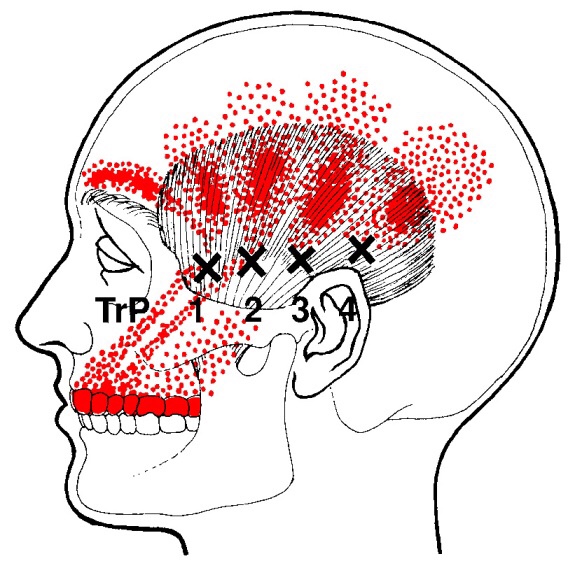
The temporalis muscle is located in the temple area of the skull. It originates on the temporal lines on the parietal bone of the skull, and inserts on the coronoid process of the mandible. It’s main action is to close the jaw. The posterior and middle fibres bilaterally retrude the mandible. Acting individually, this muscle will deviate the mandible to the same side. Trigger points in this muscle refer into the teeth causing hypersensitivity, and into and above the eye and temple, causing headaches.

What is Sever’s Disease?

Severs disease, also called calcaneal apophysitis, is a painful swelling near the insertion of the Achilles tendon on your heel.

As our bones develop, we have “growth plates” which are softer areas where the bone is still growing. In children, this growth plate is weaker than in adults. This means that children are more likely to suffer growth plate injuries than adults, especially during periods of rapid growth.

The powerful calf muscles attach onto your heel through the Achilles tendon. When your calf muscle contracts (like during running or jumping), it places a shear force on the growth plate of your heel. Severs disease is an irritation to this sensitive growth plate.

Athletically active children, who run and jump frequently in sports like soccer, basketball, gymnastics and track & field are most likely to suffer from this condition. Severs disease is slightly more common in boys and the condition affects both heels about half of the time.

Symptoms usually start as heel pain that gradually worsens during activity. Sometimes this can cause a “limp”. Rest usually temporarily relieves the pain.

Your doctor will make the diagnosis of Severs disease based on your history and an exam. Your doctor may take an x-ray to rule out other injuries like a stress fracture.

The first goal of treatment is to allow you to return to pain-free activity as soon as possible. This may require avoiding stressful activity like running and jumping for a short period of time. Cross training on a bike is usually acceptable. Ice should be applied for 15 minutes after any activity. You should always wear shoes with good arch supports and avoid walking barefoot. Your doctor may recommend a small heel lift to decrease strain on your achilles tendon.

Trigger points in the lateral pterygoid

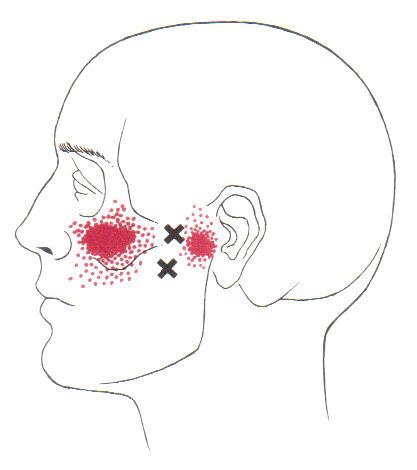
The lateral pterygoid muscle plays an important role in prober jaw function. It originates on the greater wing of the sphenoid bone and the lateral pterygoid plate, and inserts on the condyloid process of the mandible. It’s action is to pull the head of the mandibular condyle out of the mandibular fossa while opening the jaw. When trigger points develop they refer pain into the temporal mandibular joint and maxillary sinus. This referral is commonly mistaken for TM arthritis. In addition to the referral pain, trigger points in this muscle can also effect proper movement of the jaw.

Spring Cleaning Tips

If you plan on doing a bit of spring cleaning soon, here is our friendly safety reminder: Don’t forget that some chores are a workout, so stretch accordingly before and after. Also, be mindful of your posture throughout your cleaning.

Keep a neutral spine, bend at your knees when lifting heavy items, and never twist your back at unhealthy angles.

I’ve got Shin Splints; what do I do?

Shin splints, also called “Medial Tibial Stress Syndrome,” (MTSS) is caused when the muscles of your lower leg pull too hard on your bone, causing local pain and inflammation. Over half of all leg pain in athletes is caused from shin splints. Up to 1/3 of runners and soldiers experience shin splints at some point in their lifetime.

MTSS is an overuse injury frequently seen in sports involving running, jumping, or frequent stopping & starting, i.e. field hockey, soccer and cross-country. Shin splints do not occur overnight but over a period of time, often show up during the first two or three weeks of training for a new season. Shin splints can occur when there are changes to your exercise regimen, such as an increase in activity, change in shoes or a change in the surface you play on. Some doctors refer to these training areas as “the terrible toos,” – too much, too hard, too long, too fast.


Symptoms of shin splints include tenderness or pain over the inside lower portion of your shin. The discomfort begins at the start of exercise and eases as you continue. Some patients report “bumps” when touching the inner portion of their leg bone. Be sure to tell your doctor if you experience weakness, numbness or cold feet during exercise or find a very small area of sensitivity.

Unfortunately, MTSS usually develops during a time when you are training heavily for a sport or an upcoming event. Continuing this activity will often lead to ongoing problems and decreased performance. Shin splints are now believed to be a forerunner to stress fracture, so adequate rest is critical. You may need to consider non-weight bearing cross training, such as using a stationary cycle or pool running.

When directed, your return to activity should start slowly, beginning with a 1/4 mile run and progressing by 1/4 mile each time you have no pain for two consecutive workouts. You should initially avoid running on hard or uneven surfaces and begin at a lower intensity and distance, increasing by no more than 10-15% per week- first increase distance, then pace, and avoid hard or unlevel surfaces, including hills.

Sports creams and home ice massage may provide some relief. Use ice after any activity. Patients who have flat feet are predisposed to developing shin splints and may need arch supports or orthotics. Avoid using heel cushions in your shoes, as they may increase the recurrence of this problem.