Pregnancy Related Low Back Pain

DSC_0033

Pregnancy-related LBP

Researchers estimate that between 45-75% of pregnant women will experience low back pain at some stage of their pregnancy.  (1-5) Up to 33% rate their pain as severe. (6) Pregnancy-related low back pain (P-LBP) leads to lower quality of life, restricted activity, and disability – with almost 25% of pregnant women taking sick leave for LBP.  (2,7-11) The recurrence rate for pregnancy-related low back pain is 85-90%.  (11-14) Consequently, almost 1 in 5 women who report P-LBP during an initial pregnancy will avoid future pregnancies due to fear of returning symptoms.  (15) 

Pharmacologic options during pregnancy are limited, however a new study highlights a conservative alternative. A December 2017 systematic review of 102 studies found moderate-quality evidence suggesting manipulation had a significant effect on decreasing pain and increasing functional status in pregnant and post-partum women with LBP. (16)

This concurs with prior research showing that almost 75% of women undergoing chiropractic manipulation report significant pain reduction and clinically significant improvements in disability. (17,18) Postpartum LBP also responds favorably to spinal manipulation – approximately 10 times better than watchful waiting. (19)

Our providers strive to deliver safe and effective evidence-based care for your patients. Incorporating gentle manipulation with the appropriate exercises generally provides significant relief in very few visits.  


References
1. Wu WH, Meijer OG, Uegaki K, Mens JM, van Dieën JH, Wuisman PI, et al. Pregnancy related pelvic girdle pain (PPP), I: terminology, clinical presentation, and prevalence. Eur Spine J 2004;13:575–89.
2. Pierce H, Homer C, Dahlen H, King J. Pregnancy related low back and/or pelvic girdle pain: listening to Australian women. Abstract presented at the XI International Forum for Low Back Pain Research in Primary Care, Melbourne, Australia, 15–18 March 2011.
3. Diakow P.R.P., Gadsby T.A., Gadsby J.B., Gleddie J.G., Leprich D.J., Scales A.M. Back pain during pregnancy and labor. J Manipulative Physiol Ther. 1991;14(2):116–118.
4. Berg G., Hammer M., Moller-Nielsen J., Linden U., Thorblad J. Low back pain in pregnancy. Obstet Gynecol. 1988;71:71–75. 
5. Mogren IM, Pohjanen AI. Low back pain and pelvic pain during pregnancy: prevalence and risk factors. Spine . 2005 Apr 15;30(8);983-91. 
6. Hall J, Cleland J, Palmer J. The Effects of Manual Physical Therapy and Therapeutic Exercise on Peripartum Posterior Pelvic Pain: Two Case Reports. Journal of Manual and Manipulative Therapy. 2005;13(2): 94-102 
7. Wellock VK, Crichton MA. Symphysis pubis dysfunction: women’s experiences of care. Br J Midwif 2007;15:494
8. Kristiansson P, Svarsudd K, von Schoultz B. Back pain during pregnancy: a prospective study. Spine 1996;21:702-9.
9. Wu W, Meijer OG, Jutte PC, et al. Gait in patients with pregnancy-related pain in the pelvis: an emphasis on the coordination of transverse pelvic and thoracic rotations. Clin Biomech 2002;17:678-86.
10. Owens K, Pearson A, Mason G. Symphysis pubis dysfunction: a cause of significant obstetric morbidity. Eur J Obstet Gynecol Reprod Biol
11. George JW, Skaggs CD, Thompson PA, Nelson DM,  Gavard JA, Gross GA. A randomized controlled trial comparing a multimodal intervention and standard  obstetrics for low back and pelvic pain in pregnancy. Am J Obstet Gynecol 2013 Apr; 208(4):295.e1-7
13. Sabino J, Grauer JN. Pregnancy and low back pain. Curr Rev Musculoskelet Med. 2008 Jun; 1(2): 137–141.
14. Mens JMA, Vleeming A, Stoeckart R, Stam HJ, Snijders CJ. Understanding peripartum pelvic pain. Implications of a patient survey. Spine. 1996;21(11):1363–70. 
15. Wang SM, DeZinno P, Fermo L, et al. Complementary and alternative medicine for low-back pain in pregnancy: a cross-sectional survey. J Altern Complement Med. 2005;11(3):459-464.
16. Franke, Helge et al. Osteopathic manipulative treatment for low back and pelvic girdle pain during and after pregnancy: A systematic review and meta-analysis
Journal of Bodywork and Movement Therapies , Volume 21 , Issue 4 , 752 – 762
17. Shaw G. When to adjust: chiropractic and pregnancy. J Am Chiro Assoc. 2003;40(11):8-16
18. Murphy DR, Hurwitz EL, McGovern EE. Outcome of pregnancy-related lumbopelvic pain treated according to a diagnosis-based decision rule: a prospective observational cohort study. J Manipulative Physiol Ther 2009;32:616-24.
19. Schwerla F, et al. Osteopathic manipulative therapy in women with postpartum low back pain and disability: A pragmatic randomized controlled trial. J Am Osteopath Assoc. 2015 Jul;115(7):416-25.

Lumbar Spondylo-what?

Your spine is made up of 24 individual vertebrae, all stacked on top of each other. The lowest five vertebrae are referred to as your lumbar spine. Each vertebra has two basic components- the “body” and the “arch.” You can envision this as a coffee mug lying on its side. The cup would represent the vertebral body, and the handle would represent the arch. The spinal cord travels through each of the vertebral arches on its way from your brain to your tailbone.

The term lumbar spondylysis describes a condition where a part of the arch breaks free from its anchor site on the vertebral body. This condition most commonly occurs during adolescence while bones are hardening. When we are young our bones have taken shape but they have not yet become hardened. Think of this as a clay coffee mug that has not yet been fired in the kiln. During adolescence, our bones transform from this softer clay to a more brittle bone.

The condition is sometimes caused by trauma but more often is a “stress fracture” to the arch of the vertebra. This defect is thought to result from repetitive movements, especially hyperextension and rotation. The condition is more common in people who were born with a small or weak arch- think of a coffee mug handle with a very thin brittle attachment.

Lumbar spondylolysis usually affects the lowest lumbar vertebra- L5, or occasionally L4. Most patients are 10-15 years of age when they are diagnosed with the condition, although sometimes symptoms do not present until adulthood. It is more common in those who participate in sports. Some sports predispose children to this problem. Athletes who participate in diving, wrestling, weight lifting, track, football and gymnastics have the highest incidence of spondylolysis.

The pain usually starts in your back but may radiate into your buttock or thigh. Your pain usually intensifies with standing upright for prolonged periods of time or leaning backwards. You should limit movements that involve hyperextension, like leaning backwards. Females should avoid wearing high heels.

Your doctor likely performed x-rays or an MRI to make the diagnosis of spondylolysis. If your doctor has determined that your spondylolysis is new and has a chance of worsening, you may need to stop certain activities or sports for a period of time until your fracture heals. Sometimes a lumbar brace is used to help you recover more quickly.

What is Lumbar Stenosis? 

Stenosis.png

The term stenosis means “narrowing” of a tube or opening. Spinal stenosis means that the tube surrounding your spinal cord and nerve roots has become too small, and your nerves are being compressed. Stenosis can arise in different ways. Sometimes, people are born with a spinal canal that is too small. Other times, the canal may have been narrowed by surgery or conditions like disc bulges. Most commonly, spinal stenosis arises from chronic arthritic changes that narrow the canal. This type of stenosis usually develops slowly over a long period of time, and symptoms show up later in life.

Patients with stenosis often report pain, tingling, numbness or weakness in their legs. Lower back pain may or may not be present, but leg symptoms are usually more bothersome. You may notice increasing symptoms from standing or walking and relief while sitting because the available space in your spinal canal decreases when you stand, walk or lean back and increases when you sit or flex forward. Walking down hill is usually more uncomfortable than walking up hill. You may notice that when you walk with a shopping cart or lawn mower, you are more comfortable, as this promotes slight flexion. Sleeping on your side in a fetal position with a pillow between your knees may be most comfortable.

The natural course of spinal stenosis is variable. Most patients notice their symptoms stay about the same over time, while others are divided into fairly equal groups who either improve or worsen. Be sure to tell your doctor if you notice that your legs become cold, swollen or change color. Likewise, tell us if you notice a fever, unexplained weight loss, flu-like symptoms, excessive thirst or urination, numbness in your groin or loss of bladder control.

While there is no non-surgical cure for stenosis, we offer potent treatments to help ease your symptoms. Treatment is focused on helping improve your mobility so that you can walk and function better. You will be given exercises to help with conditioning. You should avoid activities that increase your pain, including heavy lifting or those that cause you to extend your back, like prolonged standing or overhead activity. When you are forced to stand, you may find relief by slightly elevating one foot on a stool or bar rail. You may find relief while washing dishes if you open your cabinet door and alternately rest one foot on the inside of the cabinet to provide a little bit of flexion. Recumbent cycling is often a more tolerable alternative to walking or running. Some patients report relief by using an inversion table.

Our exercise of the month

The Semi-Stiff Dead Lift


Begin standing with your thumbs on your rib cage and your fingers on the crests of your hip, making sure not to approximate your fingers throughout the exercise.

Stand on one leg with your knee bent only slightly.

Slowly flex forward from the hips moving your chest toward the floor, making certain not to flex your back. Return to an upright position.

Repeat 15 repetitions on each leg once per day or as directed.

I’m getting old Doc… Getting old….

Your lumbar spine (low back) is made up of 5 individual vertebrae stacked on top of a bone called the “sacrum”. To allow for flexibility and movement, there is a cushion or “disc” in between each level. As we age, these discs can wear and become thinner over time. This leads to additional changes, including bone spurs and narrowing of the opening where your nerves exit your spine.

This process is called “lumbar spondylosis”, or simply, “arthritis”. This problem most commonly involves the vertebra at the very base of your spine, which bear the highest loads.

Lumbar arthritis is exceptionally common, affecting people as young as 20 and becoming extremely likely by age 70. How quickly you develop low back arthritis is largely a trait you inherited from your parents. Other factors may play a role, including a history of trauma, smoking, operating motorized vehicles, being overweight and/ or performing repetitive movements (i.e. lifting, twisting, bending or sitting). Men seem to be affected slightly more often than women.

Symptoms often begin as back and buttock pain that gradually worsens over time. Stiffness may be present upon arising in the morning. Pain is relieved by rest or light activity and aggravated by strenuous work. Sometimes your nerves can become “pinched” in narrowed openings where they exit your spine. This can cause “sciatica” which results in pain, numbness, or tingling radiating into your leg along the path of the irritated nerve. Be sure to tell your doctor if you notice any weakness or if you have fever, abdominal pain, change in bowel or bladder function, or pain in your groin crease.

Arthritic changes can be seen on x-rays, but interestingly, the amount of wearing does not seem to correlate directly with the severity of your symptoms. People with the same degree of arthritis may have symptoms ranging from none to severe. Most researchers believe that the symptoms of osteoarthritis are not the direct result of the disease, but rather, from the conditions that preceded the disease and those that develop subsequent to it, like joint restrictions and muscle tightness. Fortunately, those conditions are treatable and our office has a variety of tools to help relieve your pain.

In general, you should avoid repeated lifting and twisting and take frequent breaks from prolonged sitting, especially in motorized vehicles. Avoid any position that causes an increase in radiating pain. Low-impact activities, like walking, stationary cycling, water aerobics, and yoga may be helpful.

Ouch! My Back Went Out!

Your spine consists of 24 individual vertebrae stacked on top of each other. Flexible cushions called “discs” live between each set of vertebrae. A disc is made up of two basic components. The inner disc, called the “nucleus”, is like a ball of jelly about the size of a marble. This jelly is held in place by the outer part of the disc called the “annulus”, which is wrapped around the inner nucleus much like a ribbon wrapping around your finger. The term lumbar disc lesion means that your disc has been damaged.

Disc lesions start when the outer fibers of the disc become strained or frayed. If enough fibers become frayed, this can create a weakness and when the disc is compressed, the outer fibers may “bulge” or “protrude” like a weak spot on an inner tube. If more fibers are damaged, the nucleus of the disc may “herniate” outward. Since the spinal cord and nerve roots live directly behind the disc, bulges that are accompanied by inflammation will likely create lower back pain that radiates into the buttock or the entire lower extremity. This condition is called sciatica. If the disc bulge is significant enough to create a mechanical compression of your nerve, you may also experience loss of your reflexes and weakness. Be sure to let our office know if you notice progressive weakness or numbness, any numbness around your groin, any loss of bowel or bladder control or fever.

Surprisingly, disc bulges are present without any symptoms in about 1/3 of the adult population. Another one third of adults will experience pain from a lumbar disc at some point in their lifetime. The condition is more common in men. Most lumbar disc problems occur at one of the two lowest discs- L5 or L4. Smokers and people who are generally inactive have a higher risk of lumbar disc problems. Certain occupations may place you at a greater risk, especially if you spend extended periods of time sitting or driving. People who are tall or overweight have increased risk of disc problems. The condition is uncommon in children and is most common between the ages of 40 and 60.

Researches have shown that disc bulges and sciatica may be successfully managed with conservative care like the type we will provide.

Put the shovel down and read this!

Your low back consists of 5 individual vertebrae stacked on top of each other. Flexible cushions called “discs” live between each set of vertebrae. A disc is made up of two basic components. The inner disc, called the “nucleus”, is like a ball of jelly about the size of a marble. This jelly is held in place by the outer part of the disc called the “annulus”, which is a tough ligament that wraps around the inner nucleus much like a ribbon wrapping around your finger.
Your low back relies on discs and other ligaments for support. “Discogenic Low Back Pain” develops when these tissues are placed under excessive stress, much like a rope that frays when it is stretched beyond its normal capacity. Most commonly, disc pain is not the result of any single event, but rather from repeated overloading. Your lumbar discs generally manage small isolated stressors quite well, but repetitive challenges lead to injury in much the same way that constantly bending a piece of copper wire will cause it to break. Examples of these stressors include: bad postures, sedentary lifestyles, poor fitting workstations, repetitive movements, improper lifting, or being overweight.

Approximately one third of adults will experience pain from a lumbar disc at some point in their lifetime. The condition is more common in men. Most lumbar disc problems occur at one of the two lowest discs- L5 or L4. Smokers and people who are generally inactive have a higher risk of lumbar disc problems. Certain occupations may place you at a greater risk, especially if you spend extended periods of time sitting or driving. People who are tall or overweight have increased risk of disc problems.

Symptoms from disc pain may begin abruptly but more commonly develop gradually. Symptoms may range from dull discomfort to surprisingly debilitating pain that becomes sharper when you move. Rest may relieve your symptoms but often leads to stiffness. The pain is generally centered in your lower back but can spread towards your hips or thighs. Be sure to tell your doctor if your pain extends beyond your knee, or if you have weakness in your lower extremities or a fever.

Repeated injuries cause your normal healthy elastic tissue to be replaced with less elastic “scar tissue.” Over time, discs may dehydrate and thin. This process can lead to ongoing pain and even arthritis. Patients who elect to forego treatment and “just deal with it” develop chronic low back pain more than 60% of the time. Seeking early and appropriate treatment like the type provided in our office is critical.

Depending on the severity of your injury, you may need to limit your activity for a while, especially bending, twisting, and lifting, or movements that cause pain. Bed rest is not in your best interest. You should remain active and return to normal activities as your symptoms allow. Light aerobic exercise (i.e. walking, swimming, etc) has been shown to help back pain sufferers. The short-term use of a lumbar support belt may be helpful. Sitting makes your back temporarily more vulnerable to sprains and strains from sudden or unexpected movements. Be sure to take “micro breaks” from workstations for 10 seconds every 20 minutes.

Trigger points and fibromyalgia

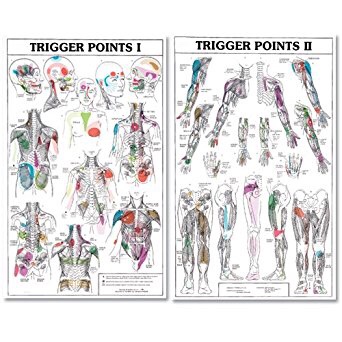
Myofascial pain syndrome (trigger points) and fibromyalgia are often confused to be the same condition and while there is a lot of interrelatedness between the two they are not quite identical. The clinical definition of a trigger point is “a hyper irritable spot associated within a taut band of skeletal muscle that is painful on compression or muscle contraction, and usually responds with a referred pain pattern distant from the spot”. Trigger points form from an overload trauma to the muscle tissue. This is contrasted with fibromyalgia which is defined as “a medical condition characterized by chronic widespread pain and a heightened pain response to pressure. Other symptoms include tiredness to a degree that normal activities are affected, sleep problems and troubles with memory. Some people also report restless leg syndrome, bowel and bladder problems, numbness and tingling and sensitivity to noise, lights and temperature. It is also associated with depression, anxiety, and post traumatic stress disorder”. Fibromyalgia will also present with localized tender points which are often mistaken for trigger points. Where these two conditions become somewhat interrelated is via the nervous system. Fibromyalgia patients suffer from a super-sensitization of the nervous system causing hyperirritability and pain. Myofascial trigger points can be caused by,or be the cause of, super sensitization. An active trigger point will irritate the sensory nerves around it eventually leading to super-sensitization. Trigger points have also been showed to form of become active due to super-sensitization. Both of these conditions can perpetuate the other, leading to layers of pain and symptoms. This being the case, trigger point therapy can have a very positive effect on decreasing the severity of pain and symptoms in patients suffering from fibromyalgia.

The Most Common Work Injury We See? This Might Be It…..

Your “lumbar spine”, or low back, is made up of five bones stacked on top of each other with a shock-absorbing disc between each level. Your low back relies on muscles and ligaments for support. “Sprains” and “strains” are the result of these tissues being stretched too hard or too far, much like a rope that frays when it is stretched beyond its normal capacity. The term “sprain” means that the

tough, durable ligaments that hold your bones together have been damaged, while “strain” means that your muscles or tendons that move your trunk have been partially torn.

Most people experience low back pain at some point in their lifetime, and 70% of those patients can attribute their symptoms to sprain/strain injuries. Lumbar sprains and strains may result from sudden or forceful movements like a fall, twist, lift, push, pull, direct blow, or quickly straightening up from a seated, crouched, or bent position. Most commonly, sprains and strains are not the result of any single event, but rather from repeated overloading. The spine can generally manage small isolated stressors quite well, but repetitive challenges lead to injury in much the same way that constantly bending a piece of copper wire will cause it to break. Examples of these stressors include: bad postures, sedentary lifestyles, poor fitting workstations, repetitive movements, improper lifting, or being overweight.

Symptoms from a sprain/strain may begin abruptly but more commonly develop gradually. Symptoms may range from dull discomfort to surprisingly debilitating pain that becomes sharper when you move. Rest may relieve your symptoms but often leads to stiffness. The pain is generally centered in your lower back but can spread towards your hips or thighs. Be sure to tell your doctor if your pain extends beyond your knee, or if you have weakness in your lower extremities or a fever.

Sprain/strain injuries cause your normal healthy elastic tissue to be replaced with less elastic “scar tissue.” This process can lead to ongoing pain and even arthritis. Patients who elect to forego treatment and “just deal with it” develop chronic low back pain more than 60% of the time. Seeking early and appropriate treatment like the type provided in our office is critical.

Depending on the severity of your injury, you may need to limit your activity for a while, especially bending, twisting, and lifting, or movements that cause pain. Bed rest is not in your best interest. You should remain active and return to normal activities as your symptoms allow. The short-term use of a lumbar support belt may be helpful. Sitting makes your back temporarily more vulnerable to sprains and strains from sudden or unexpected movements. Be sure to take “micro breaks” from workstations for 10 seconds every 20 minutes. Following acute injuries, you can apply ice for 15-20 minutes each hour. Heat may be helpful after several days or for more chronic origins of pain. Ask your doctor for specific ice/heat recommendations. Some patients report partial relief from sports creams.

A weak lateral chain will stop you in your tracks.

One very important job of your hip muscles is to maintain the alignment of your leg when you move. One of the primary hip muscles, the gluteus medius, plays an especially important stabilizing role when you walk, run, or squat. The gluteus medius attaches your thigh bone to the crest of your hip. When you lift your left leg, your right gluteus medius must contract in order to keep your body from tipping toward the left. And when you are standing on a bent leg, your gluteus medius prevents that knee from diving into a “knock knee” or “valgus” position.
Weakness of the gluteus medius allows your pelvis to drop and your knee to dive inward when you walk or run. This places tremendous strain on your hip and knee and may cause other problems too. When your knee dives inward, your kneecap is forced outward, causing it to rub harder against your thigh bone- creating a painful irritation and eventually arthritis. Walking and running with a relative “knock knee” position places tremendous stress on the ligaments around your knee and is a known cause of “sprains”. Downstream, a “knock knee” position puts additional stress on the arch of your foot, leading to other painful problems, like plantar fasciitis. Upstream, weak hips allow your pelvis to roll forward which forces your spine into a “sway back” posture. This is a known cause of lower back pain. Hip muscle weakness seems to be more common in females, especially athletes.

You should avoid activities that cause prolonged stretching of the hip abductors, like “hanging on one hip” while standing, sitting crossed legged, and sleeping in a side-lying position with your top knee flexed and touching the bed. Patients with fallen arches may benefit from arch supports or orthotics. Obesity causes more stress to the hip muscles, so overweight patients may benefit from a diet and exercise program. The most important treatment for hip abductor weakness is strength training. Hip strengthening is directly linked to symptom improvement. Moreover, people with stronger hip muscles are less likely to become injured in the first place. The exercises listed below are critical for your recovery.