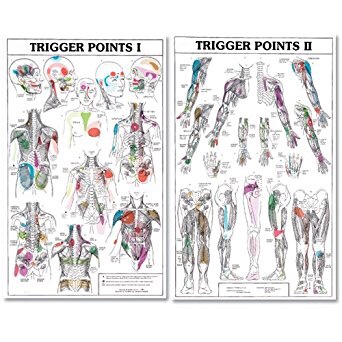
Trigger points in the gluteus Maximus muscle.

The gluteus Maximus muscle makes up your buttock. It’s is a powerful hip extensor and thus used heavily during activities such as walking, running, and climbing up stairs. Most atheletes abuse this muscle. When overworked trigger points will form, and these points will cause pain to be felt in the hip, sacrum and the as well as deep in the gluteal area. Litterally a pain in the butt!! Trigger points won’t release on their own and require interventions like trigger point massage.

Trigger point massage

Session Description


A treatment with Bryan is very user friendly. And, no, you don’t have to remove any clothing. However, bringing a t-shirt and a pair of shorts or sweats is recommended.


The first time you come for a treatment you will be asked to fill out a Client History form. Bryan will go over the information you provide, asking for more detail and discussing the type of pain you are having and its location.


The treatment itself involves locating the Trigger Points in the muscle or soft tissue and applying a deep focused pressure to the Point. This will reproduce the pain and the referral pattern that is characteristic of that pain.


The treatment will be uncomfortable at first, but as the Trigger Points release, the pain will decrease. The pressure will always be adjusted to your tolerance level. If, at any time, you feel too uncomfortable you can ask Bryan to ease off a bit.


Depending on your specific problem, Bryan may also use some stretching and / or range-of-motion techniques, as needed.


After treatment, it is usually recommended that the client apply moist heat to the area treated.


What to expect from a trigger point massage

ession Description


A treatment with Bryan is very user friendly. And, no, you don’t have to remove any clothing. However, bringing a t-shirt and a pair of shorts or sweats is recommended.


The first time you come for a treatment you will be asked to fill out a Client History form. Bryan will go over the information you provide, asking for more detail and discussing the type of pain you are having and its location.


The treatment itself involves locating the Trigger Points in the muscle or soft tissue and applying a deep focused pressure to the Point. This will reproduce the pain and the referral pattern that is characteristic of that pain.


The treatment will be uncomfortable at first, but as the Trigger Points release, the pain will decrease. The pressure will always be adjusted to your tolerance level. If, at any time, you feel too uncomfortable you can ask Bryan to ease off a bit.


Depending on your specific problem, Bryan may also use some stretching and / or range-of-motion techniques, as needed.


After treatment, it is usually recommended that the client apply moist heat to the area treated.


Trigger points

Trigger Points in muscle and other soft tissue are one of the most common causes of a wide variety of pain and dysfunction, including (but not limited to):


• Achy persistent pain
• Severe local pain
• Arm / leg pain
• Back pain
• Radiating pain
• Weakness
• Stiffness

• Pain resulting from a medical condition, such as
– Migraines
– Sciatica
– TMJ dysfunctions
– Arthritis
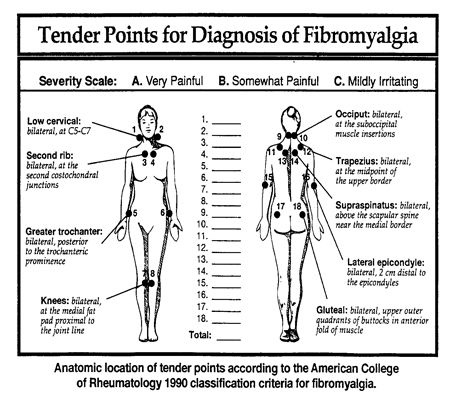
– Fibromyalgia
– Carpal tunnel syndrome
– Soft tissue injuries
– And more…

Trigger points in the Rectus Abdominis muscle.

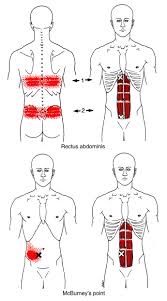
The rectus abdominis is you “six pack” muscle. It originates on the pubic bone and inserts on the costal cartilage of ribs 5-7, and the xiphoid process of the sternum. It’s main actions are to flex and rotate the spine, as well as increase the intra-abdominal pressure. Trigger points in this muscle refer pain into the mid and lower back. This muscle is tight in people who slouch and have a posteriorly rotated pelvis. An anteriorly rotated pelvis can be corrected by strengthening this muscle.

Trigger point massage

Session Description

A treatment with Bryan is very user friendly. And, no, you don’t have to remove any clothing. However, bringing a t-shirt and a pair of shorts or sweats is recommended.

The first time you come for a treatment you will be asked to fill out a Client History form. Bryan will go over the information you provide, asking for more detail and discussing the type of pain you are having and its location.

The treatment itself involves locating the Trigger Points in the muscle or soft tissue and applying a deep focused pressure to the Point. This will reproduce the pain and the referral pattern that is characteristic of that pain.

The treatment will be uncomfortable at first, but as the Trigger Points release, the pain will decrease. The pressure will always be adjusted to your tolerance level. If, at any time, you feel too uncomfortable you can ask Bryan to ease off a bit.

Depending on your specific problem, Bryan may also use some stretching and / or range-of-motion techniques, as needed.

After treatment, it is usually recommended that the client apply moist heat to the area treated.

Problems associated with trigger points

Trigger Points in muscle and other soft tissue are one of the most common causes of a wide variety of pain and dysfunction, including (but not limited to):

• Achy persistent pain
• Severe local pain
• Arm / leg pain
• Back pain
• Radiating pain
• Weakness
• Stiffness

• Pain resulting from a medical condition, such as
– Migraines
– Sciatica
– TMJ dysfunctions
– Arthritis
– Fibromyalgia
– Carpal tunnel syndrome
– Soft tissue injuries
– And more…

A treatment with Bryan Cobb RMT.

Session Description

A treatment with Bryan is very user friendly. And, no, you don’t have to remove any clothing. However, bringing a t-shirt and a pair of shorts or sweats is recommended.

The first time you come for a treatment you will be asked to fill out a Client History form. Bryan will go over the information you provide, asking for more detail and discussing the type of pain you are having and its location.

The treatment itself involves locating the Trigger Points in the muscle or soft tissue and applying a deep focused pressure to the Point. This will reproduce the pain and the referral pattern that is characteristic of that pain.

The treatment will be uncomfortable at first, but as the Trigger Points release, the pain will decrease. The pressure will always be adjusted to your tolerance level. If, at any time, you feel too uncomfortable you can ask Bryan to ease off a bit.

Depending on your specific problem, Bryan may also use some stretching and / or range-of-motion techniques, as needed.

After treatment, it is usually recommended that the client apply moist heat to the area treated.


What the Heck Is a Trigger Point?

By Bryan Cobb, Advanced Remedial Massage Therapist

What is a Trigger Point?

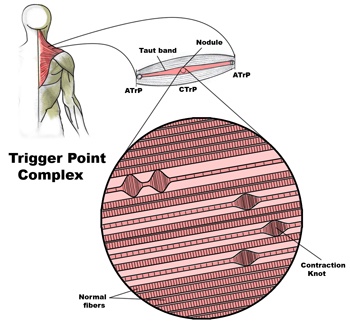
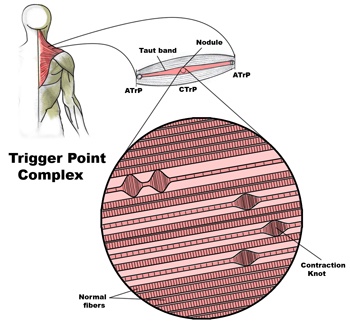
Trigger Points (TP’s) are defined as a “hyper-irritable spot within a taut band of skeletal muscle. The spot is painful on compression and can evoke characteristic referred pain and autonomic phenomena.”1

Put into plain language, a TP is a painful knot in muscle tissue that can refer pain to other areas of the body. You have probably felt the characteristic achy pain and stiffness that TP’s produce, at some time in your life.

TP’s were first brought to the attention of the medical world by Dr. Janet G. Travell. Dr. Travell, physician to President John F. Kennedy, is the acknowledged Mother of Myofascial Trigger Points.  In fact, “Trigger Point massage, the most effective modality used by massage therapists for the relief of pain, is based almost entirely on Dr. Travell’s insights.”2  Dr. Travell’s partner in her research was Dr. David G. Simons, a research scientist and aerospace physician.

Trigger Points are very common. In fact, Travell and Simons state that TP’s are responsible for, or associated with, 75% of pain complaints or conditions.1 With this kind of prevalence, it’s no wonder that TP’s are often referred to as the “scourge of mankind”.

Trigger Points can produce a wide variety of pain complaints. Some of the most common are migraine headaches, back pain, and pain and tingling into the extremities. They are usually responsible for most cases of achy deep pain that is hard to localize.

A TP will refer pain in a predictable pattern, based on its location in a given muscle. Also, since these spots are bundles of contracted muscle fibres, they can cause stiffness and a decreased range of motion.  Chronic conditions with many TP’s can also cause general fatigue and malaise, as well as muscle weakness.

Trigger Points are remarkably easy to get, but the most common causes are

TP’s (black dots) can refer pain to other areas (red)

Sudden overload of a muscle

• Poor posture

• Chronic frozen posture (e.g., from a desk job),  and

• Repetitive strain

Once in place, a TP can remain there for the remainder of your life unless an intervention takes place.

Trigger Points Not Well Known

With thousands of people dealing with chronic pain, and with TP’s being responsible for — or associated with — a high percentage of chronic pain, it is very disappointing to find that a large portion of doctors and other health care practitioners don’t know about TP’s and their symptoms.

Scientific research on TP’s dates back to the 1700’s.  There are numerous medical texts and papers written on the subject.

But, it still has been largely overlooked by the health care field.  This has led to needless frustration and suffering, as well as thousands of lost work hours and a poorer quality of life.

How Are Trigger Points Treated?

As nasty and troublesome as TP’s are, the treatment for them is surely straight-forward.  A skilled practitioner will assess the individual’s pain complaint to determine the most likely location of the TP’s and then apply one of several therapeutic modalities, the most effective of which is a massage technique called “ischemic compression”.

Basically, the therapist will apply a firm, steady pressure to the TP, strong enough to reproduce the symptoms.  The pressure will remain until the tissue softens and then the pressure will increase appropriately until the next barrier is felt.  This pressure is continued until the referral pain has subsided and the TP is released. (Note:  a full release of TP’s could take several sessions.) 

Other effective modalities include dry needling (needle placed into the belly of the TP) or wet needling (injection into the TP).  The use of moist heat and stretching prove effective, as well. The best practitioners for TP release are Massage Therapists, Physiotherapists, and Athletic Therapists.  An educated individual can also apply ischemic compression to themselves, but should start out seeing one of the above therapists to become familiar with

the modality and how to apply pressure safely.

1 Simons, D.G., Travell, D.G., & Simons, L.S. Travell and Simons’ Myofascial Pain and Dysfunction: the Trigger Point Manual.

Vol. 1.  2nd ed. Lippincott, Williams, and Wilkins, 1999.

2http://www.muscletherapyworks.com/MTW%20Biography%20T%20&%20S%2001.htm 

Pregnancy Related Low Back Pain

DSC_0033

Low back pain during pregnancy is quite common. In fact, between 50-75% of all pregnant women will experience low back pain. The pain is usually caused from rapid changes in weight, posture, gait and hormones.

The average woman gains between 20-40 pounds throughout pregnancy. This weight gain moves your center of gravity forward, causing your pelvis to tilt and your lower back to sway – placing excessive stress on the ligaments, discs, and joints of your spine.

Pregnancy-related low back pain typically starts between the fifth and seventh month of pregnancy, although a significant portion of women experience pain sooner. Symptoms often begin at the base of your spine and may radiate into your buttock or thigh. Discomfort is often aggravated by prolonged standing, sitting, coughing, or sneezing. Your symptoms may increase throughout the day, and some patients report nighttime pain that disturbs their sleep. The extremes of activity seem to contribute to pregnancy-related low back pain – with increased risk for both “sedentary” and “physically demanding” lifestyles. Patients who have suffered with back pain prior to pregnancy are more than twice as likely to re-develop back pain during pregnancy.

Be sure to tell your doctor if your symptoms include fever, chills, bleeding, spotting, unusual discharge, cramping, sudden onset pelvis pain, light-headedness, shortness of breath, chest pain, headache, calf pain or swelling, decreased fetal movement, or symptoms that radiate beyond your knee.

Unfortunately, pregnancy related low back pain occurs at a time when your medical treatment options are limited. Not surprisingly, over 90% of prenatal health care providers would recommend drug-free treatment, including the type of alternative therapy provided in this office. Studies have shown that chiropractic manipulation provides significant relief of pregnancy-related low back pain. Almost 75% of women undergoing chiropractic care report significant pain reduction with improved ability to function.

Most patients will also benefit from continuing aerobic exercise throughout pregnancy. The US Department of Health and Human Services advises that healthy pregnant women may begin or continue moderate intensity aerobic exercise for at least 150 minutes per week. Women should not begin “vigorous” exercise during pregnancy, but those who were preconditioned to vigorous exercise may continue. Be sure to check with your doctor prior to initiating or increasing any exercise program while you are pregnant.

Be sure to take frequent breaks from prolonged sitting or standing. You may find benefit by using a small foot stool to alternate feet while standing. Sleeping with a pillow between the knees in a side lying posture may help you to rest more comfortably. You should wear shoes with good arch supports. In some cases, your chiropractor may recommend a sacroiliac belt or pelvic support belt to help relieve your pregnancy-related low back pain.