

Sensitive areas of tight muscle fibers can form in your muscles after injuries or overuse. These sensitive areas are called trigger points. A trigger point in a muscle can cause strain and pain throughout the muscle. When this pain persists and worsens, doctors call it myofascial pain syndrome.
Low Back Pain
What is myofascial pain syndrome?
Myofascial pain syndrome is a chronic pain disorder. In this condition, pressure on sensitive points in your muscles (trigger points) causes pain in the muscle and sometimes in seemingly unrelated parts of your body. This is called referred pain.
This syndrome typically occurs after a muscle has been contracted repetitively. This can be caused by repetitive motions used in jobs or hobbies or by stress-related muscle tension.
Trigger points in the Q.L. Muscle
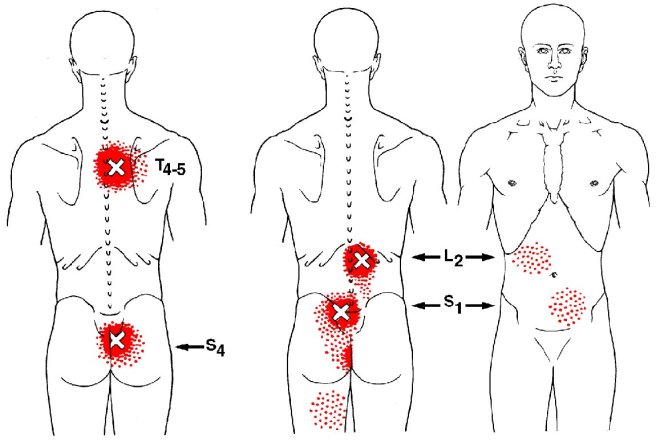
the quadratus lumborum muscle or “q.l.” Is a muscle located in your lower back. It originates on the iliac crest and iliolumbar ligament, and interns onto the last rib and transverse processes of the lumbar vertebrae. This muscle functions to stabilize the lumbar spine as well as laterally flex the spine. It will also hike the hip. Acting bilaterally it will extend the lumbar spine. Trigger points will often develop in this muscle. Trigger point referral will produce pain in the S.I. Joint and the lateral hip as well as the buttock. The pain referred into the S.I. Joint is often misdiagnosed as S.I. Joint dysfunction.
Trigger points can be found in all soft tissue.
Trigger points don’t just form in muscles. Any soft tissue or connective tissue can become damaged and develop trigger points. Once a trigger point has formed it will produce a large variety of painful symptoms. Visit http://www.aberdeenchiropractic.com for more information on trigger points and trigger point massage therapy.

Benefits of massage therapy.
Massage therapy isn’t just about relaxation. Myofascial pain is one of the most common causes of pain and dysfunction in the body. Massage therapists are are the myofascial pain experts!!

Trigger point massage therapy in Winnipeg.

Trigger points in the gluteus medius muscle.
The gluteus medius muscle is a mover and stabilizer of the hip. As a result this muscle is commonly overloaded and harbors trigger points. These trigger points can refer pain deep into the s.i. joint as well as into the low back and hip. Once developed, trigger points will not release on their own. A manual intervention such as trigger point massage therapy is needed to treat the area.

Trigger points in the multifidus muscle.
The multifidus muscle is a long muscle that travels the length of the spine. It has different actions on different parts of the spine. It extends and laterally flexes the cervical and lumbar spine, and rotates the thoracic spine. Trigger points in this muscle are common due to poor posture and bad movement mechanics. Trigger points in the lumbar area area are a common cause of low back pain. These lower points can also refer into the abdomen. Points that form in the cervical region will refer pain down the neck into the shoulder blade area.
Trigger point massage therapy.
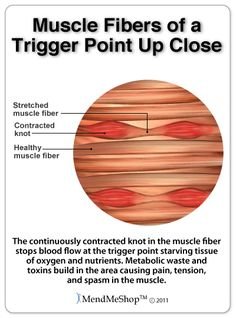
Trigger points are hyper irritable knots found in muscle tissue. These points form in a muscle due to overload stress. Trigger points can form anywhere, in any muscle. Once formed they irritate sensory nerves and produce pain, refered pain, weakness, and stiffness. Trigger points will also mimic symptoms of other conditions such as “sciatica” or Carple tunnel syndrome. Trigger points will not go away on there own, they must be manually released with hands on techniques like trigger point massage.
How trigger points form.

Activation of trigger points may be caused by a number of factors, including acute or chronic muscle overload, activation by other trigger points (key/satellite, primary/secondary), disease, psychological distress (via systemic inflammation), homeostatic imbalances, direct trauma to the region, collision trauma (such as a car crash which stresses many muscles and causes instant trigger points) radiculopathy, infections and health issues such as smoking.

