
The piriformis muscle is a small muscle deep to glute max and lies over top of the sciatic nerve. It originates on the anterior sacrum, and inserts on the greater trochanter of the femur. It’s main action is to laterally rotate the femur. When trigger points developed in this muscle they will refer pain into the sacro-iliac region, across the posterior hip and down the leg. This muscle can also be a cause of sciatic nerve irritation if it gets tight, causing “sciatica” symptoms. 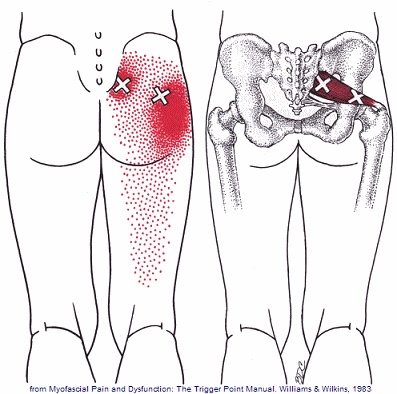
Health
Piriformis Syndrome; a real bummer.
Piriformis syndrome results from compression of the sciatic nerve as it passes underneath a muscle in your buttock called the piriformis. Your piriformis muscle attaches from the lowest part of your spine (sacrum) and travels across to your hip. The muscle helps to rotate your leg outward when it contracts. In most people, the sciatic nerve travels deep to the piriformis muscle.

When your piriformis muscle is irritated or goes into spasm, it may cause a painful compression of your sciatic nerve. Approximately ¼ of the population is more likely to suffer from piriformis syndrome because their sciatic nerve passes through the muscle.
Piriformis syndrome may begin suddenly as a result of an injury or may develop slowly from repeated irritation. Common causes include: a fall onto the buttocks, catching oneself from a “near fall,” strains, long distance walking, stair climbing or sitting on the edge of a hard surface or wallet. In many cases, a specific triggering event cannot be pinpointed. The condition is most common in 40-60 year olds and affects women more often than men.
Symptoms of piriformis syndrome include pain, numbness or tingling that begins in your buttock and radiates along the course of your sciatic nerve toward your foot. Symptoms often increase when you are sitting or standing in one position for longer than 15-20 minutes. Changing positions may help. You may notice that your symptoms increase when you walk, run, climb stairs, ride in a car, sit cross-legged or get up from a chair.
Sciatic arising from piriformis syndrome is one of the most treatable varieties and generally is relieved by the type of treatment provided in this office. You may need to temporarily limit activities that aggravate the piriformis muscle, including hill and stair climbing, walking on uneven surfaces, intense downhill running or twisting and throwing objects backwards, i.e., firewood. Be sure to avoid sitting on one foot and take frequent breaks from prolonged standing, sitting and car rides. You may find relief by applying an ice pack to your buttock for 15-20 minutes at a time, several times throughout the day.
Osteoporosis and Compression Fractures
Most of the tissues in our body are in a constant state of rejuvenation, wherein old cells are removed to be replaced by new. In our skeleton, when the production of new bone cannot keep up with the rate of tear down, our bones become progressively thinner and weaker in a process called “osteoporosis”.

Bone fractures occur when stress to a bone exceeds the bone’s ability to support that load. In healthy vertebrae, significant stress is required to cause a fracture. But in osteoporotic bones, the threshold for injury is lowered to the point that “compression fractures” may occur with seemingly minimal stress like bending, coughing, or sneezing. A compression fracture causes a wedge-shaped collapse of the front of the vertebral “body”- resembling what would occur after stepping on one edge of an aluminum can.
Compression fractures are two to three times more common in women, and the risk of developing the problem increases over time. People who have had a prior compression fracture are at greater risk for developing a subsequent fracture. Additional risk factors for compression fracture include a family history of osteoporosis, low body weight, recent weight loss, smoking, a sedentary lifestyle, poor dietary choices, inadequate calcium or vitamin D intake, excessive alcohol or caffeine intake, and scoliosis. The American Academy of Orthopedic Surgery recommends bone density screening for osteoporosis in all women over age 65 or post-menopausal women who have suffered a compression fracture. If you have not already done so, you should schedule a bone density screening.
Symptoms of a compression fracture include an “aching” or “stabbing” pain in the back, near the site of fracture. Symptoms can range from minimal to disabling. Often times, pain is referred to the ribs, hip, groin, or buttocks. Be sure to tell your doctor if you have pain or numbness that radiates into your legs, weakness, clumsiness, loss of bowel or bladder control, impotence, fever, unexplained weight loss, night sweats, excessive fatigue, or a history of cancer.
Symptoms from a compression fracture typically lasts for six to 12 weeks. Occasionally, patients will require surgical treatment of a compression fracture, but fortunately, most respond to conservative care. In general, you should maintain a relatively active lifestyle and try to avoid bed rest. If your pain prevents movement, you may talk to your doctor about wearing a brace to limit stress.
Our office will prescribe exercises to help you recover and reduce the risk of subsequent fracture. As your symptoms improve, you can begin incorporating some aerobic exercise, like walking on a treadmill. Studies have shown that light resistance training (i.e. weights and elastic bands) may help you maintain bone density and reduce the risk of future fractures. Supplements to help manage osteoporosis include daily intake of 800-1000 IU of vitamin D and 1000-1200 mg of calcium.
Did you know that you can breathe “wrong”?
Your “diaphragm” is the dome shaped muscle beneath your lungs. When it contracts and flattens, you breathe in. When it relaxes, you breathe out. But do you know your diaphragm plays an important secondary role in protecting your trunk and spine by controlling abdominal pressure?
The muscles that support your trunk form a “canister.” The front and sides of the canister are created by your abdominal and rib muscles. The back of the canister includes those muscles attached to your spine. The bottom of the canister is formed by the muscles of your pelvic floor, while your diaphragm serves as the roof. Together, these muscles control your abdominal pressure and core stability.

A well-braced core provides a stable foundation for moving your arms, legs, and head – in much the same way that when firing a canon, a large ship serves as a better platform than a rowboat.
During normal breathing, your upper chest should remain relatively still. Patients with “dysfunctional” patterns frequently overuse their upper chest muscles instead of their abdomen and lower rib cage. This depressurizes and destabilizes your core, leading to other problems like back pain.
You should not need to always think about proper breathing – this should happen subconsciously. Unfortunately, many of us have “learned” poor mechanics and need to re-learn proper breathing. One of the easiest ways to re-train proper breathing is to sit or lie still with one head on your breastbone and the other hand on your abdomen. When you breathe in, only the hand on your abdomen should move, while the hand on your chest remains still. Your normal breathing rhythm should be about there seconds of inhalation followed by six seconds of exhalation. If you find that you are exhaling too quickly, you may try “pursing” your lips to gradually increase the length of your exhalation.
The exercises that follow are essential for your recovery. Once you have restored normal breathing mechanics, you will enjoy increased core stability and your treatment will be much more successful. It is important to perform your breathing exercises consistently, as repetitive exercise will allow your body “re-learn” to subconsciously move in a safe and a coordinated fashion- thereby reducing your risk of injury.
Trigger points in the gluteus minimus
The gluteus minimus is a small but important muscle that lies deep to the gluteus medius. It originates on the gluteal surface of the ilium, and attaches on the greater trochanter of the femur. It’s main actions are to abduct and medically rotate the hip. Trigger points in this muscle refer pain into the buttock and down the lateral and posterior leg, mimicking sciatica. This muscle should be the first to be examined if a straight leg test turns out negative. 
Lower Crossed Syndrome

Your posture plays an important role in your overall health. Poor posture leads to chronic strain and discomfort. “Lower crossed syndrome” is poor posture that results from excessive tightness in your lower back and hip flexor muscles with weakness in your abdominal and buttock muscles. Patients with lower crossed syndrome often have a “sway back.” Patients who sit for prolonged periods of time are at greater risk of lower crossed syndrome.
This postural problem commonly leads to painful conditions involving the back or hips. Successful treatment of lower cross syndrome involves stretching excessively tight muscles, strengthening weak muscles, taking frequent breaks from sitting, and modifying your workstation to be more user friendly.
The High Ankle Sprain (Don’t Let This Happen To You. These SUCK.)
Your lower leg bones (tibia and fibula) are held together at the ankle by a group of soft tissues and ligaments called the “syndesmosis”. This connection prevents excessive spreading of these bones during normal activity, but injuries can cause these ligaments to be stretched or torn. This problem is called a “syndesmotic ankle sprain” or “high ankle sprain”. High ankle sprains often occur during contact sports (like football, hockey, and soccer) when your foot is planted while the rest of your body shifts forward and turns inward. High ankle sprains are much less common than other types of ankle sprains.

The pain of a high ankle sprain starts just above your ankle and runs up your shin. Interestingly, the “length” of pain correlates very closely to your severity of injury. Standing and walking is usually uncomfortable and sometimes unbearable. Bringing your toes toward your shin or rotating your foot outward will likely increase your pain. Significant bruising or swelling is possible. Be sure to tell your doctor if you notice numbness, tingling, or coldness in your foot.
Ankles that have suffered a complete separation usually require surgery, since they will have lost the ability to push off, propel, and cut. Most other stable sprains will respond to conservative care, like the type provided in this office. It is important to recognize that high ankle sprains heal more slowly than other types of ankle sprains. The average recovery time for a syndesmotic sprain is between two and seven weeks but some injuries may require up to four months away from your sport. You may need to wear a boot or avoid weight bearing for a period of time. Ice may help to limit swelling initially, and the home exercises described below are an important part of your recovery.
Trigger points in the gluteus Maximus
The gluteus Maximus is the buttock muscle. It originates on the gluteal surface of the ilium, lumbar fascia, sacrum and sacrotuberous ligament. It inserts on the gluteal tuberosity of the femur and the iliotibial tract. Extension and lateral rotation of the hip are it’s main actions. This muscle is heavily involved in activities like ice skating and is a common area to develops trigger points. When trigger points do develop they can refer pain in a crescent pattern from the gluteal fold to the sacrum. Trigger points can also refer pain deep into the buttock itself making it feel like other deeper muscles are involved. These symptoms can sometimes be mistaken for s.i. Joint problems. 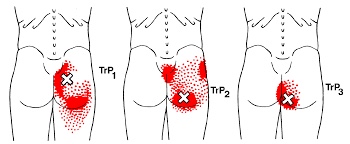
Meditation goes mainstream!

With growing evidence that meditation has significant health benefits, a 2016 study by a team of researchers from the United States, Spain, and France sought to explain how and why meditation actually works.
The study investigated the difference between “mindful meditation” in a group of experienced meditators vs. “quiet non-meditative activity” in a group of untrained control subjects. After eight hours of mindfulness practice, the meditation group showed a range of genetic and molecular differences, which in turn correlated with faster physical recovery from a stressful situation.
According to researchers, this is the first time a study has documented a rapid alteration in gene expression within meditating subjects. Interestingly, the researchers observed these changes in the SAME genes that anti-inflammatory and pain-killing drugs target! Thus, they speculate that mindful-based training may benefit patients with inflammatory conditions! This and prior studies have prompted the American Heart Association to endorse meditation as an effective cardiac preventative intervention.
Meditation has been found to be helpful for many conditions including stress management, lowering high blood pressure, heart disease, and depression. You can incorporate meditation into your life with three simple meditation exercises! The initial advice is “…go slow and be compassionate and gentle with yourself.” Your mind will try to wander (called our “default mode”) which consumes about half of our day, so try to focus (called “focus mode”)!
1) WALKING MEDITATION: At a slow to medium pace, focus on your feet. Notice how your heel hits the ground and then feel the roll of your foot followed by the big toe pushing off prior to the swing phase. Feel for stones under the foot and other interesting sensations. If your mind starts to wander (default mode), gently bring your attention back to your foot (focus mode). You WILL get better with practice, and you’ll soon find it much easier to “focus” during stressful situations!
2) NOVEL EXPERIENCES: It’s much easier to lose focus on the people you see everyday vs. those seen only one time a month. The next time you arrive home from work, pretend you haven’t seen your spouse/friend in 30 days. Give them your undivided attention. Then, try this on co-workers and other people you see every day. Believe me, they WILL notice a difference!
3) GRATITUDE EXERCISES: When you’re not in their presence, focus on a person’s face and send them a “silent gratitude” for being in your life. Try this on family members, friends, co-workers, and others!
The Medial Ankle Sprain. “The Other Sprain”.
“Ligaments” are made up of many individual fibers running parallel to each other and bundled to form a strong fibrous band. These fibrous bands hold your bones together. Just like a rope, when a ligament is stretched too far, it begins to fray or tear. “Sprain” is the term used to describe this tearing of ligament fibers.
Sprains are graded by the severity of damage to the ligament fibers. A Grade 1 sprain means the ligament has been painfully stretched, but no fibers have been torn. A Grade 2 sprain means some, but not all, of the ligaments’ fibers have been torn. A Grade 3 sprain means all of the ligaments’ fibers have been torn, and the ligament no longer has the ability to protect the joint.


Ankle sprains are the most common soft-tissue injury and will affect up to 20% of active people at some point in their life. Most ankle sprains occur because you have “rolled your ankle”. Sprains like yours, involving the inside of your ankle (medial) are much less common than injuries to the outer side. Medial ankle sprains are often accompanied by other injuries like “high ankle sprains” or fractures.
Ankle sprains cause pain and swelling over the inside of your ankle. Walking may be difficult, and bruising is common. Be sure to tell your doctor if you experience numbness, tingling, or a dramatic cold sensation in your foot, as this may indicate more significant injury.
Ankle sprains can be successfully managed but will require some work on your part. You can help reduce swelling by elevating your ankle by lying or sitting with your foot elevated or by using an ACE wrap for compression. Applying ice or ice massage for 10 minutes each hour may help relieve swelling. Depending upon the severity of your sprain, you may need to wear an ankle brace to help protect you from further injury. If walking is painful, crutches may be necessary.
Initially, a period of rest may be necessary in order to help you heal. Mild Grade 1 sprains may allow return to sport in a couple of days, while more severe injuries may take six weeks or longer to recover.

