Shoulder Impingement Syndrome

Shoulder Impingement Syndrome
Impingement syndrome
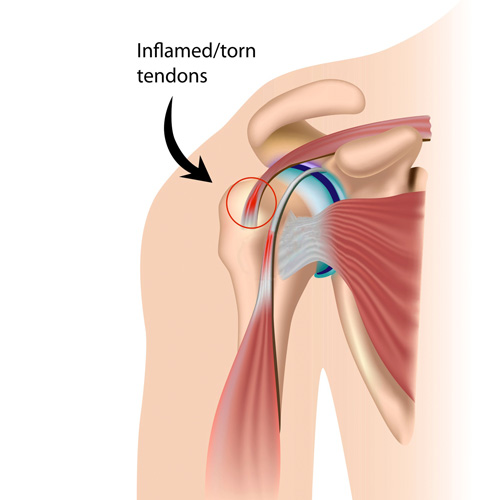
Impingement syndrome is an irritation of the structures between the upper portion of your arm and your shoulder blade mainly during overhead arm movements.The rotator cuff is comprised of four muscles that help position the humerus, your upper arm bone, into the shoulder socket during arm movement.The shoulder has great mobility but at the same time is prone to injury during falls or accident, or when there is a lack of motor control (altered biomechanics).Men over 40 performing manual labour are the most affected with this condition. It is also present in young athletes practicing sports involving repeated overhead motion such as swimming, baseball or tennis.

▬▬▬▬▬

Structures involved

The tendons of the rotator cuff, ligaments of your shoulder and subacromial bursa are the most commonly affected structures. The subacromial space gets smaller during overhead movements. This can cause, over time, irritation, inflammation and/or a lesion of the rotator cuff tendons.

page1image3462066528

▬▬▬▬▬

Signs & Symptoms that you may experience

Everyone will react differently after an injury and recovery will depend on the severity of it.

Impingement syndrome can cause but is not limited to, pain at the front of the shoulder and localized swelling. Pain or tightness is often felt when you lift your arm overhead or when you lower it from an elevated position. Pain can also be felt around your shoulder blade in your back.

Other early symptoms can include light pain with activities or during rest and in some cases, irradiating pain around your shoulder. In severe cases, you might feel pain at night and a loss of strength or range of motion. Impingement syndrome can lead to rotator cuff tendinitis or shoulder bursitis when left untreated.

▬▬▬▬▬

Recovery

Your rehabilitation plan, health, fitness & nutritional status will affect recovery speed. Most of the time, you can expect to recover fully from impingement syndrome. As a rule of thumb, this condition can take up to three months to fully recover.

▬▬▬▬▬▬▬▬▬▬▬▬▬▬▬▬▬▬▬▬▬▬▬▬▬▬▬▬▬▬▬▬▬▬▬▬▬▬▬▬▬▬▬▬▬▬▬▬▬
▬▬▬▬▬▬▬▬▬▬▬▬▬▬▬▬▬▬▬▬▬▬▬▬▬▬▬▬▬▬

▶ WHAT TO DO

Early Stage

Relative rest is a good way to protect your shoulder and prevent further damage, but it’s important to avoid overprotecting your injury. A few days rest where you avoid pain-inducing movement and activities might be necessary. A quick but progressive return to your activities of daily living, light cardiovascular exercise and specific range of motion and strengthening exercises will allow better recovery.

Rehabilitation

Follow your practitioner’s advice. It will help you manage the different phases of the recovery process and will increase the likelihood of successful rehabilitation. Your practitioner will assist you during your rehabilitation program in order to regain your normal range of motion, strength and endurance, optimal motor control and functional status.

As per the principles of rehabilitation for impingement syndrome, movement training through therapeutic exercises is an important part of functional recovery. A progressive exercise program performed over a few weeks period is pretty standard.

▶ WHAT TO AVOID

Don’t rely on passive treatment only. Each phase of the rehabilitation process is important. Patients that are actively involved in their treatment plan tend to recover faster. Keep in mind that pain is not always a good indicator of tissue damage. As soon as you feel better and the pain is well managed in collaboration with your therapist, you should reintroduce light strengthening exercises as tolerated.

Don’t Have Enough Time to Exercise? 

Photo by Ketut Subiyanto on Pexels.com

Bottom Line:

You’re busy and you’re stressed out. Well, you’re not alone. 

These are two of the most common reasons people give for not exercising consistently. Ironically, these are the two exact reasons you should be exercising and moving your body! 

Moving your body releases endorphins which help you feel good, relaxes your mind which reduces stress, and burns calories to keep you looking great. 

Why it Matters:

Your body is meant to move. Long hours commuting in your car or sitting at a desk can place a lot of stress on your musculoskeletal system. 

If your spine and core muscles are weak and unstable, then you are more likely to suffer an injury which can cause a downward spiral that impacts your relationships with food, sleep, and exercise. So taking a pro-active approach to your exercise routine is crucial to live your best life. Chiropractic adjustments are an essential part of the picture because they can help you feel good mentally and keep you moving physically. 

  • Maintaining a healthy weight can decrease the risk factors for cardiovascular and heart disease.
  • Even 15 minutes of light exercise can make a difference in your overall health.
  • Exercise can help you feel good both physically and mentally.

Next Steps: 

Schedule time every day to exercise. But, don’t get discouraged if you feel like you aren’t doing enough. Rome wasn’t built in a day! 

Even 15 minutes of walking during your afternoon break can provide you with the health benefits you are looking for. Burning an extra hundred calories per day (which could be accomplished with 10 minutes of walking) adds up to thousands of calories each month. Continue that trend, and you will notice inches falling off your waistline before you know it! 

Science Source(s): 

The Role of Exercise and Physical Activity in Weight Loss and Maintenance. Prog Cardiovasc Dis 2015

Block out that noise 

The world’s noise gets very quiet when you’re in tune with yourself

Wise words indeed. When we are out of sorts with ourselves we get what professional athletes call “rabbit ears”. We hear everything going on around us and it distracts us from what we need to do. 
Get your body, your conscious mind and your subconscious mind all pulling in the same direction and those outside distractions become nothing more than white noise. 

Chiropractic: Prevention Is Key to Avoid Back Pain.

Chiropractic: Prevention Is Key to Avoid Back Pain.

The American Chiropractic Association offers these suggestions to help protect your back and improve your spinal health: maintain a healthy diet and weight, exercise regularly, maintain proper posture, avoid prolonged inactivity or bed rest, quit smoking, and use good body mechanics when lifting.


American Chiropractic Association, August 2014


For more health and wellness tips and information follow us or check out our blog at http://www.aberdeenchiropracticblog.com 

Photo by Scott Webb on Pexels.com
Photo by Ketut Subiyanto on Pexels.com
Photo by Anete Lusina on Pexels.com

Exercise: Improves Cognitive Function in Women!

Exercise: Improves Cognitive Function in Women!

Regardless of age, females who are highly physically fit have faster neural reaction times than their less fit peers. Near infrared spectroscopy scans showed that physical fitness is associated with greater cerebral oxygenation, which may be the underlying mechanism for the observed elevations in brain function.


Frontiers in Human Neuroscience, February 2015

For more health and wellness tips and information follow us or check out our blog at http://www.aberdeenchiropracticblog.com 

Photo by August de Richelieu on Pexels.com

Sunday’s Huge Health Update!

Mental Attitude: Stress Affects Women’s Recovery After a Heart Attack. Researchers analyzed data collected from 2,397 women and 1,175 men and found that women had more difficulty recovering from a heart attack than men, possibly due to the significantly higher levels of mental stress measured among the females in the study. The findings emphasize the need to consider how stress and other psychosocial factors can affect the recovery of patients following heart attack. American Heart Association, February 2015

Health Alert: Mercury Exposure May Be a Risk Factor for Autoimmune Diseases. Exposure to high levels of methylmercury is known to cause damage to the nervous system, and it can be particularly harmful to a developing fetus. Researchers now claim that even at levels considered to be safe, mercury exposure may be a risk factor for autoimmune disorders in women of childbearing age. They found that the higher the levels of mercury detected in women, the higher the levels of autoantibodies, proteins that are a characteristic of autoimmune diseases. Lead researcher Dr. Emily Somers explains, “The presence of autoantibodies doesn’t necessarily mean they will lead to an autoimmune disease. However, we know that autoantibodies are significant predictors of future autoimmune disease, and may predate the symptoms and diagnosis of an autoimmune disease by years.”

Environmental Health Perspectives, February 2015

Diet: Low Vitamin D Levels During Childhood Linked to Heart Risks. A multi-decade study found that low vitamin D levels during childhood are associated with a significantly higher risk for artery hardening in adulthood. The findings highlight the need to ensure children get adequate levels of vitamin D in their diet or through sun exposure.
Journal of Clinical Endocrinology & Metabolism, February 2015

Exercise: Why Should We Exercise? The Mayo Clinic lists seven benefits of exercise, which include the following: helps controls weight, helps combat chronic health conditions and diseases, improves mood, boosts energy levels, promotes better sleep, reduces stress, and it can even be fun! As a general rule, strive for at least 30 minutes of physical activity every day.
Mayo Clinic, February 2015

Chiropractic: Resolution of Plantar Fasciitis Following Adjustments. In this case study, a 23-year-old woman with plantar fasciitis presented for chiropractic care. Her previous medical care included prescription orthotics, stretching, and Ibuprofen, all which failed
to resolve her heel pain and related symptoms. Her chiropractic treatment regimen consisted of adjustment to the spine and lower extremities, ultrasound therapy, taping of the foot, and neuromuscular re-education. Over the course of ten treatments, the patient noted improvements in both pain and function, supporting the benefits of multi-modal chiropractic management of plantar fasciitis. Annals of Vertebral Subluxation Research, October 2014

Wellness/Prevention: Naps Improve Your Health. A new report claims that brief daytime naps can protect against the harmful health effects of a poor night’s sleep. The study included eleven healthy men and revealed that naps appear to return the hormones and proteins involved in stress response and immune function to more normal levels. According to the Centers for Disease Control and Prevention, lack of sleep can increase the risk of health problems such as obesity, diabetes, high blood pressure, and depression, and decreased sleep is also linked to reduced work productivity, as well as an increased risk of traffic and industrial accidents. Study author Dr. Brice Faraut adds, “Napping may offer a way to counter the damaging effects of sleep restriction by helping the immune and neuroendocrine systems to recover. The findings support the development of practical strategies for addressing chronically sleep- deprived populations, such as night and shift workers.” Journal of Clinical Endocrinology & Metabolism, February 2015

Quote: “You should never be surprised when someone treats you with respect, you should expect it.” ~ Sarah Dessen

For More Information on Back Pain, Neck Pain, Headaches, Carpal Tunnel Syndrome, Fibromyalgia, and Whiplash, and more, Go To: http://www.AberdeenChiropracticBlog.com

Photo by MART PRODUCTION on Pexels.com

Diet Strategies For Fibromyalgia

Fibromyalgia (FM) is a common condition that affects about five million Americans, often between ages 20 and 45 years old. FM is very difficult to diagnose primarily because there is no definitive test like there is for heart, liver, or kidney disease. Equally challenging is the ability to effectively treat FM as there are frequently other conditions that co-exist with FM that require special treatment considerations. Typically, each FM case is unique with a different group of symptoms and therefore, each person requires individualized care.

Fibromyalgia symptoms can include generalized pain throughout the body that can vary from mild to severely disabling, extreme fatigue, nausea/flu-like symptoms, brain “fog” (“fibro-fog”), depression and/or anxiety, sleeping problems and feeling un-refreshed in the mornings, headaches, irritable bowel syndrome, morning stiffness, painful menstrual cramps, numbness or tingling (arms/hands, legs/feet), tender points, urinary pain or burning, and more!

So, let’s talk about ways to improve your FM-related symptoms through dietary approaches. When the FM symptom group includes gut trouble (bad/painful gas, bloating, and/or constipation), it’s not uncommon to have an imbalance between the “good” vs. the “bad” bacteria, yeast, and problems with digestion or absorption. Think of management as a “Four Step” process for the digestive system:

1.  REMOVE HARMFUL TOXINS: Consider food allergy testing to determine any foods the FM patient has a sensitivity for. Frequently, removing gluten, dairy, eggs, bananas, potatoes, corn, and red meat can benefit the FM patient. The use of anti-fungal and / or anti-bacterial botanicals (as opposed to drug approaches such as antibiotics) can be highly effective. A low allergy-potential diet consisting of fish, poultry, certain vegetables, legumes, fruits, rice, and olive and coconut oil is usually a good choice.

2.  IMPROVE DIGESTIVE FUNCTION: The presence of bloating and gas is usually indicative of poor digestion, and the use of a digestive enzyme with every meal can be highly effective!

3.  RESTORE THE “GOOD” BACTERIA: Probiotics (with at least 20-30 billion live organisms) at each meal are often necessary to improve the “good” gut bacteria population, which will likely also improve immune function.

4.  REPAIR THE GUT: If the gut wall is damaged, nutrients like l-glutamine, fish oils, and n-acetyl-d-glucosamine may help repair it.

This process will take several months, and some of these approaches may have to be continued over the long term. Doctors of chiropractic are trained in nutritional counseling and can help you in this process. As an added benefit, many FM sufferers find the inclusion of chiropractic adjustments to be both symptomatically relieving and energy producing.

If you, a friend or family member requires care for Fibromyalgia, we sincerely appreciate the trust and confidence shown by choosing our services!

Chiropractic and Headaches

According to the World Health Organization, headaches are among the most common disorders of the nervous system affecting an estimated 47% of adults during the past year. Headaches place a significant burden on both quality of life (personal, social, and occupational) and financial health. They are usually misdiagnosed by healthcare practitioners, and in general, are underestimated, under-recognized, and under-treated around the world. So, what about chiropractic and headaches… Does it help?

Suffice it to say, there are MANY studies showing chiropractic care helps headache sufferers. For instance, in a review of past research studies using an “evidence-based” approach, chiropractic treatment of adults with different types of headaches revealed very positive findings! Researchers note that chiropractic care helps those with episodic or chronic migraine headaches, cervicogenic headache (that is, headaches caused by neck problems), and tension-type headaches (chronic more than episodic). There appears to be additional benefit when chiropractic adjustments are combined with massage, mobilization, and/or adding certain types of exercises, although this was not consistently studied. In the studies that discussed adverse or negative effects of treatment, the researchers noted no serious adverse effects.

In patients suffering from athletic injuries, particularly post-concussion headache (PC-HA), chiropractic care can play a very important role in the patient’s recovery. With an estimated 1.6 to 3.8 million sports-related brain injuries occurring each year, approximately 136,000 involve young high school athletes (although some argue this is “grossly underestimated”).

Several published case studies report significant benefits for post-concussion patients after receiving chiropractic care, some of which included PC-HA from motor vehicle collisions, as well as from slips and falls. For example, one described an improvement in symptoms that included deficits in short-term memory as well as attention problems. In this particular study, a six-year-old boy fell from a slide in the playground, and after 18 months of continuous problems, underwent a course of chiropractic care. After just three weeks of care, his spelling test scores improved from 20% to 80% with even more benefits observed by the eighth week of care!

Another case study looked at a 16-year-old male teenager with a five-week-old football injury who had daily headaches and “a sense of fogginess” (concentration difficulties). He reported significant improvement after the second visit, with near-complete symptom resolution after the fifth visit (within two weeks of care). After seven weeks of care, he successfully returned to normal activities, including playing football.

Dizziness and vertigo are also common residuals from concussion and were present in a 30-year-old woman just three days following a motor vehicle accident. She also complained of headache, neck pain, back pain, and numbness in both arms. The case study noted significant improvement after nine visits within an 18-day time frame.

We realize you have a choice in whom you consider for your health care provision and we sincerely appreciate your trust in choosing our service for those needs.  If you, a friend, or family member requires care for neck pain or headaches, we would be honored to render our services.

Pain from subclavius trigger points

The Subclavius muscle is a small muscle on the underside of the clavicle. It originates on the first rib and it’s cartilage, and inserts on the inferior clavicle. It’s main function is to assist in protraction of the shoulder. This muscle is often shortened and tight from poor rounded shoulder posture. When trigger points form in this muscle they can refer pain into the anterior shoulder and down the radial part of the arm. Pain can also be referred into the thumb and first two fingers.