Lower Crossed Syndrome

Your posture plays an important role in your overall health. Poor posture leads to chronic strain and discomfort. “Lower crossed syndrome” is poor posture that results from excessive tightness in your lower back and hip flexor muscles with weakness in your abdominal and buttock muscles. Patients with lower crossed syndrome often have a “sway back.” Patients who sit for prolonged periods of time are at greater risk of lower crossed syndrome.

This postural problem commonly leads to painful conditions involving the back or hips. Successful treatment of lower cross syndrome involves stretching excessively tight muscles, strengthening weak muscles, taking frequent breaks from sitting, and modifying your workstation to be more user friendly.

Foot Over Pronation

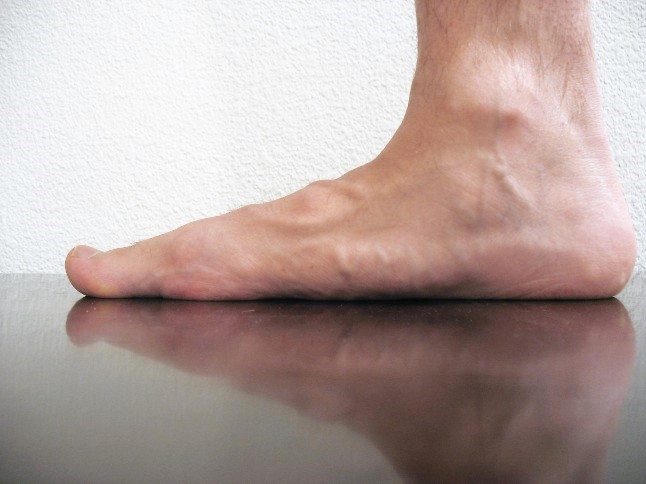
Flat-Foot-Arch-Before

The normal walking or running cycle begins with your heel striking the ground. As you transfer your body weight onto the front part of your foot, the arch of your foot naturally flattens slightly. This is called pronation.

The tissues that help maintain the arch of your foot are exposed to tremendous stress and may eventually break down. The loss of the normal arch of your foot results in a condition called “overpronation” or flat feet. This condition most commonly develops over a long period of time from repetitive stress.

Overpronation by itself is not painful, but the problem often leads to secondary problems, which may be painful. Plantar fasciitis, foot pain, shin splints and problems in the knee, hip or lower back are all related to overpronation. Patients who carry excess weight are more likely to develop this condition.

To help support your foot, you should wear shoes with good arch supports consistently. In some cases, specially molded orthotics may be needed to help support your arch.

What Is Upper Crossed Syndrome?

Your posture plays an important role in your overall health. Poor posture leads to chronic strain and discomfort. “Upper crossed syndrome” describes poor posture that results from excessive tightness in your shoulders and chest with weakness in your neck and mid-back. This combination forces your shoulders to roll inward and your head to project forward.

To help understand how upper crossed syndrome causes trouble, think of your spine as a telephone pole and your head as a bowling ball that sits on top. When the bowling ball is positioned directly over the top of the upright post, very little effort is required to keep it in place. If you tip the post forward and the ball begins to roll over the edge of the post, significantly more effort would be required from the muscles trying to hold it there. This effort results in chronic strain of the muscles of your neck and upper back.

The chronic strain is uncomfortable and may also lead to neck pain, upper back pain, headaches, TMJ pain, and ultimately- arthritis. This postural problem is exceptionally common in computer workstation users. Correction of this problem is accomplished by stretching the tight muscles, strengthening weak muscles, and modifying your workstation.

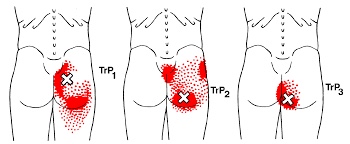
Trigger points in the gluteus medius muscle

The gluteus medius muscle plays an important role in hip and pelvic stability. It originates on the gluteal surface of the ilium, deep to the gluteus Maximus. It inserts on the greater trochanter of the femur. It’s main actions are to abduct the hip and to assist in internal rotation of the hip. It also maintains pelvic stability during walking and running. Trigger points in this muscle will refer pain into the sacrum, the iliac crest, and down the lateral hip and into the thigh. This muscle is often a cause of lower pack pain.

Trigger points in the gluteus Maximus

The gluteus Maximus is the buttock muscle. It originates on the gluteal surface of the ilium, lumbar fascia, sacrum and sacrotuberous ligament. It inserts on the gluteal tuberosity of the femur and the iliotibial tract. Extension and lateral rotation of the hip are it’s main actions. This muscle is heavily involved in activities like ice skating and is a common area to develops trigger points. When trigger points do develop they can refer pain in a crescent pattern from the gluteal fold to the sacrum. Trigger points can also refer pain deep into the buttock itself making it feel like other deeper muscles are involved. These symptoms can sometimes be mistaken for s.i. Joint problems.

Meditation goes mainstream!

​meditate-1851165_960_720

With growing evidence that meditation has significant health benefits, a 2016 study by a team of researchers from the United States, Spain, and France sought to explain how and why meditation actually works.

The study investigated the difference between “mindful meditation” in a group of experienced meditators vs. “quiet non-meditative activity” in a group of untrained control subjects. After eight hours of mindfulness practice, the meditation group showed a range of genetic and molecular differences, which in turn correlated with faster physical recovery from a stressful situation.

According to researchers, this is the first time a study has documented a rapid alteration in gene expression within meditating subjects. Interestingly, the researchers observed these changes in the SAME genes that anti-inflammatory and pain-killing drugs target! Thus, they speculate that mindful-based training may benefit patients with inflammatory conditions! This and prior studies have prompted the American Heart Association to endorse meditation as an effective cardiac preventative intervention.

Meditation has been found to be helpful for many conditions including stress management, lowering high blood pressure, heart disease, and depression. You can incorporate meditation into your life with three simple meditation exercises! The initial advice is “…go slow and be compassionate and gentle with yourself.” Your mind will try to wander (called our “default mode”) which consumes about half of our day, so try to focus (called “focus mode”)!

1)  WALKING MEDITATION: At a slow to medium pace, focus on your feet. Notice how your heel hits the ground and then feel the roll of your foot followed by the big toe pushing off prior to the swing phase. Feel for stones under the foot and other interesting sensations. If your mind starts to wander (default mode), gently bring your attention back to your foot (focus mode). You WILL get better with practice, and you’ll soon find it much easier to “focus” during stressful situations!

2)  NOVEL EXPERIENCES: It’s much easier to lose focus on the people you see everyday vs. those seen only one time a month. The next time you arrive home from work, pretend you haven’t seen your spouse/friend in 30 days. Give them your undivided attention. Then, try this on co-workers and other people you see every day. Believe me, they WILL notice a difference!

3)  GRATITUDE EXERCISES: When you’re not in their presence, focus on a person’s face and send them a “silent gratitude” for being in your life. Try this on family members, friends, co-workers, and others!

Can Chiro help me?

Adjust

​Chiropractic is the most widely accepted and most frequently used type of “alternative” healthcare in the United States. This is largely due to the fact that it works, and because of that, there has been a steady increase in acceptance by the public, third-party payers, and the Federal government. Since the mid-1990s, a number of outside (non-chiropractic) observers have suggested that chiropractic has now entered mainstream healthcare.

One can position chiropractic as being BOTH alternative and mainstream. It is “alternative” since it approaches healthcare from an entirely different direction compared to the primary care medical profession. Chiropractic is non-surgical and promotes diet and nutritional approaches vs. drugs and surgery. Chiropractic is also arguably “mainstream” as it has evolved into a strongly utilized form of primary care through popular acceptance and utilization by the public.

So, what role does chiropractic play in today’s health delivery system? This question is still being debated, but there appears to be three camps: 1) Specialist—limited to musculoskeletal (MSK) complaints on an interdisciplinary primary healthcare team; 2) Primary healthcare “gatekeepers” that focus on ambulatory MSK complaints; 3) Generalist primary healthcare provider of “alternative or complementary” medicine that manage and/or co-manage both MSK AND non-MSK conditions.

Looking at this from the patient or “consumer” perspective, chiropractic already plays an important role in the healthcare delivery for many patients. In 1993, a report claimed 7% of American adults had received chiropractic care during the prior year. According to a 2015 Gallup poll (that included 5,442 adults, aged 18+, surveyed between 2/16/15 and 5/6/15) entitled, Majority in U.S. Say Chiropractic Works for Neck, Back Pain, “Chiropractic care has a positive reputation among many US adults for effective treatment of neck and back pain, with about six in 10 adults either strongly agreeing (23%) or agreeing somewhat (38%) that chiropractors are effective at treating these types of pain.”

The “highlights” from this Gallup poll include: 1) Two-thirds say chiropractic is effective for neck and back pain. 2) Many adults say chiropractors think of the patient’s best interest. 3) More than 33 million adults in the United States (US) saw a chiropractor in the twelve months before the survey was conducted. That means roughly 14% of U.S. adults saw a chiropractor in the 12 months prior to the survey (vs. 7% in 1993). An additional 12% who responded to the Gallup pollsters saw a chiropractor in the last five years but not in the last 12 months. Overall, 51% of those polled had previously seen a chiropractor.

Whether or not you have personally utilized chiropractic, the educational process, licensing requirements, public interest, third-party payer systems, and interprofessional cooperation ALL support firm ground for which you can comfortably and confidently seek chiropractic care for your complaints.

We realize you have a choice in whom you consider for your health care provision and we sincerely appreciate your trust in choosing our service for those needs.  If you, a friend, or family member requires care, we would be honored to render our services.

Where should you turn when back pain strikes?

Shrug

Where should you turn when back pain strikes?

https://tribunecontentagency.com/article/where-to-turn-for-low-back-pain-relief/

Chiropractic should be a first line defence when back pain strikes. We are special trained to recognize the cause of back pain and treat when appropriate. When the cause is outside the scope of our practice, we are able to educate you on where you should go next.

Is there an actual cure all?

​Exercise Tip

No; but exercise seems to be as close as we will ever get! 

Some of you may have heard about how a modified form of boxing is helping patients with Parkinson’s disease (PD). If you haven’t, it’s been observed that people with Parkinson’s disease (PD) who engage in this boxing-like exercise routine can enhance their quality of life and even build impressive gains in posture, strength, flexibility, and speed. Proponents of the program report that regardless the degree of severity of PD, participants have a happier, healthier, and higher quality of life.

But must it be boxing? Maybe not. A report presented at the International Congress of Parkinson’s Disease and Movement Disorders in San Diego in June 2015 found that patients with Parkinson’s disease who began regular exercise early into the PD process had a much slower decline in their quality of life when compared with those who started exercising later. The researchers found just 2.5 hours per week of exercise is needed to improve quality of life scores. According to the report, it didn’t matter what exercise the participants did — simply getting up and moving for a total of 2.5 hours/week was reportedly enough (that’s only 20-25 minutes / day)!

Looking beyond Parkinson’s, other chronic conditions also benefit from adding exercise into a person’s lifestyle. Studies show that regular exercise as simple as walking helps reduce one’s risk for memory loss, and it slows down functional decline in the elderly. Incorporating aerobic exercise into one’s lifestyle can also improve reaction time in people at ALL AGES. Exercise has also been shown to improve both physical and emotional well-being in those afflicted with Alzheimer’s disease with as little as 60 minutes/week of moderate exercise! Patients with multiple sclerosis (MS) have also reported less stiffness and less muscle wasting when using exercise machines, aquatic exercise, and/or walking.

Research has shown just 30 minutes of brisk exercise three times a week can help reduce depressive symptoms in patients with mild-to-moderate depression. In a study involving teenagers, those who engaged in sports reported a greater level of well-being than their sedentary peers, and the more vigorous the exercise, the better their emotion health! In kids 8-12 years old, physical inactivity is strongly linked to depression.

Even anxiety, stress, and depression associated with menopause are less severe in those who exercise! So LET’S ALL GET OUT THERE AND EXERCISE!!!

What is Scoliosis?

Your spine is made up of 24 bones that stack on top of each other- normally in a straight line. “Scoliosis” means that your spine is curving from side to side, rather than being straight. Scoliosis affects between 1-3% of the population. Scoliosis may begin at any time between birth and adulthood but is most common during times that your skeleton is growing rapidly. Most cases of scoliosis begin between the ages of 13 and 18. Researchers are not completely certain why some people develop scoliosis, but they have found that the problem tends to run in families.

The curve of your scoliosis may be measured with an x-ray. Although some curves get worse, most do not. In fact, only ¼ of all adolescent idiopathic scoliosis curves will progress. Small curves in mature patients have a low risk of progression (2%), while large curves in younger patients progress more frequently. (70%) Curve progression is more common in girls, especially those with larger curves (greater than 20 degrees). Your doctor may need to monitor your scoliosis for progression by performing x-rays every 6-18 months.

Scoliosis may cause your shoulders, hips, or waist to be unlevel. Most curves are classified as “right thoracic”, which means that the peak of your curve protrudes toward the right. This is often accompanied by a forward rotation of your right shoulder and “winging” of your right shoulder blade. Many patients have a secondary curve in their lower spine that helps to balance their body. The majority of patients with mild to moderate scoliosis have no symptoms, but approximately ¼ report back pain. Unfortunately, scoliosis increases your risk of developing back pain later in life.

The primary goal of treatment is to stop curve progression. While many cases can be slowed or even reversed through appropriate management, it is important to recognize that others may progress in spite of the best care. Conservative care, including spinal manipulation (like the type provided in our office) has been shown to help some patients with scoliosis. Exercise is another effective treatment for scoliosis. It is important that you clearly understand your home exercise program and that you perform it consistently.

Patients with larger curves (30-40 degrees), or those who are at high risk for progression may benefit from wearing a brace. Braces have been shown to decrease the need for surgery in about three out of four patients. Fortunately, less than 0.3% of all scoliosis cases will ever require surgery.

You should avoid carrying heavy back packs and consider switching to a wheeled version, if necessary. Sports and exercise will not worsen most cases of scoliosis, and you should continue to participate in the things you enjoy unless directed otherwise by your doctor. The diagnosis of scoliosis is always discouraging, but you must focus on what it is really most important. Be confident in who you are! Don’t let something like a curved spine (or any other medical condition) define you as a person.