Exercise of the Month – (Resisted Shoulder Retraction)


Resisted Shoulder Retraction

  • Secure a piece of elastic resistance tubing to a doorframe.
  • Sit or stand with your elbows tucked into your sides bent at 90 degrees, forearms pointing forward.
  • Grasp the resistance band and pull it towards you by focusing on pinching your shoulder blades together.
  • Return to the start position and repeat three sets of 10 repetitions daily or as directed.

*This exercise may also be performed using a cable row machine or by looping a piece of elastic resistance band over your feet while sitting on the floor with your legs directly in front of you.

Condition Of The Month: TOS!

TOS.jpg

Thoracic Outlet Syndrome (TOS)

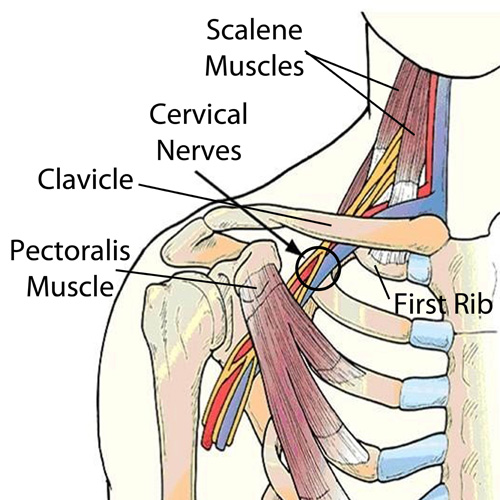
The term “thoracic outlet” describes an area at the base of your neck, just above your collarbone. Some important nerves and vessels pass through this outlet on their way into your arm. Compression of these tissues causes a condition called “thoracic outlet syndrome” which results in pain, numbness or tingling in your arm.

Several different factors can cause Thoracic Outlet Syndrome, commonly referred to as TOS. Sometimes TOS is caused from tightness in the muscles of your neck and chest, other times the space between your first rib and collarbone is too small. People who have an extra rib (cervical rib) and people who have recently suffered a neck injury may have a greater chance of having this problem.

The condition is aggravated by poor posture and by occupations that promote “slouching,” i.e., computer users, assembly line workers, supermarket checkers and students. Swimmers, volleyball players, tennis players, baseball pitchers and occupations requiring prolonged overhead activity. i.e., electricians and painters are also prime candidates for TOS.

Symptoms of TOS include arm pain, numbness, tingling and possible weakness. Neck, arm and hand pain may begin slowly and are often aggravated by elevation of the arms or excessive head movement. Loss of grip strength is possible.

Conservative treatment, like the kind we provide, has been shown to be effective at treating TOS. Through our careful exam we have identified your specific sites of compression and will use some of the following treatment to help:

You should avoid carrying heavy loads, especially on your shoulder i.e., carpet rolls. Briefcases, laptop cases or heavy shoulder bags should be lightened. Bra straps may need additional padding or consideration of replacement with a sports bra.

If you or someone you know suffers from any of these symptoms, call our office today. Our team has knowledge and tools to help you feel better quickly!

Trigger points and fibromyalgia

Myofascial pain syndrome (trigger points) and fibromyalgia are often confused to be the same condition and while there is a lot of interrelatedness between the two they are not quite identical. The clinical definition of a trigger point is “a hyper irritable spot associated within a taut band of skeletal muscle that is painful on compression or muscle contraction, and usually responds with a referred pain pattern distant from the spot”. Trigger points form from an overload trauma to the muscle tissue. This is contrasted with fibromyalgia which is defined as “a medical condition characterized by chronic widespread pain and a heightened pain response to pressure. Other symptoms include tiredness to a degree that normal activities are affected, sleep problems and troubles with memory. Some people also report restless leg syndrome, bowel and bladder problems, numbness and tingling and sensitivity to noise, lights and temperature. It is also associated with depression, anxiety, and post traumatic stress disorder”. Fibromyalgia will also present with localized tender points which are often mistaken for trigger points. Where these two conditions become somewhat interrelated is via the nervous system. Fibromyalgia patients suffer from a super-sensitization of the nervous system causing hyperirritability and pain. Myofascial trigger points can be caused by,or be the cause of, super sensitization. An active trigger point will irritate the sensory nerves around it eventually leading to super-sensitization. Trigger points have also been showed to form of become active due to super-sensitization. Both of these conditions can perpetuate the other, leading to layers of pain and symptoms. This being the case, trigger point therapy can have a very positive effect on decreasing the severity of pain and symptoms in patients suffering from fibromyalgia.

What does a shoulder separation actually mean?

Impingement

The term “acromioclavicular sprain” means that you have damaged the strong fibrous bands (ligaments) that hold the end of your collarbone (clavicle) to the tip of your shoulder blade (scapula). Another term sometimes used to describe this injury is “shoulder separation.” 40-50% of all athletic shoulder injuries involve the acromioclavicular (AC) joint. AC injuries are common in adolescents and young adults who participate in contact sports, like hockey and football. Males are affected five times more often than females.

Injuries may range from mild fraying of a single ligament to complete rupture of all of the supporting ligaments. Significant tears can allow your collarbone to move upward, out of its normal position, creating a raised bump under your skin. AC joint injuries are categorized (Grade 1-Grade 6) based upon the amount of damage. Grade 1 injuries are tender without joint separation. Grade 2 injuries may be accompanied by a slight separation of the joint. Grade 3 and above will show significant joint separation.

Injuries typically occur following a fall onto the point of your shoulder, while your arm is at your side, or by falling onto your outstretched hand. You will most likely feel pain and swelling on the very top of your shoulder. More significant injuries may produce bruising or a visible “bump” beneath the skin. Moving your shoulder will likely be painfully limited for a while.

Your treatment will vary, depending upon the severity of your injury. Grade 1, 2, and most Grade 3 injuries are best managed conservatively. A sling may be used only when needed to control painful movements. Initially, you will need to limit activity, especially reaching overhead, behind your back, or across your body. The exercises described below are an important part of your rehab and should be performed consistently to avoid long-term problems. Using an ice pack for 10-15 minutes each hour may help to limit swelling and pain.

Some mild separations will heal by themselves within a week or two. More significant injuries can take longer, and disabilities typically range between one and eight weeks. Patients who have suffered a significant amount of ligament damage may have a permanent bump on their shoulder, regardless of treatment. This bump does not usually cause ongoing problems.

If you or someone you know suffers from this condition, call our office today. Our doctors are experts at relieving many types of pain including shoulder injuries.

AC Joint

Bryan Cobb RMT.

Since 2005, Bryan has been dedicated to helping all people with chronic and acute pain caused by soft-tissue damage.

His training and experience make him uniquely qualified to treat a wide variety of pain and dysfunction and to give instruction on prevention and self-care.

Bryan is the only Massage Therapist in Manitoba — and one of the few in Canada — to be certified by the Certification Board for Myofascial Trigger Point Therapists (CBMTPT).

Bryan holds a degree as an Advanced Remedial Massage Therapist (ARMT) from the Massage Therapy College of Manitoba.  Course work at MTCM includes
• over 2,000 hours of practice, as well as
• intensive course work,
• a supervised clinical practicum, and
• community outreach placements.

MTCM has a credit transfer affiliation with the University of Winnipeg, ensuring that its courses are held to the highest level.  When Bryan studied at MTCM, the college was the only massage therapy college in western Canada accredited by the Commission on Massage Therapy Accreditation.  Today, the college is a member of the Canadian Council of Massage Therapy Schools.

Bryan is a member in good standing of the Natural Health Practitioners of Canada.

Bryan also has a background in Anatomy, Exercise Physiology, and Sport Sciences from the University of Manitoba, and he has worked as a personal trainer and fitness leader.

He is an avid natural bodybuilder and fitness enthusiast, and has a blue belt in Brazilian jiu-jitsu.

Trigger points in the serratus anterior

The serratus anterior muscle is located along the sides of the ribs. It originates on the outer surface of the upper 8-9ribs, and inserts on the medial border of the scapula. This muscle acts on the scapula in several different ways. First it rotates the scapula to turn the glenoid fossa upward. It also protracted and elevates the scapula. And lastly it helps to prevent wining. This muscle is often shortened from prolonged sitting and work on a computer. Active trigger points in this muscle refer pain locally around the trigger point with spillover down the inside of the arm. Pain can also radiate into the inferior angle of the scapula.

Trigger points in the supraspinatus

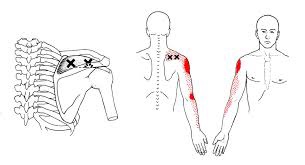
The supraspinatus is a muscle of the rotator cuff. Is sits above the infraspinatus and originates on the supraspinous fossa of the scapula. It’s insertion point is the superior facet of the greater tubercle of the humerus. It’s main function is to abduct the arm at the glenohumeral joint working with the deltoid. All rotator cuff muscles act to secure and support the head of the humerus in the glenoid fossa during arm movements acting as a sling. This muscle often gets impinged during overhead movements such as painting a ceiling. When trigger points form in this muscle they primarily refer a deep achy pain into the mid deltoid area with spillover pain radiating down the arm into the elbow.

Trigger points in the infraspinatus

The infraspinatus muscle is one of the muscles that makes up the rotator cuff. It originates on the infraspinous fossa of the scapula, and inserts on the middle facet of the greater tubercle of the humerus. It functions to externally rotate the humerus and to stabilize the head of the humerus in the glenoid cavity during upward movement of the arm. Trigger points in this muscle refer pain deep into the anterior shoulder joint and down the anterior arm. Trigger points near the lower medial border refer pain into the rhomboids. This muscle is often injured during throwing motions.

Trigger points in the triceps muscle.

The tricep muscle is named for its three heads long, medial, and lateral. The long head originates on the infraglenoid tubercle, the medial head on the posterior humerus, and the lateral head on the posterior humerus as well. They join together to insert on the Olecranon process of the ulna. The triceps function to extend the elbow. Strong extension under resistance can cause trigger points to form. Pain referred from triceps trigger points can be felt in the posterior shoulder and down the posterior forearm, as well as in in the olecranon process and the lateral epicondyle which can cause “tennis elbow” pain.