

Research has shown that working out first thing in the morning will rev up your metabolism for the rest of the day. If you’re short on time in the mornings, opt for a quick, but high-intensity workout of the basics, such as jumping jacks, push-ups, and squats.

When the rain and snow starts to fall, so do people. In fact, falls are the leading cause of nonfatal injuries in adults 45 and older. Protect yourself from a life-changing injury this winter with these 8 safety tips.
1. Choose the right shoe. Shoes and boots need to fit properly and have soles with good traction. Snow boots or hiking boots will provide the best protection for the worst type of weather.
2. Leave early. Falls are more likely to happen when you’re in a rush. Allow yourself plenty of time to get to where you’re going.
3. Walk like a penguin. Take short steps and walk as flat-footed as possible on icy or slippery ground.
4. Keep your hands free. You’ll need them to help you balance, so avoid carrying heavy loads and keep those hands out of your pockets.
5. Remove snow and ice from walkways frequently. Don’t wait for it to melt. That could take awhile. Apply ice melt and ask for help if you need it.
6. Keep the lights on. If you have exterior lights on your home, use them to help see where you’re walking at night.
7. Advocate for your safety. If the entrances or sidewalks do not look safe outside of a business or a local venue, speak up and let someone know.
8. Keep your cell phone with you. Even if it’s just on a trip to the mailbox, bring it. In the event that a fall does occur, you may need it to call someone for help.
Stay vigilant and remember these tips during this winter season. If you are injured from a fall, count on our office to help get you back on your feet quickly.


http://www.cbc.ca/beta/news/canada/calgary/fall-fitness-calgary-tips-1.4306014
The CBC actually earning our tax dollars with a solid article on fitness!

Michelle Blood has a great piece for new gym members over at LifeZette.com Check out the link at the end of the page for the whole article. Getting started can be a daunting task for many; these 5 tips will help you stay motivated, safe, on task and get you to your goals.
1.) Get checked. Before you set foot into the gym to begin any workout program, it is important you get clearance from your doctor. It is easy to overlook this step in the excitement over the idea of committing yourself to getting fit. However, failure to do so can be very costly. For the following groups of people, it is extremely important to hit the doctor’s office before you hit the gym:
2.) Get comfortable. Gyms can feel intimidating when you’re new because the layout and procedures at your gym are unfamiliar, as are the pieces of equipment and the group-exercise formats. The best way to combat these sorts of concerns is to take some time to tour the gym, to observe different group-based classes, and to receive some basic instruction on use of various pieces of equipment.
Consider approaching instructors and trainers. Most are friendly and personable, and more than willing to answer any questions you have about classes or equipment. Your fellow gym members can be an indispensable source of information as well. Ask them about their experiences in a class that interests you.
By getting as much information as you can prior to joining a class, you’ll feel more comfortable participating when you make the leap and sign up for your first group class.
3.) Get equipped. Fortunately, you don’t need to break the bank to gather up a few essentials you’ll want to have when you begin your gym-based fitness journey. Though you’re not going to need an entire new wardrobe, it would be a good idea to pick up a couple of sweat-wicking items (e.g., shorts, T-shirts) and an appropriate pair of shoes.
Other items on your shopping list might include: a filtered, refillable water bottle; showering necessities; a padlock (if your gym provides lockers); and some pre and post-workout healthy snacks. Store the essentials in a sturdy bag to throw in your trunk so you’ll always be ready to hit the gym for a quick workout whenever the mood may strike you.
4.) Get a partner. Building some accountability in to your new gym routine is a great way to bolster your chances of success. Bringing a friend or family member along to the gym has a number of advantages. When you commit to another person, you give yourself the gift of subtle, positive pressure to stick to your goals.
If you’re waffling about attending class on a given day, the fact that your partner will be there waiting for you can provide that extra bit of encouragement you need to power through your reluctance and show up for class anyway.
In addition, developing a fun competition with your partner can have some spectacular results. Science has shown us, time and again, that people lose more weight when they are involved with a team or are in a competition. Be sure to keep it positive, and you can spur one another to successes neither partner might have hoped to achieve on his or her own.
5.) Get pumped. You can beat the “I just don’t feel motivated” monster in a number of ways. Finding an effective strategy for motivating yourself is somewhat a matter of trial and error. Try some of the following to discover what works best for you.
Regardless of your level of experience — you can confidently succeed at the gym.
http://www.lifezette.com/healthzette/success-at-the-gym-five-top-tips-for-exercise-newbies/
Folks suffering with fibromyalgia (FM) commonly complain that certain foods can make their symptoms worse. How common is this? One study reported 42% of FM patients found that certain foods worsened their symptoms!
Because FM affects each person differently, there is no ONE FM diet or, “…one size fits all” when it comes to eating “right” for FM. Patients with FM usually find out by trial and error which foods work vs. those that consistently don’t. However, remembering which foods do what can be a challenge so FIRST, make a three column FOOD LOG with the following headings: BETTER, NO CHANGE, WORSE. This will allow you to QUICKLY review the list as a memory refresher.
According to Dr. Ginevra Liptan, medical director of the Frida Center for Fibromyalgia (Portland, OR) and author of Figuring Out Fibromyalgia: Current Science and the Most Effective Treatments, there are some common trends she’s observed through treating FM patients. Here are some of her recommendations:
PAY ATTENTION TO HOW FOOD MAKES YOU FEEL: It is quite common to have “sensitivities” to certain foods, but this is highly variable from person to person. Examples of problematic foods/ingredients include: MSG (commonly used in Chinese food), other preservatives, eggs, gluten, and dairy. Dr. Liptan HIGHLY recommends the food journal approach! She also recommends including a note about the type of symptoms noticed with each “WORSE” food, as symptoms can vary significantly.
ELIMINATE CERTAIN FOODS: If you suspect a certain food may be problematic, try an elimination challenge diet. That means STOP eating that food for six to eight weeks and then ADD it back into your diet and see how you feel. Remember, FM sufferers frequently have irritable bowel syndrome, also known as IBS, and this approach can be REALLY HELPFUL! Food allergies may be part of the problem, and your doctor may refer you for a consult with an allergist and/or a dietician. They will also discuss the “anti-inflammatory diet” with you.
EAT HEALTHY: In general, your diet should emphasize fruits and vegetables and lean protein. Pre-prepare food so you have something “healthy” to reach for rather than a less healthy snack when you’re hungry and tired. Consider “pre-washed” and pre-cut up vegetables; try quinoa rather than pasta. Consume anti-fatigue foods and eat multiple small meals daily vs. one to two large meals. Protein snacks (like a hardboiled egg or oatmeal – GLUTEN FREE) help a lot! Eat breakfast and include protein. Also, GET ENOUGH SLEEP (at least seven to eight hours and be consistent)!
SUPPLEMENTS: Consider a good general multi-vitamin, calcium and magnesium, omega-3 fatty acids, vitamin D3, and Co-Enzyme Q10. There are others, but this represents a great place to start. Remember to check any medication you may be taking with these/any suggestions before taking supplements!
If you, a friend or family member requires care for Fibromyalgia, we sincerely appreciate the trust and confidence shown by choosing our services!
There is a lot to be learnt from this video. Dr. Mike Evans does a great job of explaining why we need to KEEP MOVING during and after an episode of low back pain. Check it out!
One of our favourites in the office; Thoracic Rotation.
An easy exercise for your upper and mid-back. No equipment required! – (Post link to article and video on your blog or post video directly on your social media account.)”
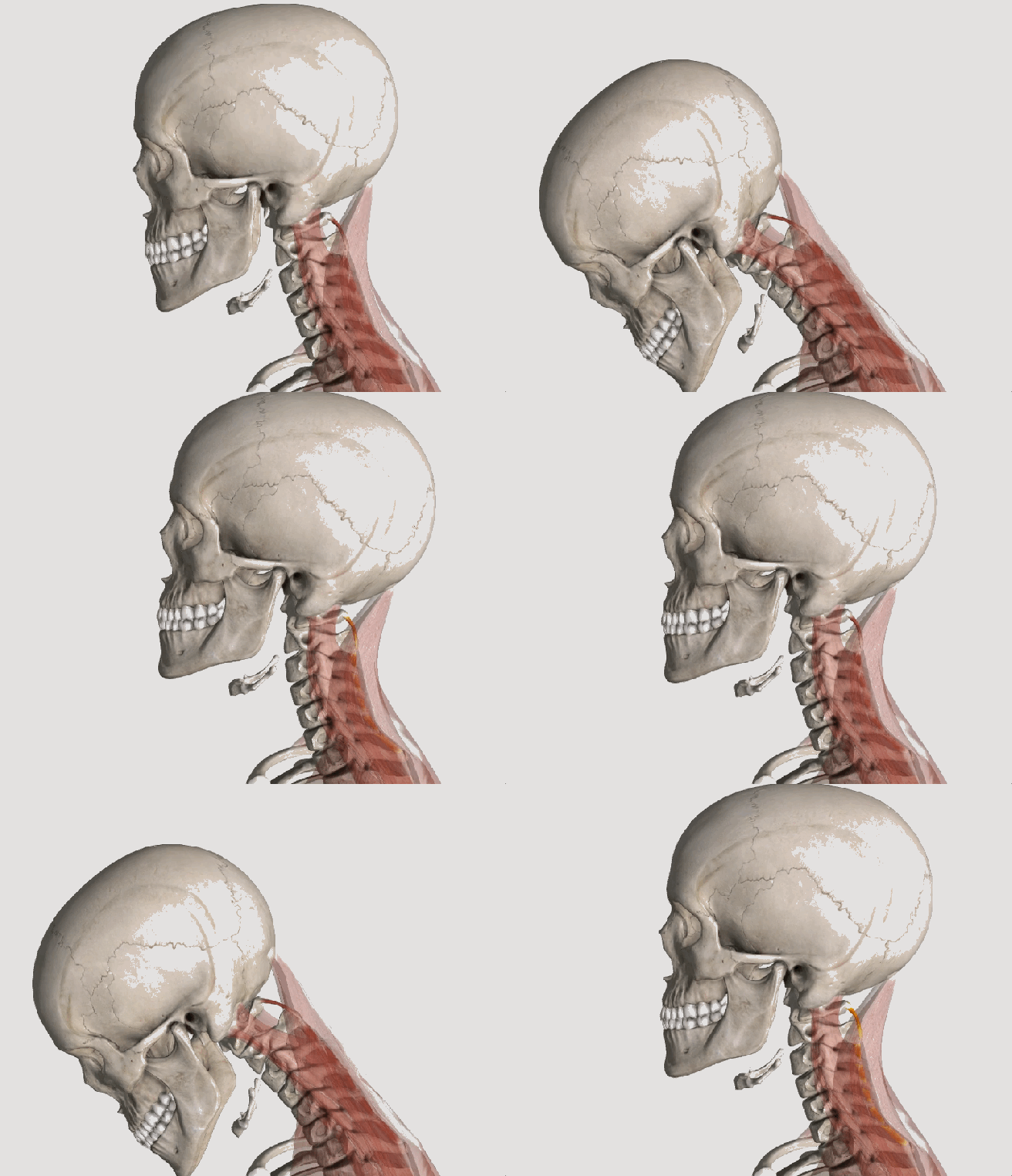
Whiplash is an injury to the soft-tissues of the neck often referred to as a sprain or strain. Because there are a unique set of symptoms associated with whiplash, doctors and researchers commonly use the term “whiplash associated disorders” or WAD to describe the condition.
WAD commonly occurs as a result of a car crash, but it can also result from a slip and fall, sports injury, a personal injury (such as an assault), and other traumatic causes. The tissues commonly involved include muscle tendons (“strain”), ligaments and joint capsules (“sprains”), disk injuries (tears, herniation), as well as brain injury or concussion—even without hitting the head!
Symptoms vary widely but often include neck pain, stiffness, tender muscles and connective tissue (myofascial pain), headache, dizziness, sensations such as burning, prickly, tingling, numbness, muscle weakness, and referred pain to the shoulder blade, mid-back, arm, head, or face. If concussion occurs, additional symptoms include cognitive problems, concentration loss, poor memory, anxiety/depression, nervousness/irritability, sleep disturbance, fatigue, and more!
Whiplash associated disorders can be broken down into three categories: WAD I includes symptoms without any significant examination findings; WAD II includes loss of cervical range of motion and evidence of soft-tissue damage; and WAD III includes WAD II elements with neurological loss—altered motor and/or sensory functions. There is a WAD IV which includes fracture, but this is less common and often excluded.
Treatment for WAD includes everything from doing nothing to intensive management from multiple disciplines—chiropractic, primary care, physical therapy, clinical psychology, pain management, and specialty services such as neurology, orthopedics, and more. The goal of treatment is to restore normal function and activity participation, as well as symptom management.
The prognosis of WAD is generally good as many will recover without residual problems within days to weeks, with most people recovering around three months after the injury. Unfortunately, some are not so lucky and have continued neck pain, stiffness, headache, and some develop post-concussive syndrome. The latter can affect cognition, memory, vision, and other brain functions. Generally speaking, the higher the WAD category, the worse the prognosis, although each case MUST be managed by its own unique characteristics. If the injury includes neurological loss (muscle strength and/or sensory dysfunction like numbness, tingling, burning, pressure), the prognosis is often worse.
Chiropractic care for the WAD patient can include manipulation, mobilization, and home-based exercises, as well as the use of anti-inflammatory herbs (ginger, turmeric, proteolysis enzymes (bromelain, papain), devil’s claw, boswellia extract, rutin, bioflavonoid, vitamin D, coenzyme Q10, etc.) and dietary modifications aimed at reducing inflammation and promoting healing.
* 83% of those patients involved in an MVA will suffer whiplash injury and 50% will be symptomatic at 1 year.
* 90% of patients with neurologic signs at onset may be symptomatic at 1 year.
* 25- 80% of patients who suffer a whiplash injury will experience late-onset dizziness
* Clinicians should be observant for radiographic signs of instability, including interspinous widening, vertebral subluxation, vertebral compression fracture, and loss of cervical lordosis.
* Horizontal displacement of greater than 3.5 mm or angular displacement of more than 11 degrees on flexion/extension views suggests instability.