Thumb/Wrist pain from De Quervain’s Disease…..

Tendons are strong, fibrous bands of tissue connecting muscles to bones. Some tendons are covered by a protective, lubricated insulation called a “synovial sheath.” The two tendons on the thumb-side of your wrist that extend and abduct your thumb into a “hitchhiker” position are covered by a sheath. Normally, these tendons move freely within this covering, much like a sword sliding through a sheath.

If these tendons and sheaths are forced to repetitively rub against the bones of your wrist, they can become painfully swollen. This condition is called De Quervain’s tenosynovitis.

The pain of De Quervain’s tenosynovitis may begin abruptly, but more commonly starts gradually and increases over time. The pain is provoked by movements of your thumb or wrist. In more severe cases, you may notice swelling on the outside of your wrist. Some patients complain of “catching” or a slight “squeaking” sound while moving their wrist.

Activities like gardening, knitting, cooking, playing a musical instrument, carpentry, walking a pet on a leash, texting, video gaming and sports like golf, volleyball, fly fishing and racquet sports are known triggers. The condition was once known as “Washer woman’s sprain,” since wringing out wet clothes can trigger the problem. Lifting infants or children by placing your outstretched finger and thumb beneath their armpit has led to the nicknames of “Mommy thumb” or “Baby wrist.”

The condition strikes women much more frequently than men. It typically affects middle-age adults and is more slightly common in African-Americans, patients with diabetes or rheumatoid arthritis may be at higher risk for this problem.

Many patients will experience resolution of their symptoms through conservative care, like the type provided in our office. You should avoid lifting, grasping and pinching movements, especially when your wrist is bent toward either side. You may need to find alternate ways to lift children and perform work, sport and leisure activities. Video game players and those who text should take frequent breaks and try to hold their wrists straighter. Avoid wearing tight wristbands. Applying ice to your wrist for 10 minutes every hour or performing an “ice massage” (freeze a paper cup filled with water, tear off the bottom to expose the ice, massage over the tendons in a figure-eight pattern for 6-10 minutes, taking breaks as needed) can provide relief.

Patients who have severe pain or swelling are less likely to respond to conservative care. These patients may require a cortisone injection to relieve their pain, however, surgery is rarely necessary.

Mobility Myth #4

stantonhurt_medium

Myth: You only need to do mobility work if you’re an athlete or if something hurts.

Truth: “Whether you’re pro athlete, weekend warrior, or parent being active with their kids, the mobility requirement for fundamental movements (running, squatting, etc.) stays the same,” says Ardoin. “We always need adequate mobility in the same key areas, such as the ankles, hips, thoracic spine (upper back), shoulders.” He says everyone should be able to meet the following mobility baselines:

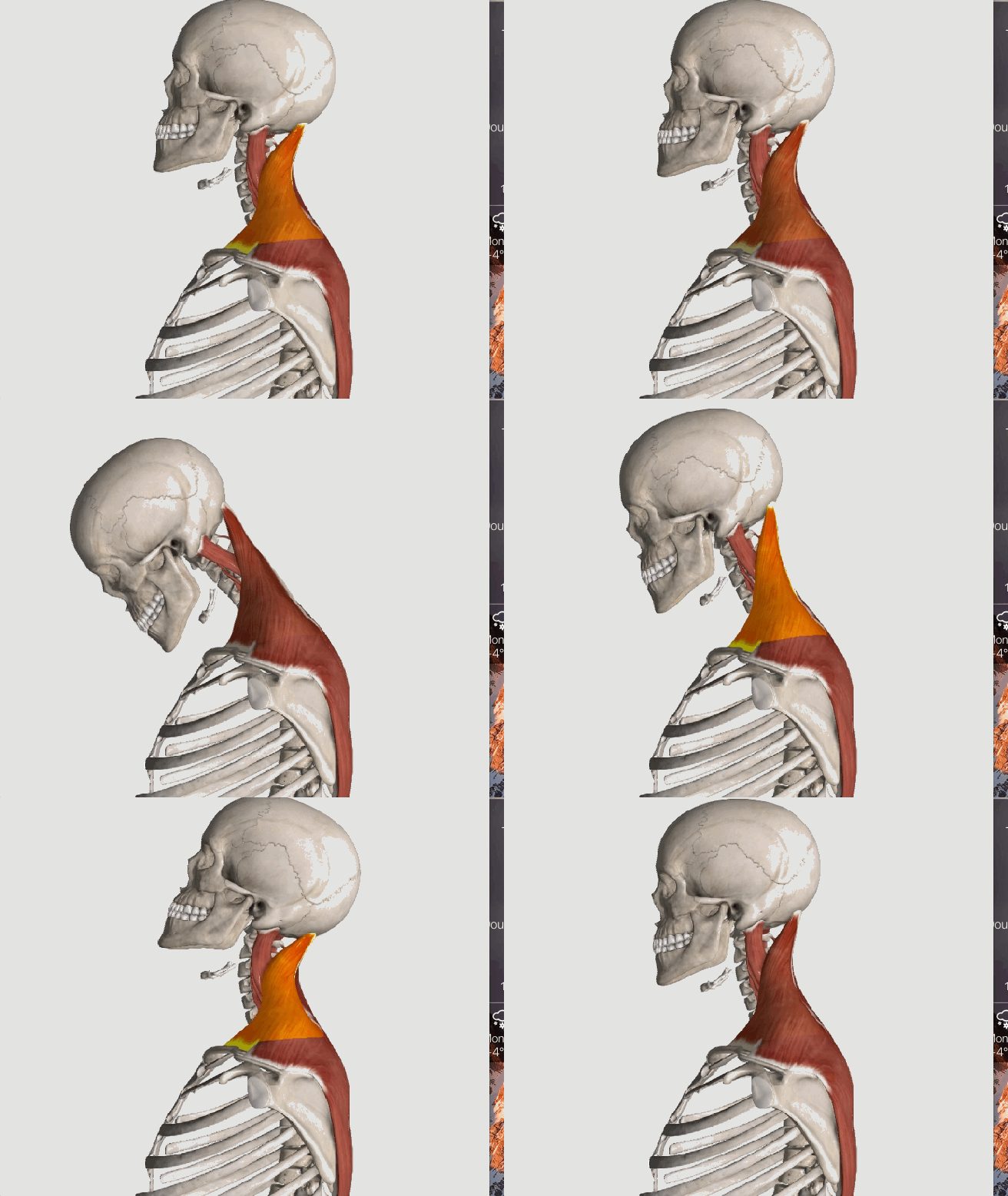
  • Touch your chin to your chest without opening your mouth.

  • Look up toward the ceiling with your face becoming parallel to the floor.

  • Rotate your head to each side until your chin reaches mid collarbone.

  • Touch your toes with straight legs.

  • Lower into a deep squat without your heels coming up or toes rotating out.

“If you don’t have access to the necessary mobility, your body will find a way to get it by compensating elsewhere, which could lead to injuries down the road,” he says.

But the injuries might be in unexpected places: Your first thought might be to deal with the area that hurts—but, often, that’s not the true source of the problem. “Often times the issue causing lower-back pain isn’t the lower back, but an issue with hip mobility,” says Esquer. An elbow issue might actually be due to a lack of wrist mobility, and upper-back pain might be due to tightness in the front of the chest and shoulders.

“A lot of times we don’t notice movement restrictions until we’re in pain,” says Esquer. Maintaining your natural mobility day in and day out (kind of like brushing your teeth to prevent cavities) will help prevent surprise injuries from popping up.

Advice for headache sufferers….

187

Get Moving.

A new study of 573 office workers found that “one hour weekly of strength training reduced headache frequency and intensity.” Timing and spacing of session times did not affect the positive outcome, but participants whose training was supervised used fewer medications.

So, if you or someone you know suffers from headaches, call us today. Our doctors have powerful natural tools for treating headaches and can help design an exercise plan to stay healthy. Learn more about headaches here:

Headache Info Video

Source:

page1image3519546256

Andersen, CH et al. Effect of resistance training on headache symptoms in adults: Secondary analysis of a RCT. Musculoskeletal Science and Practice, Volume 32, 2017, Pages 38-43 ”

Our exercise of the month

The Semi-Stiff Dead Lift


Begin standing with your thumbs on your rib cage and your fingers on the crests of your hip, making sure not to approximate your fingers throughout the exercise.

Stand on one leg with your knee bent only slightly.

Slowly flex forward from the hips moving your chest toward the floor, making certain not to flex your back. Return to an upright position.

Repeat 15 repetitions on each leg once per day or as directed.

I’m getting old Doc… Getting old….

Your lumbar spine (low back) is made up of 5 individual vertebrae stacked on top of a bone called the “sacrum”. To allow for flexibility and movement, there is a cushion or “disc” in between each level. As we age, these discs can wear and become thinner over time. This leads to additional changes, including bone spurs and narrowing of the opening where your nerves exit your spine.

This process is called “lumbar spondylosis”, or simply, “arthritis”. This problem most commonly involves the vertebra at the very base of your spine, which bear the highest loads.

Lumbar arthritis is exceptionally common, affecting people as young as 20 and becoming extremely likely by age 70. How quickly you develop low back arthritis is largely a trait you inherited from your parents. Other factors may play a role, including a history of trauma, smoking, operating motorized vehicles, being overweight and/ or performing repetitive movements (i.e. lifting, twisting, bending or sitting). Men seem to be affected slightly more often than women.

Symptoms often begin as back and buttock pain that gradually worsens over time. Stiffness may be present upon arising in the morning. Pain is relieved by rest or light activity and aggravated by strenuous work. Sometimes your nerves can become “pinched” in narrowed openings where they exit your spine. This can cause “sciatica” which results in pain, numbness, or tingling radiating into your leg along the path of the irritated nerve. Be sure to tell your doctor if you notice any weakness or if you have fever, abdominal pain, change in bowel or bladder function, or pain in your groin crease.

Arthritic changes can be seen on x-rays, but interestingly, the amount of wearing does not seem to correlate directly with the severity of your symptoms. People with the same degree of arthritis may have symptoms ranging from none to severe. Most researchers believe that the symptoms of osteoarthritis are not the direct result of the disease, but rather, from the conditions that preceded the disease and those that develop subsequent to it, like joint restrictions and muscle tightness. Fortunately, those conditions are treatable and our office has a variety of tools to help relieve your pain.

In general, you should avoid repeated lifting and twisting and take frequent breaks from prolonged sitting, especially in motorized vehicles. Avoid any position that causes an increase in radiating pain. Low-impact activities, like walking, stationary cycling, water aerobics, and yoga may be helpful.

Radial Tunnel Syndrome

Your radial nerve begins in your neck and travels past your elbow en route to its final destination in your hand. Just beyond your elbow, this nerve passes through a 2-inch area on the back of your forearm called the “Radial tunnel”. “Radial tunnel syndrome” means that your radial nerve has been compressed or irritated within this space-leading to forearm pain or hand weakness.

Radial tunnel syndrome is thought to result from muscular overuse, especially prolonged or excessive wrist extension or rotation. The most common cause of compression comes from excessive tightness in a muscle called the “Supinator”. Workers whose jobs require heavy or repetitive wrist movements are at an increased risk for this disorder. Occasionally, the radial nerve can become irritated from direct compression by a tight band or brace. The condition may be more common in those who have diabetes or thyroid problems.

Symptoms from irritation of the radial nerve depend upon which specific nerve fibers are irritated. The most common symptoms include pain, numbness, tingling or decreased sensitivity along the top of your forearm radiating toward your hand and thumb. The symptoms often mimic those of “tennis elbow.” When the nerve fibers that control muscle function become compressed, you may experience weakness when trying to extend your fingers, hand or wrist. Seventy percent of radial tunnel patients also have problems in their neck or upper back.

Conservative treatment of radial tunnel syndrome is generally successful. Fixing the problem means limiting excessive or repetitive wrist movements, especially extension and rotation. In severe cases, a splint may be necessary to limit your motion. Try to avoid compression of your forearm, particularly from tight bands or braces. Use of a tennis elbow brace will likely aggravate your symptoms. You may find relief by applying ice or ice massage to the area for 10-15 minutes at a time.

Studies show the obesity epidemic can pa

Studies show the obesity epidemic can partially be blamed on the abundance of processed foods readily available. These foods contain high amounts of added sugar and refined grains; both of which are detrimental to our health and can be quite addicting in some people. Avoid processed junk food by filling your cart with wholesome, real food instead. Food that has a shelf life, is grown from the ground, or has a mother is often the criteria for “real” food. http://ow.ly/i/GlGun

Mobility Myth #3

Meralgia Parasthetica

Myth: You can stretch and/or foam roll your iliotibial (IT) band.

Truth: First things first: your IT band is a thick ligament that stretches from your pelvis and runs along the very outside of your thigh and knee all the way down to your shin. (You may have heard runners complaining about IT band issues.)

“Stretching and rolling the IT band isn’t helpful, because it’s a thick band of fascia and can’t be broken up or elongated,” says Ardoin. (See earlier point about it taking 200 tons of force to mechanically affect tissue.) And, really, you shouldn’t want to break it up, says Esquer.

However, if you’re rolling near your IT band (to release tight quads, for example), that’s different, says Esquer. “Your IT band canbecome adhered to the adjacent quad and hamstring muscles,” says Ardoin. “Rolling between the IT band and these muscles can help the tissues slide and glide more easily.”

So it FEELS like Carpal Tunnel but it ISN’T Carpal Tunnel?

Your Median Nerve begins in your neck and travels down your arm on its way to your hand. This nerve is responsible for sensation on the palm side of your first 3 ½ fingers and also controls some of the muscles that flex your fingers. The median nerve can sometimes become entrapped near your elbow as it travels through a muscle called the “pronator teres”. Compression of the median nerve by the pronator muscle is called “Pronator Syndrome.”

Pronator syndrome is often brought on by prolonged or repeated wrist and finger movements, i.e., gripping with the palm down. Carpenters, mechanics, assembly line workers, tennis players, rowers, and weight lifters are predisposed to this problem. The condition is more common in people with excessively developed forearm muscles and is also more common in your dominant arm. Pronator syndrome most often affects adults age 45-60 and females are affected about four times more frequently than males. People who suffer from diabetes, thyroid disease, and alcoholism have an increased risk for developing pronator syndrome.

Pronator syndrome produces symptoms very similar to a more common cause of median nerve compression called “carpal tunnel syndrome”. Symptoms of pronator syndrome include numbness, tingling, or discomfort on the palm side of your thumb, index, middle finger, and half of your ring finger. The discomfort often begins near the elbow and radiates toward your hand. Your symptoms are likely aggravated by gripping activities, especially those that involve rotation of the forearm, like turning a doorknob or a screwdriver. Unlike carpal tunnel syndrome, pronator syndrome symptoms are not generally present at night. You may sometimes feel as though your hands are clumsy. In more severe cases, hand weakness can develop.

To help resolve your condition, you should avoid activities that involve repetitive hand and forearm movements. Perhaps the most important aspect of your treatment plan is to avoid repetitive forceful gripping. You may apply ice packs or ice massage directly over the pronator teres muscle for ten minutes at a time or as directed by our office. In some cases, an elbow splint may be used to limit forearm movements. If left untreated, pronator syndrome can result in permanent nerve damage. Fortunately, our office has several treatment options available to help resolve your symptoms.