

Trying to be more mindful of your calories? Try applying this rule to your daily regimen:
Before grabbing a bite to eat, drink a full glass of water first. Many times, thirst can be confused with hunger.
Before grabbing a bite to eat, drink a full glass of water first. Many times, thirst can be confused with hunger.


A great piece here from https://www.tallahassee.com/life/
Remember that high school health class? Now imagine a similar class geared toward students 65 and older.
That’s the idea behind nutrition education for older adults provided by the Family Nutrition Program, an Extension program of the University of Florida Institute of Food and Agricultural Sciences, which teaches people how to stay healthy and active on a budget.
“As we get older, our bodies change, and we are at greater risk for developing chronic diseases like high blood pressure and diabetes,” said Dr. Sharon Austin, adult programs specialist for the Family Nutrition Program. “My job is to encourage older adults to make small changes that will help them lead active, independent lives.”
The need for this kind of education is growing, Austin said. Adults over 65 are the fastest growing age group in the United States, and Florida has the highest percentage of adults 65 and older of any state, she said.
Everyone ages differently, and individual needs can be determined with your doctor, Austin said. But in general, as we get older, we may need to pay more attention to certain aspects of our eating and exercise routines to stay healthy, she said.
1. Calorie needs
As we age, our bodies typically need fewer calories because we are moving less and have less muscle mass, Austin said. “When you don’t need as many calories, you want to make sure you get more bang for your buck. That means avoiding ‘empty calories’ and choosing foods that are going to give you the nutrients you need,” she said.
2. Eating from every food group
One way to ensure that you are getting all the nutrients you need is to eat a variety of foods from every food group, Austin said. Take a look at ChooseMyPlate.gov to see how much of each food group to consume.
3. Fiber-rich foods
“Fiber isn’t just good for digestive health. It also helps lower risk for heart disease and diabetes, which are common chronic diseases in older adults,” Austin said.
You can get your daily recommended intake of fiber from whole grains, beans, and fresh fruits and vegetables, she said.
4. Fortified foods
Look for foods fortified with vitamin B12, vitamin D and calcium. “Vitamin B12 helps keep the body’s nerve and blood cells healthy, and calcium and Vitamin D help support bone health,” Austin said.
5. Drinking water
Older adults may have a decreased sense of thirst, and may more easily become dehydrated, Austin said. “One way to avoid dehydration is to sip water throughout the day from a cup or container you keep nearby during your daily routines,” she said
6. Exercises for mobility, balance and weight management
“When we talk about exercise for older adults, the goal is to set yourself up for physical independence. In our classes, we talk about everyday activities, such as cleaning the house or gardening, which can keep us strong and flexible, and burn calories. We also practice ways to increase balance, which can help us avoid falls and injury,” Austin said.
An exercise that many participants enjoy is the ‘couch potato mambo,’ Austin said. “Next time you’re sitting watching TV, get up and dance during the commercial break. It’s a small step toward health, and it’s fun.”


the vertebral arches on its way from your brain to your tailbone. The term “lumbar isthmic spondylolisthesis” describes a condition where your arch has broken free from its anchor on the vertebral body, allowing the vertebral body to slide forward. Lumbar spondylolisthesis typically affects the lowest lumbar vertebra, L5, or occasionally the second lowest, L4.
The condition is sometimes caused by trauma, but more often follows a “stress fracture” involving the arch of the vertebra. This break and slippage is thought to result from repetitive movements, especially hyperextension (arching back) and rotation. The break usually happens during childhood but does not always cause symptoms when it occurs. Many times, the condition will lie dormant until later in life. Lumbar spondylolisthesis is present in six to seven percent of the population and affects males twice as often as females. The problem is more common in those who participate in sports. Some sports predispose children to this “break and slip”. Athletes who participate in gymnastics, rowing, diving, football, wrestling, weight lifting, swimming, tennis, volleyball, and track & field throwing sports (i.e. discus, shot put, etc) are at greatest risk.
The pain usually starts in your back but may radiate into your buttock or thigh. Your pain usually intensifies with standing upright for prolonged periods of time or leaning backwards, especially during heavy activity. Some women report increased symptoms during the later stages of pregnancy. Be sure to tell your doctor if you notice pain, numbness or tingling in your groin, a loss of bowel or bladder function, fever, night sweats, pain extending beyond your knee, or weakness in your legs.
Your doctor will “grade” your spondylolisthesis based on the percent of the vertebral body that has slipped forward. Your doctor will try to determine if your spondylolisthesis is “active”, meaning a recent break or “inactive”, referring to a long-standing problem. If your doctor has determined that your spondylolisthesis is new and has a chance of worsening, you may need to stop certain activities or sports for a period of time until your fracture heals. Sometimes a lumbar brace is used to help you recover more quickly. Patients with a long-standing “inactive” spondylolisthesis may benefit from a combination of treatments including stretching and strengthening. You should limit leaning backwards or sleeping on your stomach. Females should avoid wearing high heels.
A new review of more than 50 prior research studies concluded: “manipulation and mobilization are likely to reduce pain and improve function for patients with chronic low back pain. The researchers also found that “(Chiropractic) manipulation appears to produce a larger effect than (physical therapy) mobilization.”
Click here to learn more about how chiropractic manipulation can help alleviate back pain.

A January 2018 systematic review of 51 studies examined the efficacy, effectiveness, and safety of various mobilization and manipulation therapies for the treatment of chronic low back pain. The authors concluded:
“There is moderate-quality evidence that manipulation and mobilization are likely to reduce pain and improve function for patients with chronic low back pain; manipulation appears to produce a larger effect than mobilization. Both therapies appear safe.” (1)
The study also measured manipulation against other widely prescribed options:
“Subgroup analyses showed that manipulation significantly reduced pain and disability, compared with other active comparators including exercise and physical therapy.”
This analysis reinforces the recent LBP clinical practice guideline from the American College of Physicians recommending that physicians prescribe non-pharmacologic treatment including spinal manipulation, heat, massage, and acupuncture. (2)
As evidence-based providers, we continually assimilate new research with clinical experience. We should also recognize that our clinical experiences are sometimes clouded by habitually seeing the other profession’s failures since successfully managed patients don’t often seek supplementary consult. Evidence-based practice requires that we allow consensus evidence to guide our management decisions without anecdotal bias.
References
1. Coulter ID. et al. Manipulation and mobilization for treating chronic low back pain: a systematic review and meta-analysis. 2018 Jan 31. pii: S1529-9430(18)30016-0. Spine Journal. doi: 10.1016/j.spinee.2018.01.013. [Epub ahead of print]
2. Qaseem A, Wilt TJ, McLean RM, Forciea MA, for the Clinical Guidelines Committee of the American College of Physicians. Noninvasive Treatments for Acute, Subacute, and Chronic Low Back Pain: A Clinical Practice Guideline From the American College of Physicians. Ann Intern Med. [Epub ahead of print 14 February 2017]
New Whiplash Research
Motor vehicle crashes cause 50 million injuries worldwide and nearly four million emergency department consultations annually in the US. (1,2) I thought you might be interested in reviewing three new studies concerning the most common non-hospitalized injury resulting from a motor vehicle crash – whiplash associated disorder (WAD).
1. The first study concluded approximately 50% of individuals with WAD experience on-going pain and disability. (3) This finding concurs with existing research that found only around 50% of those with WAD will fully recover, with 30% remaining moderately to severely disabled; creating significant personal, economic, and social distress. (4)
2. Elsewhere, researchers discovered “Motor impairment was observed (to) a higher degree in patients with chronic WAD. These impairments were linked to self-reported disability and were in most cases associated with pain, fear-avoidance, and symptoms of central sensitization.” (5)
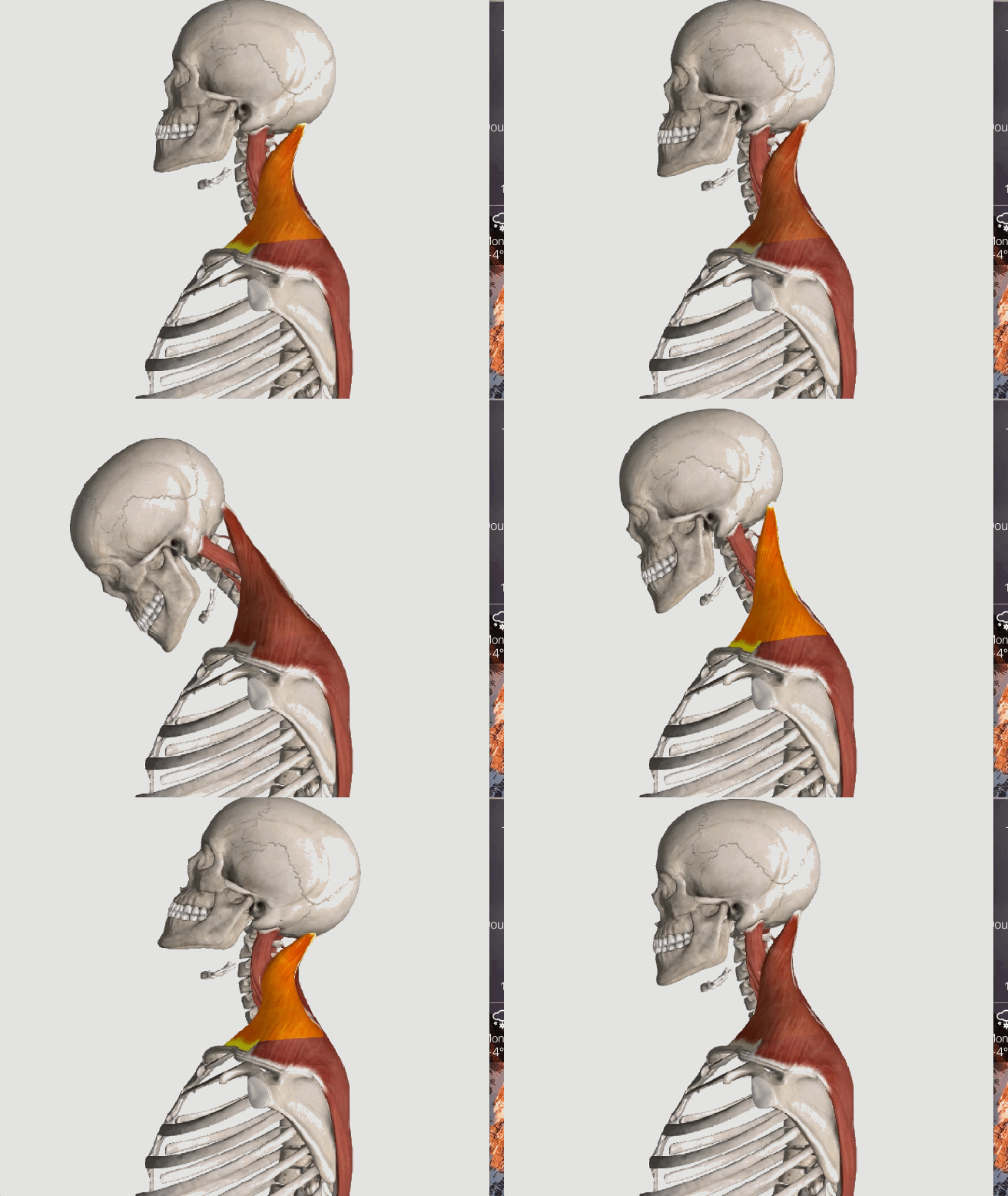
3. The final study found that following a whiplash injury, healthy muscle is replaced by fat: “Development of muscle fat infiltration in the neck muscles is associated with poor functional recovery following whiplash injury. Statistically significant differences in regional fatty infiltration were particularly notable between the severe WAD group and healthy controls.” (6)
Our providers stay abreast of the latest research to help your injured clients recover quickly and to provide you with evidence-based, credible documentation and testimony for challenging cases. We are honored to care for your injuries and will work hard to maintain your trust as an informed and capable partner.

How Does Chiropractic Help with Headaches?
Since 9 out of 10 Americans suffer from some form of headache, we tend to think of them as just a nuisance that can be relieved by taking a painkiller or a nap. Those solutions sometimes lighten the pain momentarily, but recurring headaches are a symptom that something else is wrong, and finding the root cause of your headaches is imperative to putting an end to them.
Fortunately, there’s a proven alternative. According to a new study, chiropractic treatment can provide “immediate relief” for many headache patients.
The majority of primary headaches, including tension headaches and migraines, are frequently associated with muscle tension or joint restrictions in the neck. These problems occur more often than ever before because nowadays we’re sitting in front of the computer for hours at a time or looking down at a phone to surf the web or text.
Chiropractors work to remove the triggers of these painful problems like stiffness, tightness, inflammation, and nerve irritation in the cervical spine. In addition to performing gentle spinal manipulation and soft tissue release, your chiropractor can also provide nutritional advice to help you avoid common migraine triggers found in your diet. Many patients also benefit from chiropractic advice on posture, relaxation techniques, and exercises to help prevent future problems.
So, if you or someone you know suffers from headache, call our office today. And check out this short video for more information about relief for neck-related headaches.

Pregnancy-related LBP
Researchers estimate that between 45-75% of pregnant women will experience low back pain at some stage of their pregnancy. (1-5) Up to 33% rate their pain as severe. (6) Pregnancy-related low back pain (P-LBP) leads to lower quality of life, restricted activity, and disability – with almost 25% of pregnant women taking sick leave for LBP. (2,7-11) The recurrence rate for pregnancy-related low back pain is 85-90%. (11-14) Consequently, almost 1 in 5 women who report P-LBP during an initial pregnancy will avoid future pregnancies due to fear of returning symptoms. (15)
Pharmacologic options during pregnancy are limited, however a new study highlights a conservative alternative. A December 2017 systematic review of 102 studies found moderate-quality evidence suggesting manipulation had a significant effect on decreasing pain and increasing functional status in pregnant and post-partum women with LBP. (16)
This concurs with prior research showing that almost 75% of women undergoing chiropractic manipulation report significant pain reduction and clinically significant improvements in disability. (17,18) Postpartum LBP also responds favorably to spinal manipulation – approximately 10 times better than watchful waiting. (19)
Our providers strive to deliver safe and effective evidence-based care for your patients. Incorporating gentle manipulation with the appropriate exercises generally provides significant relief in very few visits.
Your spine is made up of 24 individual vertebrae, all stacked on top of each other. The lowest five vertebrae are referred to as your lumbar spine. Each vertebra has two basic components- the “body” and the “arch.” You can envision this as a coffee mug lying on its side. The cup would represent the vertebral body, and the handle would represent the arch. The spinal cord travels through each of the vertebral arches on its way from your brain to your tailbone.

The term lumbar spondylysis describes a condition where a part of the arch breaks free from its anchor site on the vertebral body. This condition most commonly occurs during adolescence while bones are hardening. When we are young our bones have taken shape but they have not yet become hardened. Think of this as a clay coffee mug that has not yet been fired in the kiln. During adolescence, our bones transform from this softer clay to a more brittle bone.
The condition is sometimes caused by trauma but more often is a “stress fracture” to the arch of the vertebra. This defect is thought to result from repetitive movements, especially hyperextension and rotation. The condition is more common in people who were born with a small or weak arch- think of a coffee mug handle with a very thin brittle attachment.
Lumbar spondylolysis usually affects the lowest lumbar vertebra- L5, or occasionally L4. Most patients are 10-15 years of age when they are diagnosed with the condition, although sometimes symptoms do not present until adulthood. It is more common in those who participate in sports. Some sports predispose children to this problem. Athletes who participate in diving, wrestling, weight lifting, track, football and gymnastics have the highest incidence of spondylolysis.
The pain usually starts in your back but may radiate into your buttock or thigh. Your pain usually intensifies with standing upright for prolonged periods of time or leaning backwards. You should limit movements that involve hyperextension, like leaning backwards. Females should avoid wearing high heels.
Your doctor likely performed x-rays or an MRI to make the diagnosis of spondylolysis. If your doctor has determined that your spondylolysis is new and has a chance of worsening, you may need to stop certain activities or sports for a period of time until your fracture heals. Sometimes a lumbar brace is used to help you recover more quickly.
 Aberdeen Chiropractic