Golfer’s Elbow

Golf Elbow.png

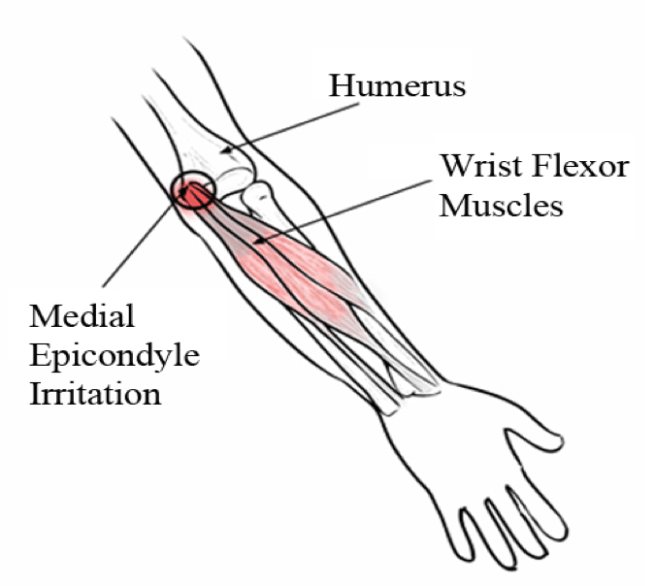
Most of the muscles that flex your wrist are attached to a bony bump on the inside of your elbow called the “medial epicondyle.” Sometimes, through injury or overuse, the site where these muscles originate can become irritated or inflamed. This condition is called “medial epicondylitis”, or “golfer’s elbow.”

Although the condition is named “golfer’s elbow,” over 90% of those affected are not even athletes, much less golfers. Nonetheless, the condition is more common in certain sports, especially golf, throwing, bowling, football, archery, and weight lifting. Occupations that require heavy gripping or repeated hand movements, like carpentry or typing, can predispose you to this condition. Smokers and people who are obese are more likely to experience this condition.

Medial epicondylitis is the most frequent cause of pain on the “inside” of your elbow but is 3-10 times less likely that its “outside” counterpart- lateral epicondylitis (i.e. “tennis elbow”). Medial epicondylitis is most common between the ages of 40 and 60. The condition strikes the dominant arm in over 3⁄4 of cases. Your symptoms will likely include a dull aching pain over the bump on the inside of your elbow that becomes more intense with use. As the condition progresses, you may notice grip weakness or limitations when shaking hands, grasping objects, and opening jars. Be sure to tell your doctor if you notice numbness or tingling traveling toward your hand.

If left untreated, medial epicondylitis can last indefinitely. Studies show that up to 40% of untreated patients suffer prolonged discomfort, some as long as three years. Fortunately, conservative treatment like the type provided in our office is effective for relieving this condition. Our office may prescribe an elbow “counterforce brace” to help dampen stress to the irritated area. This type of brace should not be used in patients who have numbness or tingling radiating into their fingers. Some patients may benefit from a “wrist splint” that is used at night to allow your tendon to heal in a lengthened position. Using ice or ice massage over your elbow can help limit pain. Your home exercises will play an important role in your recovery.

Initially, you may need to avoid activities that cause an increase in pain, like gripping, lifting, golfing, throwing balls, or swinging a racquet. Be sure to warm up properly and stretch prior to any heavy physical activity. Smokers would benefit from quitting. Overweight patients should consider increasing their aerobic activity to shed excess pounds.

page1image812349376

If you or someone you know suffers from this condition, call our office today. Our doctors are experts at relieving many types of pain including elbow injuries.

Cervical Stenosis

Stenosis.jpg

Spinal stenosis means that the tube surrounding your spinal cord and nerve roots is too small, and your nerves are being compressed. Stenosis can arise in different ways. Sometimes, people are born with a spinal canal that is too small. Other times, the canal may have been narrowed by surgery or conditions like disc bulges. Most commonly, spinal stenosis arises from chronic arthritic changes that narrow the canal. This type of stenosis usually develops slowly over a long period of time, and symptoms show up later in life.

The natural progression of stenosis is generally a slow, steady increase, although some patients’ symptoms remain the same or even improve over time. Symptoms grow in relation to the amount of nerve compression. Initially, most patients notice neck pain, headaches, and possible referral of discomfort into their shoulders and upper back. If the nerves that exit your spine become compressed, you will notice radiating pain, numbness, or tingling traveling into your arm. If the condition grows to the point that your spinal cord is compressed, you may notice loss of the fine motor skills of your hands, which translates to clumsiness, difficulty buttoning shirts, trouble using zippers, and changes in handwriting. Sometimes, pain, numbness, or tingling can radiate into your legs. Be sure to tell your doctor if you: notice leg complaints, have difficulty walking, notice balance problems, or have experienced loss of bowel or bladder control. Likewise, tell us if you notice a fever, unexplained weight loss, flu-like symptoms, or numbness & tingling on your face.

Although there is no non-surgical cure for cervical stenosis, treatments are available that may help ease your symptoms. Traction has been shown to help patients with cervical stenosis. If home traction is needed, our office will provide instructions on how this should be performed. You will be taught some stretching exercises to reduce muscle tightness and free up “trapped” nerves. You may also be given exercises to help build strength, flexibility, coordination, balance, and conditioning. You should avoid activities that increase pain, especially looking too far up or down. You may find relief of your symptoms by using ice, heat, or visiting a massage therapist. In severe cases only, surgery may be required to relieve pressure on the spinal cord and nerve roots.

page1image72491840page1image72492112

AMA Discourages Opioids

drugs11

page1image40609616

“A study published in the Journal of the American Medical Association evaluated the

page1image38215472

appropriateness of prescribing opioid medications for the treatment of hip, knee, or low

page1image40799712

back pain concluded:

page1image40390352

“Treatment with opioids was not superior to treatment with non-opioid medications.

page1image4292336240

Results do not support initiation of opioid therapy for moderate to severe chronic back pain or hip or knee osteoarthritis pain.”

page1image40572960

page1image41594864

Shoulder Internal Rotation- Towel

Shoulder Internal Rotation- Towel

  • While standing, place your involved arm behind your back at waist level.
  • Place your uninvolved hand behind your head and grasp a towel between your hands.
  • Leading with your top arm, pull the towel up until you feel a stretch in your involved shoulder.

Gradually increase the stretch over the period of one minute. Perform this stretch twice per day.


*This stretch may alternately be performed as a contract/relax stretch by gently pulling downward on the towel with your involved arm against the steady resistance of your other arm for seven seconds. Relax and gently pull the towel upward with your top arm to increase the stretch in your shoulder. “Lock in” to each new position and repeat three contract/relax cycles twice per day or as directed.

Healthy lifestyles – (Try Avocado Oil)


“One of the lesser known “good” fats we recommend adding to your diet is avocado oil. Like olive oil, it is primarily an Omega 9 oil and is an exceptional health choice with numerous health benefits including anti-inflammatory properties and reduction of harmful free radicals. But, as a bonus, Avocado oil has higher smoke/flash points than olive oil – making it a better alternative for searing or frying.”

Condition of the Month – (Sacroiliac Joint Dysfunction )

SI Joints.jpg

Sacroiliac Joint Dysfunction occurs when one or both of the sacroiliac joints loses normal motion. Learn more about this condition on the blog.

Your sacroiliac joint is the mechanical link on each side of your hip that connects your legs to the rest of your body. The joint has a limited but very important degree of mobility. Symptoms develop when one or both of the joints loses normal motion. When a joint becomes “restricted”, a self-perpetuating cycle of discomfort follows. Restriction causes the muscles to become overworked, leading to tightness, compression, inflammation, pain and more restriction.

Sacroiliac problems can happen as a result of repetitive strenuous activity or trauma- like a fall onto the buttocks. Other causes of sacroiliac joint problems include, poor posture, having one leg slightly longer than another, having an altered gait, having flat feet or scoliosis, or having pain somewhere else in your legs. Pregnancy is a common trigger for sacroiliac joint problems due to weight gain, gait changes and postural stress.

Sacroiliac joint problems often begin as a focal discomfort in your back just below the belt line, slightly to one side of center. Your pain can travel into your buttock or thigh. Symptoms are often worse by standing on the affected side. The pain may become more apparent when you change positions- like exiting a chair, car or bed, or during long car rides. The pain is often relieved by lying down.

To assist with your recovery, you should avoid any activity that provokes pain, like standing on the affected leg or prolonged sitting. Our office may suggest a sacroiliac support belt to help stabilize your joint.

If you are experiencing any of these symptoms, be sure to call us for an evaluation.

4 Reasons To Never Skip Your Cool Down.

From: https://www.shape.com/fitness/tips/post-workout-cool-down-benefits-dynamic-stretches

what-is-mobility-mobility-myths-foam-rolling

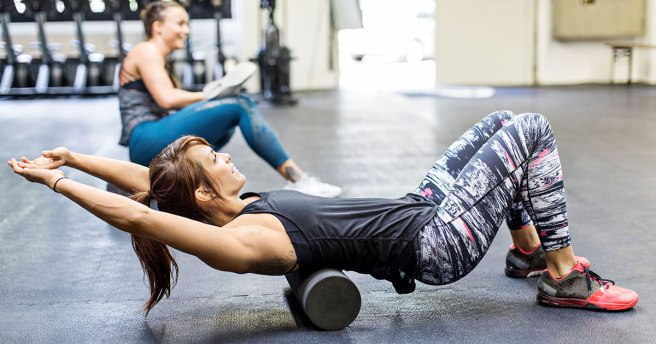
One of the biggest culprits for skipping your workout? Not having enough time. That not only translates to missed classes and training sessions, but it usually means that when you do manage to get to the gym, you’re more inclined to cut corners (like reps, sets, stretches, warm-ups, and cooldowns) to save some precious time.

But when it comes to your post-workout cooldown, you’re really doing your body a disservice by bypassing it. Coming down from, say, a run or a Tabata circuit by slowing your movements and slowly bringing down your heart rate can help you recover more easily, and increase heart health over time, according to a research published in the Journal of Exercise Physiology Online.

Read on to learn about a few more reasons why you shouldn’t skip your post-workout cooldown.

It controls your post-workout blood flow.

Exercise helps get your blood flowing, so abruptly stopping can actually cause your blood pressure to drop rapidly. When blood pressure drops too quickly, it can cause you to feel light-headed, which is why Heather Henri, M.D., an associate professor of medicine at Stanford University, recommends cooling down for about six minutes after you’ve completed a workout. Fainting is also a risk, as this impact on blood flow could cause blood to pool in your lower extremities, which delays its return to your heart and brain, according to research done by the American Council on Exercise. Cooldowns also reduce the concentration of lactic acid. Using active recovery (here are some active recovery exercise examples) to slowly reduce effort, you can actually increase power and endurance during your next round, too. This is exactly why you shouldn’t totally rest between sets during your workout.

It safely slows down your heart rate.

Your internal body temperature rises during a workout, which means your blood vessels are dilated and your heart is beating faster than normal. It’s important to gradually, and safely bring your heart rate back down after a workout, says Dr. Henri. Skipping the cooldown and dropping the heart rate suddenly can put added stress on your heart, according to research published in the journal Frontiers of Medical and Biological Engineering. Try slowing down your movements from, for example, a faster dance cardio flow to a slower one, a run to a walk, or a plyometric exercise to a movement with both feet on the ground, suggests Deborah Yates, a certified group fitness director for the Bay Club in Silicon Valley.

It prevents injury.

Incorporating a cooldown after your workout can help prevent injuries, and that goes for fitness rookies and seasoned athletes alike. Sprains, strains, and tears in the lower back, hip flexors, knees, hamstrings, and quadriceps are some of the most commonly injuries, says Yates. So, you’ll want to focus on elongating your muscle fibers, which have been under tension during your workout, to achieve your full range of motion. This can be done through hip, lower-back, and spine stretches such as a runner’s lunge or side bend, as well as core-balancing poses such as a standing half lotus and standing bow pose, says Yates.

It increases your flexibility.

The best time to work on your flexibility is when your body is fully warm and you’re breaking a sweat. But instead of hopping off the treadmill and going directly into a toe touch, experts suggest doing some dynamic stretches first. This can decrease your risk of injury, relieve back pain, and improve athletic performance, said Tanja Djelevic, Crunch fitness trainer, in “6 Active Stretches You Should Be Doing.” Taking time for this kind of cooldown can also increase your flexibility and mobility over time, which is thought to help avoid muscle tears, back pain, and joint issues. (Still wondering which is more important, mobility or flexibility? Find out. The answer might surprise you.)

Consider Chiropractic for Neck Pain Treatment

what-is-mobility-mobility-myths-foam-rolling

“Chiropractic is a proven, viable treatment for neck pain. A recent study concluded ‘Mobilization, (Cervical and Thoracic) Manipulation, and Clinical Massage are effective interventions for the management of neck pain.’

If you’re experiencing neck pain, consider an effective, conservative method of treatment, such as chiropractic.”

Reference:

Wong JJ, et al. Are manual therapies, passive physical modalities, or acupuncture e_ective for the management of patients with whiplash associated disorders or neck pain and associated disorders? An update of the Bone and Joint Decade Task Force on Neck Pain and Its Associated Disorders by the OPTIMa collaboration. Spine J. 2016 Dec;16(12):1598-1630

Healthy lifestyles (Avoid the Detriments of Sugar)

SUgar Cycle

“Routinely eating products that contain sugar leads to a vicious sugar-craving cycle.

First, sugars are absorbed into our blood and travel to the brain. Then, the sugar in the brain releases a chemical called serotonin that produces a sense of happiness and well- being. Next, as our sugar blood levels fall due to insulin production and sugar absorption, we move from a hyperactive state to more of a tired, irritable and weak state.

This causes concentration levels to fall, and our cells begin to become acidic. Our brain then once again sends a message that we need more sugar, and the cycle repeats itself. Cutting refined sugars out of your diet, or at least decreasing them, will help you avoid this cycle and feeling your best.”