
The gluteus Maximus is the buttock muscle. It originates on the gluteal surface of the ilium, lumbar fascia, sacrum and sacrotuberous ligament. It inserts on the gluteal tuberosity of the femur and the iliotibial tract. Extension and lateral rotation of the hip are it’s main actions. This muscle is heavily involved in activities like ice skating and is a common area to develops trigger points. When trigger points do develop they can refer pain in a crescent pattern from the gluteal fold to the sacrum. Trigger points can also refer pain deep into the buttock itself making it feel like other deeper muscles are involved. These symptoms can sometimes be mistaken for s.i. Joint problems. 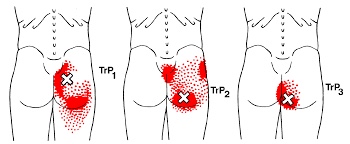
Running
SI Joint Dysfunction. Nothing FUN about it.
Your sacroiliac joint is the mechanical link on each side of your hip that connects your legs to the rest of your body. The joint has a limited but very important degree of mobility. Symptoms develop when one or both of the joints loses normal motion. When a joint becomes “restricted”, a self-perpetuating cycle of discomfort follows. Restriction causes the muscles to become overworked, leading to tightness, compression, inflammation, pain and more restriction.
 Sacroiliac problems can happen as a result of repetitive strenuous activity or trauma- like a fall onto the buttocks. Other causes of sacroiliac joint problems include, poor posture, having one leg slightly longer than another, having an altered gait, having flat feet or scoliosis, or having pain somewhere else in your legs. Pregnancy is a common trigger for sacroiliac joint problems due to weight gain, gait changes and postural stress.
Sacroiliac joint problems often begin as a focal discomfort in your back just below the belt line, slightly to one side of center. Your pain can travel into your buttock or thigh. Symptoms are often worse by standing on the affected side. The pain may become more apparent when you change positions- like exiting a chair, car or bed, or during long car rides. The pain is often relieved by lying down.
To assist with your recovery, you should avoid any activity that provokes pain, like standing on the affected leg or prolonged sitting.
Turf Toe? What Is That?
“Turf toe” means that the strong fibrous ligaments connecting your big toe to your foot have been stretched too far and have been “sprained.” This most commonly happens when your big toe is extended forcibly toward the top of your foot. This may happen abruptly from a fall or when something lands on the back of your calf while your toes are touching the ground. Turf toe commonly occurs from jamming your big toe into a hard surface. Occasionally, the injury happens over a long period of time from repetitive stress- like pushing off of the big toe each time you run or jump.

The term “turf toe” was coined because this injury became more common in athletes with the implementation of artificial turf fields. Turf toe injuries rank third after knee and ankle injuries among the most common cause for lost playing time in athletes.
A turf toe injury causes pain and swelling at the base of your big toe. You will notice your pain probably increases when your toe is straightened or bent backward toward the top of your foot. Sometimes you may notice bruising shortly after the injury. Gout, a type of arthritis that is more common in men, can sometimes act like turf toe. Be sure to tell your doctor if you or someone in your family has a history of gout.
Early treatment is focused on keeping your toe from moving too much. Depending upon the severity of the injury, turf toe usually requires a period of rest for proper healing. When directed, you may begin non-weight bearing activities, such as stationary cycling or swimming. You should take a close look at your shoes before returning to play. Wearing excessively flexible shoes on a turf field increases your chance of injury. Consider a stiff-soled shoe or hard carbon fiber insert during initial healing. When you are able to run and change directions without pain or loss of mobility, you will likely be allowed to return to play. Be sure to ice your toe for 10-15 minutes following any activity while your injury is healing.
My ankle hurts…….
The posterior tibialis muscle begins deep in your calf. The muscle is connected to the arch of your foot by a tendon that runs along the inside of your ankle, just behind the large bump called the medial malleolus. When you walk, the posterior tibialis muscle lifts the arch of your foot. 
Posterior tibial tendon dysfunction is one of the most common foot and ankle problems. The tendon may be damaged from an acute injury, like an accident or fall. More commonly, problems arise from overuse or repeated strain. Ongoing irritation slowly damages the tendon’s fibers and eventually leads to weakening and degeneration. This decreases the tendon’s ability to support your foot when you walk. As the tendon becomes less effective, the arch of your foot is allowed to collapse, which further increases the strain on the muscle and tendon.
The condition is often triggered from overuse and/or training on excessively hard surfaces. Other factors that can contribute to posterior tibial tendon dysfunction include: obesity, diabetes, hypertension, prior surgery or steroid injections.
Symptoms include pain or swelling along the course of the tendon, particularly behind your inner ankle bone. Symptoms often begin following an increase in training intensity or duration. Standing, walking, or running will likely increase your discomfort. Your pain may be aggravated by spending prolonged periods of time on your feet, especially, when standing tiptoe and walking stairs or uneven surfaces.
Early diagnosis and treatment is important to slow progression of the disorder. You may need to temporarily limit weight-bearing activity to allow your tendon to heal. Using a stationary cycle, elliptical machine, or swimming can be good alternatives to walking and running. Your doctor will likely prescribe arch supports or orthotics to help support your foot. You will be given exercises to strengthen the posterior tibialis muscle. These exercises should be performed while wearing shoes with good arch supports. In certain instances, a walking cast or boot may be needed to temporarily protect your foot.
The Dreaded Lateral Ankle Sprain
“Ligaments” are made up of many individual fibers running parallel to each other and bundled to form a strong fibrous band. These fibrous bands hold your bones together. Just like a rope, when a ligament is stretched too far, it begins to fray or tear. “Sprain” is the term used to describe this tearing of ligament fibers.
Sprains are graded by the severity of damage to the ligament fibers. A Grade 1 sprain means the ligament has been painfully stretched, but no fibers have been torn. A Grade 2 sprain means some, but not all, of the ligaments’ fibers have been torn. A Grade 3 sprain means all of the ligaments’ fibers have been torn, and the ligament no longer has the ability to protect the joint.


Ankle sprains are the most common soft-tissue injury and will affect up to 20% of active people at some point in their life. Most ankle sprains occur because you have “rolled your ankle” inward. Sprains on the outer side of your ankle are much more common than sprains on the inner side. People who have suffered a prior ankle injury are more likely to suffer subsequent ankle injuries.
Ankle sprains cause pain and swelling over the outside of your ankle. Walking may be difficult, and bruising is common. Be sure to tell your doctor if you experience numbness, tingling, or a dramatic cold sensation in your foot, as this may indicate more significant injury.
Ankle sprains can be successfully managed but will require some work on your part. You can help reduce swelling by elevating your ankle by lying or sitting with your foot elevated or by using an ACE wrap for compression. Applying ice or ice massage for 10 minutes each hour may help relieve swelling. Depending upon the severity of your sprain, you may need to wear an ankle brace to help protect you from further injury. If walking is painful, crutches may be necessary.
Initially, a period of rest may be necessary in order to help you heal. Mild Grade 1 sprains may allow return to sport in a couple of days, while more severe injuries may take six weeks or longer to recover. Surgery is rarely necessary.
Pathophysiology of trigger points.
A large number of factors have been identified as causes of trigger point activation. These include acute or chronic overload of muscle tissue, disease, psychological distress, systemic inflammation, homeostatic imbalances, direct trauma, radiculopathy, infections, and lifestyle choices such as smoking. Trigger points form as a local contraction of muscle fibres in a muscle or bundle of muscle fibres. These can pull on ligaments and tendons associated with the muscle which can cause pain to be felt deep inside a joint. It is theorized that trigger points form from excessive release of acetylcholine causing sustained depolarization of muscle fibres. Trigger points present an abnormal biochemical composition with elevated levels of acetylcholine, noradrenaline and serotonin and a lower ph. The contracted fibres in a trigger point constricts blood supply to the area creating an energy crisis in the tissue that results in the production of sensitizing substances that interact with pain receptors producing pain. When trigger points are present in a muscle there is often pain and weakness in the associated structures. These pain patterns follow specific nerve pathways that have been well mapped to allow for accurate diagnosis or the causative pain factor.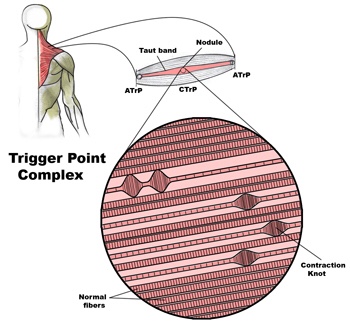
Diagnosis of trigger points.
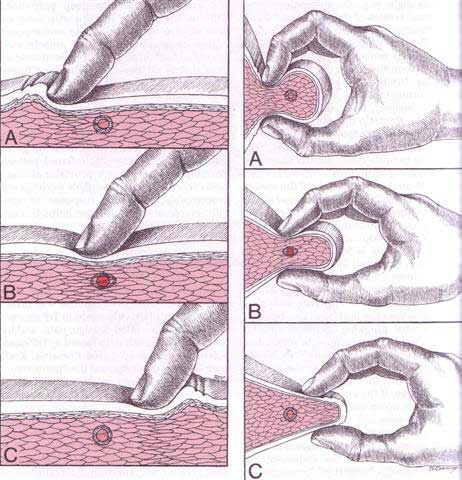
Diagnosis of trigger points typically takes into account symptoms, pain patterns, and manual palpation. When palpating the therapist will feel for a taut band of muscle with a hard nodule within it. Often a local twitch response will be elicited by running a finger perpendicular to the muscle fibres direction. Pressure applied to the trigger point will often reproduce the pain complaint of the patient and the referral pattern of the trigger point. Often there is a heat differential in the local area of the trigger point. 
What is a trigger point
Dr Janet travel coined the term trigger point in 1942 to describe clinical findings with characteristics of pain related a discrete irritable point in muscle or fascia that was not caused by acute trauma, inflammation, degeneration, neoplasm or infection. The painful point can be palpated as a nodule or tight band in the muscle that can produce a local twitch response when stimulated. Palpation of the trigger point reproduces the pain and symptoms of the patient and the pain radiates in a predictable referral pattern specific to the muscle harbouring the trigger point.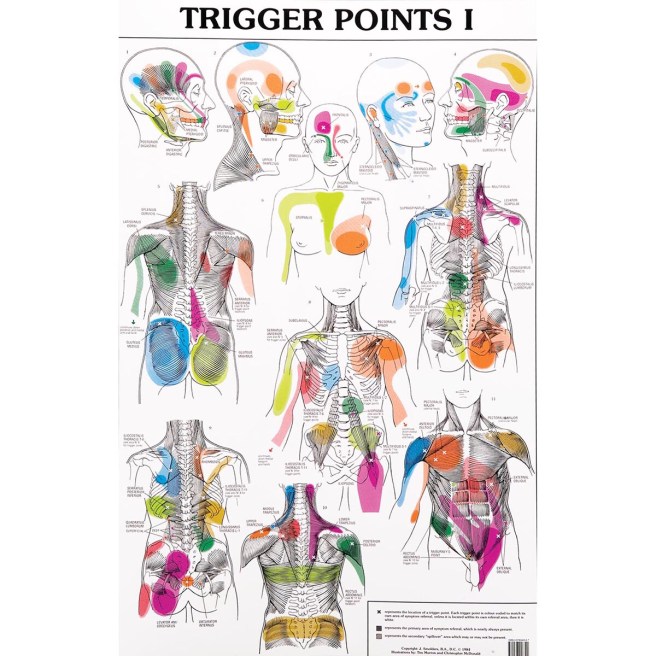
What to expect with a trigger point massage.
A treatment with Bryan is very user friendly. And, no, you don’t have to remove any clothing. However, bringing a t-shirt and a pair of shorts or sweats is recommended.
The first time you come for a treatment you will be asked to fill out a Client History form. Bryan will go over the information you provide, asking for more detail and discussing the type of pain you are having and its location.
The treatment itself involves locating the Trigger Points in the muscle or soft tissue and applying a deep focused pressure to the Point. This will reproduce the pain and the referral pattern that is characteristic of that pain.
The treatment will be uncomfortable at first, but as the Trigger Points release, the pain will decrease. The pressure will always be adjusted to your tolerance level. If, at any time, you feel too uncomfortable you can ask Bryan to ease off a bit.
Depending on your specific problem, Bryan may also use some stretching and / or range-of-motion techniques, as needed.
After treatment, it is usually recommended that the client apply moist heat to the area treated.
Home Gym Essentials
So you want to build your own home gym but you have no idea what kind of equipment to buy. There are two main limiting factors in outfitting a workout area in your house or apartment—space and budget—but with proper planning, you can design an exercise studio perfectly tailored to your needs. Simply start with the essentials, and then branch out to more specialized equipment as you need it. Below are a few of the essentials that can get your started on your home gym journey.
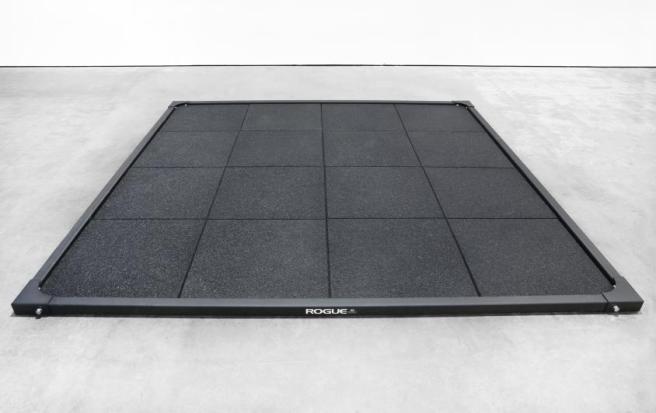
Quality Mats
No matter what your plans are for your home gym a good quality floor mat is key. You can opt for the single mat for stretching and floor work or go shoe hog with an entire flooring system but be sure to go with a high quality, durable product. Rogue Canada has some great products in this (and most) category from floor mats to olympic lifting platforms, as do spots from Fitness Experience to Home Depot.
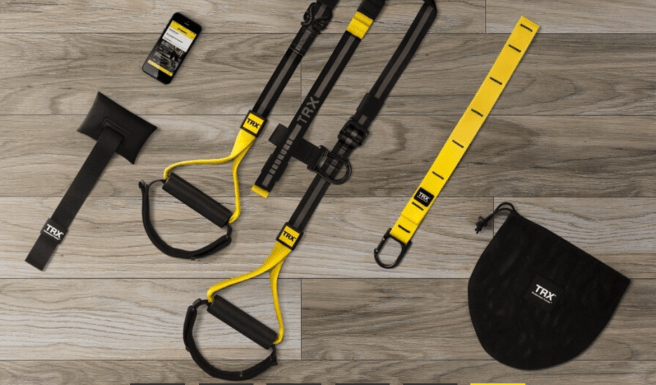
Suspension Trainer
Maximizing use of space and finding tools with multiple uses are keys when designing your home gym. One of the best pieces of equipment for both those concerns are suspension trainers. The TRX Home2 System is one of the best purchases you can make for your home gym. It includes the latest TRX Suspension Trainer for homes, as well access to the TRX app. (With more than 80 workouts designed by world-class trainers, the app will keep you busy.) While the Home2 System costs less than $200, it is one of the bigger purchases on this list. What makes it worthwhile is that Suspension Training offers a full-body workout that can be modified for any fitness level.
Resistance Bands
Easy to store, easy to use, easy to afford and easy to scale. Resistance bands are a great addition to any home gym. From stands of tubing to elastic loops and heavy resistance with handles, resistance bands come in many shapes and sizes and can be used to add to any fitness routine. Depending on your fitness goals, resistance tubing can be your main source of muscle building or an add oil that enhances lifts. They are a rehab essential as well when working through those nagging injuries that we all get from time to time and a key part of training for pliability as shown in the TB12 method. Every major fitness retailer has dozens of options for you and can help you decide on what you need based on your goals.
![brady-12967[1]](https://aberdeenchiropracticblog.com/wp-content/uploads/2017/11/brady-129671.jpg?w=656)
This list is a great start for your home fitness journey but isn’t all inclusive by any means. Everyone’s goals are different, require different levels of equipment and different levels of motivation. The key with any of them is to get committed, get started and get moving!
 Aberdeen Chiropractic