How trigger points form

Trigger points form only in muscles. They form as a local contraction in a small number of muscle fibers in a larger muscle or muscle bundle. These in turn can pull on tendons and ligaments associated with the muscle and can cause pain deep within a joint where there are no muscles. The integrated hypothesis theory states that trigger points form from excessive release of acetylcholine which produces sustained depolarization of muscle fibers. Indeed, the trigger point has an abnormal biochemical composition with elevated concentrations of acetylcholine, noradrenaline and serotonin and a lower pH.[5] These sustained contractions of muscle sarcomeres compresses local blood supply restricting the energy needs of the local region. This crisis of energy produces sensitizing substances that interact with some nociceptive (pain) nerves traversing in the local region which in turn can produce localized pain within the muscle at the neuromuscular junction (Travell and Simons 1999). When trigger points are present in muscles there is often pain and weakness in the associated structures. These pain patterns in muscles follow specific nerve pathways and have been readily mapped to allow for identification of the causative pain factor. Many trigger points have pain patterns that overlap, and some create reciprocal cyclic relationships that need to be treated extensively to remove them.

How trigger points form.

Activation of trigger points may be caused by a number of factors, including acute or chronic muscle overload, activation by other trigger points (key/satellite, primary/secondary), disease, psychological distress (via systemic inflammation), homeostatic imbalances, direct trauma to the region, collision trauma (such as a car crash which stresses many muscles and causes instant trigger points) radiculopathy, infections and health issues such as smoking.

Trigger point signs and symptoms

Pain related to a discrete, irritable point in skeletal muscle or fascia, not caused by acute local trauma, inflammation, degeneration, neoplasm or infection.
The painful point can be felt as a nodule or band in the muscle, and a twitch response can be elicited on stimulation of the trigger point.
Palpation of the trigger point reproduces the patient’s complaint of pain, and the pain radiates in a distribution typical of the specific muscle harboring the trigger point.

Fascial planes.

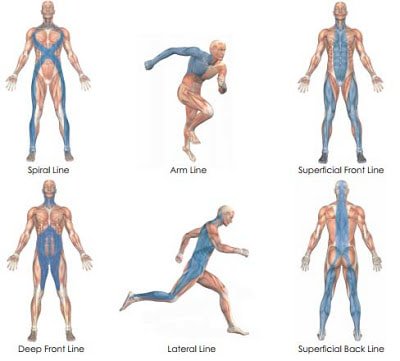
fascial connective tissue runs throughout all the bodies layers. It gives the body shape and function. Fascial litterally connects every part of your together. During movement when one part of the body moves, the body as a whole responds. Functionally the only tissue that can facilitate such responsiveness is the connective tissue. When one area of the body gets restricted or damaged, the body as a whole can become dysfunctional by setting up compensation patterns.

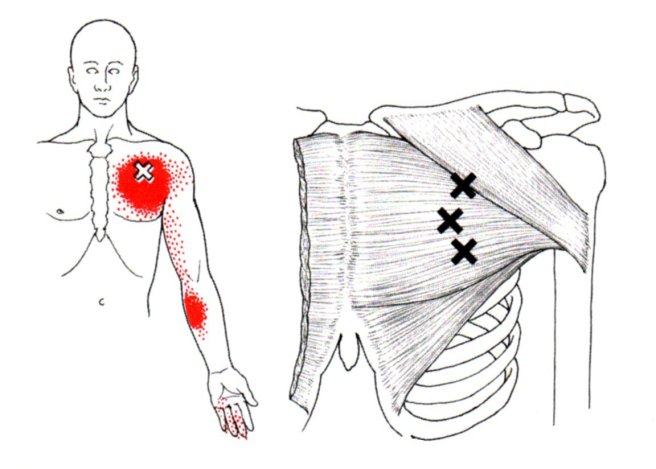
Trigger points in the pectoralis major muscle.

the pectoralis major is the main muscle of the chest. It is a powerful adductor of the arm. This muscle often is tight and shortened from poor shoulder posture. Trigger points in this muscle will cause pain to refer into the chest, shoulder, and down the arm. Trigger points in the left pec can mimic heart attack and angina symptoms.

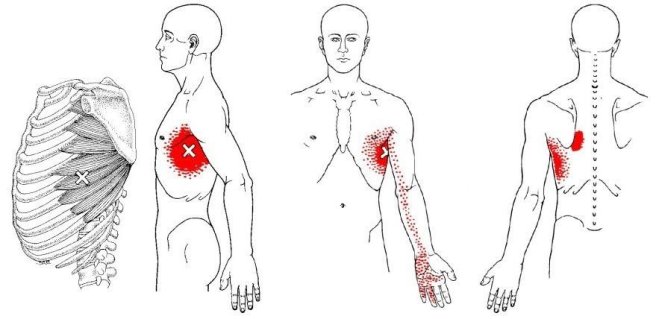
Trigger points in the serratus anterior.

The serratus anterior muscle is responsible for scapular and rib movement and stability. This muscle can become overloaded from poor posture of the shoulders, as well as heavy breathing from exertion. Trigger points in this muscle will cause pain to be felt under the armpit into the shoulder blade area, and down the arm into the fingers.

Trigger points up close.

trigger points are one of the most common sources of pain in the body. Once a trigger point has formed it won’t release on its own. Trigger point massage is one of the most effective way to release a point. It involves using a deep focused pressure applied directly to the knot. This frees the contracted tissue and stimulates healing.