Trigger points in the temporalis muscle

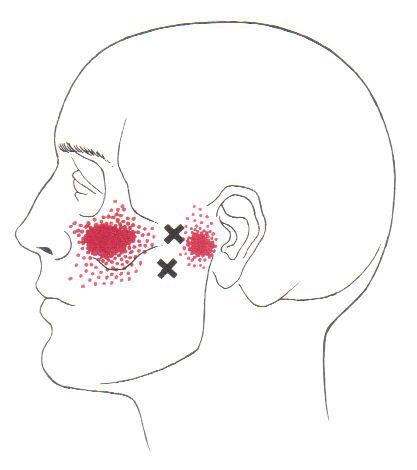
The temporalis muscle is located on the sides of the skull at the temple. This muscle assists in jaw movements for chewing and talking etc. This muscle can become overworked from excessive clenching of the jaw and grinding of the teeth from stress. Poor neck posture can also stress the muscles of the jaw. When this happens trigger points can form. These points can refer pain into the temple, skull, and face. These trigger points can also cause tooth sensitivity and pain.

Trigger points in the lateral pterygoid.

The lateral pterygoid muscle is involved in movement of the jaw. It can become become strained from chronic clenching of the jaw and grinding of the teeth. When this happened trigger points can form. This leads not only to pain and refered pain, but also dysfunctional joint mechanics. This muscle is a major player in TMJ dysfunction syndrome.

Trigger points in the multifidus muscle.

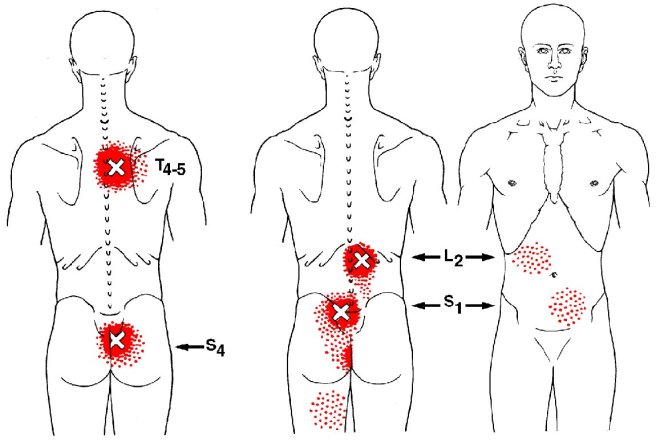
The multifidus muscle is a long muscle that travels the length of the spine. It has different actions on different parts of the spine. It extends and laterally flexes the cervical and lumbar spine, and rotates the thoracic spine. Trigger points in this muscle are common due to poor posture and bad movement mechanics. Trigger points in the lumbar area area are a common cause of low back pain. These lower points can also refer into the abdomen. Points that form in the cervical region will refer pain down the neck into the shoulder blade area.

The rectus femoris muscle is one of your quad muscles. It acts primarily to extend the knee but it also helps to flex the hip. This muscle is often overloaded from athletic activity, but it also can become chronically shortened from prolonged sitting. Trigger points will refer pain deep into the knee producing a deep ache felt into the joint.

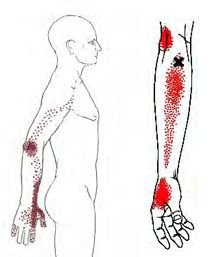
The brachioradialis muscle is located in your forearm, this muscle is responsible for helping to flex the elbow during semi pronation. Because of this it is sometimes called your drinking muscle. trigger points in this muscle will cause pain to refer into the elbow, down the forearm and into the hand. When severe enough trigger point pain can event travel up the arm.

Rhomboid trigger points

the rhomboids are muscles located in your upper back. They lie underneath the trapezius muscle. These muscles are responsible for retracting your scapula, or pulling your shoulder blades back. Since poor posture causes the shoulders to round forward, the rhomboids are often strained. When this happens trigger points will form. These points cause deep achy pain to be felt along the shoulder blade. Once trigger points have formed they will not release on there own. A manual release such as trigger point massage is required.

Trigger points in your “Lats”

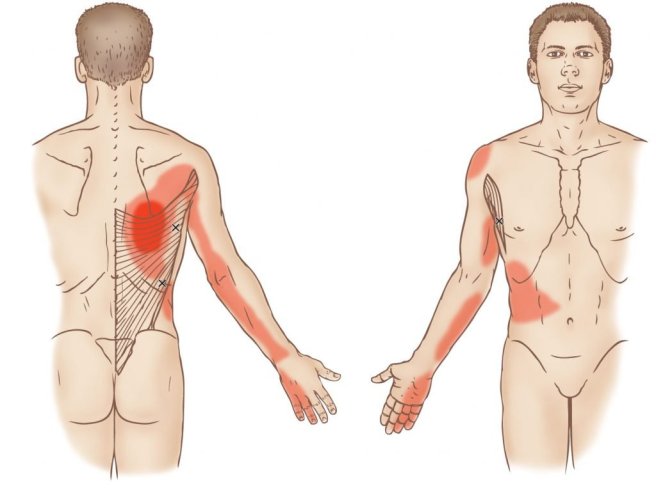
Your lats, or your latissimus dorsi muscles are the largest muscles of the back. They are responsible for adducting and medially rotating the arm. This muscle also produces extension at the shoulder joint. When trigger points for In this muscle, they can refer pain into the back, down the inside of the arm into the hand. These trigger points can also cause pain to be felt into the front of the shoulder. Once formed trigger points will not release on there own. They require a manual release technique like trigger point massage.

Trigger point massage therapy.

Trigger points are hyper irritable knots found in muscle tissue. These points form in a muscle due to overload stress. Trigger points can form anywhere, in any muscle. Once formed they irritate sensory nerves and produce pain, refered pain, weakness, and stiffness. Trigger points will also mimic symptoms of other conditions such as “sciatica” or Carple tunnel syndrome. Trigger points will not go away on there own, they must be manually released with hands on techniques like trigger point massage.

How trigger points form

Trigger points form only in muscles. They form as a local contraction in a small number of muscle fibers in a larger muscle or muscle bundle. These in turn can pull on tendons and ligaments associated with the muscle and can cause pain deep within a joint where there are no muscles. The integrated hypothesis theory states that trigger points form from excessive release of acetylcholine which produces sustained depolarization of muscle fibers. Indeed, the trigger point has an abnormal biochemical composition with elevated concentrations of acetylcholine, noradrenaline and serotonin and a lower pH.[5] These sustained contractions of muscle sarcomeres compresses local blood supply restricting the energy needs of the local region. This crisis of energy produces sensitizing substances that interact with some nociceptive (pain) nerves traversing in the local region which in turn can produce localized pain within the muscle at the neuromuscular junction (Travell and Simons 1999). When trigger points are present in muscles there is often pain and weakness in the associated structures. These pain patterns in muscles follow specific nerve pathways and have been readily mapped to allow for identification of the causative pain factor. Many trigger points have pain patterns that overlap, and some create reciprocal cyclic relationships that need to be treated extensively to remove them.

Trigger points in the suboccitpitals

the suboccipital muscles are a group of small muscles located at the base of the skull. These muscles are responsible for small movements of the head and the first two vertebrae. They also play a roll in postural stability of the skull. Trigger points are common in people with poor neck posture. these points will refer pain deep into the skull and behind the eye. They are a common source of headache pain.