

http://www.cbc.ca/beta/news/canada/calgary/fall-fitness-calgary-tips-1.4306014
The CBC actually earning our tax dollars with a solid article on fitness!
http://www.cbc.ca/beta/news/canada/calgary/fall-fitness-calgary-tips-1.4306014
The CBC actually earning our tax dollars with a solid article on fitness!
Folks suffering with fibromyalgia (FM) commonly complain that certain foods can make their symptoms worse. How common is this? One study reported 42% of FM patients found that certain foods worsened their symptoms!
Because FM affects each person differently, there is no ONE FM diet or, “…one size fits all” when it comes to eating “right” for FM. Patients with FM usually find out by trial and error which foods work vs. those that consistently don’t. However, remembering which foods do what can be a challenge so FIRST, make a three column FOOD LOG with the following headings: BETTER, NO CHANGE, WORSE. This will allow you to QUICKLY review the list as a memory refresher.
According to Dr. Ginevra Liptan, medical director of the Frida Center for Fibromyalgia (Portland, OR) and author of Figuring Out Fibromyalgia: Current Science and the Most Effective Treatments, there are some common trends she’s observed through treating FM patients. Here are some of her recommendations:
PAY ATTENTION TO HOW FOOD MAKES YOU FEEL: It is quite common to have “sensitivities” to certain foods, but this is highly variable from person to person. Examples of problematic foods/ingredients include: MSG (commonly used in Chinese food), other preservatives, eggs, gluten, and dairy. Dr. Liptan HIGHLY recommends the food journal approach! She also recommends including a note about the type of symptoms noticed with each “WORSE” food, as symptoms can vary significantly.
ELIMINATE CERTAIN FOODS: If you suspect a certain food may be problematic, try an elimination challenge diet. That means STOP eating that food for six to eight weeks and then ADD it back into your diet and see how you feel. Remember, FM sufferers frequently have irritable bowel syndrome, also known as IBS, and this approach can be REALLY HELPFUL! Food allergies may be part of the problem, and your doctor may refer you for a consult with an allergist and/or a dietician. They will also discuss the “anti-inflammatory diet” with you.
EAT HEALTHY: In general, your diet should emphasize fruits and vegetables and lean protein. Pre-prepare food so you have something “healthy” to reach for rather than a less healthy snack when you’re hungry and tired. Consider “pre-washed” and pre-cut up vegetables; try quinoa rather than pasta. Consume anti-fatigue foods and eat multiple small meals daily vs. one to two large meals. Protein snacks (like a hardboiled egg or oatmeal – GLUTEN FREE) help a lot! Eat breakfast and include protein. Also, GET ENOUGH SLEEP (at least seven to eight hours and be consistent)!
SUPPLEMENTS: Consider a good general multi-vitamin, calcium and magnesium, omega-3 fatty acids, vitamin D3, and Co-Enzyme Q10. There are others, but this represents a great place to start. Remember to check any medication you may be taking with these/any suggestions before taking supplements!
If you, a friend or family member requires care for Fibromyalgia, we sincerely appreciate the trust and confidence shown by choosing our services!
There is a lot to be learnt from this video. Dr. Mike Evans does a great job of explaining why we need to KEEP MOVING during and after an episode of low back pain. Check it out!
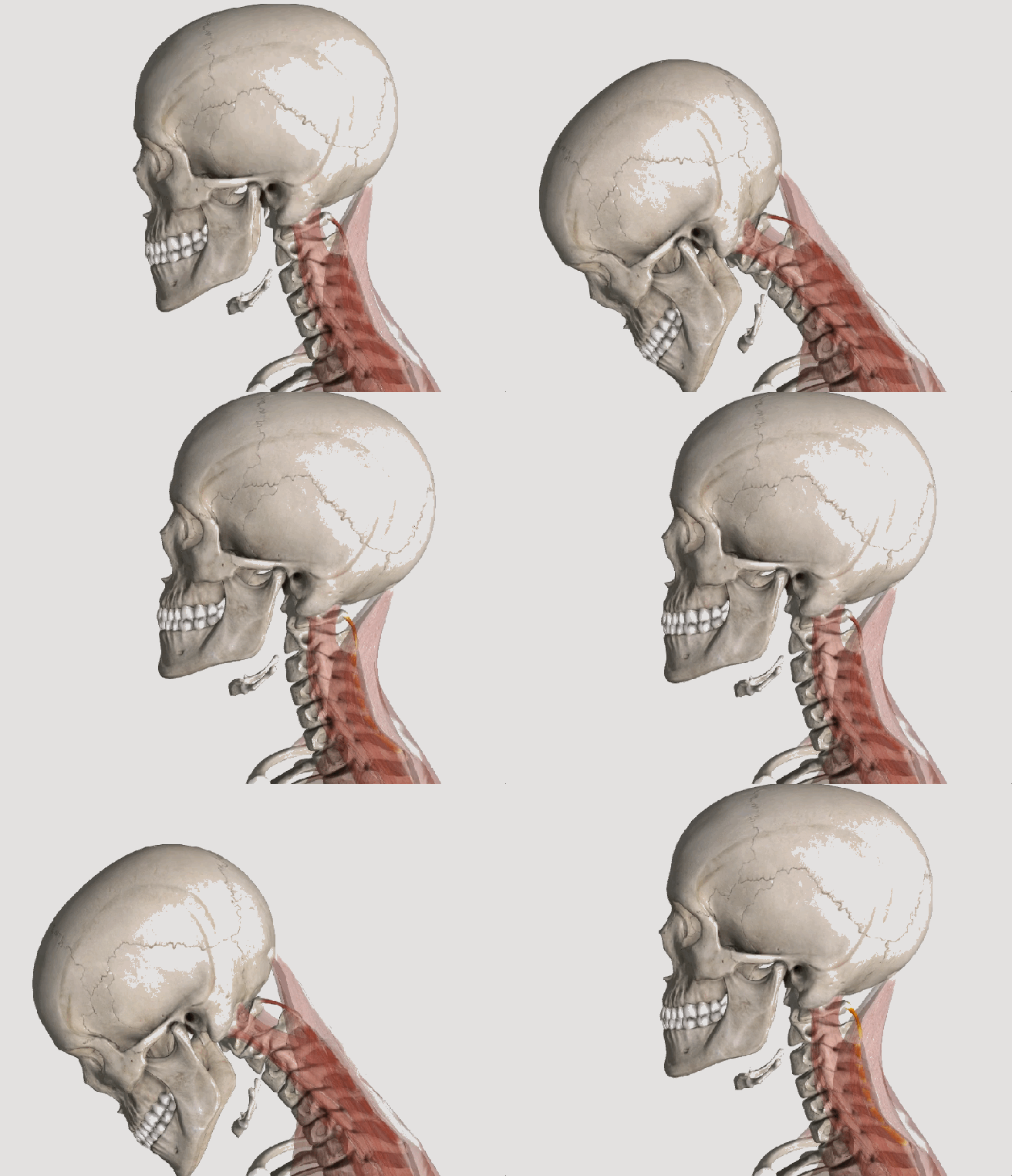
Whiplash is an injury to the soft-tissues of the neck often referred to as a sprain or strain. Because there are a unique set of symptoms associated with whiplash, doctors and researchers commonly use the term “whiplash associated disorders” or WAD to describe the condition.
WAD commonly occurs as a result of a car crash, but it can also result from a slip and fall, sports injury, a personal injury (such as an assault), and other traumatic causes. The tissues commonly involved include muscle tendons (“strain”), ligaments and joint capsules (“sprains”), disk injuries (tears, herniation), as well as brain injury or concussion—even without hitting the head!
Symptoms vary widely but often include neck pain, stiffness, tender muscles and connective tissue (myofascial pain), headache, dizziness, sensations such as burning, prickly, tingling, numbness, muscle weakness, and referred pain to the shoulder blade, mid-back, arm, head, or face. If concussion occurs, additional symptoms include cognitive problems, concentration loss, poor memory, anxiety/depression, nervousness/irritability, sleep disturbance, fatigue, and more!
Whiplash associated disorders can be broken down into three categories: WAD I includes symptoms without any significant examination findings; WAD II includes loss of cervical range of motion and evidence of soft-tissue damage; and WAD III includes WAD II elements with neurological loss—altered motor and/or sensory functions. There is a WAD IV which includes fracture, but this is less common and often excluded.
Treatment for WAD includes everything from doing nothing to intensive management from multiple disciplines—chiropractic, primary care, physical therapy, clinical psychology, pain management, and specialty services such as neurology, orthopedics, and more. The goal of treatment is to restore normal function and activity participation, as well as symptom management.
The prognosis of WAD is generally good as many will recover without residual problems within days to weeks, with most people recovering around three months after the injury. Unfortunately, some are not so lucky and have continued neck pain, stiffness, headache, and some develop post-concussive syndrome. The latter can affect cognition, memory, vision, and other brain functions. Generally speaking, the higher the WAD category, the worse the prognosis, although each case MUST be managed by its own unique characteristics. If the injury includes neurological loss (muscle strength and/or sensory dysfunction like numbness, tingling, burning, pressure), the prognosis is often worse.
Chiropractic care for the WAD patient can include manipulation, mobilization, and home-based exercises, as well as the use of anti-inflammatory herbs (ginger, turmeric, proteolysis enzymes (bromelain, papain), devil’s claw, boswellia extract, rutin, bioflavonoid, vitamin D, coenzyme Q10, etc.) and dietary modifications aimed at reducing inflammation and promoting healing.
* 83% of those patients involved in an MVA will suffer whiplash injury and 50% will be symptomatic at 1 year.
* 90% of patients with neurologic signs at onset may be symptomatic at 1 year.
* 25- 80% of patients who suffer a whiplash injury will experience late-onset dizziness
* Clinicians should be observant for radiographic signs of instability, including interspinous widening, vertebral subluxation, vertebral compression fracture, and loss of cervical lordosis.
* Horizontal displacement of greater than 3.5 mm or angular displacement of more than 11 degrees on flexion/extension views suggests instability.



Your spine is made up of 24 bones stacked on top of each other with a soft “disc” between each segment to allow for flexibility. Normally, each joint in your spine should move freely and independently. When one or more of your spinal vertebra is slightly misaligned and restricted, we call this condition a “spinal segmental joint restriction”. A “thoracic joint restriction” means that this misalignment or restriction is located in your upper or mid-back region.
To help visualize this, imagine a normal spine functioning like a big spring moving freely in every direction. A spine with a joint restriction is like having a section of that spring welded together. The spring may still move as a whole, but a portion of it is no longer functioning.
Joint restrictions can develop in many ways. Sometimes they are brought on by an accident or an injury. Other times, they develop from repetitive strains or poor posture. Being overweight, smoking, strenuous work, and emotional stress can make you more susceptible to problems.
Restricted joints give rise to a self-perpetuating cycle of discomfort. Joint restriction causes swelling and inflammation, which triggers muscular guarding leading to more restriction. Since your spine functions as a unit, rather than as isolated pieces, a joint restriction in one area of your spine often causes “compensatory” problems in another. Think of this as a rowboat with multiple oarsmen on each side. When one rower quits, the others are placed under additional stress and can become overworked.
Joint restrictions most commonly cause local tenderness and discomfort. You may notice that your range of motion is limited. Movement may increase your discomfort. Pain from a restricted joint often trickles around your rib cage or up & down your spine. Be sure to tell your chiropractor if your symptoms include any chest pain, shortness of breath, unusual cough, indigestion or flu- like complaints.
Long-standing restrictions are thought to result in arthritis – much like the way a slightly misaligned wheel on your car causes premature wearing of your tire.
You should recognize that your problem is common and generally treatable. Chiropractic care has been shown to be the safest and most effective treatment for joint restrictions. Our office offers several tools to help ease your pain. To speed your recovery, you should avoid activities that increase your pain. Be sure to take frequent breaks from sedentary activity. Yoga has been shown to help back pain sufferers so consider joining a class or picking up a DVD.


Define what makes you your best self. Define what makes you happy, healthy and well and stop at nothing to get there.
In 2015, two million Americans had a substance abuse disorder involving prescription pain relievers; with more than 20,000 overdose deaths related to these drugs. In the past decade, death rates and substance use rates quadrupled in parallel to sales of prescription pain relievers.
Chronic LBP is a primary generator for opioid prescriptions. This year, both JAMA and Annals of Internal Medicine have published and supported new clinical practice guidelines that recommend prescribing spinal manipulation over medication for LBP patients.
“For acute, subacute, or chronic low back pain, physicians and patients initially utilize spinal manipulation and delay pharmacologic management.”
Research shows that low back pain patients who undergo chiropractic care have improved outcomes with lower rates of opioid use, surgery, and overall healthcare costs.
Not surprisingly, various governing bodies, including the FDA, CDC, and 37 State Attorney General’s, have concurred that physicians and healthcare decision makers should consider non- pharmacologic therapy for LBP patients. In fact, the 2018 Joint Commission guidelines mandate that hospitals include conservative options for chronic musculoskeletal pain management, specifically naming chiropractic as a potential option.
Chiropractic care is not a replacement for traditional medical treatment of LBP, rather a complementary tool to integrate within your current management paradigm. We hope that you will continue to consider our office for those cases that may be favorably served by conservative manual therapy. We are grateful for your confidence and will work hard to maintain your trust.

 Aberdeen Chiropractic