Chiropractic as THE alternative to Opioids.

In 2015, two million Americans had a substance abuse disorder involving prescription pain relievers; with more than 20,000 overdose deaths related to these drugs. In the past decade, death rates and substance use rates quadrupled in parallel to sales of prescription pain relievers.

Chronic LBP is a primary generator for opioid prescriptions. This year, both JAMA and Annals of Internal Medicine have published and supported new clinical practice guidelines that recommend prescribing spinal manipulation over medication for LBP patients.

“For acute, subacute, or chronic low back pain, physicians and patients initially utilize spinal manipulation and delay pharmacologic management.”

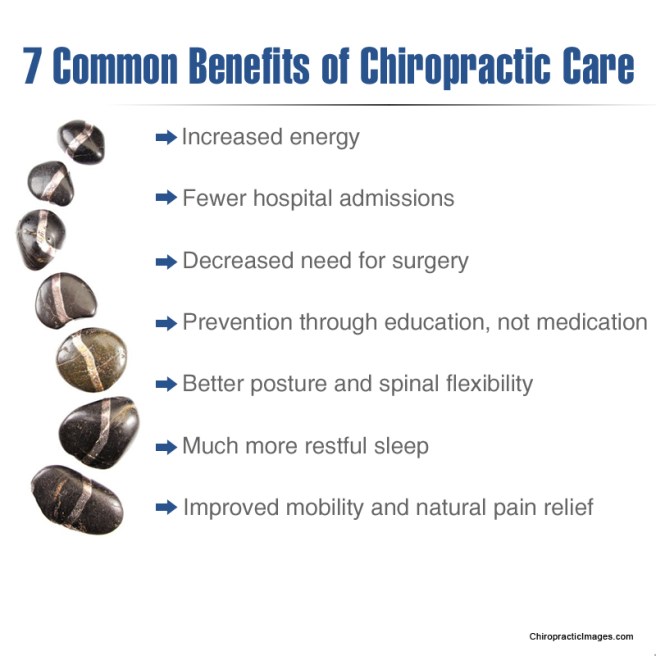
Research shows that low back pain patients who undergo chiropractic care have improved outcomes with lower rates of opioid use, surgery, and overall healthcare costs.

Not surprisingly, various governing bodies, including the FDA, CDC, and 37 State Attorney General’s, have concurred that physicians and healthcare decision makers should consider non- pharmacologic therapy for LBP patients. In fact, the 2018 Joint Commission guidelines mandate that hospitals include conservative options for chronic musculoskeletal pain management, specifically naming chiropractic as a potential option.

Chiropractic care is not a replacement for traditional medical treatment of LBP, rather a complementary tool to integrate within your current management paradigm. We hope that you will continue to consider our office for those cases that may be favorably served by conservative manual therapy. We are grateful for your confidence and will work hard to maintain your trust.

Do you have CTS?

Carpal Tunnel

Carpal tunnel syndrome (CTS) can be an extremely painful and activity-limiting condition. It affects many people of all ages and genders, though women are affected more often than men. But how do you know if what you are suffering from is truly CTS or if it’s another condition that’s producing the symptoms in your hand or wrist?
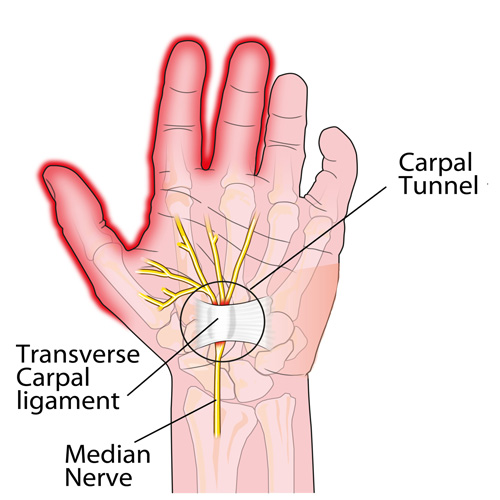
Carpal tunnel syndrome occurs when the median nerve is compressed as it passes through the wrist. However, the median nerve travels out of the neck, through the shoulder, elbow, and forearm before it passes through the wrist and into the hand. Pinching of the median nerve ANYWHERE along its course can give rise to the signs and symptoms of CTS including numbness, tingling, and/or pain into the hand and index, third, and thumb-side half of the fourth digits, and sometimes the thumb. If the pinch is significant enough, weakness can also occur. Sometimes the median nerve can become compressed at both the wrist and other body sites as it travels from the spinal cord to your hand, that’s why it’s important for a doctor to check for impingements along the entire course of the nerve.
But compression of the median nerve isn’t the only thing that can produce symptoms in the hand. Here are a couple of the more common conditions that are often confused with CTS:
1)  Ulnar neuropathy: This is pinching of the ulnar nerve (at the neck, shoulder, elbow, or wrist) but this gives rise to a similar numbness/tingling BUT into the pinky-side of the fourth and the fifth fingers (not the thumb-side of the hand). The most common pinch location is either at the neck or the inner elbow, the latter of which is called “cubital tunnel syndrome” or CuTS.
2)  Tendonitis: There are a total of nine tendons that pass through the carpal tunnel that help us grip or make a fist. Similarly, there are five main tendons on the back side of the hand that allow us to open our hands and spread our fingers. ANY of these tendons can get strained or torn, which results in swelling and pain as well as limited function BUT there is usually NO NUMBNESS/TINGLING!
3)  DeQuervain’s disease: This is really a tendonitis of an extensor tendon of the thumb and its synovial sheath that lubricates it resulting in a “tenosynovitis.” This creates pain with thumb movements, especially if you grasp your thumb in the palm of your hand and then bend your wrist sideways towards the pinky-side of the hand.
Chiropractors are well-trained to diagnose and treat patients with CTS. And if you don’t have CTS but another condition listed above, they can offer treatment (or a referral, if necessary) to help resolve it so you can return to your normal activities as soon as possible.

Lumbar Disc Herniation

Great article – thanks to Dr. C. Liebenson for the share.

From the Journal Pain Physician: Incidence of Spontaneous Resorption of
Lumbar Disc Herniation: A Meta-Analysis.

Due to the natural course of lumbar disc herniations (LDH) patients should consider conservative treatment before surgery.

“There is a general consensus among contemporary orthopedists
that, for most patients with LDH, an initial
trial of conservative treatment is preferable to surgical
intervention.”

Source: Zhong, M., et al. (2017). Incidence of Spontaneous Resorption of Lumbar Disc Herniation: A Meta-Analysis. Pain Physician20, E45-E52


316046269_1280x720

2 Critical Questions

2-critical-questions


Evidence-based chiropractors must routinely answer two questions:

  • Does this patient have inflamed tissue or degenerated tissue?
  • Has this injury resulted in a compensatory movement pattern?

Chiropractors treat the cause of dysfunction and not the just the pain—right? This becomes more challenging when patients present with an assortment of orthopedic diagnoses. Let’s be honest, we see the worst of the worst on a daily basis, and we are often the last option.

Identifying IF inflammation is a source of pain may be one of the biggest differentiators in your initial exam.

Chiropractors see patients in pain resulting from acute injuries. Newly injured tissue often contains an inflammatory component for healing. However, emerging clinical research tells us that reoccurring painful conditions often lack an inflammatory component. Effective treatment of pain is dependent on a clear understanding of whether inflammation is present or not.

Learn how to identify chemical vs. mechanical pain

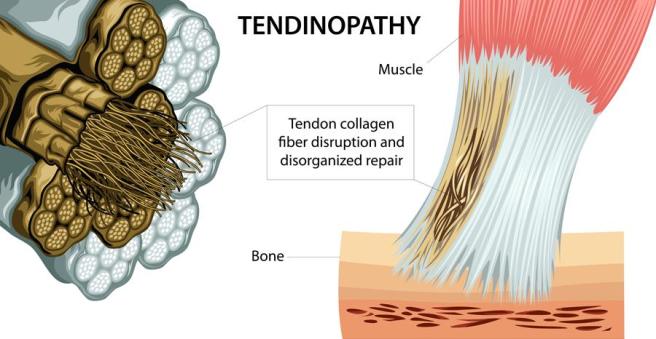
Many chronic tendon problems are not the result of ongoing inflammation, rather failed inflammation. Chronic failed inflammation results in tissue degeneration that diminishes long-term tissue capacity, size, and function. Tendons, when degenerated, exhibit lower stiffness. A failed healing response results in proliferation of tissue with decreased load transfer and elastic capability. We sometimes refer to this as scar tissue. This deficit must be accounted for during locomotion. Diminished tendon load transfer will lead to widespread biomechanical dysfunction. The patient must be willing to change their movement pattern or habits to stop this process.

Chronic problems often lead to widespread biomechanical dysfunction.

We have all seen the patient with chronic, but intermittent, plantar fasciitis who develops subsequent knee, hip, or back pain. Human movement is coordinated by a hierarchal system. The CNS initiates, controls and executes movement patterns. The human body knows movements—not muscles. If one tissue in the loop loses its integrity the patient may develop a new movement pattern. This new movement pattern may not be efficient to all the tissue components and result in new injuries. Our tissue only has a certain capacity. Muscles and tendons will strain, ligaments will sprain, and bones will break at different rates and/or amounts of load. Rehab should focus on optimal movement patterns instead of strengthening isolated muscles.

Let’s examine a patient with Achilles tendinosis?

Patients with Achilles pain will often favor the outside of their foot. Pain will result in an adaptive behavior altering the activity of agonist, synergist and antagonist muscles. A recent study in the Journal of Physiology highlighted this compensatory behavior:

“This was seen during single-legged hopping, where the contribution from the triceps surae muscle to the plantar flexors was decreased and the co-contraction from the tibialis anterior muscle was also decreased on the involved side in individuals with Achilles tendinosis. This may be attributed to the protective mechanism shielding the already injured tendon from further injury or even rupture.” (1)

If the agonist and antagonists have decreased activity, then how do these patients transfer load while walking?

“The EMG activity of the synergist muscle, the peroneal longus muscle in the present study, increased to compensate for the mechanical deficit resulting from the compliant Achilles tendon and to achieve the task goal.”

These patients have now condemned their gait cycle to walk on a supinated foot that transfers compensatory repercussions to the knee and hip. The increased load on the peroneal muscles may also result in injury in time. This is not an isolated problem, rather the typical continuum of an “…itis” to an “…opathy” over time. These are not isolated lesions; rather the start of widespread biomechanical dysfunction that may result in any number of orthopedic diagnosis. The authors conclude:

“Pain is a signal of tissue damage, although damaged tissues are not always painful.”

Excellent chiropractic clinical outcomes require that providers look upstream and downstream for biomechanical co-conspirators. ChiroUp helps your patients recognize how specific orthopedic conditions change movement patterns. Preselected exercise protocols incorporate ideal movement patterns during the rehab process. In the case of tendinopathy, ChiroUp protocols incorporate eccentric exercise to facilitate and strengthen the damaged tissue and prevent recurrence of pain.


Reference

  1. Chang Y-J, Kulig K. The neuromechanical adaptations to Achilles tendinosis. The Journal of Physiology. 2015;593(Pt 15):3373-3387. doi:10.1113/JP270220.

Canada’s Pain Crisis

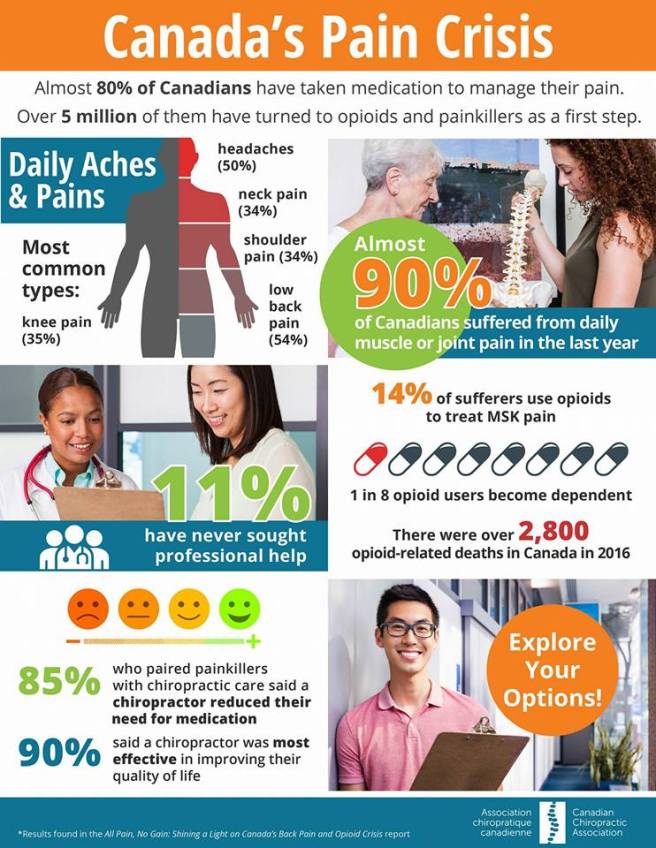
In a nation of only 36 million people, over 5 million people turned to opioid use for their pain despite the availability of better options. Opioids should never be the first step in pain management; preventing overuse takes education of both the public who are using and the professionals prescribing these drugs.

At Aberdeen Chiropractic we are proud to be part of the solution to Canada’s opioid crisis by providing safe, effective care for back pain, neck pain and headaches. Our goal is to assess, correct and prevent your pain with a variety of interventions including Chiropractic, Acupuncture, Laser, Exercise Rehabilitation and Trigger Point Therapy.


Pain Crisis

Can We Prevent Carpel Tunnel?

Carpal Tunnel


Carpal tunnel syndrome (CTS) is the most common of the many “entrapment neuropathies”— nerve pinches in the arms or legs—likely because we use our hands and fingers repetitively for long time frames at work and during many of our hobbies. In addition, the wrist is a very complicated joint because it’s not a simple ball-and-socket or hinge, like the hip, elbow, or knee.

 
The wrist is made up of eight small “carpal” bones that are all shaped very differently and fit together a bit like a puzzle. These eight bones are lined up in two rows of four bones that form the “roof“ of the tunnel.

 
The shape of the tunnel changes with different activities, and the contents within the tunnel have to accommodate for this. Nine of the tendons that allow the hand to move the fingers also travel through the tunnel. Look at the palm-side of your wrist as you wiggle your fingers. See all the activity going on there? The median nerve travels through the tunnel as well, just under the “floor”, which is a very strong ligament that stretches from the pinky to the thumb-side of the tunnel.

 
Virtually ANY condition that increases the pressure inside the already tightly packed tunnel can create CTS symptoms like numbness, tingling, burning, etc. Over time, grip strength may weaken, causing one to accidentally drop objects.

 
To add to the causation list of CTS, conditions like obesity, pregnancy, diabetes, hypothyroid, rheumatoid arthritis (and other “arthropathies”), taking birth control pills (BCPs), and more can cause CTS without any increase in hand/wrist activities!
So HOW can we prevent CTS?


First, consider your job and your “workstation.” There are ergonomic keyboard and mouse options that can help you maintain a “neutral” wrist posture. If you have to bend your wrist a lot to do your work tasks—like placing items in a package, assembly work, etc.—see if you can change the angle of the package or assembly set up that allows your wrist to be straight, NOT BENT! Also, sit/stand up straight, chin tucked back, and DON’T SLOUCH!

 
A “night splint” forces the wrist to stay straight and can REALLY help! Managing your weight and health (manage your diabetes, thyroid, and medications that increase swelling like BCPs) is VERY important! There are also natural anti-inflammatory vitamins and herbs like ginger, turmeric, and bioflavonoid you may want to consider—your doctor of chiropractic can help you with this!

 
Chiropractors can manage CTS very well and can frequently help patients avoid the need for a surgical release. The “KEY” is to not wait—get treated early on!


What is wrong with my shoulder?

Impingement


Shoulder pain is a REALLY common problem that can arise from many causes. There are actually several joints that make up the shoulder, so shoulder injuries can be quite complex!
Probably the most common source of shoulder pain arises from the muscle tendons and the bursa—the fluid-filled sacs that lubricate, cushion, and protect the sliding tendons near their attachment to bone. The rotator cuff is made up from a group of four muscles and their connecting tendons. Typically, when the tendons tear, the bursa swells and “impingement” occurs. When this happens, it’s very painful to raise the arm up from the side.
The term “strain” applies to injuries of the muscles and tendons and are classified as mild, moderate, or severe (some refer to this as first, second, and third degree tears), depending on the amount of tissue that has torn. Overexertion, overuse, sports injuries, dislocation, fracture, frozen shoulder, joint instability, and pinched nerves can all give rise to shoulder pain.
The diagnosis of what’s actually causing a patient’s shoulder pain is often determined by the history of how the injury occurred, or the “mechanism of injury.” This is followed up by measuring the range of motion and performing provocative tests to see which positions bother the shoulder the most. A doctor may use X-rays to assess for fracture/dislocation and an MRI to assess muscle tendon tears, labral tears (a rim of cartilage surrounding the glenoid fossa or cup of the ball & socket joint), and other soft tissue injuries.
People with jobs that require heavy lifting or repetitive pounding (carpenters and jack-hammer operators, for example), who play sports such as football and rugby, and those who smoke, have diabetes, and/or an overactive thyroid are at higher risk of injury. Because the shoulder joint is normally not very stable, MANY people tear their rotator cuff or injure their shoulder during their lifetime. One study found 17% of participants had full thickness rotator cuff tears (as opposed to partial tears). The researchers reported that age was an important determinant, as the incidence of full tears was only 6% in those less than 60 years old vs. 30% in those over 60! So obviously, this IS NOT an injury limited to the younger active person!
Outside of a medical emergency, patients should always try non-surgical treatment options first. Doctors of chiropractic offer the shoulder injury patient a non-surgical option that emphasizes exercise and self-management strategies in addition to manual manipulation, mobilization, and more. The most important message is BE PATIENT as these usually take time to manage, often up to a year.

Whiplash Injury? Get Help Now!

whiplash


Should I seek treatment for whiplash right away?

Even though whiplash or whiplash associated disorders (WAD) is very common, it remains poorly understood. Recent studies report that up to 60% of people may still have pain six months after their injury. Why is that?
Investigations have shown there are changes in the muscle and muscle function in the neck and shoulder regions in chronic WAD patients. Symptoms often include balance problems as well as increased sensitivity to a variety of stimuli including pressure, light vibration, and temperature.
Interestingly, this hypersensitivity not only occurs in the injured area, but also in areas away from the neck such as the front of the lower leg or the shin bone. This can only be explained by some type of neurobiological processing of pain within the central nervous system, which includes the spinal cord and brain.
It’s not surprising that when pain continues for lengthy time frames, people with these symptoms may also experience psychological distress. The confusing thing is that not every WAD injury case has this “central sensitization” and when it’s present—its intensity is highly variable.
Current research into WAD is focused on the following: 1) developing better treatments in the early or acute whiplash injury stage with the goal to PREVENT development of these chronic symptoms; 2) determining what factors can PREDICT slower recovery following a WAD injury; 3) investigation into how the stress response associated with motor vehicle crashes influence pain, other symptoms and recovery, and how to best address and MANAGE the stress response; 4) research into the effect a WAD injury has on daily life function; and 5) developing improved assessment methods for healthcare providers so that EARLY treatments can be more targeted and effective.
A Swedish study is currently looking at the importance of reducing the acceleration of the occupant during an automobile collision by redesigning the body of the vehicle and its safety systems. In rear-end crashes, the main issue is to design a seat and head restraint that absorbs energy in a controlled way and gives support to the whole spine. In frontal crashes, the air bag, seat belt pretensioner, and load limiter must work together in a coordinated way to reduce the acceleration between the vertebrae of the spine and occupant.
What is known is that a “wait and watch” approach may NOT be appropriate in a lot of cases. It appears there is a relatively short window of time, the first three months, when treatment seems to be most effective. Doctors of chiropractic are trained to identify and treat these types of injuries, so PLEASE, don’t delay your initial visit—time is truly of the essence.  Don’t waste it!