I’ve got ITB Syndrome Doc! Now What?

Your iliotibial band is a fibrous band of tissue running from the crest of your hip, down to your knee. A muscle near the crest of your hip called the tensor fascia lata, attaches to this band to help control movements of your leg. Your iliotibial band passes over the point of your hip and over another bony bump on the outside of your knee called the lateral epicondyle. When the band is too tight, it can become painfully inflamed as it repeatedly rubs over the top of either of these bony projections. Irritation at the bony bump near the knee is called iliotibial band friction syndrome.


The condition usually presents as pain on the outside of your knee that becomes worse with repetitive knee flexion or extension. This condition is the leading cause of lateral knee pain in runners, especially slower “joggers.” The pain usually develops 10-15 minutes into the workout. You may sometimes feel or hear a click during movement. Symptoms generally ease at rest. Running on slick “wintry” surfaces may aggravate the condition. Excessively worn running shoes may be a culprit.

This problem is commonly caused by weakness in your gluteal muscles. When these muscles are weak, the muscle that attaches to your iliotibial band must contract harder to stabilize your hip. Having one leg longer than another is a known aggravating factor.

Runners should minimize downhill running and avoid running on a banked surface like the crown of a road or indoor track, as well as wet or icy surfaces. Runners should reverse directions on a circular track at least each mile. Bicyclists may need to adjust seat height and avoid “toe in” pedal positions. Avoid using stair climbers or performing squats and dead lifts. Sports cream and home ice massage may provide some relief of symptoms.

Osteoarthritis of the Hand

The bones in your hand have a slick, protective covering called “cartilage” on the joint surfaces that touch each other. This cartilage serves as a friction reducer and shock absorber, thereby, helping to extend the life of your joints. “Arthritis” means that your cartilage has begun to thin or crack and may eventually wear away –impairing your strength and dexterity. Painful hand arthritis affects

up to 1 in 4 people. This degeneration has a tendency to affect specific joints, especially those of your index and middle fingers and the base of your thumb.

Your chance of developing arthritis increases with age. Hand arthritis is 2 1/2 times more common in women. Arthritis occurs more often in joints that have been previously injured and in patients who perform repetitive movement of the hands- particularly labor and manufacturing jobs. Other risk factors include obesity and the presence of arthritis in your parents. Contrary to popular opinion, knuckle cracking does not increase your risk of arthritis, regardless of duration or frequency.

Symptoms usually begin slowly and progress into longstanding hand pain that comes and goes. Your symptoms are likely aggravated by activity and relieved by rest. Hard, bony enlargements often develop along the joint lines, especially in women. You may notice morning stiffness that subsides fairly quickly. Be sure to tell your doctor if you notice lasting morning stiffness or swelling, as this could be a sign of a different type of arthritis.

The American College of Rheumatology recommends the use of non-drug treatments (like the type provided in this office) for hand osteoarthritis. Patients with thumb osteoarthritis may benefit from a nighttime splint. Topical creams, especially those including “capsaicin” may help relieve symptoms. You may find relief by warming your hands with a hot pack or “paraffin bath” when they feel stiff. Some patients report benefit by taking Glucosamine Sulfate. The mainstay of treatment includes exercises to help improve your mobility and strength.

Runner’s Knee Sucks.

Patellofemoral pain syndrome (PFPS) describes a painful irritation of the cartilage behind your kneecap. Although anyone may be affected, it is often the result of overuse of the knee in sports that require jumping or running so it is sometimes referred to as “Runner’s knee”. PFPS is the most common cause of knee pain in the general population, affecting an estimated 25% of adults.

One of the most common causes of PFPS is an imbalance between the muscles that help to guide your kneecap in its V-shaped groove at the end of your thigh bone. Repeatedly flexing and extending a misaligned kneecap leads to pain, swelling and eventually arthritis. Misalignment of the kneecap (patella) is often secondary to problems in the hip and foot, especially weakness of your gluteal muscles or flat feet.

PFPS produces a dull pain behind the kneecap that is aggravated by prolonged walking, running, squatting, jumping, stair climbing or arising from a seated position. The pain is often worse when walking downhill or down stairs. Longstanding misalignment can cause damage to the cartilage, which results in popping, grinding or giving way.

Conservative care, like the type provided in this office, is generally successful at relieving your symptoms. Initially, it is important for you to minimize activities that provoke your pain, especially running, jumping and activities that stress you into a “knock-kneed” position. Don’t allow your knees to cross in front of your toes when squatting. Some athletes may need to modify their activity to include swimming or bicycling instead of running.

Performing your home exercises consistently is one of the most important things that you can do to help realign the patella, relieve pain and prevent recurrence. The use of home ice or ice massage applied around your kneecap for 10-15 minutes, several times per day may be helpful.

What is Tarsal Tunnel Syndrome?

The tarsal tunnel is the space behind the bump on the inside of your ankle. The tibial nerve lives in this tunnel along with some tendons. Tarsal tunnel syndrome means that the tibial nerve is being irritated within the tunnel. This results in pain, numbness or tingling into your heel and the arch of your foot.

The tibial nerve may be irritated by compression (from trauma , arthritic spurs, or swelling of other tissues within the tunnel), or more commonly by constant stretch (from flat feet). Research has shown that tarsal tunnel pressure increases almost 30 fold in people with flat feet.
Tarsal tunnel is slightly more common in women, and high heels are suspect. The condition often affects both feet. Conditions like diabetes and thyroid disorders may aggravate nerve problems like tarsal tunnel. Plantar fasciitis commonly accompanies tarsal tunnel syndrome.

The discomfort is often described as “burning”. Symptoms may increase with long periods of standing, running or exercise. Almost half of patients report increased symptoms at night.

Your doctor will make the diagnosis of tarsal tunnel syndrome based on your history and an exam. Your doctor may take an x-ray to rule out other problems like arthritic spurs or a stress fracture. In severe cases, more sophisticated nerve testing may be necessary.

The first goal of treatment is to allow you to return to pain-free activity as soon as possible. The second goal is to correct the mechanical problem that allowed this condition to begin with.

What is knee tendonitis?

Tendons are strong bands of fibrous tissue that connect your muscles to your bones. Your “patellar tendon” connects your kneecap (patella) to your shin bone (tibia). “Patellar tendonopathy” results from repetitive straining and micro-tearing of this connection, resulting in pain and inflammation. The condition is referred to as “jumper’s knee,” since damage is thought to often result from repetitive jumping.

The condition should probably be called “landing knee,” since forces on the patellar tendon are twice as great during landing as compared to those created during take off.

Patellar tendinopathy is common, affecting almost 20% of all athletes with a rate as high as 50% in sports that require repetitive forceful jumping, like basketball and volleyball. The condition may affect one or both knees and may be slightly more common in males.

Weakness in the quadriceps muscle of your thigh can allow excessive bending of your knee when you land following a jump. This places your patellar tendon at a greater risk for injury. Having strong quadriceps muscles protects your knee from excessive flexion and injury.

Symptoms of patellar tendinopathy include pain or swelling just below your kneecap. This may begin without an identifiable injury and may come and go for months or years. Symptoms are usually aggravated by activity, but most athletes have been able to continue playing through the pain. Pain often increases during activities that require strong quadriceps contraction, like jumping, squatting, arising from a seated position, stair climbing, or running. Walking down stairs or running down hill seems to be more bothersome than going up.

Some athletes may have unconsciously learned to protect their knee by developing unnatural jumping mechanics. This could include landing with a more rigid knee, or allowing too much hip flexion. You may need to become more conscious of landing with the right amount of knee flexion with your foot in a neutral position and avoiding excessive hip flexion. Your doctor would be able to answer any questions you have about good jumping mechanics.

Patellar tendon straps, like a Cho-pat, can help reduce stress on your patellar tendon and relieve pain. Three fourths of the people who use patellar tendon straps for patellar tendinitis report improvement.

Patellar tendinopathy is treatable. Patients who follow a well-planned strengthening program show similar outcomes to those who have undergone surgery for the problem. Initially, you may need to decrease your training intensity to help protect your knee. You should stay away from activities that produce more than mild pain. You should avoid complete rest, as this could actually increase your risk of recurrence. Using ice packs or ice massage for 10-15 minutes at a time, especially following activity, may help to reduce inflammation.

Do you wake up with numb fingers?

The term “thoracic outlet” describes an area at the base of your neck, just above your collarbone. Some important nerves and vessels pass through this outlet on their way into your arm. Compression of these tissues causes a condition called “thoracic outlet syndrome” which results in pain, numbness or tingling in your arm.

Several different factors can cause Thoracic Outlet Syndrome,

commonly referred to as TOS. Sometimes TOS is caused from tightness in the muscles of your neck and chest, other times the space between your first rib and collarbone is too small. People who have an extra rib (cervical rib) and people who have recently suffered a neck injury may have a greater chance of having this problem.

The condition is aggravated by poor posture and by occupations that promote “slouching,” i.e., computer users, assembly line workers, supermarket checkers and students. Swimmers, volleyball players, tennis players, baseball pitchers and occupations requiring prolonged overhead activity. i.e., electricians and painters are also prime candidates for TOS.

Symptoms of TOS include arm pain, numbness, tingling and possible weakness. Neck, arm and hand pain may begin slowly and are often aggravated by elevation of the arms or excessive head movement. Loss of grip strength is possible.

Conservative treatment, like the kind we provide, has been shown to be effective at treating TOS. Through our careful exam we have identified your specific sites of compression and will use some of the following treatment to help:

You should avoid carrying heavy loads, especially on your shoulder i.e., carpet rolls. Briefcases, laptop cases or heavy shoulder bags should be lightened. Bra straps may need additional padding or consideration of replacement with a sports bra.

The all too common knee cartilage tear.

The meniscus is a piece of tough, smooth, rubbery cartilage in the middle of your knee. Each of your knees have a meniscus on the inside (medial meniscus) and another on the outside (lateral meniscus). Each meniscus attaches to the top of your shin bone (tibia) and acts as a shock absorbent guide for your thigh bone (femur), which rests above.
Meniscus

Damage or tears to the meniscus are common. Males are affected three or four times more often than females. Tears may occur at any age. In children and adolescents, the menisci are more durable and rubbery, so most injures are “traumatic” as a result of a forceful twisting injury. As we age, our meniscus grows weaker, and “degenerative” tears become more likely, often resulting from simple or even unrecognized injuries.

Symptoms of meniscus injury depend on the type and severity of damage. Patients sometimes hear a pop or snap at the time of initial injury. Patients with acute injuries may have difficulty bearing weight and may develop a limp. Stiffness is a common complaint. Clicking, catching, locking or giving-way is possible. Meniscus injuries are usually aggravated by movement and become particularly uncomfortable with deep squatting.

Although some meniscus injuries may require surgery, most can be treated conservatively with the type of treatments provided in our office. Your age roughly correlates with the need for surgery. Approximately 2/3 of acute meniscal tears in children and adolescents will require surgery, but only about 1 in 20 patients over the age of 40 will require knee arthroscopy. Surgery is necessary more often in patients who cannot fully bend or straighten their leg, or whose knee locks and gets stuck in one place.

Home management includes rest, ice, compression and elevation (RICE). You should apply ice over your knee for 15 minutes at a time, three or four times a day. Wrapping an ACE bandage around your knee will provide compression to help minimize swelling. You may elevate your leg by placing a pillow beneath your knee to help reduce swelling.

You may need to limit your activity to prevent further damage while you are recovering from injury. Activities that involve twisting on a weight-bearing flexed knee are the most harmful. You may need to temporarily or permanently discontinue some high energy sports activity. Other activities, like water walking, may be substituted for higher energy sports, like soccer and tennis. Ice or ice massage should be used following activity.

Patients who have undergone surgical repair of their meniscus are more likely to develop arthritis. These patients will also benefit from a well-planned home exercise program.

What is Sever’s Disease?

Severs disease, also called calcaneal apophysitis, is a painful swelling near the insertion of the Achilles tendon on your heel.

As our bones develop, we have “growth plates” which are softer areas where the bone is still growing. In children, this growth plate is weaker than in adults. This means that children are more likely to suffer growth plate injuries than adults, especially during periods of rapid growth.

The powerful calf muscles attach onto your heel through the Achilles tendon. When your calf muscle contracts (like during running or jumping), it places a shear force on the growth plate of your heel. Severs disease is an irritation to this sensitive growth plate.

Athletically active children, who run and jump frequently in sports like soccer, basketball, gymnastics and track & field are most likely to suffer from this condition. Severs disease is slightly more common in boys and the condition affects both heels about half of the time.

Symptoms usually start as heel pain that gradually worsens during activity. Sometimes this can cause a “limp”. Rest usually temporarily relieves the pain.

Your doctor will make the diagnosis of Severs disease based on your history and an exam. Your doctor may take an x-ray to rule out other injuries like a stress fracture.

The first goal of treatment is to allow you to return to pain-free activity as soon as possible. This may require avoiding stressful activity like running and jumping for a short period of time. Cross training on a bike is usually acceptable. Ice should be applied for 15 minutes after any activity. You should always wear shoes with good arch supports and avoid walking barefoot. Your doctor may recommend a small heel lift to decrease strain on your achilles tendon.

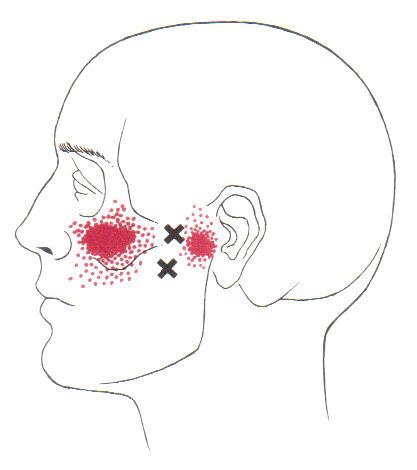
Trigger points in the lateral pterygoid

The lateral pterygoid muscle plays an important role in prober jaw function. It originates on the greater wing of the sphenoid bone and the lateral pterygoid plate, and inserts on the condyloid process of the mandible. It’s action is to pull the head of the mandibular condyle out of the mandibular fossa while opening the jaw. When trigger points develop they refer pain into the temporal mandibular joint and maxillary sinus. This referral is commonly mistaken for TM arthritis. In addition to the referral pain, trigger points in this muscle can also effect proper movement of the jaw.