Put the shovel down and read this!

Your low back consists of 5 individual vertebrae stacked on top of each other. Flexible cushions called “discs” live between each set of vertebrae. A disc is made up of two basic components. The inner disc, called the “nucleus”, is like a ball of jelly about the size of a marble. This jelly is held in place by the outer part of the disc called the “annulus”, which is a tough ligament that wraps around the inner nucleus much like a ribbon wrapping around your finger.
Your low back relies on discs and other ligaments for support. “Discogenic Low Back Pain” develops when these tissues are placed under excessive stress, much like a rope that frays when it is stretched beyond its normal capacity. Most commonly, disc pain is not the result of any single event, but rather from repeated overloading. Your lumbar discs generally manage small isolated stressors quite well, but repetitive challenges lead to injury in much the same way that constantly bending a piece of copper wire will cause it to break. Examples of these stressors include: bad postures, sedentary lifestyles, poor fitting workstations, repetitive movements, improper lifting, or being overweight.

Approximately one third of adults will experience pain from a lumbar disc at some point in their lifetime. The condition is more common in men. Most lumbar disc problems occur at one of the two lowest discs- L5 or L4. Smokers and people who are generally inactive have a higher risk of lumbar disc problems. Certain occupations may place you at a greater risk, especially if you spend extended periods of time sitting or driving. People who are tall or overweight have increased risk of disc problems.

Symptoms from disc pain may begin abruptly but more commonly develop gradually. Symptoms may range from dull discomfort to surprisingly debilitating pain that becomes sharper when you move. Rest may relieve your symptoms but often leads to stiffness. The pain is generally centered in your lower back but can spread towards your hips or thighs. Be sure to tell your doctor if your pain extends beyond your knee, or if you have weakness in your lower extremities or a fever.

Repeated injuries cause your normal healthy elastic tissue to be replaced with less elastic “scar tissue.” Over time, discs may dehydrate and thin. This process can lead to ongoing pain and even arthritis. Patients who elect to forego treatment and “just deal with it” develop chronic low back pain more than 60% of the time. Seeking early and appropriate treatment like the type provided in our office is critical.

Depending on the severity of your injury, you may need to limit your activity for a while, especially bending, twisting, and lifting, or movements that cause pain. Bed rest is not in your best interest. You should remain active and return to normal activities as your symptoms allow. Light aerobic exercise (i.e. walking, swimming, etc) has been shown to help back pain sufferers. The short-term use of a lumbar support belt may be helpful. Sitting makes your back temporarily more vulnerable to sprains and strains from sudden or unexpected movements. Be sure to take “micro breaks” from workstations for 10 seconds every 20 minutes.


Transformative Recovery: Personal Trainers’ Role in Injury Rehabilitation

Recovering from an injury can be a challenging and often frustrating journey. While many individuals are eager to return to their regular routines, doing so without proper guidance can lead to further harm and prolonged recovery. This is where the expertise of a personal trainer becomes invaluable. Personal trainers provide tailored support and guidance, ensuring a safe and effective rehabilitation process. Here are key reasons why people with injuries should consider working with a personal trainer:

1. Customized Rehabilitation Programs

Personal trainers assess your specific injury, fitness level, and overall health to create a personalized rehabilitation plan. They design exercises that target the injured area, promoting healing while avoiding movements that could exacerbate the injury. This customized approach ensures that every workout is both safe and beneficial.

2. Expert Knowledge and Experience

Certified personal trainers have extensive knowledge of human anatomy, biomechanics, and injury rehabilitation. They understand the complexities of different injuries and the most effective methods for recovery. Their expertise allows them to select appropriate exercises and modifications, reducing the risk of further injury and speeding up the healing process.

3. Proper Technique and Form

One of the most critical aspects of exercising with an injury is maintaining proper technique and form. Personal trainers provide hands-on instruction and continuous feedback, ensuring that you perform each exercise correctly. This attention to detail helps prevent compensation patterns and incorrect movements that could hinder recovery or cause new injuries.

4. Progress Monitoring and Adjustments

Recovery from an injury is a dynamic process that requires ongoing assessment and adjustment. Personal trainers monitor your progress closely, making necessary modifications to your program based on your healing and feedback. This adaptive approach ensures that your rehabilitation plan evolves with your recovery, maximizing effectiveness and safety.

5. Motivation and Support

Rehabilitating an injury can be mentally and physically taxing. Personal trainers offer invaluable motivation and emotional support, helping you stay committed to your recovery plan. Their encouragement and positive reinforcement can boost your confidence and keep you focused on your goals, even during challenging times.

6. Safe Transition to Regular Activity

Returning to your regular exercise routine or daily activities too quickly can lead to setbacks. Personal trainers guide you through a safe and gradual transition, ensuring that your body is adequately prepared for increased activity levels. They help bridge the gap between rehabilitation and full recovery, reducing the likelihood of re-injury.

7. Education on Injury Prevention

Personal trainers educate clients on proper techniques, body mechanics, and lifestyle choices that can prevent future injuries. They teach you how to listen to your body, recognize early signs of strain, and incorporate preventive measures into your fitness routine. This proactive approach promotes long-term health and reduces the risk of recurrent injuries.

8. Holistic Health and Wellness

Beyond injury rehabilitation, personal trainers take a holistic approach to your health and wellness. They consider factors such as nutrition, sleep, stress management, and overall fitness, all of which play crucial roles in recovery and injury prevention. By addressing these aspects, trainers help you achieve optimal health and well-being.

Conclusion

Working with a personal trainer can be a transformative experience for individuals recovering from injuries. The combination of personalized rehabilitation programs, expert knowledge, proper technique instruction, progress monitoring, motivation, safe transitions, education on injury prevention, and holistic health support creates an ideal environment for recovery. If you’re dealing with an injury and looking to regain your strength and functionality, partnering with a personal trainer could be the key to a successful and sustainable recovery. Prioritize your health and take the first step toward healing with the guidance of a skilled personal trainer.

Rotator Cuff Tendonopathy

Overhead Athlete? This one’s for you!

Rotator cuff tendinopathy is an irritation of one or more tendons of a group of muscles stabilizing the shoulder called the rotator cuff.

Repeated overhead movement can, over time, cause irritation, inflammation and/or a lesion to these tendons.

The rotator cuff consists of four muscles that help position the humerus, your upper arm bone, into the shoulder socket during arm movement.

The shoulder has great mobility but is prone to injury during falls or accidents, or in case of altered motor control.

Rotator cuff tendinopathy can cause, but is not limited to, pain felt at the shoulder and sometimes the scapula, a pinching sensation, loss of strength and active range of motion, and localized swelling.

The pain and pinching sensation are often felt when raising the arm overhead or when lowering the arm from an elevated position. Pain may also be present at night. In more advanced cases, you may additionally feel pain during the day while at rest.

Treatment consists of Class IV Laser Therapy, management of any biomechanical stresses in the area and exercise rehabilitation to address any weaknesses that can be putting undue stress on the area. 

Contact us for treatment in Winnipeg

Find and Follow us on Twitter and Instagram!

#LaserTherapy
#ShoulderInjuries
#Winnipeg
#Chiropractic
#ArmInjury
#RotatorCuff

Shoulder Impingement Injury

Photo by Jim De Ramos on Pexels.com

Impingement syndrome is an irritation of the structures between the upper portion of your arm and your shoulder blade mainly during overhead arm movements.

The rotator cuff is comprised of four muscles that help stabilize the humerus (upper arm bone), in the shoulder socket during arm movement.

The shoulder has great mobility but is in return susceptible to injury not only during falls and other accidents, but also if motor control is inadequate.

Men over 40 performing manual labor are the most affected with this condition. It is also present in young athletes practicing sports involving repeated overhead motion such as swimming, baseball or tennis.

Treatment of impingement injuries consists of Class IV Laser Therapy, management of any biomechanical stresses in the area and exercise rehabilitation to address any weaknesses that can be putting undue stress on the area. 

#LaserTherapy
#ShoulderInjuries
#Winnipeg
#Chiropractic
#ArmInjury
#RotatorCuff

Suffering with a shoulder injury? Contact us for treatment in Winnipeg

Find and Follow us on Twitter and Instagram!

Photo by Florian Doppler on Pexels.com

Hip/Spine/Groin Warm Up

When trying to prep the lower body for training, I’ve always been a fan of compounding movements that hit multiple areas at once, the same way sports/training do. Vernon Griffith shows us a great set of movements that will help prep your spine, hips and groins for the training to come. Give him a follow for more great training and mobility information!

Stress and Weight 

Photo by RODNAE Productions on Pexels.com

Bottom Line:

A recent research study found over 75% of people experience at least a moderate amount of stress every day! 

Chronic stress is not fun to deal with, but did you know it can also affect your weight? 

When you are stressed your body goes into survival (or “fight or flight”) mode which changes your hormonal balance. You don’t need to be running from a saber tooth tiger to enter fight or flight mode. Even everyday events like traffic and stress at work can cause you to have that physiological response. 

Why it Matters:

Recent research suggests that chronic stress can result in:

  • high blood pressure,
  • changes in your brain,
  • and weight gain.

When you are stressed out, it is more likely that you will over-eat and less likely that you will get enough sleep and exercise. Stress causes your body to release cortisol, a hormone that can produce a build-up of fatty tissue and cause weight gain. Cortisol increases both your appetite and the amount of fat the body stores. By recognizing your stressors, and engaging in a few simple relaxation techniques, you can learn to reduce your body’s natural stress response. 

  • The hormone Cortisol is released in response to stress and increases your blood sugar.
  • Chronic stress can lead to elevated cortisol levels. 
  • An association has been found between increased cortisol levels and obesity.

Next Steps: 

Relaxation techniques such as meditation, yoga, or even simple breathing exercises can help your body counter the stress response. Also, exercise has been shown to decrease stress levels substantially. 

The next time you are feeling stressed out, take a moment to breathe a few deep breaths and try to get some exercise into your schedule that day. Not only will you feel better mentally, but your body will be able to reduce the amount of Cortisol produced which will limit your body’s fat storage and help curb any thoughts of over-eating. Staying fit and trim does start in your head! 

Science Source(s): 

Hair Cortisol and Adiposity in a Population‐Based Sample of 2,527 Men and Women Aged 54 to 87 Years. Obesity 2017

Don’t Have Enough Time to Exercise? 

Photo by Ketut Subiyanto on Pexels.com

Bottom Line:

You’re busy and you’re stressed out. Well, you’re not alone. 

These are two of the most common reasons people give for not exercising consistently. Ironically, these are the two exact reasons you should be exercising and moving your body! 

Moving your body releases endorphins which help you feel good, relaxes your mind which reduces stress, and burns calories to keep you looking great. 

Why it Matters:

Your body is meant to move. Long hours commuting in your car or sitting at a desk can place a lot of stress on your musculoskeletal system. 

If your spine and core muscles are weak and unstable, then you are more likely to suffer an injury which can cause a downward spiral that impacts your relationships with food, sleep, and exercise. So taking a pro-active approach to your exercise routine is crucial to live your best life. Chiropractic adjustments are an essential part of the picture because they can help you feel good mentally and keep you moving physically. 

  • Maintaining a healthy weight can decrease the risk factors for cardiovascular and heart disease.
  • Even 15 minutes of light exercise can make a difference in your overall health.
  • Exercise can help you feel good both physically and mentally.

Next Steps: 

Schedule time every day to exercise. But, don’t get discouraged if you feel like you aren’t doing enough. Rome wasn’t built in a day! 

Even 15 minutes of walking during your afternoon break can provide you with the health benefits you are looking for. Burning an extra hundred calories per day (which could be accomplished with 10 minutes of walking) adds up to thousands of calories each month. Continue that trend, and you will notice inches falling off your waistline before you know it! 

Science Source(s): 

The Role of Exercise and Physical Activity in Weight Loss and Maintenance. Prog Cardiovasc Dis 2015

Knee Osteoarthritis

Photo by cottonbro on Pexels.com
Knee Osteoarthritis
Knee osteoarthritis is a condition that can cause stiffness that limits joint range of motion. Over time, the knee’s flexion and extension movements become limited, generally causing pain and an alteration of the normal biomechanics. Your thigh muscles also have to work harder during movement, generating a feeling of muscle tension.To date, the exact causes of osteoarthritis have not been fully identified. It is completely normal to have a mild level of osteoarthritis with age. However, the more advanced stages of osteoarthritis can affect the ability to carry out daily activities and sports. An exacerbation of symptoms usually occurs during a period when the level of physical activity has been drastically increased. Direct trauma to the knee can increase the symptoms of osteoarthritis.

▬▬▬▬▬

Structures involved

In the knee, the joint affected by osteoarthritis is the t​ ibiofemoral joint​, formed by the femur bone and the tibia bone. It is mainly ​cartilage​ damage combined with the presence, in some cases, of slight bone spurs in the joint that appear to be responsible for the restriction of movement. Over time, certain muscles in the thigh area may compensate for the joint restriction and become more tense.page1image34813889601

▬▬▬▬▬

Signs & Symptoms that you may experience

Each person will react differently to osteoarthritis and management will depend on its stage. Knee osteoarthritis can produce, but is not limited to, local pain in the knee, localized edema and stiffness in certain knee movements. Repetitive movements of the knee during walking or other sports activities and a squatting position with direct pressure can cause pain.

▬▬▬▬▬

Developments

Knee osteoarthritis is a progressive condition that cannot be cured, which means that the range of motion may decrease over time. An active lifestyle and a rehabilitation plan may however slow the progression of this condition and make it easier to manage the symptoms.

▬▬▬▬▬▬▬▬▬▬▬▬▬▬▬▬▬▬▬▬▬▬▬▬▬▬▬▬▬▬▬▬▬▬▬▬▬▬▬▬▬▬▬▬▬▬▬▬▬▬▬▬▬▬▬▬▬▬▬▬▬▬▬▬▬▬▬▬▬▬▬▬▬▬▬▬▬▬▬▬

▶​ ​WHAT TO DO

Painful episodes

Relative rest is a good way to prevent your symptoms from getting worse after a painful episode. A few days of rest while reducing activities that cause significant pain​ m​ ay be necessary, but it is very important to avoid deconditioning. A quick return to your daily activities, light cardiovascular exercises that do not cause an increase in pain, joint mobilization exercises and knee and hip muscles strengthening exercises will allow for better recovery.

Rehabilitation

Follow your therapist’s advice. This will help you manage the various stages of the healing process and increase the odds of success. Your therapist will accompany you during your rehabilitation program in order to improve range of motion of your knee’s joint, regain flexibility, muscle strength and endurance, and functional state.

According to the principles of knee osteoarthritis rehabilitation, improving joint range of motion should be an integral part of the treatment plan. A program to improve joint range of motion and flexibility, as well as specific muscle strengthening is common to control the symptoms of knee osteoarthritis.

▶ ​WHAT TO AVOID

Do not rely solely on a passive treatment approach. Each phase of the rehabilitation process is important. Patients who actively participate in their treatment plan tend to recover more quickly. Keep in mind that pain is not always a good indicator of joint or tissue damage. A significant level of pain does not necessarily imply a more advanced stage of osteoarthritis. As soon as you feel better and the pain is well under control, introduce, in collaboration with your therapist, light mobility and strengthening exercises based on your tolerance. Remember that exercise is an excellent way to manage pain associated with osteoarthritis.

Trigger point pain

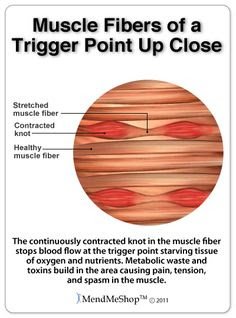
Myofascial trigger points are contracted knots that form in muscle tissue. They form from overload stress placed on the muscle. Both chronic stress such as poor posture and acute stress such as an injury will cause trigger points to form. Once there a trigger point will produce pain, referred pain, weakness and stiffness. Trigger points don’t go away with rest or with time, some form of intervention such as trigger point massage is needed to treat the injured muscles. Trigger points can form in any muscle in the body and are one of the most common causes of pain.

Trigger points in the hamstrings.

With all the sitting going on these days, tight hamstrings are becoming increasingly common. When your hamstrings are tight they almost certainly have trigger points. These contracted knots in the muscle are a common cause of pain felt in the back of the leg, knee and lower buttocks. Trigger points don’t go away with rest or stretching, they need a therapeutic intervention such as massage to be released.