
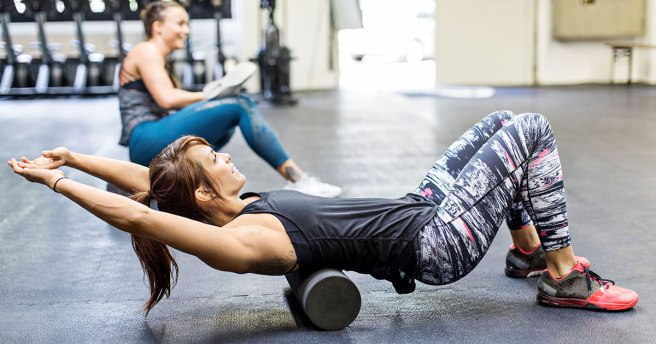
Great stuff from our friends at Shape.com:
Myth: Stretching and foam rolling will address all of my mobility problems.
Truth: Stretching and soft tissue work (like foam rolling and massage) may seem like the bread and butter of mobility, but there’s more to know. “If you have a true mechanical mobility problem, soft tissue work and different stretching techniques are definitely great options,” says Ardoin. But you might experience tightness or a loss of motion that doesn’t have anything to do with tissue restrictions like tight muscles or joint stiffness.
“In these particular people, they actually have the mobility needed, but their brain doesn’t know how to access it,” says Ardoin. This sort of muscle-brain disconnect could be because of current pain, previous injuries, or, “sometimes people just forget how to move,” he says.
In this case, your muscles are working against each other instead of synergistically—and it’s not something stretching or foam rolling will fix. The good news is that there’s not actually anything physically wrong. The bad news: This is tough to diagnose on your own. “If you have a loss of motion while you perform the motion yourself but have full ROM when performed passively, then it’s safe to assume that you have the ROM available but your brain doesn’t know how to access it,” says Ardoin.
For example, let’s say you have a “tight” shoulder. Make a large, slow circle with your right arm. Then totally relax your arm while someone else rotates your arm in a circle for you. Did it go farther while you let the motion happen passively? Ding, ding! Could be a brain problem, not a muscle problem. Think this might be you? Seeing a trainer or physical therapist to confirm it (and help you work on the issue) can’t hurt.


 tough, durable ligaments that hold your bones together have been damaged, while “strain” means that your muscles or tendons that move your trunk have been partially torn.
 Weakness of the gluteus medius allows your pelvis to drop and your knee to dive inward when you walk or run. This places tremendous strain on your hip and knee and may cause other problems too. When your knee dives inward, your kneecap is forced outward, causing it to rub harder against your thigh bone- creating a painful irritation and eventually arthritis. Walking and running with a relative “knock knee” position places tremendous stress on the ligaments around your knee and is a known cause of “sprains”. Downstream, a “knock knee” position puts additional stress on the arch of your foot, leading to other painful problems, like plantar fasciitis. Upstream, weak hips allow your pelvis to roll forward which forces your spine into a “sway back” posture. This is a known cause of lower back pain. Hip muscle weakness seems to be more common in females, especially athletes.

 You can visualize this as imagining one of your bucket handles is misaligned and not moving in sync with the others.
 When a facet is irritated, you will likely notice pain on one side of your back that may radiate into your flank, hip, and thigh. The pain may come and go. Your pain may increase when you arch backwards or return to an upright position after bending forward. Many patients report relief when they lie down. Symptoms of facet syndrome do not usually radiate past your knee. Be sure to tell your chiropractor if your symptoms include any radiation of pain below your knee, weakness, groin numbness, changes in bowel or bladder function, or if you have a fever.
 This nerve can be compressed beneath a ligament, tendon or tight muscle in your hip and pelvis. Pregnancy or being even slightly overweight makes this condition more likely. Tight clothing including girdles, compressive shorts, or tight belts may aggravate or cause this condition. Carpenters’ tool belts or police duty belts may compress this nerve. Prolonged sitting or lying in a fetal position may aggravate this problem. Diabetics are at greater risk.
 Your lower back is made up of 5 bones stacked on top of each other with a soft “disc” between each segment to allow for flexibility. Normally, each joint in your spine should move freely and independently. Our examination of your spine has shown that one or more of the joints in your low back is slightly misaligned and restricted. We call this condition “lumbar segmental joint restriction”.
 Aberdeen Chiropractic