Pregnancy Related Low Back Pain

DSC_0033

Low back pain during pregnancy is quite common. In fact, between 50-75% of all pregnant women will experience low back pain. The pain is usually caused from rapid changes in weight, posture, gait and hormones.

The average woman gains between 20-40 pounds throughout pregnancy. This weight gain moves your center of gravity forward, causing your pelvis to tilt and your lower back to sway – placing excessive stress on the ligaments, discs, and joints of your spine.

Pregnancy-related low back pain typically starts between the fifth and seventh month of pregnancy, although a significant portion of women experience pain sooner. Symptoms often begin at the base of your spine and may radiate into your buttock or thigh. Discomfort is often aggravated by prolonged standing, sitting, coughing, or sneezing. Your symptoms may increase throughout the day, and some patients report nighttime pain that disturbs their sleep. The extremes of activity seem to contribute to pregnancy-related low back pain – with increased risk for both “sedentary” and “physically demanding” lifestyles. Patients who have suffered with back pain prior to pregnancy are more than twice as likely to re-develop back pain during pregnancy.

Be sure to tell your doctor if your symptoms include fever, chills, bleeding, spotting, unusual discharge, cramping, sudden onset pelvis pain, light-headedness, shortness of breath, chest pain, headache, calf pain or swelling, decreased fetal movement, or symptoms that radiate beyond your knee.

Unfortunately, pregnancy related low back pain occurs at a time when your medical treatment options are limited. Not surprisingly, over 90% of prenatal health care providers would recommend drug-free treatment, including the type of alternative therapy provided in this office. Studies have shown that chiropractic manipulation provides significant relief of pregnancy-related low back pain. Almost 75% of women undergoing chiropractic care report significant pain reduction with improved ability to function.

Most patients will also benefit from continuing aerobic exercise throughout pregnancy. The US Department of Health and Human Services advises that healthy pregnant women may begin or continue moderate intensity aerobic exercise for at least 150 minutes per week. Women should not begin “vigorous” exercise during pregnancy, but those who were preconditioned to vigorous exercise may continue. Be sure to check with your doctor prior to initiating or increasing any exercise program while you are pregnant.

Be sure to take frequent breaks from prolonged sitting or standing. You may find benefit by using a small foot stool to alternate feet while standing. Sleeping with a pillow between the knees in a side lying posture may help you to rest more comfortably. You should wear shoes with good arch supports. In some cases, your chiropractor may recommend a sacroiliac belt or pelvic support belt to help relieve your pregnancy-related low back pain.
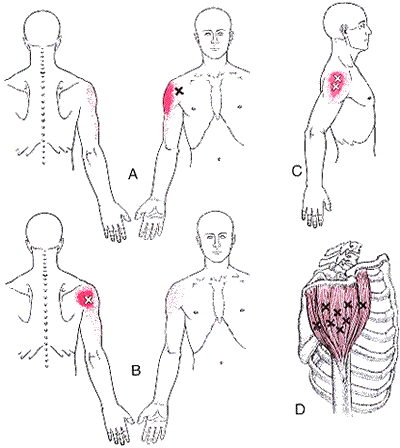
Trigger points in the deltoid muscle

The deltoid is the main muscle that makes up the shoulder. It originates on the clavicle, acromion, and spine of the scapula. It inserts on the deltoid tuberosity of the humerus. The deltoid acts at the shoulder to produce abduction, and assist with flexion and extension. The deltoid is especially prone to developing trigger points. These posterior style will refer pain into the anterior and lateral shoulder. Trigger points in the posterior delt will refer pain into the posterior shoulder with spillover down the lateral arm.

Lumbar Radiculopathy? That sounds ridiculous!

Your nervous system is basically a big electrical circuit. Your spinal cord transmits all of the electrical nerve impulses between your brain and lower back. From there, individual nerves emerge from your spine then travel to supply sensation and movement to a specific area of your buttock, legs and/or feet. This allows you to move and feel sensations like touch, heat, cold and pain. Anything that

interferes with this transmission can cause problems.

You have been diagnosed with a “Lumbar Radiculopathy”. This means that one or more of the nerves emerging from your lower back has become irritated or possibly pinched. This often results in pain, numbness or tingling in the specific area of your leg that is supplied by the irritated nerve. The term “Sciatica” is often used to describe this condition, because most (but not all) “lumbar radiculopathies” involve the sciatic nerve which supplies the back & outside of your thigh and calf. Symptoms of a lumbar radiculopathy may vary from a dull ache to a constant severe sharp shooting pain. Your symptoms are likely aggravated by certain positions or movements.

To solve this problem, we will treat the source of your nerve irritation. It is important for you to follow your treatment plan closely and be sure to tell us immediately if you experience any progression of your leg pain, numbness or weakness.

Trigger points in the adductor pollicis

The adductor pollicis is a muscle in the hand and acts on the thumb. It originates on the transverse head of the third metacarpal, the oblique head of the base of the second and third metacarpals, and the trapezoid and capitate bones. It inserts on the base of the proximal phalanx and ulnar sesamoid. This muscle acts to adduct and flex the thumb. Trigger points cause pain and aching along the outside of the thumb and hand, spillover pain may reach the thenar eminence.

Lumbar Degenerative Spondylolisthesis

Your lumbar spine (low back) is made up of five individual vertebra stacked on top of a bone called the sacrum. To allow for flexibility and movement, there is a cushion or “disc” in between each level. As we age, our discs and joints can wear and become thinner from a process called arthritis. This leads to additional changes, including loosening of the ligaments that hold your vertebra in place.

The term “degenerative lumbar spondylolisthesis” means that one of your vertebra has shifted forward on top of the one below as a result of arthritis and loosening ligaments. The condition usually comes on after age 50 and affects women six times more frequently than men. Degenerative spondylolisthesis occurs most commonly at your second lowest spinal level. (L4-5)

Sometimes, spondylolisthesis develops silently, but most patients report episodes of back pain that have occurred for many years. Patients often report increased pain when standing or when rising from a sitting position. Pain tends to increase throughout the day. If your nerve openings have become narrowed, the nerves may be pinched, and you may experience pain radiating into your legs. Leg symptoms that shift from side to side are characteristic of degenerative spondylolisthesis. Leg pain and tingling are fairly common, but be sure to tell your doctor if you notice more significant symptoms, like leg numbness, heaviness, weakness, loss of bowel or bladder function, or impotence.

Studies have shown no advantage for surgery over conservative care for most cases of degenerative spondylolisthesis. Approximately one-third of patients will experience progression of symptoms over time, and only 10-15% will ever need surgery to correct the problem. Fortunately, the majority of patients will benefit from treatment and exercises to help stabilize their spine.

You will need to perform your exercises consistently for sustained improvement. You should also try to add some type of aerobic exercise to your daily routine. Stationary cycling is a very good choice, and other options include water walking and swimming. Avoid wearing high heels. You may find some benefit for your arthritic symptoms by taking 1500mg of Glucosamine Sulfate each day. Using a hot pack for 10-15 minutes directly over your lower back may provide some benefit.

Trigger points in the adductor longus.

The adductor longus is a muscle of the groin. It originates on the pubic body just below the pubic crest, and inserts on the middle third of the linea aspera of the femur. It acts on the hip joint to cause adduction and flexion. Distal Trigger points in this muscle refer pain to the upper medial knee and down the tibia. Proximal trigger points refer pain into the anterior hip. These trigger points are the most common muscular cause of groin pain.

Lumbar Spondylolisthesis

Your spine is made up of 24 individual vertebrae all stacked on top of each other. The lowest five vertebrae are referred to as your lumbar spine. Each vertebra has two basic components: the “body” and the “arch.” You can envision this as a coffee mug lying on its side. The cup would represent the vertebral body, and the handle would represent the arch. The spinal cord travels through each of

the vertebral arches on its way from your brain to your tailbone. The term “lumbar isthmic spondylolisthesis” describes a condition where your arch has broken free from its anchor on the vertebral body, allowing the vertebral body to slide forward. Lumbar spondylolisthesis typically affects the lowest lumbar vertebra, L5, or occasionally the second lowest, L4.

The condition is sometimes caused by trauma, but more often follows a “stress fracture” involving the arch of the vertebra. This break and slippage is thought to result from repetitive movements, especially hyperextension (arching back) and rotation. The break usually happens during childhood but does not always cause symptoms when it occurs. Many times, the condition will lie dormant until later in life. Lumbar spondylolisthesis is present in six to seven percent of the population and affects males twice as often as females. The problem is more common in those who participate in sports. Some sports predispose children to this “break and slip”. Athletes who participate in gymnastics, rowing, diving, football, wrestling, weight lifting, swimming, tennis, volleyball, and track & field throwing sports (i.e. discus, shot put, etc) are at greatest risk.

The pain usually starts in your back but may radiate into your buttock or thigh. Your pain usually intensifies with standing upright for prolonged periods of time or leaning backwards, especially during heavy activity. Some women report increased symptoms during the later stages of pregnancy. Be sure to tell your doctor if you notice pain, numbness or tingling in your groin, a loss of bowel or bladder function, fever, night sweats, pain extending beyond your knee, or weakness in your legs.

Your doctor will “grade” your spondylolisthesis based on the percent of the vertebral body that has slipped forward. Your doctor will try to determine if your spondylolisthesis is “active”, meaning a recent break or “inactive”, referring to a long-standing problem. If your doctor has determined that your spondylolisthesis is new and has a chance of worsening, you may need to stop certain activities or sports for a period of time until your fracture heals. Sometimes a lumbar brace is used to help you recover more quickly. Patients with a long-standing “inactive” spondylolisthesis may benefit from a combination of treatments including stretching and strengthening. You should limit leaning backwards or sleeping on your stomach. Females should avoid wearing high heels.

Lumbar Spondylo-what?

Your spine is made up of 24 individual vertebrae, all stacked on top of each other. The lowest five vertebrae are referred to as your lumbar spine. Each vertebra has two basic components- the “body” and the “arch.” You can envision this as a coffee mug lying on its side. The cup would represent the vertebral body, and the handle would represent the arch. The spinal cord travels through each of the vertebral arches on its way from your brain to your tailbone.

The term lumbar spondylysis describes a condition where a part of the arch breaks free from its anchor site on the vertebral body. This condition most commonly occurs during adolescence while bones are hardening. When we are young our bones have taken shape but they have not yet become hardened. Think of this as a clay coffee mug that has not yet been fired in the kiln. During adolescence, our bones transform from this softer clay to a more brittle bone.

The condition is sometimes caused by trauma but more often is a “stress fracture” to the arch of the vertebra. This defect is thought to result from repetitive movements, especially hyperextension and rotation. The condition is more common in people who were born with a small or weak arch- think of a coffee mug handle with a very thin brittle attachment.

Lumbar spondylolysis usually affects the lowest lumbar vertebra- L5, or occasionally L4. Most patients are 10-15 years of age when they are diagnosed with the condition, although sometimes symptoms do not present until adulthood. It is more common in those who participate in sports. Some sports predispose children to this problem. Athletes who participate in diving, wrestling, weight lifting, track, football and gymnastics have the highest incidence of spondylolysis.

The pain usually starts in your back but may radiate into your buttock or thigh. Your pain usually intensifies with standing upright for prolonged periods of time or leaning backwards. You should limit movements that involve hyperextension, like leaning backwards. Females should avoid wearing high heels.

Your doctor likely performed x-rays or an MRI to make the diagnosis of spondylolysis. If your doctor has determined that your spondylolysis is new and has a chance of worsening, you may need to stop certain activities or sports for a period of time until your fracture heals. Sometimes a lumbar brace is used to help you recover more quickly.

5 Tips To Staying In Shape While Injured

5 tips

Dealing with an injury is not only painful but can be frustrating as well when you’re sidelined from your regular fitness routine. If you’ve ever been injured or had to sit out due to illness, you know that deconditioning happens very quickly. In fact, muscles begin to shrink within days, and cardiovascular fitness starts decreasing after two to three weeks without training. The good news is that there are ways you can stay in shape even while recovering from an injury. Here are our suggestions:

1. First things first, see us before getting back into any form of exercise, especially if you have a back or neck injury. We can determine if it’s safe for you to begin physical activity and develop a rehabilitation program to keep you healthy. 

2. Seek alternative methods of exercise. There’s always something you can do to work around your injuries and maintain a level of fitness. Low impact workouts like swimming or aqua aerobics are often good ways to exercise while injured. 

3. Focus on training un-injured areas.  If you have an ankle or leg injury, try a circuit of exercises that don’t require you to stand up and use your lower body, such as chest presses, seated rows, and core workouts you can do on the floor. For an upper-body injury, you can still get a great workout in by using just your legs (think leg presses, lunges, and the stationary bike). 

4. Focus on creating or improving other healthy habits like getting more sleep or eating nutritious foods.

5. Lastly, be patient and give yourself a break. Rest and time are essential parts of the healing process. Take care of yourself physically and emotionally. When you’re able to jump back into your old routine, you’ll have hopefully been able to maintain a reasonable level of fitness by using these tips.

What is Lumbar Stenosis? 

Stenosis.png

The term stenosis means “narrowing” of a tube or opening. Spinal stenosis means that the tube surrounding your spinal cord and nerve roots has become too small, and your nerves are being compressed. Stenosis can arise in different ways. Sometimes, people are born with a spinal canal that is too small. Other times, the canal may have been narrowed by surgery or conditions like disc bulges. Most commonly, spinal stenosis arises from chronic arthritic changes that narrow the canal. This type of stenosis usually develops slowly over a long period of time, and symptoms show up later in life.

Patients with stenosis often report pain, tingling, numbness or weakness in their legs. Lower back pain may or may not be present, but leg symptoms are usually more bothersome. You may notice increasing symptoms from standing or walking and relief while sitting because the available space in your spinal canal decreases when you stand, walk or lean back and increases when you sit or flex forward. Walking down hill is usually more uncomfortable than walking up hill. You may notice that when you walk with a shopping cart or lawn mower, you are more comfortable, as this promotes slight flexion. Sleeping on your side in a fetal position with a pillow between your knees may be most comfortable.

The natural course of spinal stenosis is variable. Most patients notice their symptoms stay about the same over time, while others are divided into fairly equal groups who either improve or worsen. Be sure to tell your doctor if you notice that your legs become cold, swollen or change color. Likewise, tell us if you notice a fever, unexplained weight loss, flu-like symptoms, excessive thirst or urination, numbness in your groin or loss of bladder control.

While there is no non-surgical cure for stenosis, we offer potent treatments to help ease your symptoms. Treatment is focused on helping improve your mobility so that you can walk and function better. You will be given exercises to help with conditioning. You should avoid activities that increase your pain, including heavy lifting or those that cause you to extend your back, like prolonged standing or overhead activity. When you are forced to stand, you may find relief by slightly elevating one foot on a stool or bar rail. You may find relief while washing dishes if you open your cabinet door and alternately rest one foot on the inside of the cabinet to provide a little bit of flexion. Recumbent cycling is often a more tolerable alternative to walking or running. Some patients report relief by using an inversion table.