The adductor longus is a muscle of the groin. It originates on the pubic body just below the pubic crest, and inserts on the middle third of the linea aspera of the femur. It acts on the hip joint to cause adduction and flexion. Distal Trigger points in this muscle refer pain to the upper medial knee and down the tibia. Proximal trigger points refer pain into the anterior hip. These trigger points are the most common muscular cause of groin pain. 
Leg Pain
Mobility Myth #4

Myth: You only need to do mobility work if you’re an athlete or if something hurts.
Truth: “Whether you’re pro athlete, weekend warrior, or parent being active with their kids, the mobility requirement for fundamental movements (running, squatting, etc.) stays the same,” says Ardoin. “We always need adequate mobility in the same key areas, such as the ankles, hips, thoracic spine (upper back), shoulders.” He says everyone should be able to meet the following mobility baselines:
-
Touch your chin to your chest without opening your mouth.
-
Look up toward the ceiling with your face becoming parallel to the floor.
-
Rotate your head to each side until your chin reaches mid collarbone.
-
Touch your toes with straight legs.
-
Lower into a deep squat without your heels coming up or toes rotating out.
“If you don’t have access to the necessary mobility, your body will find a way to get it by compensating elsewhere, which could lead to injuries down the road,” he says.
But the injuries might be in unexpected places: Your first thought might be to deal with the area that hurts—but, often, that’s not the true source of the problem. “Often times the issue causing lower-back pain isn’t the lower back, but an issue with hip mobility,” says Esquer. An elbow issue might actually be due to a lack of wrist mobility, and upper-back pain might be due to tightness in the front of the chest and shoulders.
“A lot of times we don’t notice movement restrictions until we’re in pain,” says Esquer. Maintaining your natural mobility day in and day out (kind of like brushing your teeth to prevent cavities) will help prevent surprise injuries from popping up.
Our exercise of the month
The Semi-Stiff Dead Lift
Begin standing with your thumbs on your rib cage and your fingers on the crests of your hip, making sure not to approximate your fingers throughout the exercise.
Stand on one leg with your knee bent only slightly.
Slowly flex forward from the hips moving your chest toward the floor, making certain not to flex your back. Return to an upright position.
Repeat 15 repetitions on each leg once per day or as directed.
Mobility Myth #3

Myth: You can stretch and/or foam roll your iliotibial (IT) band.
Truth: First things first: your IT band is a thick ligament that stretches from your pelvis and runs along the very outside of your thigh and knee all the way down to your shin. (You may have heard runners complaining about IT band issues.)
“Stretching and rolling the IT band isn’t helpful, because it’s a thick band of fascia and can’t be broken up or elongated,” says Ardoin. (See earlier point about it taking 200 tons of force to mechanically affect tissue.) And, really, you shouldn’t want to break it up, says Esquer.
However, if you’re rolling near your IT band (to release tight quads, for example), that’s different, says Esquer. “Your IT band canbecome adhered to the adjacent quad and hamstring muscles,” says Ardoin. “Rolling between the IT band and these muscles can help the tissues slide and glide more easily.”
Trigger points and fibromyalgia
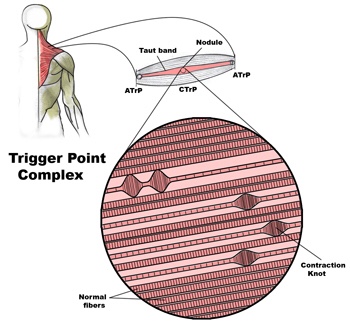
Myofascial pain syndrome (trigger points) and fibromyalgia are often confused to be the same condition and while there is a lot of interrelatedness between the two they are not quite identical. The clinical definition of a trigger point is “a hyper irritable spot associated within a taut band of skeletal muscle that is painful on compression or muscle contraction, and usually responds with a referred pain pattern distant from the spot”. Trigger points form from an overload trauma to the muscle tissue. This is contrasted with fibromyalgia which is defined as “a medical condition characterized by chronic widespread pain and a heightened pain response to pressure. Other symptoms include tiredness to a degree that normal activities are affected, sleep problems and troubles with memory. Some people also report restless leg syndrome, bowel and bladder problems, numbness and tingling and sensitivity to noise, lights and temperature. It is also associated with depression, anxiety, and post traumatic stress disorder”. Fibromyalgia will also present with localized tender points which are often mistaken for trigger points. Where these two conditions become somewhat interrelated is via the nervous system. Fibromyalgia patients suffer from a super-sensitization of the nervous system causing hyperirritability and pain. Myofascial trigger points can be caused by,or be the cause of, super sensitization. An active trigger point will irritate the sensory nerves around it eventually leading to super-sensitization. Trigger points have also been showed to form of become active due to super-sensitization. Both of these conditions can perpetuate the other, leading to layers of pain and symptoms. This being the case, trigger point therapy can have a very positive effect on decreasing the severity of pain and symptoms in patients suffering from fibromyalgia.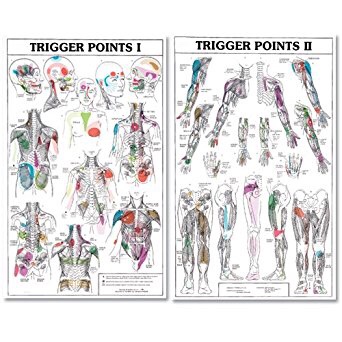

Trigger points in the adductor longus and brevis.
These muscles are located in the groin. The longus originates on the pubic body just below the pubic crest and inserts on the middle third of the linea aspera.The brevis muscle originates on the inferior ramus and body of the pubis and has its attachment to the lesser trochanter and linea aspera of the femur. Trigger points in these muscles are the most common muscular cause of groin pain. Distal trigger points refer pain to the upper medial knee and down the tibia. Proximal trigger points refer into the anterior hip area.
Trigger points in the iliopsoas muscle
This muscle originates on the bodies and disks of T12-L5 and the inner ilium. It inserts on the lesser trochanter of the femur. The psoas flexes the hip when the spine is fixed. When the leg is fixed it extends the lumbar spine increasing lumbar lordosis. This Muscle is often chronically shortened due to inactivity and sitting posture. When trigger points are present they will refer pain primarily to the lower lumbar area and the sacrum as well as into the anterior thigh. Trigger points in the iliopsoas muscle can mimic appendicitis.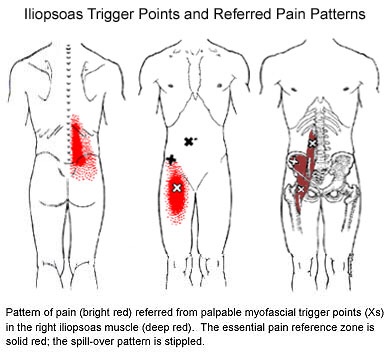
Trigger points in the piriformis muscle
The piriformis muscle is a small muscle deep to glute max and lies over top of the sciatic nerve. It originates on the anterior sacrum, and inserts on the greater trochanter of the femur. It’s main action is to laterally rotate the femur. When trigger points developed in this muscle they will refer pain into the sacro-iliac region, across the posterior hip and down the leg. This muscle can also be a cause of sciatic nerve irritation if it gets tight, causing “sciatica” symptoms. 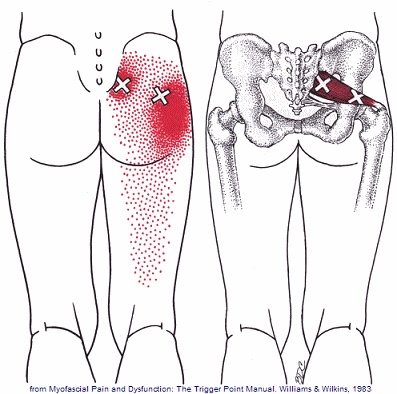
Trigger points in the gluteus minimus
The gluteus minimus is a small but important muscle that lies deep to the gluteus medius. It originates on the gluteal surface of the ilium, and attaches on the greater trochanter of the femur. It’s main actions are to abduct and medically rotate the hip. Trigger points in this muscle refer pain into the buttock and down the lateral and posterior leg, mimicking sciatica. This muscle should be the first to be examined if a straight leg test turns out negative. 
Pathophysiology of trigger points.
A large number of factors have been identified as causes of trigger point activation. These include acute or chronic overload of muscle tissue, disease, psychological distress, systemic inflammation, homeostatic imbalances, direct trauma, radiculopathy, infections, and lifestyle choices such as smoking. Trigger points form as a local contraction of muscle fibres in a muscle or bundle of muscle fibres. These can pull on ligaments and tendons associated with the muscle which can cause pain to be felt deep inside a joint. It is theorized that trigger points form from excessive release of acetylcholine causing sustained depolarization of muscle fibres. Trigger points present an abnormal biochemical composition with elevated levels of acetylcholine, noradrenaline and serotonin and a lower ph. The contracted fibres in a trigger point constricts blood supply to the area creating an energy crisis in the tissue that results in the production of sensitizing substances that interact with pain receptors producing pain. When trigger points are present in a muscle there is often pain and weakness in the associated structures. These pain patterns follow specific nerve pathways that have been well mapped to allow for accurate diagnosis or the causative pain factor.