The all too common knee cartilage tear.

The meniscus is a piece of tough, smooth, rubbery cartilage in the middle of your knee. Each of your knees have a meniscus on the inside (medial meniscus) and another on the outside (lateral meniscus). Each meniscus attaches to the top of your shin bone (tibia) and acts as a shock absorbent guide for your thigh bone (femur), which rests above.
Meniscus

Damage or tears to the meniscus are common. Males are affected three or four times more often than females. Tears may occur at any age. In children and adolescents, the menisci are more durable and rubbery, so most injures are “traumatic” as a result of a forceful twisting injury. As we age, our meniscus grows weaker, and “degenerative” tears become more likely, often resulting from simple or even unrecognized injuries.

Symptoms of meniscus injury depend on the type and severity of damage. Patients sometimes hear a pop or snap at the time of initial injury. Patients with acute injuries may have difficulty bearing weight and may develop a limp. Stiffness is a common complaint. Clicking, catching, locking or giving-way is possible. Meniscus injuries are usually aggravated by movement and become particularly uncomfortable with deep squatting.

Although some meniscus injuries may require surgery, most can be treated conservatively with the type of treatments provided in our office. Your age roughly correlates with the need for surgery. Approximately 2/3 of acute meniscal tears in children and adolescents will require surgery, but only about 1 in 20 patients over the age of 40 will require knee arthroscopy. Surgery is necessary more often in patients who cannot fully bend or straighten their leg, or whose knee locks and gets stuck in one place.

Home management includes rest, ice, compression and elevation (RICE). You should apply ice over your knee for 15 minutes at a time, three or four times a day. Wrapping an ACE bandage around your knee will provide compression to help minimize swelling. You may elevate your leg by placing a pillow beneath your knee to help reduce swelling.

You may need to limit your activity to prevent further damage while you are recovering from injury. Activities that involve twisting on a weight-bearing flexed knee are the most harmful. You may need to temporarily or permanently discontinue some high energy sports activity. Other activities, like water walking, may be substituted for higher energy sports, like soccer and tennis. Ice or ice massage should be used following activity.

Patients who have undergone surgical repair of their meniscus are more likely to develop arthritis. These patients will also benefit from a well-planned home exercise program.

What is a knee sprain?

“Ligaments” are made up of many individual fibers running parallel to each other and bundled to form a strong fibrous band. These fibrous bands hold your bones together. Just like a rope, when a ligament is stretched too far, it begins to fray or tear. “Sprain” is the term used to describe this tearing of ligament fibers.

Sprains are graded by the amount of damage to the ligament fibers. A Grade I sprain means the ligament has been painfully stretched, but no fibers have been torn. A Grade II sprain means some, but not all of the ligamentous fibers, have been torn. A Grade III sprain means that all of the ligamentous fibers have been torn, and the ligament no longer has the ability to protect the joint. Knee sprains commonly involve one or more of your knee’s ligaments including: the medial collateral, lateral collateral, anterior cruciate, and posterior cruciate.

Most knee sprains begin as the result of a sudden stop, twist, or blow from the side or front. Some patients recall a “pop” or “snap” at the time of injury. Knee sprains cause pain and swelling within the joint. Your knee may be tender to touch, and some patients report a sensation of “giving way” or difficulty walking.

Most knee sprains can be successfully managed without surgery but will require some work on your part. Initially, a period of rest may be necessary in order to help you heal. Mild Grade I sprains may return to activity in a couple of days, while more severe injuries may take six weeks or longer to recover. You can help reduce swelling by elevating your knee and using an ACE wrap for compression. Applying ice or ice massage for 10 minutes each hour may help relieve swelling. Depending upon the severity of your sprain, you may need to wear a knee brace to help protect you from further injury. If walking is painful, crutches may be necessary.

I’ve never baked anything in my life; how do I have a Baker’s Cyst?

Your body has strategically-placed, fluid-filled cushions called “bursa” around each joint. Bursa act to reduce friction where muscular tendons rub on bone. Your knee is surrounded by several bursa that share fluid with the inside of your knee joint and with each other. You can think of this like a chain of lakes connected by streams. If the inside of your knee joint or any of the bursa around your knee becomes inflamed, the entire system fills. When swelling exceeds each individual bursa’s capacity, this fluid creates a soft balloon-like swelling of the popliteal bursa behind your knee called a “Popliteal cyst”, or more commonly a “Baker’s cyst”.
This swelling is usually not from a problem with the popliteal bursa itself, but rather, inflammation somewhere else in the joint that has distended the popliteal bursa. This swelling is often the result of arthritis or damage to a ligament or cartilage within the knee.

A Baker’s cyst is often painful, and the discomfort may increase when you attempt to move your knee. Depending on the severity of your swelling, your symptoms may vary between a feeling of fullness and significant pain. It is not unusual for a Baker’s cyst to change in size from day to day, depending on the amount of swelling. Be sure to tell us if your pain progressively increases when you walk or if you notice warmth, redness or swelling in your calf, as these could be signs of a more significant problem.

Sometimes rest and elevation of your leg help to alleviate pain and swelling. Initially, you may need to avoid activities, like squatting, kneeling, heavy lifting, climbing stairs, or running. Wearing a brace on your knee may compress the cyst and cause an increase in your pain. Since Baker’s cysts are generally a problem that is secondary to another condition, treatment is most effective when directed at the underlying problem.

What is my Fibular Head and why does it hurt?

The bone on the outermost portion of your lower leg is called the “fibula.” Your fibula is joined to the larger “tibia” at the ankle and the knee. These connections allow for better function and dispersal of weight (1/6th of your body weight is supported by the fibula).

Proper function of your knee requires natural gliding movements of the tibia/ fibula joint. The diagnosis of “Fibular head dysfunction” means that this joint has been “sprained” or has become “stuck” in an abnormal position. Fibular head problems affect all age groups but are particularly common in young females.


Problems involving the fibular head are often the result of an injury to your leg, hamstring, or ankle. Sports and activities that require violent twisting motions with the knee bent are particularly suspect. Athletes who participate in football, soccer, rugby, wrestling, gymnastics, judo, broad jumping, dancing, long jumping, and skiing may be more likely to suffer this type of injury. Patients who sprain their ankle or slip and fall with their knee flexed under their body may suffer fibular head problems. Sometimes, symptoms begin without an identifiable injury.

Patients with fibular head problems generally complain of pain on the outside of their knee. Symptoms become more intense with weight bearing or when applying pressure over the irritated area. Sometimes, the condition affects both knees at the same time. In more severe cases, you may experience numbness or tingling on the outside of your leg. Be sure to tell your doctor if you notice numbness, tingling, or weakness in your leg or ankle.

In most cases, fibular head dysfunction is treatable with conservative care, like the type provided in our office. Initially, you may need to limit excessive twisting movements and hyperflexion, (i.e. heel to butt.) Taping or bracing may help patients who have suffered a sprain or have an “unstable” joint.

Pes Anserine Bursitis; What Is It?

The term “pes anserine” is Latin for goose’s foot, and describes the appearance of three tendons that converge and insert on the inner portion of your knee. The pes anserine bursa is a fluid-filled, friction-reducing cushion, sandwiched between these tendons and your leg bone.

Injuries or irritation can cause the lining of the bursa to produce too much fluid, resulting in painful swelling. Patients with knee osteoarthritis are likely to have chronic irritation of the pes anserine bursa. The condition is more common in overweight patients, diabetics, and females. Runners and athletes in sports that require rapid side-to-side movements (i.e. football, soccer, tennis, etc.) are more likely suffer from the condition. Swimmers who do the breast stroke commonly suffer from pes anserine bursitis.
Symptoms include pain on the inner side of your knee, just below the joint. Your pain is probably worse when you stand up or walk stairs. Discomfort increases during activities that require side-to-side movements (i.e. tennis, dancing). Be sure to tell your doctor if you notice clicking, popping, or locking of your knee, excessive thirst, excessive urination, fever, or pain & swelling in your calf.

In addition to the treatment provided by our office, you may find relief by applying home ice or ice massage for 8-10 minutes. Having flat feet places additional stress on the inside of your knee, so patients with fallen arches will benefit from arch supports or orthotics. Overweight patients will benefit from a diet and exercise program.

Pulled Hammie! Man Down!

stantonhurt_medium.gif

Your hamstring is the group of muscles in the back of your thigh that flex your knee, i.e., moving your heel toward your buttock. The term “strain” means that a muscle or its tendon has been stressed beyond its limit and has frayed, much like a rope that has been pulled too hard. Your hamstring may be “pulled” or “strained” when it is forced to contract beyond its capacity, like during running or from excessive stretch. This tearing leads to bleeding, bruising, swelling, pain and loss of function.

The symptoms of a hamstring strain may vary from mild discomfort to severe pain, depending upon the amount of tissue that has been torn. Over 90% of hamstring strains occur abruptly with a tearing, burning or popping feeling accompanied by immediate pain below your buttock. Your symptoms will likely increase when straightening your leg, walking or flexing forward. You may notice some bruising that starts near the site of injury. Be sure to tell your doctor if you have notable pain in your lower back, if your pain extends into your calf, if your pain worsens with coughing or sneezing, or if you have a rash on the back of your thigh.

Hamstring injuries are more common when your muscles are tired from activity and happen more frequently as we age. Having excessive tightness or weakness in your hamstring, having quadriceps that are significantly stronger than your hamstring, having too little core strength or poor running form also predispose you to injury.

Nearly all hamstring strains can be successfully managed with conservative care, like the type provided in our office. Your healing period will vary based on several factors, including the specific region of your hamstring that has been injured. Tears that involve the part of the muscle closest to your ischial tuberosity (the bones you sit on) take longer to heal than those that occur further down the muscle.

Initially, you should use ice or ice massage over the injured area for 15 minutes at a time, up to once per hour. Our office may advise you to use an ACE wrap or compression bandage to help limit swelling. The use of NSAIDs for hamstring strains is controversial, as some research suggests this may delay healing. Patients who have more severe injuries may need to use crutches. While you are recovering, you may need to limit some activities, like running and jumping and instead, cross train by stationary cycling or swimming. You are more likely to strain your hamstring in the future and recurrent injuries may take twice as long to heal as the initial injury, so be sure to allow yourself adequate healing time, consistently perform your exercises and warm-up properly prior to activity.

Trigger points in the gluteus minimus

The gluteus minimus is a small but important muscle that lies deep to the gluteus medius. It originates on the gluteal surface of the ilium, and attaches on the greater trochanter of the femur. It’s main actions are to abduct and medically rotate the hip. Trigger points in this muscle refer pain into the buttock and down the lateral and posterior leg, mimicking sciatica. This muscle should be the first to be examined if a straight leg test turns out negative.

Osgood Schlatter’s Disease

Children and adolescents have soft “growth plates,” which are areas where their bone is still growing. In children, this growth plate is much weaker than in adults. This means that children are more likely to suffer growth plate injuries than adults, especially during periods of rapid growth.

Osgood Schlatter’s disease, also called tibial epiphysitis, is a painful irritation of the growth plate near the insertion of your quadriceps muscle on your knee. The powerful thigh muscles attach onto your knee through the patellar tendon. When your thigh muscle contracts- like during running or jumping, they place a sheer force on the growth plate of your knee.
Osgood Schlatter’s disease is more common in athletes, particularly those who participate in soccer, gymnastics, basketball, running or track. It is most common between the ages of 10 and 15 and is relatively equally common between boys and girls. Excessively tight thigh or calf muscles may contribute to this problem.
You may experience pain with activity that requires running or jumping. You will often feel tenderness or even bony enlargement of your “tibial tuberosity”, just below your knee. Kneeling or prolonged squatting may be painful.

Some athletes with mild cases may continue activity as long as it does not increase your symptoms. Most cases may require a period of rest to allow the condition to heal. Depending on the severity of your condition, you may need to limit activities that require running and jumping for a while, usually two to eight weeks. You can often cross train in the pool or on a stationary bike.

You should avoid running with a narrow stride “on a line,” as this may increase your symptoms. Our office may recommend use of a patellar tendon strap to assist with your healing. Osgood Schlatter’s disease can temporarily limit your activity, but most of the time, it can be successfully managed, allowing your return to pain-free activity in a relatively short period of time.

Knee Arthritis; Who, Where, Why and How?

The bones in your knee have a slick protective covering called “cartilage” on the joint surfaces that touch each other. This cartilage serves as a friction reducer and shock absorber, thereby helping to extend the life of your joints. “Arthritis” means that your cartilage has begun to thin or crack and may eventually wear away, leading to a painful “bone on bone” situation.

Knee arthritis is very common, affecting more than 1/3 of adults over age 65. People who are overweight or have a history of knee injury or surgery are more likely to develop arthritis. Jobs and activities that require repetitive squatting, kneeling, pivoting or stair climbing may cause increased wear. Contrary to popular opinion, runners have no increased risk of developing knee arthritis. Women are two to three times more likely to develop knee arthritis as compared to men.

The pain of knee arthritis is often described as a “deep ache” that is aggravated by activity and relieved by rest. You probably notice morning stiffness that goes away after a short period of activity, but returns after sitting for long periods of time. Some patients have difficulty squatting, bending and walking stairs. You may notice that your knees pop and crack. Eventually, knee arthritis can cause you to walk slower, lose your balance and even fall more often. Many patients notice that their symptoms increase with weather changes.

Although there is no cure for the irreversible wearing associated with arthritis, there is help for your symptoms. Performing your home exercises is very important. The way that your knee is aligned (and wears) is largely based upon how your hip and foot function, so many of your home exercises will target those regions. Our office may prescribe arch supports or orthotics, since people with flat feet are almost twice as likely to suffer from knee arthritis.

Overweight patients should begin or increase low-impact aerobic exercises like walking, stationary cycling, elliptical exercising, water walking or swimming. Be sure to take frequent breaks from prolonged sitting and avoid overly painful activities.

Pathophysiology of trigger points.

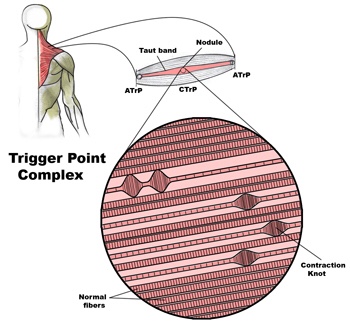
A large number of factors have been identified as causes of trigger point activation. These include acute or chronic overload of muscle tissue, disease, psychological distress, systemic inflammation, homeostatic imbalances, direct trauma, radiculopathy, infections, and lifestyle choices such as smoking. Trigger points form as a local contraction of muscle fibres in a muscle or bundle of muscle fibres. These can pull on ligaments and tendons associated with the muscle which can cause pain to be felt deep inside a joint. It is theorized that trigger points form from excessive release of acetylcholine causing sustained depolarization of muscle fibres. Trigger points present an abnormal biochemical composition with elevated levels of acetylcholine, noradrenaline and serotonin and a lower ph. The contracted fibres in a trigger point constricts blood supply to the area creating an energy crisis in the tissue that results in the production of sensitizing substances that interact with pain receptors producing pain. When trigger points are present in a muscle there is often pain and weakness in the associated structures. These pain patterns follow specific nerve pathways that have been well mapped to allow for accurate diagnosis or the causative pain factor.