Don’t Get Thirsty!

Thirsty

The majority of Americans are dehydrated on a daily basis. It’s recommended we get 8 glasses of water a day, which proves to be a challenge for those who regularly consume other drinks, such as coffee, juice, and alcoholic beverages. Not only do these other drinks fill you up and make it harder for you to ingest a healthier beverage (such as water), it’s also counterproductive, as it dehydrates you. If you need help consuming more water throughout the day, consider these tips:


  • Carry a reusable water bottle with you at all time.
  • Always drink before, during, and after a workout.
  • Add flavor to your water with lemons, limes, or cucumbers.
  • Create a schedule for you to remember to drink water, such as drinking a glass at the top of every hour.

Thumb/Wrist pain from De Quervain’s Disease…..

Tendons are strong, fibrous bands of tissue connecting muscles to bones. Some tendons are covered by a protective, lubricated insulation called a “synovial sheath.” The two tendons on the thumb-side of your wrist that extend and abduct your thumb into a “hitchhiker” position are covered by a sheath. Normally, these tendons move freely within this covering, much like a sword sliding through a sheath.

If these tendons and sheaths are forced to repetitively rub against the bones of your wrist, they can become painfully swollen. This condition is called De Quervain’s tenosynovitis.

The pain of De Quervain’s tenosynovitis may begin abruptly, but more commonly starts gradually and increases over time. The pain is provoked by movements of your thumb or wrist. In more severe cases, you may notice swelling on the outside of your wrist. Some patients complain of “catching” or a slight “squeaking” sound while moving their wrist.

Activities like gardening, knitting, cooking, playing a musical instrument, carpentry, walking a pet on a leash, texting, video gaming and sports like golf, volleyball, fly fishing and racquet sports are known triggers. The condition was once known as “Washer woman’s sprain,” since wringing out wet clothes can trigger the problem. Lifting infants or children by placing your outstretched finger and thumb beneath their armpit has led to the nicknames of “Mommy thumb” or “Baby wrist.”

The condition strikes women much more frequently than men. It typically affects middle-age adults and is more slightly common in African-Americans, patients with diabetes or rheumatoid arthritis may be at higher risk for this problem.

Many patients will experience resolution of their symptoms through conservative care, like the type provided in our office. You should avoid lifting, grasping and pinching movements, especially when your wrist is bent toward either side. You may need to find alternate ways to lift children and perform work, sport and leisure activities. Video game players and those who text should take frequent breaks and try to hold their wrists straighter. Avoid wearing tight wristbands. Applying ice to your wrist for 10 minutes every hour or performing an “ice massage” (freeze a paper cup filled with water, tear off the bottom to expose the ice, massage over the tendons in a figure-eight pattern for 6-10 minutes, taking breaks as needed) can provide relief.

Patients who have severe pain or swelling are less likely to respond to conservative care. These patients may require a cortisone injection to relieve their pain, however, surgery is rarely necessary.

Mobility Myth #4

stantonhurt_medium

Myth: You only need to do mobility work if you’re an athlete or if something hurts.

Truth: “Whether you’re pro athlete, weekend warrior, or parent being active with their kids, the mobility requirement for fundamental movements (running, squatting, etc.) stays the same,” says Ardoin. “We always need adequate mobility in the same key areas, such as the ankles, hips, thoracic spine (upper back), shoulders.” He says everyone should be able to meet the following mobility baselines:

  • Touch your chin to your chest without opening your mouth.

  • Look up toward the ceiling with your face becoming parallel to the floor.

  • Rotate your head to each side until your chin reaches mid collarbone.

  • Touch your toes with straight legs.

  • Lower into a deep squat without your heels coming up or toes rotating out.

“If you don’t have access to the necessary mobility, your body will find a way to get it by compensating elsewhere, which could lead to injuries down the road,” he says.

But the injuries might be in unexpected places: Your first thought might be to deal with the area that hurts—but, often, that’s not the true source of the problem. “Often times the issue causing lower-back pain isn’t the lower back, but an issue with hip mobility,” says Esquer. An elbow issue might actually be due to a lack of wrist mobility, and upper-back pain might be due to tightness in the front of the chest and shoulders.

“A lot of times we don’t notice movement restrictions until we’re in pain,” says Esquer. Maintaining your natural mobility day in and day out (kind of like brushing your teeth to prevent cavities) will help prevent surprise injuries from popping up.

Radial Tunnel Syndrome

Your radial nerve begins in your neck and travels past your elbow en route to its final destination in your hand. Just beyond your elbow, this nerve passes through a 2-inch area on the back of your forearm called the “Radial tunnel”. “Radial tunnel syndrome” means that your radial nerve has been compressed or irritated within this space-leading to forearm pain or hand weakness.

Radial tunnel syndrome is thought to result from muscular overuse, especially prolonged or excessive wrist extension or rotation. The most common cause of compression comes from excessive tightness in a muscle called the “Supinator”. Workers whose jobs require heavy or repetitive wrist movements are at an increased risk for this disorder. Occasionally, the radial nerve can become irritated from direct compression by a tight band or brace. The condition may be more common in those who have diabetes or thyroid problems.

Symptoms from irritation of the radial nerve depend upon which specific nerve fibers are irritated. The most common symptoms include pain, numbness, tingling or decreased sensitivity along the top of your forearm radiating toward your hand and thumb. The symptoms often mimic those of “tennis elbow.” When the nerve fibers that control muscle function become compressed, you may experience weakness when trying to extend your fingers, hand or wrist. Seventy percent of radial tunnel patients also have problems in their neck or upper back.

Conservative treatment of radial tunnel syndrome is generally successful. Fixing the problem means limiting excessive or repetitive wrist movements, especially extension and rotation. In severe cases, a splint may be necessary to limit your motion. Try to avoid compression of your forearm, particularly from tight bands or braces. Use of a tennis elbow brace will likely aggravate your symptoms. You may find relief by applying ice or ice massage to the area for 10-15 minutes at a time.

Mobility Myth #2

what-is-mobility-mobility-myths-foam-rolling

Myth: You can get rid of knots or scar tissue with foam rolling or massage.

Truth: “You probably hear of ‘breaking up fascia’ and ‘breaking up scar tissue,’ but the reality is that it literally takes 200 tons to deform scar tissue or cause mechanic changes to the fascia,” says Los Angeles–based physical therapist Jen Esquer, D.P.T., creator of the Mobility Method program. So whenever you’ve been told that someone is “massaging out a knot” in your back, or that foam rolling is “realigning your muscle fibers,” it’s a load of B.S. (You’ve probably also heard that foam rolling can get rid of cellulite.)

“Think: If you bump into something super hard, yeah, you might bruise, but you’re not actually breaking something in your body or tearing tissue,” says Esquer. “So why would we think that lying or rolling around on a foam roller for a while would have that extreme effect?”

You might be thinking, “But it totally helps!” You’re not wrong—it does. It just helps for a different reason: “Really, foam rolling and massage work by bombarding the brain with safe, feel-good information, convincing the muscle to relax and let go,” says Ardoin. That calming of the nervous system results in the release of tension and tightness that you feel.

And since it’s all about relaxation, you should never be trying to create pain in the body, says Esquer: “You don’t want to fire anything back up and make it potentially worse. It always comes back to relaxation.”

What is scoliosis?

Your spine is made up of 24 bones that stack on top of each other- normally in a straight line. “Scoliosis” means that your spine is curving from side to side, rather than being straight. Scoliosis affects between 1-3% of the population. Scoliosis may begin at any time between birth and adulthood but is most common during times that your skeleton is growing rapidly. Most cases of scoliosis begin between the ages of 13 and 18. Researchers are not completely certain why some people develop scoliosis, but they have found that the problem tends to run in families.

The curve of your scoliosis may be measured with an x-ray. Although some curves get worse, most do not. In fact, only ¼ of all adolescent idiopathic scoliosis curves will progress. Small curves in mature patients have a low risk of progression (2%), while large curves in younger patients progress more frequently. (70%) Curve progression is more common in girls, especially those with larger curves (greater than 20 degrees). Your doctor may need to monitor your scoliosis for progression by performing x-rays every 6-18 months.

Scoliosis may cause your shoulders, hips, or waist to be unlevel. Most curves are classified as “right thoracic”, which means that the peak of your curve protrudes toward the right. This is often accompanied by a forward rotation of your right shoulder and “winging” of your right shoulder blade. Many patients have a secondary curve in their lower spine that helps to balance their body. The majority of patients with mild to moderate scoliosis have no symptoms, but approximately ¼ report back pain. Unfortunately, scoliosis increases your risk of developing back pain later in life.

The primary goal of treatment is to stop curve progression. While many cases can be slowed or even reversed through appropriate management, it is important to recognize that others may progress in spite of the best care. Conservative care, including spinal manipulation (like the type provided in our office) has been shown to help some patients with scoliosis. Exercise is another effective treatment for scoliosis. It is important that you clearly understand your home exercise program and that you perform it consistently.

Patients with larger curves (30-40 degrees), or those who are at high risk for progression may benefit from wearing a brace. Braces have been shown to decrease the need for surgery in about three out of four patients. Fortunately, less than 0.3% of all scoliosis cases will ever require surgery.

You should avoid carrying heavy back packs and consider switching to a wheeled version, if necessary. Sports and exercise will not worsen most cases of scoliosis, and you should continue to participate in the things you enjoy unless directed otherwise by your doctor. The diagnosis of scoliosis is always discouraging, but you must focus on what it is really most important. Be confident in who you are! Don’t let something like a curved spine (or any other medical condition) define you as a person.

TMJ dysfunction

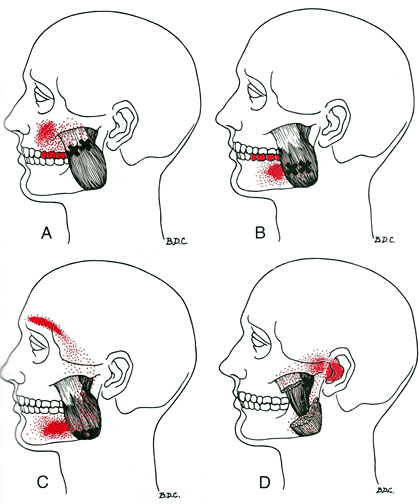
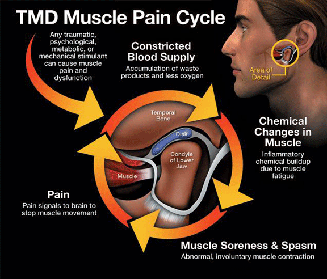
Temporomandibular joint dysfunction is a blanket term that refers to pain and dysfunction of the jaw muscles and the tempomandibular joints which connect the mandible to the skull. The most common symptoms are pain and restricted mandibular movement as well as grinding noises coming from the joint. This condition is more common in women then in men, and affects a large portion of patients suffering from fibromyalgia. Trigger points in the muscles of mastication are frequently involved in TMJ dysfunction. Trigger points in the pterygoid and masseter muscles for example will not only refer pain into the tempomandibular joints, but will also cause a dysfunctional movement pattern that can restrict range of motion. Trigger point therapy can be an effective modality to treat TMJ dysfunction.

I smoke and I sit; does that matter?

Your thoracic spine is made up of 12 individual vertebrae stacked on top of each other. To allow for flexibility and movement, there is a cushion or “disc” in between each level. As we age, these discs can wear and become thinner over time. This leads to additional changes, including bone spurs and narrowing of the opening where your nerves exit your spine. This process is called “thoracic spondylosis”, or simply, “arthritis”.

How quickly you develop back arthritis is largely a trait you inherited from your parents. Other factors may play a role, including a history of trauma, smoking, operating motorized vehicles, being overweight and/ or performing repetitive movements (i.e. lifting, twisting, bending or sitting). Men seem to be affected slightly more often than women.

Symptoms often begin as back pain that gradually worsens over time. Stiffness may be present upon arising in the morning. Pain is relieved by rest or light activity and aggravated by strenuous work. Sometimes your nerves can become “pinched” in narrowed openings where they exit your spine. This can cause pain, numbness, or tingling radiating around your trunk along the path of the irritated nerve. Be sure to tell your doctor if you notice any weakness or if you have a rash (running along your rib), fever, abdominal pain, change in bowel or bladder function, or pain in your groin crease.

Arthritic changes can be seen on x-rays, but interestingly, the amount of wearing does not seem to correlate directly with the severity of your symptoms. People with the same degree of arthritis may have symptoms ranging from none to severe. Most researchers believe that the symptoms of osteoarthritis are not the direct result of the disease, but rather, from the conditions that preceded the disease and those that develop after it, like joint restrictions and muscle tightness. Fortunately, those conditions are treatable and our office has a variety of tools to help relieve your pain.

In general, you should avoid repeated lifting and twisting and take frequent breaks from prolonged sitting, especially in motorized vehicles. Avoid any position that causes an increase in radiating pain. Light exercise, like walking, stationary cycling, water aerobics, and yoga may be helpful. Smokers should find a program to help them quit and overweight patients will benefit from a diet and exercise program.

Trigger points and fibromyalgia

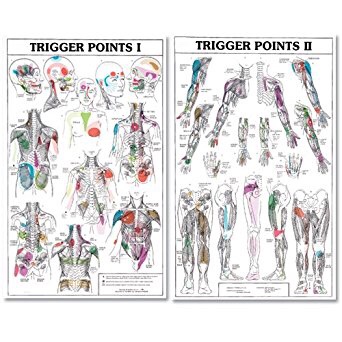
Myofascial pain syndrome (trigger points) and fibromyalgia are often confused to be the same condition and while there is a lot of interrelatedness between the two they are not quite identical. The clinical definition of a trigger point is “a hyper irritable spot associated within a taut band of skeletal muscle that is painful on compression or muscle contraction, and usually responds with a referred pain pattern distant from the spot”. Trigger points form from an overload trauma to the muscle tissue. This is contrasted with fibromyalgia which is defined as “a medical condition characterized by chronic widespread pain and a heightened pain response to pressure. Other symptoms include tiredness to a degree that normal activities are affected, sleep problems and troubles with memory. Some people also report restless leg syndrome, bowel and bladder problems, numbness and tingling and sensitivity to noise, lights and temperature. It is also associated with depression, anxiety, and post traumatic stress disorder”. Fibromyalgia will also present with localized tender points which are often mistaken for trigger points. Where these two conditions become somewhat interrelated is via the nervous system. Fibromyalgia patients suffer from a super-sensitization of the nervous system causing hyperirritability and pain. Myofascial trigger points can be caused by,or be the cause of, super sensitization. An active trigger point will irritate the sensory nerves around it eventually leading to super-sensitization. Trigger points have also been showed to form of become active due to super-sensitization. Both of these conditions can perpetuate the other, leading to layers of pain and symptoms. This being the case, trigger point therapy can have a very positive effect on decreasing the severity of pain and symptoms in patients suffering from fibromyalgia.

The Thoracic Disc Lesion

Your spine consists of 24 individual vertebrae stacked on top of each other. Flexible cushions called “discs” live between each set of vertebra. A disc is made up of two basic parts. The inner disc, called the “nucleus” is like a ball of jelly about the size of a marble. This jelly is held in place by the outer part of the disc called the “annulus,” which is wrapped around the inner nucleus,

much like a ribbon wrapping around your finger. The term “thoracic disc lesion” means that one or more of the 12 discs in the center section of your spine has been damaged.

Disc problems start when the outer fibers of the disc become strained or frayed. If enough fibers become frayed, the disc weakens and when compressed, may “bulge” like a weak spot on an inner tube. If more fibers are damaged, the nucleus of the disc may “herniate” out of the disc.

Surprisingly, thoracic disc bulges are present without any symptoms in almost half of the adult population. Disc bulges that cause pain commonly occur in the neck or lower back but are relatively infrequent in the thoracic spine – accounting for less than 1% of all symptomatic disc problems. The condition is most common between the ages of 40 and 60. Certain occupations or activities place you at greater risk, especially physically demanding activities that involve repetitive twisting, awkward postures.

Pain can range from dull, localized discomfort to sharp, radiating pain. Your symptoms may change unpredictably. If the disc bulge is bad enough to compress your nerve, you could experience sharp, burning, or shooting pain in a band-like distribution around your rib cage. Thoracic disc herniations commonly mimick other conditions like heart or lung problems. Be sure to let our office know if you notice chest pressure; shortness of breath; pain radiating into your arm, face, or jaw; pain with deep breathing; clumsiness; loss of bowel or bladder control; unexplained weight loss; night sweats; pain that awakens you at night; fever; indigestion; nausea; flu-like symptoms or if you notice a rash following the margin of one of your ribs.

You should avoid excessive bed rest while recovering. Researchers have shown that disc bulges may be successfully managed with exercise and conservative care, like the type we will provide.