
The deltoid is the main muscle that makes up the shoulder. It originates on the clavicle, acromion, and spine of the scapula. It inserts on the deltoid tuberosity of the humerus. The deltoid acts at the shoulder to produce abduction, and assist with flexion and extension. The deltoid is especially prone to developing trigger points. These posterior style will refer pain into the anterior and lateral shoulder. Trigger points in the posterior delt will refer pain into the posterior shoulder with spillover down the lateral arm.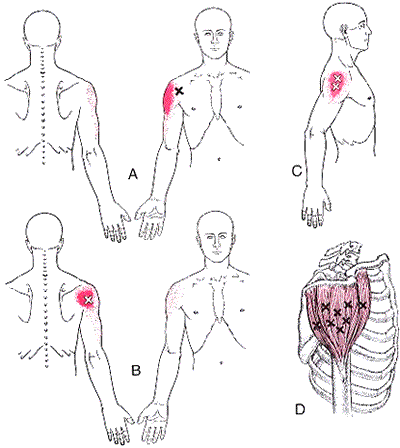
Health
A collaborative vision for the future

According to the latest National Health Interview Survey (1), nearly 1 in 4 Americans seek the services of a chiropractor, with utilization steadily increasing over the past decade. The majority of users reported chiropractic helping “a great deal”. The overwhelming majority reported chiropractic care combined with medical treatment as helpful.
The preceding sentence is a collaborative vision for the future. Outcomes-based healthcare requires that providers work toward an integrated model where management is selected based upon merit, not habit.
We are honored by the opportunity to co-manage your musculoskeletal pain and will strive to maintain your trust.
References
1. Adams J. et al. The Prevalence, Patterns, and Predictors of Chiropractic Use Among US Adults: Results From the 2012 National Health Interview Survey. SPINE. 42(23):1810–1816, Dec 2017
Trigger points in the adductor pollicis
The adductor pollicis is a muscle in the hand and acts on the thumb. It originates on the transverse head of the third metacarpal, the oblique head of the base of the second and third metacarpals, and the trapezoid and capitate bones. It inserts on the base of the proximal phalanx and ulnar sesamoid. This muscle acts to adduct and flex the thumb. Trigger points cause pain and aching along the outside of the thumb and hand, spillover pain may reach the thenar eminence.
Condition Of The Month: TOS!
Thoracic Outlet Syndrome (TOS)
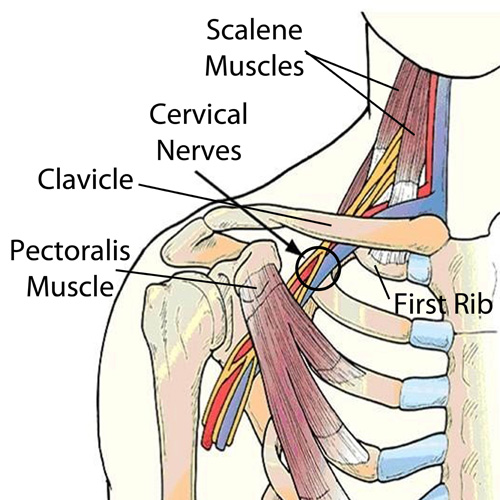
The term “thoracic outlet” describes an area at the base of your neck, just above your collarbone. Some important nerves and vessels pass through this outlet on their way into your arm. Compression of these tissues causes a condition called “thoracic outlet syndrome” which results in pain, numbness or tingling in your arm.
Several different factors can cause Thoracic Outlet Syndrome, commonly referred to as TOS. Sometimes TOS is caused from tightness in the muscles of your neck and chest, other times the space between your first rib and collarbone is too small. People who have an extra rib (cervical rib) and people who have recently suffered a neck injury may have a greater chance of having this problem.
The condition is aggravated by poor posture and by occupations that promote “slouching,” i.e., computer users, assembly line workers, supermarket checkers and students. Swimmers, volleyball players, tennis players, baseball pitchers and occupations requiring prolonged overhead activity. i.e., electricians and painters are also prime candidates for TOS.
Symptoms of TOS include arm pain, numbness, tingling and possible weakness. Neck, arm and hand pain may begin slowly and are often aggravated by elevation of the arms or excessive head movement. Loss of grip strength is possible.
Conservative treatment, like the kind we provide, has been shown to be effective at treating TOS. Through our careful exam we have identified your specific sites of compression and will use some of the following treatment to help:
You should avoid carrying heavy loads, especially on your shoulder i.e., carpet rolls. Briefcases, laptop cases or heavy shoulder bags should be lightened. Bra straps may need additional padding or consideration of replacement with a sports bra.
If you or someone you know suffers from any of these symptoms, call our office today. Our team has knowledge and tools to help you feel better quickly!
Help For Those Stuck At A Desk All Day
Desk workers should periodically perform the “Brugger relief position” to help maintain good sitting posture.
Here’s how to do it:
- Position your body at the chair’s edge, feet pointed outward. Weight should be on your legs and your abdomen should be relaxed.
- Tilt your pelvis forward, lift your sternum, arch your back, drop your arms, and roll out your palms while squeezing your shoulders together.
- Take a few deep cleansing breaths.
Learn more about proper workstation ergonomics in this video.
Trigger points in the adductor longus.
The adductor longus is a muscle of the groin. It originates on the pubic body just below the pubic crest, and inserts on the middle third of the linea aspera of the femur. It acts on the hip joint to cause adduction and flexion. Distal Trigger points in this muscle refer pain to the upper medial knee and down the tibia. Proximal trigger points refer pain into the anterior hip. These trigger points are the most common muscular cause of groin pain. 
A simple tip to help control caloric intake

Trying to be more mindful of your calories? Try applying this rule to your daily regimen:
Before grabbing a bite to eat, drink a full glass of water first. Many times, thirst can be confused with hunger.
How do nutritional needs change as we age?

A great piece here from https://www.tallahassee.com/life/
Remember that high school health class? Now imagine a similar class geared toward students 65 and older.
That’s the idea behind nutrition education for older adults provided by the Family Nutrition Program, an Extension program of the University of Florida Institute of Food and Agricultural Sciences, which teaches people how to stay healthy and active on a budget.
“As we get older, our bodies change, and we are at greater risk for developing chronic diseases like high blood pressure and diabetes,” said Dr. Sharon Austin, adult programs specialist for the Family Nutrition Program. “My job is to encourage older adults to make small changes that will help them lead active, independent lives.”
The need for this kind of education is growing, Austin said. Adults over 65 are the fastest growing age group in the United States, and Florida has the highest percentage of adults 65 and older of any state, she said.
Everyone ages differently, and individual needs can be determined with your doctor, Austin said. But in general, as we get older, we may need to pay more attention to certain aspects of our eating and exercise routines to stay healthy, she said.
1. Calorie needs
As we age, our bodies typically need fewer calories because we are moving less and have less muscle mass, Austin said. “When you don’t need as many calories, you want to make sure you get more bang for your buck. That means avoiding ‘empty calories’ and choosing foods that are going to give you the nutrients you need,” she said.
2. Eating from every food group
One way to ensure that you are getting all the nutrients you need is to eat a variety of foods from every food group, Austin said. Take a look at ChooseMyPlate.gov to see how much of each food group to consume.
3. Fiber-rich foods
“Fiber isn’t just good for digestive health. It also helps lower risk for heart disease and diabetes, which are common chronic diseases in older adults,” Austin said.
You can get your daily recommended intake of fiber from whole grains, beans, and fresh fruits and vegetables, she said.
4. Fortified foods
Look for foods fortified with vitamin B12, vitamin D and calcium. “Vitamin B12 helps keep the body’s nerve and blood cells healthy, and calcium and Vitamin D help support bone health,” Austin said.
5. Drinking water
Older adults may have a decreased sense of thirst, and may more easily become dehydrated, Austin said. “One way to avoid dehydration is to sip water throughout the day from a cup or container you keep nearby during your daily routines,” she said
6. Exercises for mobility, balance and weight management
“When we talk about exercise for older adults, the goal is to set yourself up for physical independence. In our classes, we talk about everyday activities, such as cleaning the house or gardening, which can keep us strong and flexible, and burn calories. We also practice ways to increase balance, which can help us avoid falls and injury,” Austin said.
An exercise that many participants enjoy is the ‘couch potato mambo,’ Austin said. “Next time you’re sitting watching TV, get up and dance during the commercial break. It’s a small step toward health, and it’s fun.”
How Does Chiropractic Help With Headaches?

How Does Chiropractic Help with Headaches?
Since 9 out of 10 Americans suffer from some form of headache, we tend to think of them as just a nuisance that can be relieved by taking a painkiller or a nap. Those solutions sometimes lighten the pain momentarily, but recurring headaches are a symptom that something else is wrong, and finding the root cause of your headaches is imperative to putting an end to them.
Fortunately, there’s a proven alternative. According to a new study, chiropractic treatment can provide “immediate relief” for many headache patients.
The majority of primary headaches, including tension headaches and migraines, are frequently associated with muscle tension or joint restrictions in the neck. These problems occur more often than ever before because nowadays we’re sitting in front of the computer for hours at a time or looking down at a phone to surf the web or text.
Chiropractors work to remove the triggers of these painful problems like stiffness, tightness, inflammation, and nerve irritation in the cervical spine. In addition to performing gentle spinal manipulation and soft tissue release, your chiropractor can also provide nutritional advice to help you avoid common migraine triggers found in your diet. Many patients also benefit from chiropractic advice on posture, relaxation techniques, and exercises to help prevent future problems.
So, if you or someone you know suffers from headache, call our office today. And check out this short video for more information about relief for neck-related headaches.
5 Tips To Staying In Shape While Injured

Dealing with an injury is not only painful but can be frustrating as well when you’re sidelined from your regular fitness routine. If you’ve ever been injured or had to sit out due to illness, you know that deconditioning happens very quickly. In fact, muscles begin to shrink within days, and cardiovascular fitness starts decreasing after two to three weeks without training. The good news is that there are ways you can stay in shape even while recovering from an injury. Here are our suggestions:
1. First things first, see us before getting back into any form of exercise, especially if you have a back or neck injury. We can determine if it’s safe for you to begin physical activity and develop a rehabilitation program to keep you healthy.
2. Seek alternative methods of exercise. There’s always something you can do to work around your injuries and maintain a level of fitness. Low impact workouts like swimming or aqua aerobics are often good ways to exercise while injured.
3. Focus on training un-injured areas. If you have an ankle or leg injury, try a circuit of exercises that don’t require you to stand up and use your lower body, such as chest presses, seated rows, and core workouts you can do on the floor. For an upper-body injury, you can still get a great workout in by using just your legs (think leg presses, lunges, and the stationary bike).
4. Focus on creating or improving other healthy habits like getting more sleep or eating nutritious foods.
5. Lastly, be patient and give yourself a break. Rest and time are essential parts of the healing process. Take care of yourself physically and emotionally. When you’re able to jump back into your old routine, you’ll have hopefully been able to maintain a reasonable level of fitness by using these tips.
 Aberdeen Chiropractic