Trigger points

Trigger Points in muscle and other soft tissue are one of the most common causes of a wide variety of pain and dysfunction, including (but not limited to):


• Achy persistent pain
• Severe local pain
• Arm / leg pain
• Back pain
• Radiating pain
• Weakness
• Stiffness

• Pain resulting from a medical condition, such as
– Migraines
– Sciatica
– TMJ dysfunctions
– Arthritis
– Fibromyalgia
– Carpal tunnel syndrome
– Soft tissue injuries
– And more…

Trigger point massage

Session Description

A treatment with Bryan is very user friendly. And, no, you don’t have to remove any clothing. However, bringing a t-shirt and a pair of shorts or sweats is recommended.

The first time you come for a treatment you will be asked to fill out a Client History form. Bryan will go over the information you provide, asking for more detail and discussing the type of pain you are having and its location.

The treatment itself involves locating the Trigger Points in the muscle or soft tissue and applying a deep focused pressure to the Point. This will reproduce the pain and the referral pattern that is characteristic of that pain.

The treatment will be uncomfortable at first, but as the Trigger Points release, the pain will decrease. The pressure will always be adjusted to your tolerance level. If, at any time, you feel too uncomfortable you can ask Bryan to ease off a bit.

Depending on your specific problem, Bryan may also use some stretching and / or range-of-motion techniques, as needed.

After treatment, it is usually recommended that the client apply moist heat to the area treated.

Problems associated with trigger points

Trigger Points in muscle and other soft tissue are one of the most common causes of a wide variety of pain and dysfunction, including (but not limited to):

• Achy persistent pain
• Severe local pain
• Arm / leg pain
• Back pain
• Radiating pain
• Weakness
• Stiffness

• Pain resulting from a medical condition, such as
– Migraines
– Sciatica
– TMJ dysfunctions
– Arthritis
– Fibromyalgia
– Carpal tunnel syndrome
– Soft tissue injuries
– And more…

2 Critical Steps to Resolving Ankle Sprains

Efficient treatment of ankle sprains continues well after the pain subsides.  While the majority of inversion (lateral) ankle sprains heal relatively quickly, up to 1/3 of patients, continue to note symptoms at one year, and up to 25% report pain, instability, crepitus, weakness, stiffness, or swelling at three years. (1) Re-injury is frequent, with rates reaching almost 75% in sports, like basketball. (2) Successful management of ankle sprains and prevention of re-injury are predicated on a couple of fundamental principles.

Management of ankle inversion sprains requires two steps; each is equally important.

  • The first step entails the evaluation and treatment of acute pain.
  • The second step involves preventing subsequent sprains – and new research validates the importance of chiropractic care to improve clinical outcomes in these recalcitrant cases.


STEP 1—Move for Pain Relief

Early return to activity for acute inversion sprains is supported by the literature.  Exercises and treatments that promote joint motion and early return to weight bearing for acute ankle sprains have proven more effective than immobilization.  While grade III sprains (ligament rupture) may require immobilization, grade I and II ankle sprains should forego complete immobilization and instead focus on regaining full range of motion. In fact, early rehab and return to weight bearing will increase ankle range of motion, decrease pain, and reduce swelling sooner than immobilization.

In a study by Linde et al., 150 patients with inversion ankle sprains were treated with early motion and weight bearing. After one month, 90% of the patients treated with early motion and weight bearing demonstrated pain-free gait and 97% had increased work ability. (3) Early mobility exercises would typically include:

These four exercises promote balance and range of motion – specifically dorsiflexion, which is a key contributor to ankle injury. Patients who have lost an average of 11 degrees of dorsiflexion are five times more likely to suffer lateral ankle sprains. (4)

In office care should also include mobilization and manipulation for restoring function. Joint mobilization has been shown to decrease pain, increase dorsiflexion, and improve ankle function. (5) IASTM or transverse friction massage to the affected ligament may help mobilize scar tissue and increase pliability. Myofascial release may help release tightness or adhesions in the gastroc and soleus. (Side note: The FAKTR concept seamlessly incorporates all of these tools to produce top-tier outcomes.)

Knowing when to treat and when to refer is critical. Whitman’s clinical prediction rule identifies four variables to predict the success of manipulation and exercise for the treatment of inversion ankle sprains. (6) The presence of three out of four of the following variables predict greater than a 95% success rate for manual therapy and exercise:

  • Symptoms worse when standing
  • Symptoms worse in the evening
  • Navicular drop greater than 5 mm
  • Distal tibiofibular joint hypomobility


STEP 2- Prevent Re-injury

The second step is shorter and easier than the first.  The most crucial variable in the successful prevention of future ankle sprains is improving BALANCE. Balance training reduces the incidence of ankle sprains and increases dynamic neuromuscular control, postural sway, and joint position sense in athletes. (7) A study by de Vasconcelos et al. (2018) found that balance training reduced the incidence of ankle sprains by 38% compared with the control group.  (7)

Two of the most common exercises used for balance and proprioception include the single-leg stance exercise and Veles.  A simple explanation stressing the importance of balance training may be necessary to promote patient compliance.

Finally, encourage your patients start walking “normal” as soon as possible. As evidence-based chiropractors, we need to return patients back to their normal gait as soon as tolerable. Patients with foot and ankle pain will often favor a supinated gait in order to unload the soft tissues of the foot and arch in favor of their bony architecture on the lateral foot. The lateral column of the foot affords stability but at the expense of a very inefficient gait. Over an extended period, these patients may develop a Tailor’s bunion, i.e. 5th metatarsal head bursitis. However, in the case of ankle sprains, a rapid increase in activity may overload the metatarsal fast enough to cause a Jones Fracture. Return to normal gait will minimize these compensations.


A treatment with Bryan Cobb RMT.

Session Description

A treatment with Bryan is very user friendly. And, no, you don’t have to remove any clothing. However, bringing a t-shirt and a pair of shorts or sweats is recommended.

The first time you come for a treatment you will be asked to fill out a Client History form. Bryan will go over the information you provide, asking for more detail and discussing the type of pain you are having and its location.

The treatment itself involves locating the Trigger Points in the muscle or soft tissue and applying a deep focused pressure to the Point. This will reproduce the pain and the referral pattern that is characteristic of that pain.

The treatment will be uncomfortable at first, but as the Trigger Points release, the pain will decrease. The pressure will always be adjusted to your tolerance level. If, at any time, you feel too uncomfortable you can ask Bryan to ease off a bit.

Depending on your specific problem, Bryan may also use some stretching and / or range-of-motion techniques, as needed.

After treatment, it is usually recommended that the client apply moist heat to the area treated.


What the Heck Is a Trigger Point?

By Bryan Cobb, Advanced Remedial Massage Therapist

What is a Trigger Point?

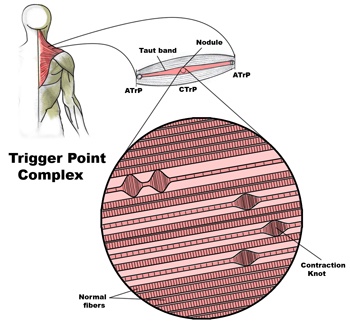
Trigger Points (TP’s) are defined as a “hyper-irritable spot within a taut band of skeletal muscle. The spot is painful on compression and can evoke characteristic referred pain and autonomic phenomena.”1

Put into plain language, a TP is a painful knot in muscle tissue that can refer pain to other areas of the body. You have probably felt the characteristic achy pain and stiffness that TP’s produce, at some time in your life.

TP’s were first brought to the attention of the medical world by Dr. Janet G. Travell. Dr. Travell, physician to President John F. Kennedy, is the acknowledged Mother of Myofascial Trigger Points.  In fact, “Trigger Point massage, the most effective modality used by massage therapists for the relief of pain, is based almost entirely on Dr. Travell’s insights.”2  Dr. Travell’s partner in her research was Dr. David G. Simons, a research scientist and aerospace physician.

Trigger Points are very common. In fact, Travell and Simons state that TP’s are responsible for, or associated with, 75% of pain complaints or conditions.1 With this kind of prevalence, it’s no wonder that TP’s are often referred to as the “scourge of mankind”.

Trigger Points can produce a wide variety of pain complaints. Some of the most common are migraine headaches, back pain, and pain and tingling into the extremities. They are usually responsible for most cases of achy deep pain that is hard to localize.

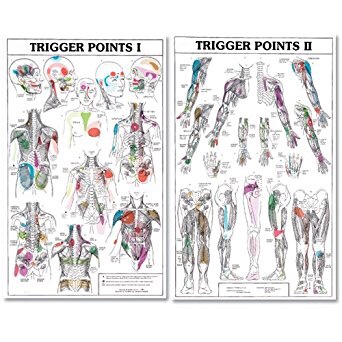
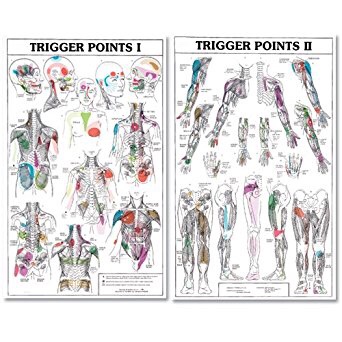
A TP will refer pain in a predictable pattern, based on its location in a given muscle. Also, since these spots are bundles of contracted muscle fibres, they can cause stiffness and a decreased range of motion.  Chronic conditions with many TP’s can also cause general fatigue and malaise, as well as muscle weakness.

Trigger Points are remarkably easy to get, but the most common causes are

TP’s (black dots) can refer pain to other areas (red)

Sudden overload of a muscle

• Poor posture

• Chronic frozen posture (e.g., from a desk job),  and

• Repetitive strain

Once in place, a TP can remain there for the remainder of your life unless an intervention takes place.

Trigger Points Not Well Known

With thousands of people dealing with chronic pain, and with TP’s being responsible for — or associated with — a high percentage of chronic pain, it is very disappointing to find that a large portion of doctors and other health care practitioners don’t know about TP’s and their symptoms.

Scientific research on TP’s dates back to the 1700’s.  There are numerous medical texts and papers written on the subject.

But, it still has been largely overlooked by the health care field.  This has led to needless frustration and suffering, as well as thousands of lost work hours and a poorer quality of life.

How Are Trigger Points Treated?

As nasty and troublesome as TP’s are, the treatment for them is surely straight-forward.  A skilled practitioner will assess the individual’s pain complaint to determine the most likely location of the TP’s and then apply one of several therapeutic modalities, the most effective of which is a massage technique called “ischemic compression”.

Basically, the therapist will apply a firm, steady pressure to the TP, strong enough to reproduce the symptoms.  The pressure will remain until the tissue softens and then the pressure will increase appropriately until the next barrier is felt.  This pressure is continued until the referral pain has subsided and the TP is released. (Note:  a full release of TP’s could take several sessions.) 

Other effective modalities include dry needling (needle placed into the belly of the TP) or wet needling (injection into the TP).  The use of moist heat and stretching prove effective, as well. The best practitioners for TP release are Massage Therapists, Physiotherapists, and Athletic Therapists.  An educated individual can also apply ischemic compression to themselves, but should start out seeing one of the above therapists to become familiar with

the modality and how to apply pressure safely.

1 Simons, D.G., Travell, D.G., & Simons, L.S. Travell and Simons’ Myofascial Pain and Dysfunction: the Trigger Point Manual.

Vol. 1.  2nd ed. Lippincott, Williams, and Wilkins, 1999.

2http://www.muscletherapyworks.com/MTW%20Biography%20T%20&%20S%2001.htm 

Lumbar Radiculopathy? That sounds ridiculous!

Your nervous system is basically a big electrical circuit. Your spinal cord transmits all of the electrical nerve impulses between your brain and lower back. From there, individual nerves emerge from your spine then travel to supply sensation and movement to a specific area of your buttock, legs and/or feet. This allows you to move and feel sensations like touch, heat, cold and pain. Anything that

interferes with this transmission can cause problems.

You have been diagnosed with a “Lumbar Radiculopathy”. This means that one or more of the nerves emerging from your lower back has become irritated or possibly pinched. This often results in pain, numbness or tingling in the specific area of your leg that is supplied by the irritated nerve. The term “Sciatica” is often used to describe this condition, because most (but not all) “lumbar radiculopathies” involve the sciatic nerve which supplies the back & outside of your thigh and calf. Symptoms of a lumbar radiculopathy may vary from a dull ache to a constant severe sharp shooting pain. Your symptoms are likely aggravated by certain positions or movements.

To solve this problem, we will treat the source of your nerve irritation. It is important for you to follow your treatment plan closely and be sure to tell us immediately if you experience any progression of your leg pain, numbness or weakness.

What is Lumbar Stenosis? 

Stenosis.png

The term stenosis means “narrowing” of a tube or opening. Spinal stenosis means that the tube surrounding your spinal cord and nerve roots has become too small, and your nerves are being compressed. Stenosis can arise in different ways. Sometimes, people are born with a spinal canal that is too small. Other times, the canal may have been narrowed by surgery or conditions like disc bulges. Most commonly, spinal stenosis arises from chronic arthritic changes that narrow the canal. This type of stenosis usually develops slowly over a long period of time, and symptoms show up later in life.

Patients with stenosis often report pain, tingling, numbness or weakness in their legs. Lower back pain may or may not be present, but leg symptoms are usually more bothersome. You may notice increasing symptoms from standing or walking and relief while sitting because the available space in your spinal canal decreases when you stand, walk or lean back and increases when you sit or flex forward. Walking down hill is usually more uncomfortable than walking up hill. You may notice that when you walk with a shopping cart or lawn mower, you are more comfortable, as this promotes slight flexion. Sleeping on your side in a fetal position with a pillow between your knees may be most comfortable.

The natural course of spinal stenosis is variable. Most patients notice their symptoms stay about the same over time, while others are divided into fairly equal groups who either improve or worsen. Be sure to tell your doctor if you notice that your legs become cold, swollen or change color. Likewise, tell us if you notice a fever, unexplained weight loss, flu-like symptoms, excessive thirst or urination, numbness in your groin or loss of bladder control.

While there is no non-surgical cure for stenosis, we offer potent treatments to help ease your symptoms. Treatment is focused on helping improve your mobility so that you can walk and function better. You will be given exercises to help with conditioning. You should avoid activities that increase your pain, including heavy lifting or those that cause you to extend your back, like prolonged standing or overhead activity. When you are forced to stand, you may find relief by slightly elevating one foot on a stool or bar rail. You may find relief while washing dishes if you open your cabinet door and alternately rest one foot on the inside of the cabinet to provide a little bit of flexion. Recumbent cycling is often a more tolerable alternative to walking or running. Some patients report relief by using an inversion table.

Ouch! My Back Went Out!

Your spine consists of 24 individual vertebrae stacked on top of each other. Flexible cushions called “discs” live between each set of vertebrae. A disc is made up of two basic components. The inner disc, called the “nucleus”, is like a ball of jelly about the size of a marble. This jelly is held in place by the outer part of the disc called the “annulus”, which is wrapped around the inner nucleus much like a ribbon wrapping around your finger. The term lumbar disc lesion means that your disc has been damaged.

Disc lesions start when the outer fibers of the disc become strained or frayed. If enough fibers become frayed, this can create a weakness and when the disc is compressed, the outer fibers may “bulge” or “protrude” like a weak spot on an inner tube. If more fibers are damaged, the nucleus of the disc may “herniate” outward. Since the spinal cord and nerve roots live directly behind the disc, bulges that are accompanied by inflammation will likely create lower back pain that radiates into the buttock or the entire lower extremity. This condition is called sciatica. If the disc bulge is significant enough to create a mechanical compression of your nerve, you may also experience loss of your reflexes and weakness. Be sure to let our office know if you notice progressive weakness or numbness, any numbness around your groin, any loss of bowel or bladder control or fever.

Surprisingly, disc bulges are present without any symptoms in about 1/3 of the adult population. Another one third of adults will experience pain from a lumbar disc at some point in their lifetime. The condition is more common in men. Most lumbar disc problems occur at one of the two lowest discs- L5 or L4. Smokers and people who are generally inactive have a higher risk of lumbar disc problems. Certain occupations may place you at a greater risk, especially if you spend extended periods of time sitting or driving. People who are tall or overweight have increased risk of disc problems. The condition is uncommon in children and is most common between the ages of 40 and 60.

Researches have shown that disc bulges and sciatica may be successfully managed with conservative care like the type we will provide.

Put the shovel down and read this!

Your low back consists of 5 individual vertebrae stacked on top of each other. Flexible cushions called “discs” live between each set of vertebrae. A disc is made up of two basic components. The inner disc, called the “nucleus”, is like a ball of jelly about the size of a marble. This jelly is held in place by the outer part of the disc called the “annulus”, which is a tough ligament that wraps around the inner nucleus much like a ribbon wrapping around your finger.
Your low back relies on discs and other ligaments for support. “Discogenic Low Back Pain” develops when these tissues are placed under excessive stress, much like a rope that frays when it is stretched beyond its normal capacity. Most commonly, disc pain is not the result of any single event, but rather from repeated overloading. Your lumbar discs generally manage small isolated stressors quite well, but repetitive challenges lead to injury in much the same way that constantly bending a piece of copper wire will cause it to break. Examples of these stressors include: bad postures, sedentary lifestyles, poor fitting workstations, repetitive movements, improper lifting, or being overweight.
Approximately one third of adults will experience pain from a lumbar disc at some point in their lifetime. The condition is more common in men. Most lumbar disc problems occur at one of the two lowest discs- L5 or L4. Smokers and people who are generally inactive have a higher risk of lumbar disc problems. Certain occupations may place you at a greater risk, especially if you spend extended periods of time sitting or driving. People who are tall or overweight have increased risk of disc problems.

Symptoms from disc pain may begin abruptly but more commonly develop gradually. Symptoms may range from dull discomfort to surprisingly debilitating pain that becomes sharper when you move. Rest may relieve your symptoms but often leads to stiffness. The pain is generally centered in your lower back but can spread towards your hips or thighs. Be sure to tell your doctor if your pain extends beyond your knee, or if you have weakness in your lower extremities or a fever.

Repeated injuries cause your normal healthy elastic tissue to be replaced with less elastic “scar tissue.” Over time, discs may dehydrate and thin. This process can lead to ongoing pain and even arthritis. Patients who elect to forego treatment and “just deal with it” develop chronic low back pain more than 60% of the time. Seeking early and appropriate treatment like the type provided in our office is critical.

Depending on the severity of your injury, you may need to limit your activity for a while, especially bending, twisting, and lifting, or movements that cause pain. Bed rest is not in your best interest. You should remain active and return to normal activities as your symptoms allow. Light aerobic exercise (i.e. walking, swimming, etc) has been shown to help back pain sufferers. The short-term use of a lumbar support belt may be helpful. Sitting makes your back temporarily more vulnerable to sprains and strains from sudden or unexpected movements. Be sure to take “micro breaks” from workstations for 10 seconds every 20 minutes.

Trigger points and fibromyalgia

Myofascial pain syndrome (trigger points) and fibromyalgia are often confused to be the same condition and while there is a lot of interrelatedness between the two they are not quite identical. The clinical definition of a trigger point is “a hyper irritable spot associated within a taut band of skeletal muscle that is painful on compression or muscle contraction, and usually responds with a referred pain pattern distant from the spot”. Trigger points form from an overload trauma to the muscle tissue. This is contrasted with fibromyalgia which is defined as “a medical condition characterized by chronic widespread pain and a heightened pain response to pressure. Other symptoms include tiredness to a degree that normal activities are affected, sleep problems and troubles with memory. Some people also report restless leg syndrome, bowel and bladder problems, numbness and tingling and sensitivity to noise, lights and temperature. It is also associated with depression, anxiety, and post traumatic stress disorder”. Fibromyalgia will also present with localized tender points which are often mistaken for trigger points. Where these two conditions become somewhat interrelated is via the nervous system. Fibromyalgia patients suffer from a super-sensitization of the nervous system causing hyperirritability and pain. Myofascial trigger points can be caused by,or be the cause of, super sensitization. An active trigger point will irritate the sensory nerves around it eventually leading to super-sensitization. Trigger points have also been showed to form of become active due to super-sensitization. Both of these conditions can perpetuate the other, leading to layers of pain and symptoms. This being the case, trigger point therapy can have a very positive effect on decreasing the severity of pain and symptoms in patients suffering from fibromyalgia.