Why Posture Is So Important For Fitness

Why Posture Is So Important For Exercise & Fitness

Great article from http://www.brit.co on posture and fitness.

If you’ve ever rolled your eyes when your mom told you to “sit up straighter,” listen up! Turns out she was on to something. Good posture is important for more reasons than physical presentation. And for fitness fanatics, it’s actually critical. “Good posture impacts how you walk, jump, and lift,” says Aaptiv trainer Ackeem Emmons. “Proper alignment also eases strain or pain on your spinal cord.”

woman running outside

For runners and gym-goers, the impacts are even more specific. “When you’re running, having good posture allows you to breathe better,” Emmons says. “The more air in your diaphragm, the further you can go. The better your posture, the more fluid your form.” All of this translates to more efficient and successful running. In the gym, proper form and alignment help you isolate certain muscle groups and execute heavy compound movements, he adds.

Beyond the obvious physical gains, your posture can also impact you mentally as well. “Standing tall with proper posture gives the immediate impression of confidence and courage,” says Aaptiv trainer Ceasar F. Barajas. “You’re mentally setting the tone for success when you straighten up a bit.”

If you’re suddenly feeling hyper-aware of your spinal column, don’t worry. According to Aaptiv trainers Jaime McFaden and Benjamin Green, you can work every day to gradually correct limp posture. “Sit up straight and gently pull your shoulders back and down, stretching the neck. Press both feet firmly into the ground and lift your chest,” McFaden says.

“I’m on a bike anywhere from three to six days per week, hunched over with a rounded back,” explains Green. “Throughout the day, if I catch myself not standing up straight, I open up my shoulders.” If it helps, imagine a string attached to the top of your head, pulling you up, he adds.

For those looking for a more intense posture intervention, our Aaptiv trainers shared five exercises and poses that will help open up your chest, align your spine, and gradually correct poor posture. Keep reading for more moves and be sure to check out all of Aaptiv’s yoga and stretching classes in-app to support (pun intended) your good posture journey.

woman planking

1. Planks — Aaptiv Trainer Kelly Chase: Lie on your stomach with your legs straight behind you. Bring your arms forward and rest your weight on your forearms. Your elbows should be directly below your shoulders. Your arms can rest straight and flat with your palms facing the ground or you can bring your hands together to form a triangular shape. Engage your core and keep your body as straight as possible, careful not to create any dip or arch in your lower back. Hold for 30 seconds. As you become stronger, you can increase your hold time.

Woman Using Exercise Band

2. Band Scapular Retraction Rows — Aaptiv Trainer Candice Cunningham: You’ll need a resistance band for this exercise. Sit upright on the floor with both feet extended in front of you. Keeping your legs straight together, wrap the band around the bottoms of your feet, holding the ends in your hands. Focus on holding your back completely straight as you gradually pull the ends of the band into your chest in a row-style movement. Your elbows should bend out to the sides at chest height. Straighten your arms and repeat.

Complete 10 reps.

woman doing superman exercise

3. Supermans — Aaptiv Trainer Benjamin Green: Lie straight and face down on your mat. Extend your arms in front of you with your biceps next to your ears. Exhale and simultaneously, raise your legs, arms, and chest off the mat, creating a U-shape in your body. Squeeze your lower back and hold for two deep breaths. Inhale and lower your limbs back to the mat.

Complete 10 reps.

woman doing bird dog exercise

4. Bird Dogs — Aaptiv trainer Ackeem Emmons: Start on your hands and knees with your palms directly below your shoulders and your knees below your hips. Put your weight on your left knee and left hand as you slowly lift your right leg and straighten it behind you, keeping it in line with your flat back. Lift your right arm and extend it forward in line with your back. Reach with your fingers, careful to maintain a straight line through your body from fingertips to toes. Flex your right foot so your toes are pointed toward the ground and hold for five deep breaths. Repeat on the other side.

Complete 10 reps on each side.

woman doing yoga

5. Tadasana (Mountain Pose) — Aaptiv trainer Ceasar Barajas: You can perform this pose standing or sitting (at your desk perhaps?). Take a deep breath in and roll your shoulders up towards your ears. Exhale and roll them back down. Continue consciously breathing deeply and engage your core. Imagine someone poured cold water down your back to further engage your core and move deeper in the stretch.

Perform this move as often as you need.

I’ve got ITB Syndrome Doc! Now What?

Your iliotibial band is a fibrous band of tissue running from the crest of your hip, down to your knee. A muscle near the crest of your hip called the tensor fascia lata, attaches to this band to help control movements of your leg. Your iliotibial band passes over the point of your hip and over another bony bump on the outside of your knee called the lateral epicondyle. When the band is too tight, it can become painfully inflamed as it repeatedly rubs over the top of either of these bony projections. Irritation at the bony bump near the knee is called iliotibial band friction syndrome.


The condition usually presents as pain on the outside of your knee that becomes worse with repetitive knee flexion or extension. This condition is the leading cause of lateral knee pain in runners, especially slower “joggers.” The pain usually develops 10-15 minutes into the workout. You may sometimes feel or hear a click during movement. Symptoms generally ease at rest. Running on slick “wintry” surfaces may aggravate the condition. Excessively worn running shoes may be a culprit.

This problem is commonly caused by weakness in your gluteal muscles. When these muscles are weak, the muscle that attaches to your iliotibial band must contract harder to stabilize your hip. Having one leg longer than another is a known aggravating factor.

Runners should minimize downhill running and avoid running on a banked surface like the crown of a road or indoor track, as well as wet or icy surfaces. Runners should reverse directions on a circular track at least each mile. Bicyclists may need to adjust seat height and avoid “toe in” pedal positions. Avoid using stair climbers or performing squats and dead lifts. Sports cream and home ice massage may provide some relief of symptoms.

FAI starts you on the road to failure.

Your hip socket or “acetabulum” is covered by smooth, glassy cartilage extending all the way to its outer rim. The term “Femoroacetabular impingement” (FAI) means that this rim of cartilage is being pinched when you move your hip into certain positions. Repetitive pinching results in irritation, tearing, or even detachment of this cartilage from your hip socket.

FAI occurs because of a mismatch between the head of your femur and the socket of your hip. The mismatch may be from an abnormally shaped hip bone (cam deformity), or having too much cartilage on the rim of your hip socket (pincer deformity). Most frequently, FAI results from a combination of both (combined or mixed deformity).

FAI is most common in young active people. Although the deformity may be present on both sides, symptoms are usually one-sided. The condition is equally common among men and women. Symptoms of FAI include a constant dull pain with periods of sharp pain, made worse by activity. Walking, pivoting, prolonged sitting, stair climbing, and impact activities like running or jumping can aggravate your symptoms. Snapping, locking, and clicking are common.

Our office will help direct a rehab program to maximize your chance of recovery. You should attempt to stay active, but avoid activities that aggravate symptoms. You may consider temporarily switching to low-impact activities, like stationary biking or water-walking. You should avoid motions that combine flexion and internal rotation, like- getting out of a car with one leg at a time, swimming the breaststroke, or performing squats. Patients with FAI should avoid excessive stretching, as this could aggravate the condition, but will likely benefit from strengthening exercises in the type of treatment provided in this office.

Spring Cleaning Tips

If you plan on doing a bit of spring cleaning soon, here is our friendly safety reminder: Don’t forget that some chores are a workout, so stretch accordingly before and after. Also, be mindful of your posture throughout your cleaning.

Keep a neutral spine, bend at your knees when lifting heavy items, and never twist your back at unhealthy angles.

Trigger points in the serratus anterior

The serratus anterior muscle is located along the sides of the ribs. It originates on the outer surface of the upper 8-9ribs, and inserts on the medial border of the scapula. This muscle acts on the scapula in several different ways. First it rotates the scapula to turn the glenoid fossa upward. It also protracted and elevates the scapula. And lastly it helps to prevent wining. This muscle is often shortened from prolonged sitting and work on a computer. Active trigger points in this muscle refer pain locally around the trigger point with spillover down the inside of the arm. Pain can also radiate into the inferior angle of the scapula.

There is nothing great about greater trochanteric pain syndrome. Nothing at all.

Your hip typically has about six small fluid-filled sacs called “bursa” that act as cushions between tendons and bone. One of the most common causes of hip pain is a condition called, “hip bursitis” which means that one or more of your bursas have become painfully inflamed. The broader (more accurate) diagnosis of “Greater trochanteric pain syndrome” (GTPS) describes an uncomfortable collection of problems affecting the outermost portion of your hip. GTPS can include swelling of one or more of the fibrous tendons that attach your muscles onto your hip – a condition called, “tendinitis.” In addition to bursitis & tendonitis, GTPS may originate from tightness in the muscle that travels over your hip en route to your knee- resulting in compression and irritation to your hip.


Greater trochanteric pain syndrome is most common in middle age to elderly adults and is 2-4 times more common in females. Sometimes the problem affects both hips at the same time. Approximately 1/3 of patients with GTPS have lower back pain. Patients who have arthritis in their hips and knees are more likely to suffer from ongoing complaints.

Your symptoms probably include a persistent pain on the outside of your hip, buttock, and upper thigh. Your discomfort may be aggravated by sitting with your leg crossed, arising from a seated position, prolonged standing, climbing stairs, and high-impact activities, like running. Sometimes patients find it difficult to sleep, since lying on the painful hip usually increases symptoms.

For adults, x-rays may or may not be needed to confirm the diagnosis, but children and adolescents usually require films to rule out more serious childhood diseases. Be sure to tell your doctor if you notice that you have a fever, leg numbness, pain radiating significantly beyond your knee, or pain in the front of your groin crease (the area where you leg meets your pelvis.)

Conservative treatment, like the type provided in this office, is successful in about 90% of cases. If you have acute pain, you may need to temporarily limit or discontinue activities that increase your discomfort. Using ice or ice massage at home may help. Some patients find temporarily relief by applying sports creams. Very commonly, patients with pain on the outside of their hip suffer from weakness in one of their buttock muscles, called the “gluteus medius.” When this muscle lacks strength, it is unable to protect your hip during normal activities, like walking. Research has shown that strengthening your hip has a dramatic effect on your progress.

Athletes should avoid running on a banked surface, like the crown of a road or indoor track. Be sure to reverse directions each mile if you run on a circular track. Avoid running on wet or icy surfaces, as this can cause increased tension in your hip. Runners with a “lazy” narrow-based running gait will benefit by increasing their step width to minimize stress on their hip. Cyclists need to make sure that their seat is not positioned too high. Overweight patients should consider weight reduction programs.

I have Plantar Fasciitis; now what?

The “Plantar fascia” is a fibrous band running from the under surface of your heel to the ball of your foot. “Plantar fasciitis” is a painful inflammation of this tissue caused by chronic over stretching and mild tearing.

Plantar fasciitis is commonly associated with fallen arches of the foot. To understand how this happens, cup your hand to make a “C” shape. This represents a foot with a high arch. Imagine a band running from your fingertips to your wrist. This represents the plantar fascia. Now, straighten your fingers to simulate what happens when the arch “falls.” When this happens in your foot, the plantar fascia is stretched and can begin to tear away from your heel.


Plantar fasciitis affects 10% of the population and is more common in women. Approximately one fourth of patients have the problem in both feet at the same time. People who place excessive stress on their feet by being overweight, standing for long periods, or participating in endurance sports are more likely to develop the condition as well. Shoes without adequate arch supports, including sandals or going barefoot, increase your chances of developing plantar fasciitis. Wearing high-heeled shoes or boots may contribute to the problem.

The most common symptom of plantar fasciitis is pain in the heel or arch when standing up after a period of inactivity, particularly first thing in the morning. When you are sleeping, the arch is in a relaxed or shortened state, and the plantar fascia is able to heal. When you stand up first thing in the morning, you stretch the fascia, once again tearing it away from its attachment on the heel. The condition may progress to the point that you experience pain throughout the day, even while resting. The pain often eases after you walk for a period of time, only to redevelop. You may notice some tenderness when you touch your heel, and you probably have tight calf and hamstring muscles as well.

Plantar fasciitis can be a frustrating condition, often lasting 18 months or more if left untreated. Fortunately, you may recover more quickly with proper treatment. One of the most important things that you can do is to make sure that you are wearing shoes with good arch supports on a consistent basis. A period of rest may be necessary to help you recover. Runners may need to temporarily decrease mileage or switch to less stressful activities like swimming, cycling, or using an elliptical machine. A splint or “Strassburg sock” worn at night will help to keep your plantar fascia in a stretched position while it is healing.

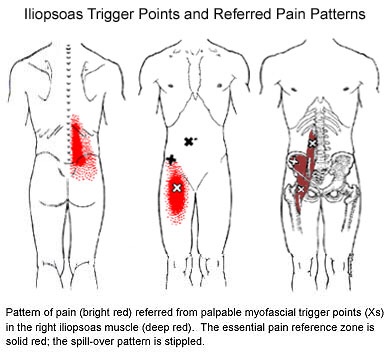
Trigger points in the iliopsoas muscle

This muscle originates on the bodies and disks of T12-L5 and the inner ilium. It inserts on the lesser trochanter of the femur. The psoas flexes the hip when the spine is fixed. When the leg is fixed it extends the lumbar spine increasing lumbar lordosis. This Muscle is often chronically shortened due to inactivity and sitting posture. When trigger points are present they will refer pain primarily to the lower lumbar area and the sacrum as well as into the anterior thigh. Trigger points in the iliopsoas muscle can mimic appendicitis.

My abductors are weak, what does that mean?

One very important job of your hip muscles is to maintain the alignment of your leg when you move. One of the primary hip muscles, the gluteus medius, plays an especially important stabilizing role when you walk, run, or squat. The gluteus medius attaches your thigh bone to the crest of your hip. When you lift your left leg, your right gluteus medius must contract in order to keep your body from tipping toward the left. And when you are standing on a bent leg, your gluteus medius prevents that knee from diving into a “knock knee” or “valgus” position.
Weakness of the gluteus medius allows your pelvis to drop and your knee to dive inward when you walk or run. This places tremendous strain on your hip and knee and may cause other problems too. When your knee dives inward, your kneecap is forced outward, causing it to rub harder against your thigh bone- creating a painful irritation and eventually arthritis. Walking and running with a relative “knock knee” position places tremendous stress on the ligaments around your knee and is a known cause of “sprains”. Downstream, a “knock knee” position puts additional stress on the arch of your foot, leading to other painful problems, like plantar fasciitis. Upstream, weak hips allow your pelvis to roll forward which forces your spine into a “sway back” posture. This is a known cause of lower back pain. Hip muscle weakness seems to be more common in females, especially athletes.

You should avoid activities that cause prolonged stretching of the hip abductors, like “hanging on one hip” while standing, sitting crossed legged, and sleeping in a side-lying position with your top knee flexed and touching the bed. Patients with fallen arches may benefit from arch supports or orthotics. Obesity causes more stress to the hip muscles, so overweight patients may benefit from a diet and exercise program. The most important treatment for hip abductor weakness is strength training. Hip strengthening is directly linked to symptom improvement. Moreover, people with stronger hip muscles are less likely to become injured in the first place. The exercises listed below are critical for your recovery.

Meet the Hip Cycle. You can thank me later.

1. Side lying with back and shoulders against a wall so you can’t roll back.

2. Bend your bottom leg and put the sole of your foot against the wall to be more stable.

3. Start position is with your foot directly in line with your hip. Do not let it get any lower than that. The highest point of your foot needs to be the bump on the outside of your ankle.

Do 5-10 reps of each of the following without rest between exercises twice a day. The goal is 20 reps each.

a. 6″ leg raises in abduction
b. Knee up to chest (90* knee and hip)
c. 12″ leg raises into abduction
d. Bicycling (knee up to chest, extend knee and sweep back to start with leg straight)
e. Clockwise circles
f. Counterclockwise circles
Good luck.