What is the BEST diet for Fibromyalgia?

2KL6JYQYH4I6REYMIWBYVUGXPI

Fibromyalgia (FM) and its cause remains a mystery, but most studies suggest that FM is NOT the result of a single event but rather a combination of many physical, chemical, and emotional stressors.

The question of the month regarding the BEST FM diet is intriguing since one might assume that the many causes should mean that there isn’t one dietary solution. But is that true? Could there be a “best diet” to help ease the symptoms from such a multi-faceted disorder?

Certainly, healthy eating is VERY important for ALL of us regardless of our current ailment(s). Obesity is rampant largely due to the fact that 60% of the calories consumed by the “typical” American center around eating highly inflaming food that include those rich in Sugar, Omega-6 oil, Flour, and Trans fats (“SOFT” foods, if you will!). Obesity has been cited as “an epidemic” largely due to kids and adults becoming too sedentary (watching TV, playing on electronic devices, etc.) and eating poorly.

Perhaps the BEST way to manage the pain associated with FM and to maintain a healthy BMI (Body Mass Index, or ratio between height and weight) is to substitute ANTI-INFLAMING foods for those that inflame (or SOFT foods).

You can simplify your diet by substituting OUT “fast foods” for fruits, vegetables, and lean meats. So there you have it. It’s that simple. The problem is making up your mind to change and then actually doing it. Once these two things take place, most everyone can easily “recalibrate” their caloric intake and easily adapt.

Not only have studies shown that chronic illnesses like heart disease, stroke, and diabetes significantly benefit by following this simple dietary shift, but so does pain arising from the musculoskeletal system! This is because the human body is made up largely of chemicals, and chemical shifts are constantly taking place when it moves. If you reach for an anti-inflammatory drug like ibuprofen or naproxen and it helps, it’s because you ARE inflamed and the drug reduces the pain associated with that inflammation. This is an indication that an anti-inflammatory diet WILL HELP as well (but without the negative side effects)!

The list of chronic conditions that result in muscle pain not only includes FM but also obesity, metabolic syndrome, and type II diabetes. Conditions like tension-type and migraine headaches, neck and back pain, disk herniation, and tendonopathies and MANY more ALL respond WELL to making this SIMPLE change in the diet. For more information on how to “DEFLAME,” visit http://www.deflame.com! It could be a potential “lifesaver!

Fibromyalgia and Exercise

Listen

Are there differences in lifestyle between people with vs. without fibromyalgia (FM)?

A recent study found women with FM found spend more time engaged in sedentary behaviors and less time in physical activity. In the study, researchers followed 413 female patients with FM and 188 age-matched healthy female controls. Researchers used three different approaches to access physical activity: a triaxial accelerometer to examine sedentary time, time spent in physical activity, and step counts.

They discovered those who suffered from FM spent an average of 39 more minutes per day in sedentary activity and 21 fewer minutes per day in light physical activity, 17 fewer minutes per day in moderate physical activity, and 19 fewer minutes per day in moderate-to-vigorous physical activity. In addition, those with FM took a mean of 1,881 fewer steps that those without FM.

Now, this isn’t really a surprise given the fact that people with FM are in pain and more likely to have difficulties sleeping and tolerating prolonged activities. After comparing the sufferers to the non-sufferers, the researchers found only 21% of FM patients vs. 46% of non-FM controls achieved the recommended 150 minutes/week (a little over 20 min. / day) of “moderate-to-vigorous” physical activity. They also found that only 16% vs. 45%, respectively, walked the recommended ≥10,000 steps per day.

One of the BEST forms of exercise for most people is walking. A walking program should be a staple exercise. It’s important to note that this should be GRADUALLY introduced so as to avoid an overuse injury—strain or sprain of the muscles and joints. This gradual introduction into activity is ESPECIALLY important for the FM sufferer as overuse injuries can make them afraid to do something that can REALLY help when done correctly!

What to expect from a trigger point massage

ession Description


A treatment with Bryan is very user friendly. And, no, you don’t have to remove any clothing. However, bringing a t-shirt and a pair of shorts or sweats is recommended.


The first time you come for a treatment you will be asked to fill out a Client History form. Bryan will go over the information you provide, asking for more detail and discussing the type of pain you are having and its location.


The treatment itself involves locating the Trigger Points in the muscle or soft tissue and applying a deep focused pressure to the Point. This will reproduce the pain and the referral pattern that is characteristic of that pain.


The treatment will be uncomfortable at first, but as the Trigger Points release, the pain will decrease. The pressure will always be adjusted to your tolerance level. If, at any time, you feel too uncomfortable you can ask Bryan to ease off a bit.


Depending on your specific problem, Bryan may also use some stretching and / or range-of-motion techniques, as needed.


After treatment, it is usually recommended that the client apply moist heat to the area treated.


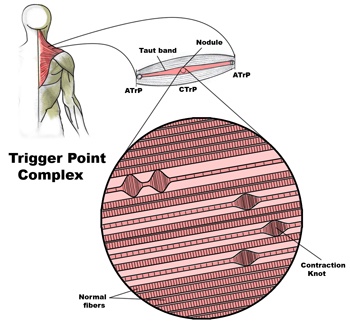
Trigger points

Trigger Points in muscle and other soft tissue are one of the most common causes of a wide variety of pain and dysfunction, including (but not limited to):


• Achy persistent pain
• Severe local pain
• Arm / leg pain
• Back pain
• Radiating pain
• Weakness
• Stiffness

• Pain resulting from a medical condition, such as
– Migraines
– Sciatica
– TMJ dysfunctions
– Arthritis
– Fibromyalgia
– Carpal tunnel syndrome
– Soft tissue injuries
– And more…

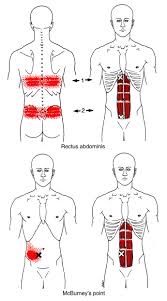
Trigger points in the Rectus Abdominis muscle.

The rectus abdominis is you “six pack” muscle. It originates on the pubic bone and inserts on the costal cartilage of ribs 5-7, and the xiphoid process of the sternum. It’s main actions are to flex and rotate the spine, as well as increase the intra-abdominal pressure. Trigger points in this muscle refer pain into the mid and lower back. This muscle is tight in people who slouch and have a posteriorly rotated pelvis. An anteriorly rotated pelvis can be corrected by strengthening this muscle.

Trigger points in the sternocleidomastoid muscle.

The Sternocleidomastoid muscle is a strap like muscle in your neck. It originates on the manubrium and medial clavicle. It inserts on the mastoid process of the temporal bone, and the superior nuchal line. This muscle acts alone to rotate the face to the opposite side and lift it two rod the ceiling. Together they flex the head and neck. Trigger points in sternal division of this muscle refer pain to the cheek and along the supraorbital ridge. The lowest points refer down to the sternum. The highest points refer to the occipital ridge and vertex of the head. Trigger points in the costal division refer to the into the forehead. The most superior trigger points refer into the ear, and can postural dizziness.

Trigger points in the trapezius muscle.

The trapezius muscle is a large diamond shaped muscle that travels from the neck to the mid back. It originates on the nuchal ligament, and the spinous processes of C6-T12. It has its insertion on the scapular spine, acromion process, and distal clavicle. The upper fibres of this muscle work to elevate the shoulder, and rotate the glenoid fossa upwards. The lower fibres assist this motion, and the middle fibres are strong adductors of the scapula. This is the number one muscle in the body tp get trigger points. Trigger points in the lateral upper edge refer pain in the lateral neck and temples, a common cause of headaches. Points in the middle and lower fibres refer pain into the posterior neck and shoulder.

Trigger points in the Tensor Fasciae Latae muscle.

The Tensor Fasciae Latae muscle is located at the front of the hip. It originates on the iliac crest and inserts into the iliotibial band. This muscle acts to assist hip flexion, abduction, and medial rotation. Trigger points in this muscle will refer pain down the lateral aspect of the leg, and into the greater trochanter. Trigger points can also mimic symptoms of trochanteric bursitis.

Trigger points in the temporalis muscle.

The temporalis muscle is located at the temples of the skull. It originates on the temporal lines of the parietal bone of the skull. It inserts on the coronoid process of the mandible. It functions bilaterally to close the jaw, and unilaterally to deviate the mandible to the same side. When trigger points develop in this muscle they often cause headaches into and above the eye and temple as well as hypersensitivity of the teeth.