
The Teres minor muscle is on of the rotator cuff muscles. It originates on the lateral border of the scapula, and inserts on the inferior facet of the greater tubercle of the humerus. This muscle assists with external rotation of the humerus as well as shoulder stability. This muscle is often damaged with a shoulder injury. Trigger points will refer into the posterior deltoid and down the back of the arm.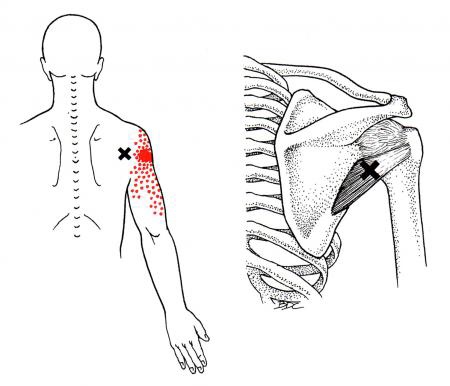
Fibromyalgia
Pain from subclavius trigger points
The Subclavius muscle is a small muscle on the underside of the clavicle. It originates on the first rib and it’s cartilage, and inserts on the inferior clavicle. It’s main function is to assist in protraction of the shoulder. This muscle is often shortened and tight from poor rounded shoulder posture. When trigger points form in this muscle they can refer pain into the anterior shoulder and down the radial part of the arm. Pain can also be referred into the thumb and first two fingers. 
Trigger point pain from the sternalis muscle
The sternalis muscle is a little known muscle located at the sternum. This muscle seems to be vestigial in that it doesn’t have a known function. In originates on the superior portion of the sternum and the upper part of the pectoralis muscle. It’s insertion is the cartilage of ribs 3-7, or sometimes the sheath of the rectus abdominis, or the lower part of pectoralis major. Even though this muscle doesn’t seem to have a purpose anymore it can still harbour trigger points. These points will cause pain to be felt intensely deep in the sternum, with spillover pain radiating down the inside of the arm.
Supraspinatus trigger points
The supraspinatus muscle is one of the muscles that makes up your rotator cuff. It attaches from the scapula to the humerus. It functions mainly to laterally rotate the arm as well as stabilize the shoulder joint. It also assists in abduction of the arm. This muscle can often harbour stubborn trigger points. These points refer pain into the shoulder, down the arm, into the elbow, and even into the forearm if irritated enough. These points can be effectively treated with trigger point massage therapy.
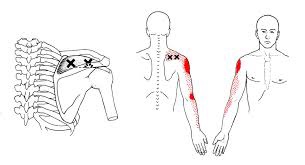
Trigger points in the pectoralis major muscle.
A very common muscle to become overloaded and damaged, and thus develop trigger points, is the pectoralis major muscle. This is the muscle that makes up the chest. It’s main functions are adduction and internal rotation at the shoulder. Poor rounded shoulder posture is a common cause of pec tightness and trigger points. trigger points in this muscle will produce pain felt into the front of the shoulder, the chest, and down the medial arm. If these symptoms occur in the left pec it can mimick heart pain. In women, these points can be a cause of breast pain and nipple hypersensitivity.
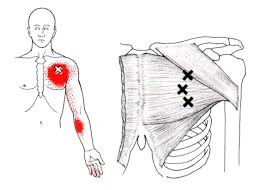
Shoulder and arm pain from the subscapularis muscle.
The subscapularis muscle is one of the rotator cuff muscles. It is located on the inside of the scapula, and can be difficult to access. This muscle functions to internally rotate the arm as well as to adduct the shoulder. It is also a stabilizer of the shoulder joint. When this muscle is overloaded or injured trigger points can form. These points will refer pain into the back of the shoulder and down the inside of the arm to the wrist. Trigger points in the subscapularis are often associated with a frozen shoulder.

Tricep trigger points and elbow pain.

The triceps muscle is the main extensor of the elbow. It is the muscle in the back part of the arm and travels from the shoulder to the elbow. Trigger points in this muscle will cause pain when trying to straighten the elbow. Tricep trigger points refer pain into both the inside and outside of the elbow and are thus a common cause of both tennis and golfers elbow.
Brachioradialis trigger points and forearm and hand pain.
The Brachioradialis muscle is located in the forearm. It is responsible for flexing the elbow in semipronation such as when lifting a coffee mug up to your mouth. Trigger points in this muscle are an often overlooked source of elbow pain. These points will also refer pain down the forearm and into the web of the thumb.
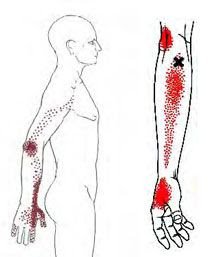
Trigger points in the trapezius muscle
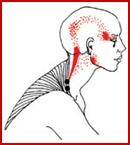
The trapezius muscle is a large diamond shaped muscle in your upper and middle back and neck. It it responsible for both shoulder and neck movements. Trigger points in the upper portion of this muscle are the most common points to develop in the body. These trigger points most often occur due to poor posture, such as a slumped sitting posture. Trigger points in the upper portion of the traps will cause pain to refer into the neck, head, and into the temple. These points are one of the most common causes of headaches.
Trigger points in the scalenes
The scalene muscles are located in your neck. They function to stabilize the cervical spine against lateral movement and elevate the first and second rib to assist inspiration. These muscles are often overloaded and develop trigger points from pulling, lifting, and tugging movements, prolonged cough due to illness, shallow breathing mechanics, and poor neck posture. Trigger points in these muscles can refer in two finger-like projections into the chest, other common patterns are into the shoulder, scapula and down the lateral arm, into the thumb and index finger. The scalene can impinge on the brachial plexus causing nerve pain or numbness down the arm. This is called thoracic outlet syndrome.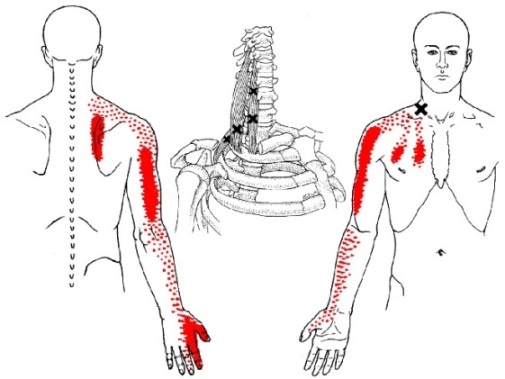
 Aberdeen Chiropractic