
Myofascial pain syndrome (trigger points) and fibromyalgia are often confused to be the same condition and while there is a lot of interrelatedness between the two they are not quite identical. The clinical definition of a trigger point is “a hyper irritable spot associated within a taut band of skeletal muscle that is painful on compression or muscle contraction, and usually responds with a referred pain pattern distant from the spot”. Trigger points form from an overload trauma to the muscle tissue. This is contrasted with fibromyalgia which is defined as “a medical condition characterized by chronic widespread pain and a heightened pain response to pressure. Other symptoms include tiredness to a degree that normal activities are affected, sleep problems and troubles with memory. Some people also report restless leg syndrome, bowel and bladder problems, numbness and tingling and sensitivity to noise, lights and temperature. It is also associated with depression, anxiety, and post traumatic stress disorder”. Fibromyalgia will also present with localized tender points which are often mistaken for trigger points. Where these two conditions become somewhat interrelated is via the nervous system. Fibromyalgia patients suffer from a super-sensitization of the nervous system causing hyperirritability and pain. Myofascial trigger points can be caused by,or be the cause of, super sensitization. An active trigger point will irritate the sensory nerves around it eventually leading to super-sensitization. Trigger points have also been showed to form of become active due to super-sensitization. Both of these conditions can perpetuate the other, leading to layers of pain and symptoms. This being the case, trigger point therapy can have a very positive effect on decreasing the severity of pain and symptoms in patients suffering from fibromyalgia.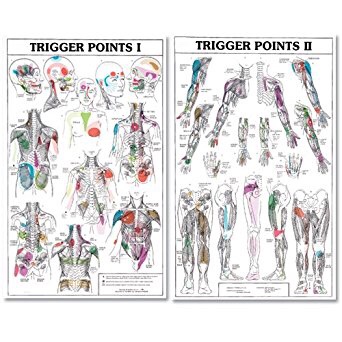

Fibromyalgia
Trigger points in the adductor longus and brevis.
These muscles are located in the groin. The longus originates on the pubic body just below the pubic crest and inserts on the middle third of the linea aspera.The brevis muscle originates on the inferior ramus and body of the pubis and has its attachment to the lesser trochanter and linea aspera of the femur. Trigger points in these muscles are the most common muscular cause of groin pain. Distal trigger points refer pain to the upper medial knee and down the tibia. Proximal trigger points refer into the anterior hip area.
A weak lateral chain will stop you in your tracks.
One very important job of your hip muscles is to maintain the alignment of your leg when you move. One of the primary hip muscles, the gluteus medius, plays an especially important stabilizing role when you walk, run, or squat. The gluteus medius attaches your thigh bone to the crest of your hip. When you lift your left leg, your right gluteus medius must contract in order to keep your body from tipping toward the left. And when you are standing on a bent leg, your gluteus medius prevents that knee from diving into a “knock knee” or “valgus” position.
 Weakness of the gluteus medius allows your pelvis to drop and your knee to dive inward when you walk or run. This places tremendous strain on your hip and knee and may cause other problems too. When your knee dives inward, your kneecap is forced outward, causing it to rub harder against your thigh bone- creating a painful irritation and eventually arthritis. Walking and running with a relative “knock knee” position places tremendous stress on the ligaments around your knee and is a known cause of “sprains”. Downstream, a “knock knee” position puts additional stress on the arch of your foot, leading to other painful problems, like plantar fasciitis. Upstream, weak hips allow your pelvis to roll forward which forces your spine into a “sway back” posture. This is a known cause of lower back pain. Hip muscle weakness seems to be more common in females, especially athletes.
You should avoid activities that cause prolonged stretching of the hip abductors, like “hanging on one hip” while standing, sitting crossed legged, and sleeping in a side-lying position with your top knee flexed and touching the bed. Patients with fallen arches may benefit from arch supports or orthotics. Obesity causes more stress to the hip muscles, so overweight patients may benefit from a diet and exercise program. The most important treatment for hip abductor weakness is strength training. Hip strengthening is directly linked to symptom improvement. Moreover, people with stronger hip muscles are less likely to become injured in the first place. The exercises listed below are critical for your recovery.
Bryan Cobb RMT.
Since 2005, Bryan has been dedicated to helping all people with chronic and acute pain caused by soft-tissue damage.
His training and experience make him uniquely qualified to treat a wide variety of pain and dysfunction and to give instruction on prevention and self-care.
Bryan is the only Massage Therapist in Manitoba — and one of the few in Canada — to be certified by the Certification Board for Myofascial Trigger Point Therapists (CBMTPT).
Bryan holds a degree as an Advanced Remedial Massage Therapist (ARMT) from the Massage Therapy College of Manitoba. Course work at MTCM includes
• over 2,000 hours of practice, as well as
• intensive course work,
• a supervised clinical practicum, and
• community outreach placements.MTCM has a credit transfer affiliation with the University of Winnipeg, ensuring that its courses are held to the highest level. When Bryan studied at MTCM, the college was the only massage therapy college in western Canada accredited by the Commission on Massage Therapy Accreditation. Today, the college is a member of the Canadian Council of Massage Therapy Schools.
Bryan is a member in good standing of the Natural Health Practitioners of Canada.
Bryan also has a background in Anatomy, Exercise Physiology, and Sport Sciences from the University of Manitoba, and he has worked as a personal trainer and fitness leader.
He is an avid natural bodybuilder and fitness enthusiast, and has a blue belt in Brazilian jiu-jitsu.
Meralgia paresthetica? Yeah, we know all about it.
Meralgia paresthetica is an often missed diagnosis for tingling, numbness, and burning pain on the front and outside of your thigh. The condition is caused by a pinching or irritation to the “lateral femoral cutaneous nerve” that supplies sensation to your thigh.
 This nerve can be compressed beneath a ligament, tendon or tight muscle in your hip and pelvis. Pregnancy or being even slightly overweight makes this condition more likely. Tight clothing including girdles, compressive shorts, or tight belts may aggravate or cause this condition. Carpenters’ tool belts or police duty belts may compress this nerve. Prolonged sitting or lying in a fetal position may aggravate this problem. Diabetics are at greater risk.
In the early stages of this condition, your symptoms are usually mild and intermittent. Walking or standing may aggravate the symptoms, and sitting tends to relieve them. In more advanced stages, numbness and tingling changes to shooting pain that is unaffected by your position.
The central goal of treatment is to decrease any cause of compression. In some cases, simply wearing looser clothing or belts may help relieve your symptoms. Some men find relief by switching from a belt to suspenders. Avoid wearing a tool belt or duty belt that places pressure over the area. If you are overweight, begin a sensible weight loss program to avoid compression from excessive tissue.
Trigger points in the Quadratus Lumborum muscle.
The quadratus lumborum muscle is a commonly overlooked source of low back pain and is often responsible for “pseudo disc syndrome”. This muscle originates on the inferior border of the 12th rib and lumbar transverse processes. It inserts on the iliac crest and iliolumbar ligament. The q.l.’s main actions are extension and lateral flexion of the spine. It also acts as a stabilizer of the lumbar spine. Trigger points in this muscle refer pain into the sacroiliac joint and the lower buttock. Pain can also spread anteriorly along the crest of the ilium into the lower abdomen and groin and to the greater trochanter. 
Why Posture Is So Important For Fitness
Why Posture Is So Important For Exercise & Fitness
Great article from http://www.brit.co on posture and fitness.
If you’ve ever rolled your eyes when your mom told you to “sit up straighter,” listen up! Turns out she was on to something. Good posture is important for more reasons than physical presentation. And for fitness fanatics, it’s actually critical. “Good posture impacts how you walk, jump, and lift,” says Aaptiv trainer Ackeem Emmons. “Proper alignment also eases strain or pain on your spinal cord.”

For runners and gym-goers, the impacts are even more specific. “When you’re running, having good posture allows you to breathe better,” Emmons says. “The more air in your diaphragm, the further you can go. The better your posture, the more fluid your form.” All of this translates to more efficient and successful running. In the gym, proper form and alignment help you isolate certain muscle groups and execute heavy compound movements, he adds.
Beyond the obvious physical gains, your posture can also impact you mentally as well. “Standing tall with proper posture gives the immediate impression of confidence and courage,” says Aaptiv trainer Ceasar F. Barajas. “You’re mentally setting the tone for success when you straighten up a bit.”
If you’re suddenly feeling hyper-aware of your spinal column, don’t worry. According to Aaptiv trainers Jaime McFaden and Benjamin Green, you can work every day to gradually correct limp posture. “Sit up straight and gently pull your shoulders back and down, stretching the neck. Press both feet firmly into the ground and lift your chest,” McFaden says.
“I’m on a bike anywhere from three to six days per week, hunched over with a rounded back,” explains Green. “Throughout the day, if I catch myself not standing up straight, I open up my shoulders.” If it helps, imagine a string attached to the top of your head, pulling you up, he adds.
For those looking for a more intense posture intervention, our Aaptiv trainers shared five exercises and poses that will help open up your chest, align your spine, and gradually correct poor posture. Keep reading for more moves and be sure to check out all of Aaptiv’s yoga and stretching classes in-app to support (pun intended) your good posture journey.

1. Planks — Aaptiv Trainer Kelly Chase: Lie on your stomach with your legs straight behind you. Bring your arms forward and rest your weight on your forearms. Your elbows should be directly below your shoulders. Your arms can rest straight and flat with your palms facing the ground or you can bring your hands together to form a triangular shape. Engage your core and keep your body as straight as possible, careful not to create any dip or arch in your lower back. Hold for 30 seconds. As you become stronger, you can increase your hold time.

2. Band Scapular Retraction Rows — Aaptiv Trainer Candice Cunningham: You’ll need a resistance band for this exercise. Sit upright on the floor with both feet extended in front of you. Keeping your legs straight together, wrap the band around the bottoms of your feet, holding the ends in your hands. Focus on holding your back completely straight as you gradually pull the ends of the band into your chest in a row-style movement. Your elbows should bend out to the sides at chest height. Straighten your arms and repeat.
Complete 10 reps.

3. Supermans — Aaptiv Trainer Benjamin Green: Lie straight and face down on your mat. Extend your arms in front of you with your biceps next to your ears. Exhale and simultaneously, raise your legs, arms, and chest off the mat, creating a U-shape in your body. Squeeze your lower back and hold for two deep breaths. Inhale and lower your limbs back to the mat.
Complete 10 reps.

4. Bird Dogs — Aaptiv trainer Ackeem Emmons: Start on your hands and knees with your palms directly below your shoulders and your knees below your hips. Put your weight on your left knee and left hand as you slowly lift your right leg and straighten it behind you, keeping it in line with your flat back. Lift your right arm and extend it forward in line with your back. Reach with your fingers, careful to maintain a straight line through your body from fingertips to toes. Flex your right foot so your toes are pointed toward the ground and hold for five deep breaths. Repeat on the other side.
Complete 10 reps on each side.

5. Tadasana (Mountain Pose) — Aaptiv trainer Ceasar Barajas: You can perform this pose standing or sitting (at your desk perhaps?). Take a deep breath in and roll your shoulders up towards your ears. Exhale and roll them back down. Continue consciously breathing deeply and engage your core. Imagine someone poured cold water down your back to further engage your core and move deeper in the stretch.
Perform this move as often as you need.
Trigger points in the temporalis muscle
The temporalis muscle is located in the temple area of the skull. It originates on the temporal lines on the parietal bone of the skull, and inserts on the coronoid process of the mandible. It’s main action is to close the jaw. The posterior and middle fibres bilaterally retrude the mandible. Acting individually, this muscle will deviate the mandible to the same side. Trigger points in this muscle refer into the teeth causing hypersensitivity, and into and above the eye and temple, causing headaches.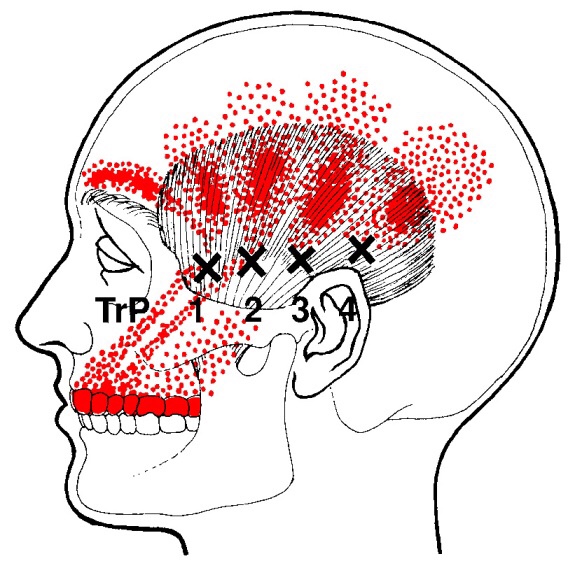
Trigger points in the serratus anterior
The serratus anterior muscle is located along the sides of the ribs. It originates on the outer surface of the upper 8-9ribs, and inserts on the medial border of the scapula. This muscle acts on the scapula in several different ways. First it rotates the scapula to turn the glenoid fossa upward. It also protracted and elevates the scapula. And lastly it helps to prevent wining. This muscle is often shortened from prolonged sitting and work on a computer. Active trigger points in this muscle refer pain locally around the trigger point with spillover down the inside of the arm. Pain can also radiate into the inferior angle of the scapula. 
Trigger points in the iliopsoas muscle
This muscle originates on the bodies and disks of T12-L5 and the inner ilium. It inserts on the lesser trochanter of the femur. The psoas flexes the hip when the spine is fixed. When the leg is fixed it extends the lumbar spine increasing lumbar lordosis. This Muscle is often chronically shortened due to inactivity and sitting posture. When trigger points are present they will refer pain primarily to the lower lumbar area and the sacrum as well as into the anterior thigh. Trigger points in the iliopsoas muscle can mimic appendicitis.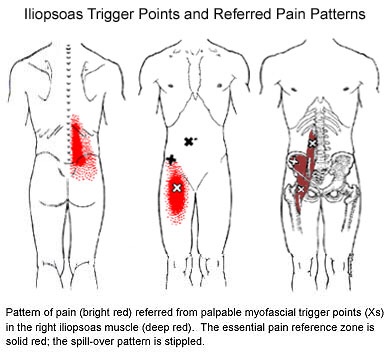
 Aberdeen Chiropractic