A treatment with Bryan Cobb RMT.

Session Description

A treatment with Bryan is very user friendly. And, no, you don’t have to remove any clothing. However, bringing a t-shirt and a pair of shorts or sweats is recommended.

The first time you come for a treatment you will be asked to fill out a Client History form. Bryan will go over the information you provide, asking for more detail and discussing the type of pain you are having and its location.

The treatment itself involves locating the Trigger Points in the muscle or soft tissue and applying a deep focused pressure to the Point. This will reproduce the pain and the referral pattern that is characteristic of that pain.

The treatment will be uncomfortable at first, but as the Trigger Points release, the pain will decrease. The pressure will always be adjusted to your tolerance level. If, at any time, you feel too uncomfortable you can ask Bryan to ease off a bit.

Depending on your specific problem, Bryan may also use some stretching and / or range-of-motion techniques, as needed.

After treatment, it is usually recommended that the client apply moist heat to the area treated.


What the Heck Is a Trigger Point?

By Bryan Cobb, Advanced Remedial Massage Therapist

What is a Trigger Point?

Trigger Points (TP’s) are defined as a “hyper-irritable spot within a taut band of skeletal muscle. The spot is painful on compression and can evoke characteristic referred pain and autonomic phenomena.”1

Put into plain language, a TP is a painful knot in muscle tissue that can refer pain to other areas of the body. You have probably felt the characteristic achy pain and stiffness that TP’s produce, at some time in your life.

TP’s were first brought to the attention of the medical world by Dr. Janet G. Travell. Dr. Travell, physician to President John F. Kennedy, is the acknowledged Mother of Myofascial Trigger Points.  In fact, “Trigger Point massage, the most effective modality used by massage therapists for the relief of pain, is based almost entirely on Dr. Travell’s insights.”2  Dr. Travell’s partner in her research was Dr. David G. Simons, a research scientist and aerospace physician.

Trigger Points are very common. In fact, Travell and Simons state that TP’s are responsible for, or associated with, 75% of pain complaints or conditions.1 With this kind of prevalence, it’s no wonder that TP’s are often referred to as the “scourge of mankind”.

Trigger Points can produce a wide variety of pain complaints. Some of the most common are migraine headaches, back pain, and pain and tingling into the extremities. They are usually responsible for most cases of achy deep pain that is hard to localize.

A TP will refer pain in a predictable pattern, based on its location in a given muscle. Also, since these spots are bundles of contracted muscle fibres, they can cause stiffness and a decreased range of motion.  Chronic conditions with many TP’s can also cause general fatigue and malaise, as well as muscle weakness.

Trigger Points are remarkably easy to get, but the most common causes are

TP’s (black dots) can refer pain to other areas (red)

Sudden overload of a muscle

• Poor posture

• Chronic frozen posture (e.g., from a desk job),  and

• Repetitive strain

Once in place, a TP can remain there for the remainder of your life unless an intervention takes place.

Trigger Points Not Well Known

With thousands of people dealing with chronic pain, and with TP’s being responsible for — or associated with — a high percentage of chronic pain, it is very disappointing to find that a large portion of doctors and other health care practitioners don’t know about TP’s and their symptoms.

Scientific research on TP’s dates back to the 1700’s.  There are numerous medical texts and papers written on the subject.

But, it still has been largely overlooked by the health care field.  This has led to needless frustration and suffering, as well as thousands of lost work hours and a poorer quality of life.

How Are Trigger Points Treated?

As nasty and troublesome as TP’s are, the treatment for them is surely straight-forward.  A skilled practitioner will assess the individual’s pain complaint to determine the most likely location of the TP’s and then apply one of several therapeutic modalities, the most effective of which is a massage technique called “ischemic compression”.

Basically, the therapist will apply a firm, steady pressure to the TP, strong enough to reproduce the symptoms.  The pressure will remain until the tissue softens and then the pressure will increase appropriately until the next barrier is felt.  This pressure is continued until the referral pain has subsided and the TP is released. (Note:  a full release of TP’s could take several sessions.) 

Other effective modalities include dry needling (needle placed into the belly of the TP) or wet needling (injection into the TP).  The use of moist heat and stretching prove effective, as well. The best practitioners for TP release are Massage Therapists, Physiotherapists, and Athletic Therapists.  An educated individual can also apply ischemic compression to themselves, but should start out seeing one of the above therapists to become familiar with

the modality and how to apply pressure safely.

1 Simons, D.G., Travell, D.G., & Simons, L.S. Travell and Simons’ Myofascial Pain and Dysfunction: the Trigger Point Manual.

Vol. 1.  2nd ed. Lippincott, Williams, and Wilkins, 1999.

2http://www.muscletherapyworks.com/MTW%20Biography%20T%20&%20S%2001.htm 
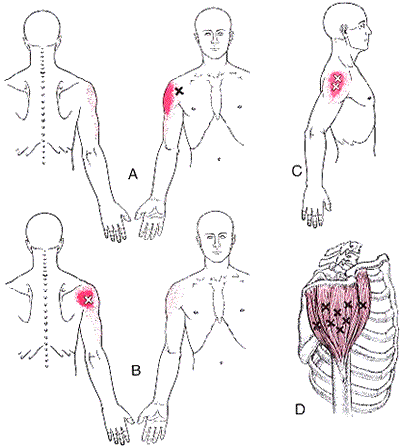
Trigger points in the deltoid muscle

The deltoid is the main muscle that makes up the shoulder. It originates on the clavicle, acromion, and spine of the scapula. It inserts on the deltoid tuberosity of the humerus. The deltoid acts at the shoulder to produce abduction, and assist with flexion and extension. The deltoid is especially prone to developing trigger points. These posterior style will refer pain into the anterior and lateral shoulder. Trigger points in the posterior delt will refer pain into the posterior shoulder with spillover down the lateral arm.

Trigger points in the adductor pollicis

The adductor pollicis is a muscle in the hand and acts on the thumb. It originates on the transverse head of the third metacarpal, the oblique head of the base of the second and third metacarpals, and the trapezoid and capitate bones. It inserts on the base of the proximal phalanx and ulnar sesamoid. This muscle acts to adduct and flex the thumb. Trigger points cause pain and aching along the outside of the thumb and hand, spillover pain may reach the thenar eminence.

Trigger points in the adductor longus.

The adductor longus is a muscle of the groin. It originates on the pubic body just below the pubic crest, and inserts on the middle third of the linea aspera of the femur. It acts on the hip joint to cause adduction and flexion. Distal Trigger points in this muscle refer pain to the upper medial knee and down the tibia. Proximal trigger points refer pain into the anterior hip. These trigger points are the most common muscular cause of groin pain.

Mobility Myth #4

stantonhurt_medium

Myth: You only need to do mobility work if you’re an athlete or if something hurts.

Truth: “Whether you’re pro athlete, weekend warrior, or parent being active with their kids, the mobility requirement for fundamental movements (running, squatting, etc.) stays the same,” says Ardoin. “We always need adequate mobility in the same key areas, such as the ankles, hips, thoracic spine (upper back), shoulders.” He says everyone should be able to meet the following mobility baselines:

  • Touch your chin to your chest without opening your mouth.

  • Look up toward the ceiling with your face becoming parallel to the floor.

  • Rotate your head to each side until your chin reaches mid collarbone.

  • Touch your toes with straight legs.

  • Lower into a deep squat without your heels coming up or toes rotating out.

“If you don’t have access to the necessary mobility, your body will find a way to get it by compensating elsewhere, which could lead to injuries down the road,” he says.

But the injuries might be in unexpected places: Your first thought might be to deal with the area that hurts—but, often, that’s not the true source of the problem. “Often times the issue causing lower-back pain isn’t the lower back, but an issue with hip mobility,” says Esquer. An elbow issue might actually be due to a lack of wrist mobility, and upper-back pain might be due to tightness in the front of the chest and shoulders.

“A lot of times we don’t notice movement restrictions until we’re in pain,” says Esquer. Maintaining your natural mobility day in and day out (kind of like brushing your teeth to prevent cavities) will help prevent surprise injuries from popping up.

Radial Tunnel Syndrome

Your radial nerve begins in your neck and travels past your elbow en route to its final destination in your hand. Just beyond your elbow, this nerve passes through a 2-inch area on the back of your forearm called the “Radial tunnel”. “Radial tunnel syndrome” means that your radial nerve has been compressed or irritated within this space-leading to forearm pain or hand weakness.

Radial tunnel syndrome is thought to result from muscular overuse, especially prolonged or excessive wrist extension or rotation. The most common cause of compression comes from excessive tightness in a muscle called the “Supinator”. Workers whose jobs require heavy or repetitive wrist movements are at an increased risk for this disorder. Occasionally, the radial nerve can become irritated from direct compression by a tight band or brace. The condition may be more common in those who have diabetes or thyroid problems.

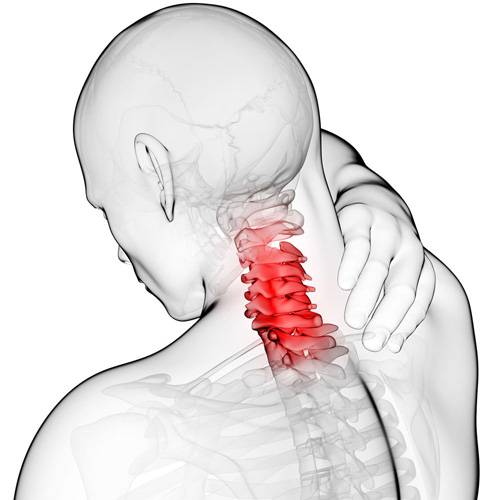
Symptoms from irritation of the radial nerve depend upon which specific nerve fibers are irritated. The most common symptoms include pain, numbness, tingling or decreased sensitivity along the top of your forearm radiating toward your hand and thumb. The symptoms often mimic those of “tennis elbow.” When the nerve fibers that control muscle function become compressed, you may experience weakness when trying to extend your fingers, hand or wrist. Seventy percent of radial tunnel patients also have problems in their neck or upper back.

Conservative treatment of radial tunnel syndrome is generally successful. Fixing the problem means limiting excessive or repetitive wrist movements, especially extension and rotation. In severe cases, a splint may be necessary to limit your motion. Try to avoid compression of your forearm, particularly from tight bands or braces. Use of a tennis elbow brace will likely aggravate your symptoms. You may find relief by applying ice or ice massage to the area for 10-15 minutes at a time.

Mobility Myth #3

Meralgia Parasthetica

Myth: You can stretch and/or foam roll your iliotibial (IT) band.

Truth: First things first: your IT band is a thick ligament that stretches from your pelvis and runs along the very outside of your thigh and knee all the way down to your shin. (You may have heard runners complaining about IT band issues.)

“Stretching and rolling the IT band isn’t helpful, because it’s a thick band of fascia and can’t be broken up or elongated,” says Ardoin. (See earlier point about it taking 200 tons of force to mechanically affect tissue.) And, really, you shouldn’t want to break it up, says Esquer.

However, if you’re rolling near your IT band (to release tight quads, for example), that’s different, says Esquer. “Your IT band canbecome adhered to the adjacent quad and hamstring muscles,” says Ardoin. “Rolling between the IT band and these muscles can help the tissues slide and glide more easily.”

Mobility Myth #2

what-is-mobility-mobility-myths-foam-rolling

Myth: You can get rid of knots or scar tissue with foam rolling or massage.

Truth: “You probably hear of ‘breaking up fascia’ and ‘breaking up scar tissue,’ but the reality is that it literally takes 200 tons to deform scar tissue or cause mechanic changes to the fascia,” says Los Angeles–based physical therapist Jen Esquer, D.P.T., creator of the Mobility Method program. So whenever you’ve been told that someone is “massaging out a knot” in your back, or that foam rolling is “realigning your muscle fibers,” it’s a load of B.S. (You’ve probably also heard that foam rolling can get rid of cellulite.)

“Think: If you bump into something super hard, yeah, you might bruise, but you’re not actually breaking something in your body or tearing tissue,” says Esquer. “So why would we think that lying or rolling around on a foam roller for a while would have that extreme effect?”

You might be thinking, “But it totally helps!” You’re not wrong—it does. It just helps for a different reason: “Really, foam rolling and massage work by bombarding the brain with safe, feel-good information, convincing the muscle to relax and let go,” says Ardoin. That calming of the nervous system results in the release of tension and tightness that you feel.

And since it’s all about relaxation, you should never be trying to create pain in the body, says Esquer: “You don’t want to fire anything back up and make it potentially worse. It always comes back to relaxation.”

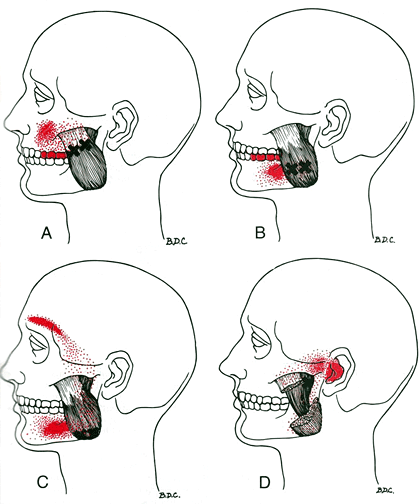
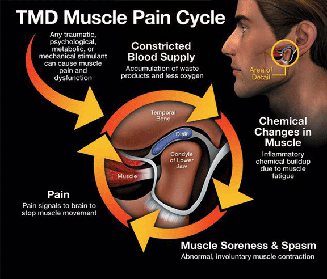
TMJ dysfunction

Temporomandibular joint dysfunction is a blanket term that refers to pain and dysfunction of the jaw muscles and the tempomandibular joints which connect the mandible to the skull. The most common symptoms are pain and restricted mandibular movement as well as grinding noises coming from the joint. This condition is more common in women then in men, and affects a large portion of patients suffering from fibromyalgia. Trigger points in the muscles of mastication are frequently involved in TMJ dysfunction. Trigger points in the pterygoid and masseter muscles for example will not only refer pain into the tempomandibular joints, but will also cause a dysfunctional movement pattern that can restrict range of motion. Trigger point therapy can be an effective modality to treat TMJ dysfunction.