Chiro & Concussions

head-shot2

Whiplash Associated Disorders (WAD) is the appropriate terminology to use when addressing the myriad of symptoms that can occur as a result of a motor vehicle collision (MVC). In a recent publication in The Physician and Sports Medicine (Volume 43, Issue 3, 2015; 7/3/15 online:1-11), the article “The role of the cervical spine in post-concussive syndrome” takes a look at the neck when it’s injured in a car accident and how this relates to concussion.

It’s estimated about 3.8 million concussion injuries, also referred to as “mild traumatic brain injury” (mTBI), occur each year in the United States. Ironically, it’s one of the least understood injuries in the sports medicine and neuroscience communities. The GOOD NEWS is that concussion symptoms resolve within 7-10 days in the majority of cases; unfortunately, this isn’t the case with 10-15% of patients. Symptoms can last weeks, months, or even years in this group for which the term “post-concussive syndrome” (PCS) is used (defined as three or more symptoms lasting for four weeks as defined by the ICD-10) or three months following a minor head injury (as defined by the Diagnostic and Statistical Manual of Mental Disorders).

There have been significant advances in understanding what takes place in the acute phase of mTBI, but unfortunately, there is no clear physiological explanation for the chronic phase. Studies show the range of force to the head needed to cause concussion is between 60-160g (“g” = gravity) with 96.1g representing the highest predictive value in a football injury, whereas as little as 4.5g of neck acceleration can cause mild strain injury to the neck. In spite of this difference, the signs and symptoms reported by those injured in low-speed MVCs vs. football collisions are strikingly similar!

Research shows if an individual sustains an injury where the head is accelerated between 60-160g, it is HIGHLY likely that the tissues of the cervical spine (neck) have also reached their injury threshold of 4.5g. In a study that looked at hockey players, those who sustained a concussion also had WAD / neck injuries indicating that these injuries occur concurrently. Injuries to the neck in WAD include the same symptoms that occur in concussion including headache, dizziness/balance loss, nausea, visual and auditory problems, and cognitive dysfunction, just to name a few.

The paper concludes with five cases of PCS that responded well to a combination of active exercise/rehabilitation AND passive manual therapy (cervical spine manipulation). The favourable outcome supports the concept that the neck injury portion of WAD is a very important aspect to consider when treating patients with PCS!

This “link” between neck injury and concussion explains why chiropractic care is essential in the treatment of the concussion patient! This is especially true when the symptoms of concussion persist longer than one month!

We realize you have a choice in whom you consider for your health care provision and we sincerely appreciate your trust in choosing our service for those needs.  If you, a friend, or family member requires care for Whiplash, we would be honoured to render our services.

Chiropractic and Headaches

According to the World Health Organization, headaches are among the most common disorders of the nervous system affecting an estimated 47% of adults during the past year. Headaches place a significant burden on both quality of life (personal, social, and occupational) and financial health. They are usually misdiagnosed by healthcare practitioners, and in general, are underestimated, under-recognized, and under-treated around the world. So, what about chiropractic and headaches… Does it help?

Suffice it to say, there are MANY studies showing chiropractic care helps headache sufferers. For instance, in a review of past research studies using an “evidence-based” approach, chiropractic treatment of adults with different types of headaches revealed very positive findings! Researchers note that chiropractic care helps those with episodic or chronic migraine headaches, cervicogenic headache (that is, headaches caused by neck problems), and tension-type headaches (chronic more than episodic). There appears to be additional benefit when chiropractic adjustments are combined with massage, mobilization, and/or adding certain types of exercises, although this was not consistently studied. In the studies that discussed adverse or negative effects of treatment, the researchers noted no serious adverse effects.

In patients suffering from athletic injuries, particularly post-concussion headache (PC-HA), chiropractic care can play a very important role in the patient’s recovery. With an estimated 1.6 to 3.8 million sports-related brain injuries occurring each year, approximately 136,000 involve young high school athletes (although some argue this is “grossly underestimated”).

Several published case studies report significant benefits for post-concussion patients after receiving chiropractic care, some of which included PC-HA from motor vehicle collisions, as well as from slips and falls. For example, one described an improvement in symptoms that included deficits in short-term memory as well as attention problems. In this particular study, a six-year-old boy fell from a slide in the playground, and after 18 months of continuous problems, underwent a course of chiropractic care. After just three weeks of care, his spelling test scores improved from 20% to 80% with even more benefits observed by the eighth week of care!

Another case study looked at a 16-year-old male teenager with a five-week-old football injury who had daily headaches and “a sense of fogginess” (concentration difficulties). He reported significant improvement after the second visit, with near-complete symptom resolution after the fifth visit (within two weeks of care). After seven weeks of care, he successfully returned to normal activities, including playing football.

Dizziness and vertigo are also common residuals from concussion and were present in a 30-year-old woman just three days following a motor vehicle accident. She also complained of headache, neck pain, back pain, and numbness in both arms. The case study noted significant improvement after nine visits within an 18-day time frame.

We realize you have a choice in whom you consider for your health care provision and we sincerely appreciate your trust in choosing our service for those needs.  If you, a friend, or family member requires care for neck pain or headaches, we would be honored to render our services.

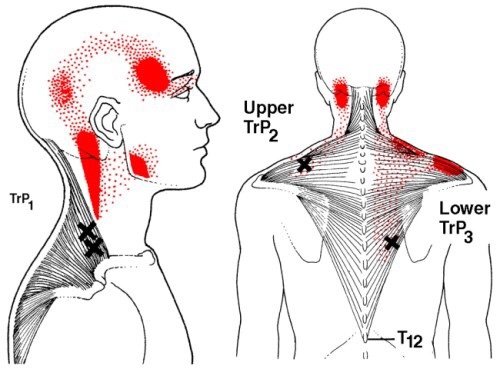
Trigger points in the upper traps.

One of the most common issues that I treat on a daily basis is trigger points in the upper traps. The trapezius muscle or “traps” is a large diamond shaped muscle located in you back and neck. The upper portion of this muscle is one on the most common areas to become strained due to poor posture or emotional stress. When this

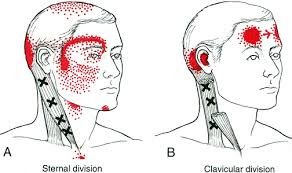
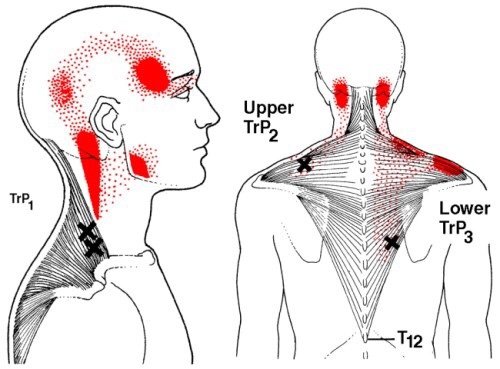
happens trigger points are sure to develop. These points will cause pain to be felt up the neck, behind the ear, and traveling to the temple. Trigger points in the upper traps are one of the most common causes of headache pain, as well as a stiff neck.

Trigger points.

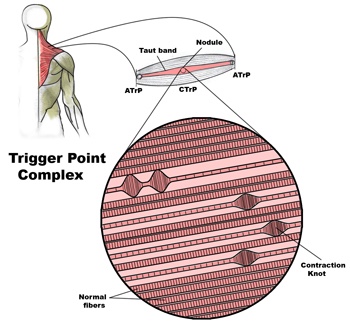
Trigger points are knots of contracted muscle or connective tissue that form as a result of overload stress. Once formed these points will produce pain, refered pain, weakness, and stiffness. Trigger points can also mimic other conditions such as Carple tunnel syndrome and sciatica. Trigger points will on go away on their own, they must be manually released.

Trigger points in the trapezius muscle.

The trapezius muscle is a large diamond shaped muscle located in your back. This muscle is often overloaded due to poor sitting posture or excessive exercise. When this occurs trigger points will form. These points can cause back, neck, and shoulder pain. Trigger points in the upper traps are a leading cause of headache.

How can I make my WRD less severe?

WRD 2

Whiplash is really a slang term for the rapid back and forth whipping of the head on the neck, usually associated with motor vehicle accidents. The title “Whiplash Associated Disorders”, or WAD, describes it best because it includes ALL of the MANY signs and symptoms of the disorder.

WAD basically comes in three sizes based on the degree of injury. A WAD I is present when there is pain but no physical examination findings; WAD II occurs when there are exam findings but no neurological loss (numbness or weakness); and WAD III includes loss of neurological function.  There is also a separate WAD level that includes fractures and dislocations (WAD IV).

There are many things that can be done by the patient to assist in the healing process for WAD. The first well-studied recommendation is to “continue with your usual activities.” Try to keep active and not change your routine. The good news is that WAD (especially types I and II) usually resolves without complication, and recovery is even more likely to occur if you don’t deviate much from your routine.

For those whose symptoms are more severe and/or not resolving, mobilization and manipulation of the neck and back are very effective treatment options. In addition to treatments you’d receive in a chiropractic office, there are MANY things you can do at home as “self-help strategies.” Some of these include (“PRICE”):

1)  PROTECT: Though it’s important to continue with your usual daily activities, this is dependent on both the degree of tissue injury and your pain tolerance. So do as many of your usual daily activities as possible, but AVOID those that result in a sharp, lancinating type of pain or those where recovery from the pain is delayed.  Therefore, this category may require modifying your ADLs (activities of daily living). A cervical collar (hard or

soft) should NOT to be used UNLESS you have an unstable injury (fracture or a grade III sprain).

2)  REST: Doing too much is like picking at a cut (which can delay healing) and doing too little can lead to a delayed healing response as well. Staying within reasonable pain boundaries is a good guide.

3) ICE > HEAT: Ice reduces swelling, and your doctor will typically recommend it over applying heat, especially on a recent injury. Heat draws fluids in, and while it may feel good, it can make your symptoms worse.

4)  COMPRESS: We can basically ignore this when referencing neck pain. This pertains better to wrapping an ankle, knee, wrist, or elbow with an elastic compression orthotic or brace.

5)  ELEVATE: This too is meant for the acute stages of an extremity injury like a foot or ankle.

Exercises unique for neck pain in the acute, subacute, and chronic stages of healing are perhaps the most important of the self-help approaches. In the ACUTE phase, try these…

1)  Range of Motion: Once again, stay within “reasonable pain boundaries” as you move your head forwards, backwards, side to side, and rotate left and right. These can be done either with or without LIGHT resistance applied using one or two fingers placed against your head. Limit the repetitions to three slow reps in each direction and emphasize the release of the movement.

2)  Chin/head Glides: Tuck in the chin (think of creating a double or triple chin) followed by poking the chin/head out.

In the SUBACUTE and CHRONIC phases of healing, the importance of strengthening the deep neck flexors cannot be over emphasized. Please refer to last month’s article for a description of this (see #3 of the 6 recommendations listed).

Can WRD cause my dizziness?

MVA

Whiplash, or better termed “Whiplash Associated Disorders” (WAD), is a condition that carries multiple signs and symptoms ranging from neck pain and stiffness to headache, confusion, ringing in the ears, and more. But can WAD cause dizziness? Let’s take a look!

Dizziness is a general term that is used rather loosely by the general population. We’ve all experienced dizziness from time-to-time that is considered “normal,” such as standing up too quickly or while experiencing a rough flight.

Often, dizziness and problems with balance go hand in hand. There are three main organs that control our balance: 1) the vestibular system (the inner ear); 2) the cerebellum (lies in the back of the head); and, 3) the dorsal columns (located in the back part of the spinal cord). In this article, we will primarily focus on the inner ear because, of the three, it’s unique for causing dizziness. Our vision also plays an important role in maintaining balance, as we tend to lose our balance much faster when we close our eyes.

It’s appropriate to first discuss the transient, usually short episode of “normal” lightheadedness associated with rising quickly. This is typically caused by a momentary drop in blood pressure, and hence, oxygen simply doesn’t reach the brain quick enough when moving from sitting to standing. Again, this is normal and termed “orthostatic hypotension” (OH).

However, OH can be exaggerated by colds, the flu, allergy flair-ups, when hyperventilating, or at times of increased stress or anxiety. OH is also associated with the use of tobacco, alcohol, and/or some medications. Bleeding can represent a more serious cause of OH such as with bleeding ulcers or some types of colitis, and less seriously, with menstruation.

The term BPPV or benign paroxysmal positional vertigo, has to do with the inner ear where our semicircular canals are located. The canals lie in three planes and give us a 3D, 360º perspective about where we are in space. The fluid flowing through these canals bends little hair-like projections, which are connected to sensory nerves that tell the brain about our spatial position. If the function of these canals is disturbed, it can mix-up the messages the brain receives, thus resulting in dizziness. Exercises are available on the Internet that can help with BPPV (look for Epley’s and Brandt-Daroff exercises).

DANGEROUS causes of dizziness include: HEART – fainting (passing out) accompanied by chest pain, shortness of breath, nausea, pain or pressure in the back, neck, jaw, upper belly, or in one or both arms, sudden weakness, and/or a fast or irregular heartbeat.  STROKE – sudden numbness, paralysis, or weakness in the face, arm, or leg, especially if only on one side of the body; drooling, slurred speech, short “black outs,” sudden visual changes, confusion/difficulty speaking, and/or a sudden and severe, “out of the ordinary” headache. CALL 911 (or the number for emergency services if you’re outside the United States) if you suspect you may be having a heart attack or stroke!

Trigger point massage

Session Description


A treatment with Bryan is very user friendly. And, no, you don’t have to remove any clothing. However, bringing a t-shirt and a pair of shorts or sweats is recommended.


The first time you come for a treatment you will be asked to fill out a Client History form. Bryan will go over the information you provide, asking for more detail and discussing the type of pain you are having and its location.


The treatment itself involves locating the Trigger Points in the muscle or soft tissue and applying a deep focused pressure to the Point. This will reproduce the pain and the referral pattern that is characteristic of that pain.


The treatment will be uncomfortable at first, but as the Trigger Points release, the pain will decrease. The pressure will always be adjusted to your tolerance level. If, at any time, you feel too uncomfortable you can ask Bryan to ease off a bit.


Depending on your specific problem, Bryan may also use some stretching and / or range-of-motion techniques, as needed.


After treatment, it is usually recommended that the client apply moist heat to the area treated.