
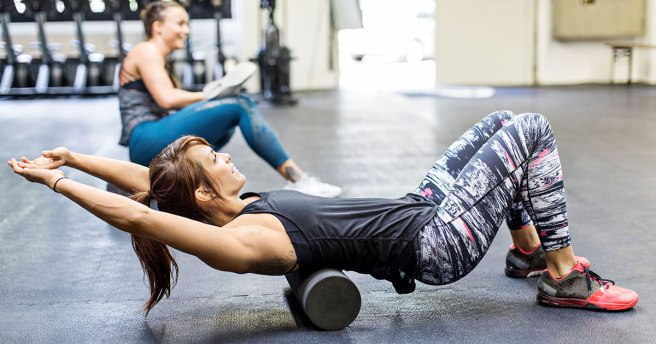
Myth: You can get rid of knots or scar tissue with foam rolling or massage.
Truth: “You probably hear of ‘breaking up fascia’ and ‘breaking up scar tissue,’ but the reality is that it literally takes 200 tons to deform scar tissue or cause mechanic changes to the fascia,” says Los Angeles–based physical therapist Jen Esquer, D.P.T., creator of the Mobility Method program. So whenever you’ve been told that someone is “massaging out a knot” in your back, or that foam rolling is “realigning your muscle fibers,” it’s a load of B.S. (You’ve probably also heard that foam rolling can get rid of cellulite.)
“Think: If you bump into something super hard, yeah, you might bruise, but you’re not actually breaking something in your body or tearing tissue,” says Esquer. “So why would we think that lying or rolling around on a foam roller for a while would have that extreme effect?”
You might be thinking, “But it totally helps!” You’re not wrong—it does. It just helps for a different reason: “Really, foam rolling and massage work by bombarding the brain with safe, feel-good information, convincing the muscle to relax and let go,” says Ardoin. That calming of the nervous system results in the release of tension and tightness that you feel.
And since it’s all about relaxation, you should never be trying to create pain in the body, says Esquer: “You don’t want to fire anything back up and make it potentially worse. It always comes back to relaxation.”

 Your low back relies on discs and other ligaments for support. “Discogenic Low Back Pain” develops when these tissues are placed under excessive stress, much like a rope that frays when it is stretched beyond its normal capacity. Most commonly, disc pain is not the result of any single event, but rather from repeated overloading. Your lumbar discs generally manage small isolated stressors quite well, but repetitive challenges lead to injury in much the same way that constantly bending a piece of copper wire will cause it to break. Examples of these stressors include: bad postures, sedentary lifestyles, poor fitting workstations, repetitive movements, improper lifting, or being overweight.


 tough, durable ligaments that hold your bones together have been damaged, while “strain” means that your muscles or tendons that move your trunk have been partially torn.
 Weakness of the gluteus medius allows your pelvis to drop and your knee to dive inward when you walk or run. This places tremendous strain on your hip and knee and may cause other problems too. When your knee dives inward, your kneecap is forced outward, causing it to rub harder against your thigh bone- creating a painful irritation and eventually arthritis. Walking and running with a relative “knock knee” position places tremendous stress on the ligaments around your knee and is a known cause of “sprains”. Downstream, a “knock knee” position puts additional stress on the arch of your foot, leading to other painful problems, like plantar fasciitis. Upstream, weak hips allow your pelvis to roll forward which forces your spine into a “sway back” posture. This is a known cause of lower back pain. Hip muscle weakness seems to be more common in females, especially athletes.
 You can visualize this as imagining one of your bucket handles is misaligned and not moving in sync with the others.
 When a facet is irritated, you will likely notice pain on one side of your back that may radiate into your flank, hip, and thigh. The pain may come and go. Your pain may increase when you arch backwards or return to an upright position after bending forward. Many patients report relief when they lie down. Symptoms of facet syndrome do not usually radiate past your knee. Be sure to tell your chiropractor if your symptoms include any radiation of pain below your knee, weakness, groin numbness, changes in bowel or bladder function, or if you have a fever.
