Daily Living Advice

Cigarette smoking kills almost 6 million people annually. Up to half of all smokers will die from a smoking related illness like heart disease, lung cancer and COPD.

Smokers who quit can significantly reduce their risk of dying from these and many other diseases.


The combination of counseling and medication (nicotine replacement therapy) have proven to be the best way to quit smoking. Talk to your doctor about your options

Condition Of The Month: Thoracic Joint Restriction

T Spine Joint

Your spine is made up of 24 bones stacked on top of each other with a soft “disc” between each segment to allow for flexibility. Normally, each joint in your spine should move freely and independently. When one or more of your spinal vertebra is slightly misaligned and restricted, we call this condition a “spinal segmental joint restriction”. A “thoracic joint restriction” means that this misalignment or restriction is located in your upper or mid-back region.

To help visualize this, imagine a normal spine functioning like a big spring moving freely in every direction. A spine with a joint restriction is like having a section of that spring welded together. The spring may still move as a whole, but a portion of it is no longer functioning.

Joint restrictions can develop in many ways. Sometimes they are brought on by an accident or an injury. Other times, they develop from repetitive strains or poor posture. Being overweight, smoking, strenuous work, and emotional stress can make you more susceptible to problems.

Restricted joints give rise to a self-perpetuating cycle of discomfort. Joint restriction causes swelling and inflammation, which triggers muscular guarding leading to more restriction. Since your spine functions as a unit, rather than as isolated pieces, a joint restriction in one area of your spine often causes “compensatory” problems in another. Think of this as a rowboat with multiple oarsmen on each side. When one rower quits, the others are placed under additional stress and can become overworked.

Joint restrictions most commonly cause local tenderness and discomfort. You may notice that your range of motion is limited. Movement may increase your discomfort. Pain from a restricted joint often trickles around your rib cage or up & down your spine. Be sure to tell your chiropractor if your symptoms include any chest pain, shortness of breath, unusual cough, indigestion or flu- like complaints.

Long-standing restrictions are thought to result in arthritis – much like the way a slightly misaligned wheel on your car causes premature wearing of your tire.

You should recognize that your problem is common and generally treatable. Chiropractic care has been shown to be the safest and most effective treatment for joint restrictions. Our office offers several tools to help ease your pain. To speed your recovery, you should avoid activities that increase your pain. Be sure to take frequent breaks from sedentary activity. Yoga has been shown to help back pain sufferers so consider joining a class or picking up a DVD.

Diet & Fibromyalgia

ca7d54809225587bf2cc5d89e2eb01f4

Fibromyalgia (FM) is a common condition that affects about five million Americans, often between ages 20 and 45 years old. FM is very difficult to diagnose primarily because there is no definitive test like there is for heart, liver, or kidney disease. Equally challenging is the ability to effectively treat FM as there are frequently other conditions that co-exist with FM that require special treatment considerations. Typically, each FM case is unique with a different group of symptoms and therefore, each person requires individualized care.

Fibromyalgia symptoms can include generalized pain throughout the body that can vary from mild to severely disabling, extreme fatigue, nausea/flu-like symptoms, brain “fog” (“fibro-fog”), depression and/or anxiety, sleeping problems and feeling un-refreshed in the mornings, headaches, irritable bowel syndrome, morning stiffness, painful menstrual cramps, numbness or tingling (arms/hands, legs/feet), tender points, urinary pain or burning, and more!

So, let’s talk about ways to improve your FM-related symptoms through dietary approaches. When the FM symptom group includes gut trouble (bad/painful gas, bloating, and/or constipation), it’s not uncommon to have an imbalance between the “good” vs. the “bad” bacteria, yeast, and problems with digestion or absorption. Think of management as a “Four Step” process for the digestive system:

1.  REMOVE SENSITIVITIES: Consider food allergy testing to determine any foods the FM patient has a sensitivity for. Frequently, removing gluten, dairy, eggs, bananas, potatoes, corn, and red meat can benefit the FM patient. The use of anti-fungal and / or anti-bacterial botanicals (as opposed to drug approaches such as antibiotics) can be highly effective. A low allergy-potential diet consisting of fish, poultry, certain vegetables, legumes, fruits, rice, and olive and coconut oil is usually a good choice.

2.  IMPROVE DIGESTIVE FUNCTION: The presence of bloating and gas is usually indicative of poor digestion, and the use of a digestive enzyme with every meal can be highly effective!

3.  RESTORE THE “GOOD” BACTERIA: Probiotics (with at least 20-30 billion live organisms) at each meal are often necessary to improve the “good” gut bacteria population, which will likely also improve immune function.

4.  REPAIR THE GUT: If the gut wall is damaged, nutrients like l-glutamine, fish oils, and n-acetyl-d-glucosamine may help repair it.

This process will take several months, and some of these approaches may have to be continued over the long term. Doctors of chiropractic are trained in nutritional counseling and can help you in this process. As an added benefit, many FM sufferers find the inclusion of chiropractic adjustments to be both symptomatically relieving and energy producing.

If you, a friend or family member requires care for Fibromyalgia, we sincerely appreciate the trust and confidence shown by choosing our services!

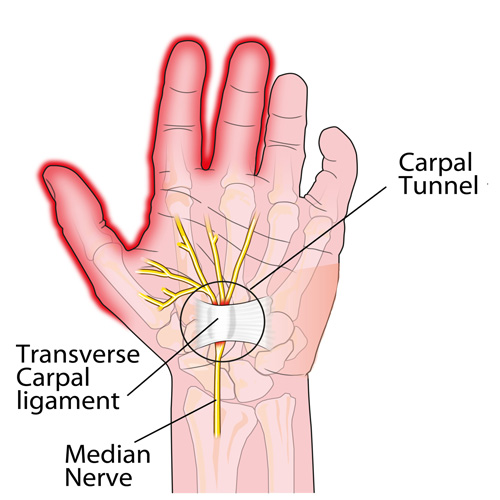
Carpel Tunnel in a nutshell

Here it is: carpal tunnel syndrome (CTS) in a nutshell!


WHAT: CTS is caused by an injury to the median nerve (MN) as it travels through the wrist.
WHERE: The eight small carpal bones and a ligament form a tunnel in which tendons and nerves pass through to reach the hand.
HOW: The MN gets pinched/irritated from repetitive stress.
WHY: The tunnel is tight as it includes the MN and nine rapidly moving muscle tendons!
PROGRESS: CTS usually starts slow and often progresses over weeks, months, even years.
SYMPTOMS: Pain, numbness, tingling, and/or weakness of the hand, sparing the little finger.
PROGNOSIS: CTS is easier to treat shortly after it starts, and waiting too long to seek care may lead to worse outcomes.
RISK FACTORS: 1) family history (genetics); 2) women are more likely to suffer from CTS than men; 3) age over 50; 4) manual jobs; 5) pregnancy; 6) conditions like diabetes, hypothyroid, rheumatoid arthritis (RA), osteoarthritis, autoimmune diseases (includes RA, certain types of thyroid disease), gout, kidney disease (especially dialysis patients), Down syndrome, amyloidosis, acromegaly, tumors on the median nerve; 7) medications (those that affect the immune system such as interleukin-2, possibly corticosteroids), anti-clotting drugs such as warfarin, hormone replacement, BCPs; 8) obesity; 9) smoking; 10) alcohol abuse; and 11) trauma/injuries (fractures, tendonitis).
TREATMENT: Ideally, treatment should begin as soon as possible after symptoms first start, but this RARELY occurs due its slow and gradual onset. Non-surgical care includes anti-inflammatory care (ice, anti-inflammatory nutrients—ginger, turmeric, bioflavonoids; NSAIDs like ibuprofen), wrist splinting (primarily at night), corticosteroid injections, job/ergonomic modifications, exercises (yoga, stretching, strengthening, and aerobic fitness), low level laser therapy, ice, acupuncture, and chiropractic care. Chiropractic care includes MANY of the above PLUS manual therapies applied to the neck, shoulder, arm, wrist, and hand.Carpal Tunnel