

Warm weather precaution –
“Beat the heat this summer when it comes to outdoor chores. Aberdeen Chiropractic advises to get the work done before 10 a.m. if you’re a morning person. Otherwise, do your chores after 6 p.m.”
Warm weather precaution –
“Beat the heat this summer when it comes to outdoor chores. Aberdeen Chiropractic advises to get the work done before 10 a.m. if you’re a morning person. Otherwise, do your chores after 6 p.m.”
Resisted Shoulder Retraction
*This exercise may also be performed using a cable row machine or by looping a piece of elastic resistance band over your feet while sitting on the floor with your legs directly in front of you.

According to the latest National Health Interview Survey (1), nearly 1 in 4 Americans seek the services of a chiropractor, with utilization steadily increasing over the past decade. The majority of users reported chiropractic helping “a great deal”. The overwhelming majority reported chiropractic care combined with medical treatment as helpful.
The preceding sentence is a collaborative vision for the future. Outcomes-based healthcare requires that providers work toward an integrated model where management is selected based upon merit, not habit.
We are honored by the opportunity to co-manage your musculoskeletal pain and will strive to maintain your trust.
Your nervous system is basically a big electrical circuit. Your spinal cord transmits all of the electrical nerve impulses between your brain and lower back. From there, individual nerves emerge from your spine then travel to supply sensation and movement to a specific area of your buttock, legs and/or feet. This allows you to move and feel sensations like touch, heat, cold and pain. Anything that

interferes with this transmission can cause problems.
You have been diagnosed with a “Lumbar Radiculopathy”. This means that one or more of the nerves emerging from your lower back has become irritated or possibly pinched. This often results in pain, numbness or tingling in the specific area of your leg that is supplied by the irritated nerve. The term “Sciatica” is often used to describe this condition, because most (but not all) “lumbar radiculopathies” involve the sciatic nerve which supplies the back & outside of your thigh and calf. Symptoms of a lumbar radiculopathy may vary from a dull ache to a constant severe sharp shooting pain. Your symptoms are likely aggravated by certain positions or movements.
To solve this problem, we will treat the source of your nerve irritation. It is important for you to follow your treatment plan closely and be sure to tell us immediately if you experience any progression of your leg pain, numbness or weakness.

Summer is winding down, and families across America are gearing up for the beginning of a new school year. Help your kids (or yourself) start the year off right by considering some of our healthy back-to-school tips.
Although backpacks are practical, carrying around heavy books and supplies every day can cause discomfort and injury over time.
Be sure to do a quick backpack check:
Encourage your child to practice good posture when sitting in the classroom. Hunching over the desk for hours every day is sure to cause discomfort.
To sit at a desk correctly, they should:
forward head posture, which will strain the neck. Consider purchasing a desktop bookstand to help prop the book up to eye-level.
Back-to-school also means back-to-sports for many kids. Remember that if your child was inactive in their sport for a couple of months, they might need to ease back into it. Always encourage them to warm-up beforehand, stretch afterward, and keep their workouts reasonable for their conditioning level and age.
By being proactive in your child’s health, you can help prevent problems. If your child does experience back, neck, head, or joint pain this school year, please give us a call.

Chiropractic Care is a Safe and Effective Option
SATURDAY, May 19, 2018 — Chiropractic care can help ease low back pain when added to a comprehensive treatment plan, a new clinical trial has found.
Active-duty military personnel reported having fewer back problems when they visited a chiropractor along with receiving usual medical care, the researchers said.
“This study provides the strongest evidence to date that chiropractic is safe, that it’s effective and that it can be integrated into a multidisciplinary health care setting,” said lead researcher Christine Goertz. She is CEO of the nonprofit Spine Institute for Quality in Davenport, Iowa.
Still, at least one pain specialist said more research may be needed to confirm chiropractic’s value for lower back pain.
The study comes in the context of the ongoing U.S. opioid crisis. This epidemic of addiction has created an urgent need for research into pain management that doesn’t involve medications, such as chiropractic care, Goertz said.
Chiropractic care focuses on the musculoskeletal system and the nervous system, mainly as they relate to the spine, according to the American Chiropractic Association.
Chiropractors aim to reduce low back pain by restoring joint mobility and proper alignment in the spine, through a process called spinal manipulation. Controlled force is applied hands-on to individual joints of the spine, to loosen them up and to stretch or break tight muscle tissue surrounding them.
Between 8 percent and 14 percent of U.S. adults seek chiropractic care, but there has been little research into its safety and effectiveness, Goertz said.
“Chiropractic has been controversial in the past, partially because chiropractic grew up outside the conventional medical care system,” she said. “For a long time, we really didn’t have a lot of evidence supporting the outcomes that both patients and doctors of chiropractic were reporting.”
To conduct a real-world test of chiropractic’s usefulness, Goertz and her colleagues enrolled 750 back pain patients at three military hospitals across the nation.
Low back pain is one of the most common reasons military personnel seek medical care, and a condition most likely to interrupt combat duty, according to the researchers.
Study participants were randomly assigned to receive either usual medical care, or that same care along with chiropractic.
Usual medical care involved seeing a doctor, taking pain medications, undergoing physical therapy and performing exercises, the study authors noted. Patients were treated for six weeks, then tracked for another six weeks.
“We found that at every time point, those patients that received chiropractic care had better outcomes in terms of their level of pain intensity and pain-related disability,” Goertz said.
“In addition, we also found that patients who saw the chiropractor tended to be much more satisfied with the care they received, and more likely to have perceived benefit from the care they received,” she added.
However, more adverse events were associated with chiropractic care.
The group receiving usual medical care reported 19 adverse effects, mostly muscle or joint stiffness attributed to physical therapy or exercise.
But 43 adverse events were reported by those also receiving chiropractic care, with 38 of them described as muscle or joint stiffness related to chiropractic procedures.
Dr. Karan Johar, medical director of NYC Pain Specialists and an attending physician at Lenox Hill Hospital in New York City, downplayed the study.
Johar noted that the investigators did not make sure each patient received the exact same type of chiropractic or traditional medical care, making it tough to pinpoint what worked for each patient.
The diagnosis of low back pain also is very broad, adding to the lack of clarity regarding how much chiropractic care contributed to patients’ well-being, he said.
“It’s very hard to assess if that study proves that chiropractic care helps,” Johar explained.
Insurance coverage for chiropractic care varies widely, Goertz noted. For example, Medicare covers chiropractic for spinal manipulation only, and will not reimburse chiropractors for examining patients.
“The majority of payers cover chiropractic in some way or another,” she said, “but the copay can be larger than the amount of the office visit.”
Goertz hopes more studies will find medical benefit in chiropractic care and that insurance companies will “follow the evidence” and improve coverage of these services.
The trial results were published online Friday in JAMA Network Open.
More information The U.S. National Institutes of Health has more about spinal manipulation for low back pain.
Copyright © 2018 HealthDay. All rights reserved.
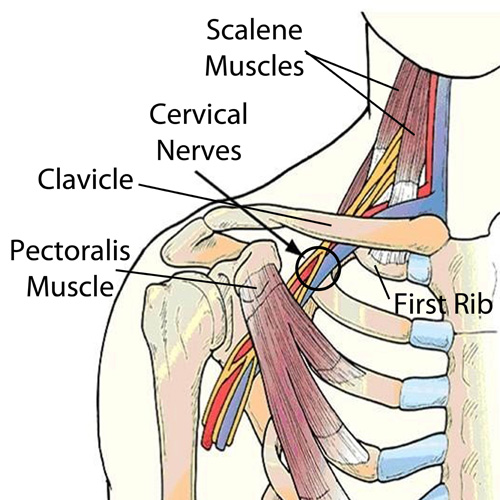
Thoracic Outlet Syndrome (TOS)
The term “thoracic outlet” describes an area at the base of your neck, just above your collarbone. Some important nerves and vessels pass through this outlet on their way into your arm. Compression of these tissues causes a condition called “thoracic outlet syndrome” which results in pain, numbness or tingling in your arm.
Several different factors can cause Thoracic Outlet Syndrome, commonly referred to as TOS. Sometimes TOS is caused from tightness in the muscles of your neck and chest, other times the space between your first rib and collarbone is too small. People who have an extra rib (cervical rib) and people who have recently suffered a neck injury may have a greater chance of having this problem.
The condition is aggravated by poor posture and by occupations that promote “slouching,” i.e., computer users, assembly line workers, supermarket checkers and students. Swimmers, volleyball players, tennis players, baseball pitchers and occupations requiring prolonged overhead activity. i.e., electricians and painters are also prime candidates for TOS.
Symptoms of TOS include arm pain, numbness, tingling and possible weakness. Neck, arm and hand pain may begin slowly and are often aggravated by elevation of the arms or excessive head movement. Loss of grip strength is possible.
Conservative treatment, like the kind we provide, has been shown to be effective at treating TOS. Through our careful exam we have identified your specific sites of compression and will use some of the following treatment to help:
You should avoid carrying heavy loads, especially on your shoulder i.e., carpet rolls. Briefcases, laptop cases or heavy shoulder bags should be lightened. Bra straps may need additional padding or consideration of replacement with a sports bra.
If you or someone you know suffers from any of these symptoms, call our office today. Our team has knowledge and tools to help you feel better quickly!
Desk workers should periodically perform the “Brugger relief position” to help maintain good sitting posture.
Here’s how to do it:
Learn more about proper workstation ergonomics in this video.
Your lumbar spine (low back) is made up of five individual vertebra stacked on top of a bone called the sacrum. To allow for flexibility and movement, there is a cushion or “disc” in between each level. As we age, our discs and joints can wear and become thinner from a process called arthritis. This leads to additional changes, including loosening of the ligaments that hold your vertebra in place.

The term “degenerative lumbar spondylolisthesis” means that one of your vertebra has shifted forward on top of the one below as a result of arthritis and loosening ligaments. The condition usually comes on after age 50 and affects women six times more frequently than men. Degenerative spondylolisthesis occurs most commonly at your second lowest spinal level. (L4-5)
Sometimes, spondylolisthesis develops silently, but most patients report episodes of back pain that have occurred for many years. Patients often report increased pain when standing or when rising from a sitting position. Pain tends to increase throughout the day. If your nerve openings have become narrowed, the nerves may be pinched, and you may experience pain radiating into your legs. Leg symptoms that shift from side to side are characteristic of degenerative spondylolisthesis. Leg pain and tingling are fairly common, but be sure to tell your doctor if you notice more significant symptoms, like leg numbness, heaviness, weakness, loss of bowel or bladder function, or impotence.
Studies have shown no advantage for surgery over conservative care for most cases of degenerative spondylolisthesis. Approximately one-third of patients will experience progression of symptoms over time, and only 10-15% will ever need surgery to correct the problem. Fortunately, the majority of patients will benefit from treatment and exercises to help stabilize their spine.
You will need to perform your exercises consistently for sustained improvement. You should also try to add some type of aerobic exercise to your daily routine. Stationary cycling is a very good choice, and other options include water walking and swimming. Avoid wearing high heels. You may find some benefit for your arthritic symptoms by taking 1500mg of Glucosamine Sulfate each day. Using a hot pack for 10-15 minutes directly over your lower back may provide some benefit.
Text neck is the term used to describe the neck pain and damage sustained from looking down at your cell phone, tablet, or other wireless devices too frequently and for too long.

Using a mobile device often can lead to poor posture and symptoms of text neck.
Watch: Text Neck Treatment Video<spanclass=”div-video-link”></spanclass=”div-video-link”>
And it seems increasingly common. Recently, a patient came in to my practice complaining of severe upper back pain. He woke up and was experiencing severe, acute, upper back muscle strain. I told him I believe the pain is due to the hours he was spending hunched over his cell phone. Diagnosis: Text neck.
Of course, this posture of bending your neck to look down does not occur only when texting. For years, we’ve all looked down to read. The problem with texting is that it adds one more activity that causes us to look down—and people tend to do it for much longer periods. It is especially concerning because young, growing children could possibly cause permanent damage to their cervical spines that could lead to lifelong neck pain.
See Cervical Spine Anatomy and Neck Pain
Text neck most commonly causes neck pain and soreness. In addition, looking down at your cell phone too much each day can lead to:
See What Is Cervical Radiculopathy?
I believe, as some studies suggest, text neck may possibly lead to chronic problems due to early onset of arthritis in the neck.
See Facet Joint Osteoarthritis
A recent study shows that 79% of the population between the ages 18 and 44 have their cell phones with them almost all the time—with only 2 hours of their waking day spent without their cell phone on hand.1
First, prevention is key. Here are several pieces of advice for preventing the development or advancement of text neck:
See Ten Tips for Improving Posture and Ergonomics
See Ergonomics of the Office and Workplace: An Overview
The bottom line is to avoid looking down with your head bent forward for extended periods throughout the day. Spend a whole day being mindful of your posture—is your head bent forward when you drive? When you watch TV? Any prolonged period when your head is looking down is a time when you are putting excessive strain on your neck.
See Office Chair, Posture, and Driving Ergonomics
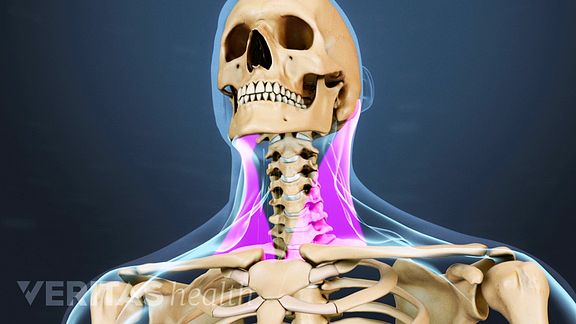
Keeping the neck straight and your phone at eye level can help prevent text neck.
Watch: Neck Strains and Sprains Video
Next, rehabilitation is important.
See Core Body Strength Exercises
See Neck Stretches
Some people will also benefit from a more comprehensive treatment plan, such as a combination of manual adjustments, massage therapy, and cold laser therapy.
https://www.spine-health.com/blog/modern-spine-ailment-text-neck

 Aberdeen Chiropractic