Effective Plantar Fasciitis Treatment with Class IV Laser

What is it?

Plantar fasciitis is inflammation of the thick tissue on the bottom of the foot that connects the heel to the toes and creates the arch of the foot.

Symptoms

The most common complaint is pain in the bottom of the heel. The heel pain may be dull or sharp. The bottom of the foot may also ache or burn. This can be painful and make walking more difficult.
The pain is usually worse:

  • In the morning when you take your first steps
  • After standing or sitting for a while
  • When climbing stairs
  • After intense activity

The pain may develop slowly over time, or suddenly after intense activity.

What Causes Plantar Fasciitis?

Plantar fasciitis develops because of repeated small tears to the flat band of ligamentous tissue that connects your heel to the bones of your toes. These tears weaken the arch that supports the foot. As the arch of the foot weakens, increasing strain is placed on the deeper ligaments and tendons of the foot and lower leg. Over time, Plantar Fasciitis can result in Chronic Pain, Heel Spurs and Degenerative Joint Disease (Arthritis).
You are more likely to get plantar fasciitis if you have:
• Foot arch problems (both flat feet and high arches)
• Long-distance running, especially running downhill or on uneven surfaces
• Sudden weight gain or obesity
• Tight Achilles tendon (the tendon connecting the calf muscles to the heel)
• Shoes with poor arch support or soft soles
Plantar fasciitis is seen in both men and women. However, it most often affects active men ages 40 – 70. It is one of the most common orthopedic complaints relating to the foot.
Plantar fasciitis is commonly thought of as being caused by a heel spur, but research has found that this is not the case. On x-ray, heel spurs are seen in people with and without plantar fasciitis.

Signs and tests

The health care provider will perform a physical exam. This may show:
• Tenderness on the bottom of your foot
• Flat feet or high arches
• Mild foot swelling or redness
• Stiffness or tightness of the arch in the bottom of your foot.

Physicians typically treat Plantar Fasciitis with anti-inflammatory drugs and steroid injections. These medications temporarily reduce the pain associated with Plantar Fasciitis but do not treat the cause of the problem. Traditional methods can usually take between 9 months to two years to resolve this condition.

Class IV Laser Plantar Fasciitis Program 

Our program utilizes the latest class IV Lasers, and combines them with other therapies to help reduce the pain, strengthen the muscles around the foot and ankle joints, and increase range of motion. The Class IV Laser is at the heart of our treatment program. It provides a safe, effective, non-invasive, painless solution for plantar fasciitis. Patients generally respond exceptionally well to treatments and usually notice significant pain relief after just a few treatments.

Permanent correction of Plantar Fasciitis requires two procedures.

1. Heal the Damaged Fascia

Ending the pain caused by Plantar Fasciitis requires stopping the cycle of inflammation. This is critical because chronically inflamed tissues block the flow of needed nutrients and oxygen to surrounding muscles and joints. The advanced CLASS IV LASER restores the flow of nutrients and oxygen to the inflamed tissue allowing the cells to repair themselves at an accelerated rate.

2. Correct the Foot and Gait Mechanics

Most cases of plantar fasciitis are resolved very easily with Class IV Laser Therapy alone; however, if the condition has become chronic this can lead to alterations in the gait that will have to be addressed. This could involve stabilizing the arch with orthotics  or implementing a simple series of specific strengthening and stretching exercises.
Plantar fasciitis when treated early has an exceptionally good prognosis with our protocol. We encourage those with Plantar Fasciitis to seek our help right away. The longer one suffers with this painful condition the more likely it will cause other conditions in the knee, hip and spine.

Ischial Bursitis

Photo by Edgar Martu00ednez on Pexels.com

Ischial Bursitis
Ischial bursitis is the irritation of the bursa at the bony prominence behind the pelvis,​ ​called ischial tuberosity. This bony prominence represents an insertion zone for several muscles, including the hamstrings, and provides support in the sitting position.

Activities and sports that require the hamstring muscles to be repeatedly contracted or stretched during running, jumping or kicking can cause irritation of the bursa and sometimes inflammation. Ischial bursitis usually results from injury to the hamstring tendons. Prolonged sitting on a hard surface or falling on the buttocks can also aggravate the irritation.

▬▬▬▬▬

Structures involved

The b​ursa ​is a small fluid-filled sac. The bursa located in the pelvis acts as a lubricant to reduce friction between the muscles and the ischial tuberosity.

▬▬▬▬▬

Signs & Symptoms that you may experience

Each person will react differently after an injury and recovery will depend on the severity of the injury. Ischial bursitis can produce, but is not limited to pain in the buttock area, localized swelling of the bursa and reduced mobility at the hip.

▬▬▬▬▬

Recovery

Your rehabilitation plan, health profile, fitness level and nutritional status affect the recovery time. In most cases, you can expect a full recovery from ischial bursitis. As a general rule, this condition may take a few months to fully recover.1

Guyon’s canal syndrome

One of the conditions best suited to laser therapy

This syndrome corresponds to a compression or irritation of the ulnar nerve at the level of the Guyon’s canal, located on the anterior surface of the wrist towards the fifth finger.

This condition is usually the result of a direct trauma to the hand or following a prolonged compression of the hand, such as in cyclists or golfers. Also, Guyon’s canal syndrome can occur as a result of repeated grasping movements along hand movements. This problem can also occur following a sustained position with the wrist bent.

▬▬▬▬▬

Structures involved

In the wrist, the ulnar nerve passes directly between the pisohamate ligament, which connects two carpal bones together, and the fascia of the palmaris brevis muscle located in the palm of the hand. These two structures together form Guyon’s canal. In addition to the ulnar nerve, the canal also contains the deep branch of the ulnar artery. The syndrome usually occurs when, for one reason or another, the space in Guyon’s canal is reduced and the ulnar nerve is compressed.

▬▬▬▬▬

Signs & Symptoms that you may experience

Guyon’s canal syndrome can cause, but is not limited to, numbness, tingling and loss of sensation in the fifth finger and half of the fourth. Atrophy of the hand muscles may also occur. During the night, you may experience pain and numbness from prolonged bending of the wrist. Symptoms are also exacerbated during repetitive activities involving wrist movements or prolonged pressure on the hand.

▬▬▬▬▬

Recovery

Your rehabilitation plan, health profile, fitness level and nutritional status affect the recovery time. Most of the time, you should recover completely from Guyon’s canal syndrome. This condition may take a few months to fully recover.

▬▬▬▬▬▬▬▬▬▬▬▬▬▬▬▬▬▬▬▬▬▬▬▬▬▬▬▬▬▬▬▬▬▬▬▬▬▬▬▬▬▬▬▬▬▬▬▬▬▬▬▬▬▬▬▬▬▬▬▬▬▬▬▬▬▬▬▬▬▬▬▬▬▬▬▬▬▬▬▬

▶​ ​WHAT TO DO

Early Stage

Relative rest is a good way to protect your Guyon’s canal syndrome and prevent your injury from getting worse, but it is important to avoid over-protecting it. A few days of rest by reducing activities that cause pain may be necessary. A quick return to your daily activities, light cardiovascular exercise and specific mobility and strengthening exercises will allow for better recovery.

Rehabilitation

Follow your therapist’s advice. This will help you manage the various stages of the healing process and increase the odds of successful rehabilitation. Your therapist will accompany you during your rehabilitation program to restore your joint range of motion, muscle strength and endurance, flexibility and functional status.

▶ ​WHAT TO AVOID

Do not rely solely on a passive treatment approach. Each phase of the rehabilitation process is important. Patients who actively participate in their treatment plan tend to recover more quickly. As soon as you feel better and the pain is well under control, introduce, in collaboration with your therapist, mild strengthening exercises based on your tolerance.

Understanding Acromioclavicular Sprain: Causes, Symptoms, and Treatment

The term “acromioclavicular sprain” means that you have damaged the strong fibrous bands (ligaments) that hold the end of your collarbone (clavicle) to the tip of your shoulder blade (scapula). Another term sometimes used to describe this injury is “shoulder separation.” 40-50% of all athletic shoulder injuries involve the acromioclavicular (AC) joint. AC injuries are common in adolescents and young adults who participate in contact sports, like hockey and football. Males are affected five times more often than females.

Injuries may range from mild fraying of a single ligament to complete rupture of all of the supporting ligaments. Significant tears can allow your collarbone to move upward, out of its normal position, creating a raised bump under your skin. AC joint injuries are categorized (Grade 1-Grade 6) based upon the amount of damage. Grade 1 injuries are tender without joint separation. Grade 2 injuries may be accompanied by a slight separation of the joint. Grade 3 and above will show significant joint separation.

Injuries typically occur following a fall onto the point of your shoulder, while your arm is at your side, or by falling onto your outstretched hand. You will most likely feel pain and swelling on the very top of your shoulder. More significant injuries may produce bruising or a visible “bump” beneath the skin. Moving your shoulder will likely be painfully limited for a while.

Your treatment will vary, depending upon the severity of your injury. Grade 1, 2, and most Grade 3 injuries are best managed conservatively. A sling may be used only when needed to control painful movements. Initially, you will need to limit activity, especially reaching overhead, behind your back, or across your body. The exercises described below are an important part of your rehab and should be performed consistently to avoid long-term problems. Using an ice pack for 10-15 minutes each hour may help to limit swelling and pain.

Some mild separations will heal by themselves within a week or two. More significant injuries can take longer, and disabilities typically range between one and eight weeks. Patients who have suffered a significant amount of ligament damage may have a permanent bump on their shoulder, regardless of treatment. This bump does not usually cause ongoing problems.

Understanding Thoracic Outlet Syndrome: Causes, Risk Factors, and Symptoms

Thoracic Outlet Syndrome

Thoracic outlet syndrome (TOS) occurs when nerves and blood vessels passing through the thoracic outlet, located just above the collarbone, become compressed. This compression leads to symptoms such as pain, numbness, or tingling in the arm, affecting daily activities and quality of life.

Several factors contribute to the development of TOS. Tight muscles in the neck and chest, as well as a narrow space between the first rib and collarbone, can cause compression. Additionally, individuals with an extra rib (cervical rib) or those who have experienced a recent neck injury are at increased risk of developing TOS.

Poor posture exacerbates TOS, making individuals who spend prolonged periods in positions that promote slouching, such as computer users, assembly line workers, and students, particularly susceptible. Athletes engaging in sports like swimming, volleyball, tennis, and baseball, which involve repetitive overhead movements, are also prone to TOS. Likewise, occupations like electricians and painters, requiring prolonged overhead activity, heighten the risk.

Symptoms of TOS manifest as arm pain, numbness, tingling, and possible weakness. These symptoms typically develop gradually and worsen with arm elevation or excessive head movement. Loss of grip strength may also occur, further impeding daily tasks.

Conservative treatments, like those provided by chiropractors, have shown efficacy in managing TOS symptoms. Avoiding activities that exacerbate symptoms, such as carrying heavy loads on the shoulder, is crucial. Measures like lightening the load of briefcases, laptop cases, or heavy shoulder bags can alleviate pressure on the thoracic outlet. Additionally, padding bra straps or opting for a sports bra may help reduce discomfort and prevent further aggravation of symptoms.

Overall, proactive management of TOS involves addressing contributing factors, modifying activities to reduce strain on the thoracic outlet, and seeking conservative treatments like chiropractic care to alleviate symptoms and improve quality of life. By adopting these strategies, individuals can effectively manage TOS and regain function and comfort in daily life.

Thoracic Outlet Syndrome

Thoracic Outlet Syndrome

Thoracic Outlet Syndrome

Thoracic outlet syndrome is a collection of symptoms of pain and numbness that can extend from the neck area to the hand.

Symptoms often result from the compression of nerve and blood structures in the space between the scalene muscles in the neck, collarbone and first rib.

Thoracic outlet syndrome occurs more often in people who perform repetitive activities above the shoulders such as swimming, racquet sports or simply in manual workers. This syndrome is more common in women than in men.

Nerves and blood vessels in the space between the muscles of the neck, collarbone and first rib are often involved in this condition.

A fracture of the collarbone, altered posture, a supernumerary rib or overdeveloped chest muscles can lead to thoracic outlet syndrome.

Symptoms depend on which vascular or nerve structures are compressed. Thoracic outlet syndrome can produce, but is not limited to, pain in the neck, shoulder, arm or hand. Symptoms may also include numbness in the forearm and some fingers. People may also experience a feeling of weakness on the affected side.

Compression of the blood vessels may cause a decrease in blood flow to the arm, resulting in increased swelling and redness in that arm. Symptoms usually appear or increase when the arms are extended, or held high above the shoulders for a period of time. They are often more acute at night.

Your rehabilitation plan, health profile and fitness level affect the recovery time. In most cases, you can expect a full recovery from thoracic outlet syndrome. Recovery will depend on the severity of the compression.

A few days of rest by reducing activities that cause pain may be necessary. A gradual return to your daily activities, light cardiovascular exercise and mobility and strengthening exercises will allow for better recovery.

Follow your therapist’s advice. This will help you manage the various stages of the healing process and increase the odds of successful rehabilitation. Your therapist will accompany you during your rehabilitation program to help you regain optimal posture, joint range of motion, muscle flexibility, muscle endurance and functional status.

According to the principles of thoracic outlet syndrome, improving posture and reducing muscle tension would be two important elements for functional recovery. A progressive rehabilitation program over a period of a few weeks is quite common.Do not rely solely on a passive treatment approach. Each phase of the rehabilitation process is important. Patients who actively participate in their treatment plan tend to recover more quickly. Remember that pain is not always a good indicator of tissue damage. As soon as you feel better and the pain is well under control, introduce, in collaboration with your therapist, light and progressive exercises based on your tolerance.

Shoulder Impingement Syndrome

Shoulder Impingement Syndrome
Impingement syndrome
Impingement syndrome is an irritation of the structures between the upper portion of your arm and your shoulder blade mainly during overhead arm movements.The rotator cuff is comprised of four muscles that help position the humerus, your upper arm bone, into the shoulder socket during arm movement.The shoulder has great mobility but at the same time is prone to injury during falls or accident, or when there is a lack of motor control (altered biomechanics).Men over 40 performing manual labour are the most affected with this condition. It is also present in young athletes practicing sports involving repeated overhead motion such as swimming, baseball or tennis.

▬▬▬▬▬

Structures involved

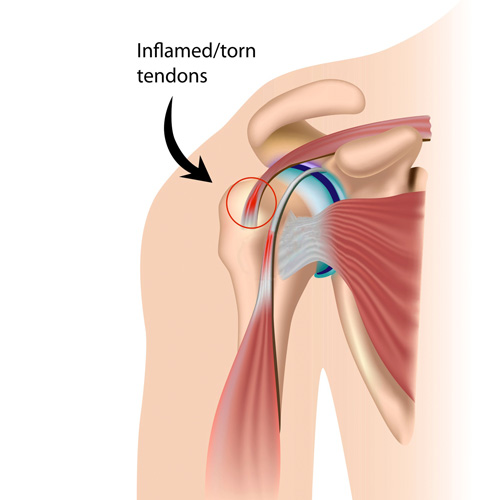
The tendons of the rotator cuff, ligaments of your shoulder and subacromial bursa are the most commonly affected structures. The subacromial space gets smaller during overhead movements. This can cause, over time, irritation, inflammation and/or a lesion of the rotator cuff tendons.

page1image3462066528

▬▬▬▬▬

Signs & Symptoms that you may experience

Everyone will react differently after an injury and recovery will depend on the severity of it.

Impingement syndrome can cause but is not limited to, pain at the front of the shoulder and localized swelling. Pain or tightness is often felt when you lift your arm overhead or when you lower it from an elevated position. Pain can also be felt around your shoulder blade in your back.

Other early symptoms can include light pain with activities or during rest and in some cases, irradiating pain around your shoulder. In severe cases, you might feel pain at night and a loss of strength or range of motion. Impingement syndrome can lead to rotator cuff tendinitis or shoulder bursitis when left untreated.

▬▬▬▬▬

Recovery

Your rehabilitation plan, health, fitness & nutritional status will affect recovery speed. Most of the time, you can expect to recover fully from impingement syndrome. As a rule of thumb, this condition can take up to three months to fully recover.

▬▬▬▬▬▬▬▬▬▬▬▬▬▬▬▬▬▬▬▬▬▬▬▬▬▬▬▬▬▬▬▬▬▬▬▬▬▬▬▬▬▬▬▬▬▬▬▬▬
▬▬▬▬▬▬▬▬▬▬▬▬▬▬▬▬▬▬▬▬▬▬▬▬▬▬▬▬▬▬

▶ WHAT TO DO

Early Stage

Relative rest is a good way to protect your shoulder and prevent further damage, but it’s important to avoid overprotecting your injury. A few days rest where you avoid pain-inducing movement and activities might be necessary. A quick but progressive return to your activities of daily living, light cardiovascular exercise and specific range of motion and strengthening exercises will allow better recovery.

Rehabilitation

Follow your practitioner’s advice. It will help you manage the different phases of the recovery process and will increase the likelihood of successful rehabilitation. Your practitioner will assist you during your rehabilitation program in order to regain your normal range of motion, strength and endurance, optimal motor control and functional status.

As per the principles of rehabilitation for impingement syndrome, movement training through therapeutic exercises is an important part of functional recovery. A progressive exercise program performed over a few weeks period is pretty standard.

▶ WHAT TO AVOID

Don’t rely on passive treatment only. Each phase of the rehabilitation process is important. Patients that are actively involved in their treatment plan tend to recover faster. Keep in mind that pain is not always a good indicator of tissue damage. As soon as you feel better and the pain is well managed in collaboration with your therapist, you should reintroduce light strengthening exercises as tolerated.

Anterior Cruciate Ligament Sprain (ACL Sprain)

Photo by cottonbro on Pexels.com

Anterior Cruciate Ligament Sprain
Anterior cruciate ligament (ACL) sprain is a partial or complete stretch or tear of the ligament. This injury is relatively common among athletes and physical activity enthusiasts.It occurs mainly during a sudden pivot, a hyperextension movement of the knee, a jump or after a contact behind the leg. Movements that cause rapid twisting or hyperextension of the knee joint can lead to ACL injury.An audible creak may be heard at the time of injury and the knee may sometimes appear unstable.

▬▬▬▬▬

Structures involved

The anterior cruciate ligament is the main structure involved. The function of the ​anterior cruciate ligament is to stabilize the knee and prevent hyperextension. ACL sprains often occur in conjunction with other knee injuries such as torn m​ eniscus​, ​articular cartilage​ lesion​ o​ r ​collateral ligament​ injury.

▬▬▬▬▬

Signs & Symptoms that you may experience

Each person will react differently after an injury and recovery will depend on the severity of the injury. Sprained ACL can produce, but is not limited to,​ pain and swelling, often immediate, around the knee. The range of motion of the knee is often limited and the knee may be sensitive to touch.

▬▬▬▬▬

Recovery

Your rehabilitation plan, health profile, fitness level and nutritional status affect the recovery time. In most cases, you can expect full recovery from an ACL sprain. Typically, this injury can take a few months to fully recover.

The Best Sleep Position 

Bottom Line:

One of the most common questions we get from patients is: “What’s the best sleeping position?” Considering you spend nearly one-third of your life sleeping, this is an important question to ask! Top researchers have found one of the best positions to sleep is on your side with your head supported, shoulders centered, and a pillow between your legs. This allows for the best alignment of your spine and reduces the pressure on your neck, low back, hips, and legs – all of which leads to a more restful night of sleep.

Why it Matters:

Sleeping is the time where your body can maximize rest and recovery. Not only can a lack of sleep cause grogginess the next day, but chronic sleep issues can lead to depression, insomnia, and even make aches and pains worse! If you have ever woken up with a “crick” in your neck, you know how taxing an awkward sleeping position can be on your spine. Maintaining a neutral position and keeping your spine in alignment overnight is an essential part of waking up energized and ready to conquer the day. 

  • Chronic sleep disturbances have been linked to depression and many common pain syndromes.
  • Maintaining proper spinal alignment at night can decrease your aches and pains.
  • Sleeping on your side with your head and legs supported is the best sleep position for your spine.

Next Steps: 

Tonight, when you lie in bed, take a look and make sure your nose and belly button are in alignment. If they are, it’s a good sign your spine is in both an optimal and comfortable sleep posture. Then, take a small pillow and place it between your knees to give your legs and hips that proper added support. Following these quick tips will help you get into the best position to have a great night’s sleep. 

Science Source: 

National Sleep Foundation. http://www.sleep.org 

Harvard Health Publishing. Harvard Medical School 2018

Hip Osteoarthritis

Hip osteoarthritis is a condition that can cause stiffness that limits joint range of motion. Over time, certain hip movements become limited, usually causing pain and alteration of normal biomechanics. Your muscles must therefore work harder during movement, generating a feeling of muscle tension.To date, the exact causes of osteoarthritis have not been fully identified. It is completely normal to have a mild level of osteoarthritis with age. However, the more advanced stages of osteoarthritis can affect the ability to carry out daily and physical activities. An exacerbation of symptoms usually occurs during a period when the level of physical activity has been drastically increased. Direct trauma to the hip can increase the symptoms of osteoarthritis.

▬▬▬▬▬

Structures involved

At the hip, the joint affected by osteoarthritis is the ​acetabulofemoral joint,​ formed by the p​ elvic ​bone and the ​femur​ bone. It is mainly cartilage damage combined with the presence, in some cases, of slight bone spurs in the joint that appear to be responsible for the restriction of movement. Over time, some muscles in the hip area may become tighter to compensate for the joint restriction.

▬▬▬▬▬

Signs & Symptoms that you may experience

Each person will react differently to osteoarthritis and management will depend on its stage. Hip osteoarthritis can produce, but is not limited to, local pain in the groin area, edema and stiffness in certain hip movements. Repetitive hip movements during walking or other sports activities, prolonged standing and sleeping with direct pressure may cause pain.

▬▬▬▬▬

Developments

Osteoarthritis of the hip is a progressive condition that cannot be cured, which means that the range of motion may decrease over time. An active lifestyle and a rehabilitation plan may however slow the progression of this condition and make it easier to manage the symptoms.1
▬▬▬▬▬▬▬▬▬▬▬▬▬▬▬▬▬▬▬▬▬▬▬▬▬▬▬▬▬▬▬▬▬▬▬▬▬▬▬▬▬▬▬▬▬▬▬▬▬▬▬▬▬▬▬▬▬▬▬▬▬▬▬▬▬▬▬▬▬▬▬▬▬▬▬▬▬▬▬▬

▶​ ​WHAT TO DO

Painful episodes

Relative rest is a good way to prevent your symptoms from getting worse. A few days of rest while reducing activities that cause significant pain​ m​ ay be necessary, but it is very important to avoid deconditioning. A quick return to your daily activities, light cardiovascular exercises that do not cause an increase in pain, joint mobilization exercises and hip muscles strengthening exercises will allow for better recovery.

Rehabilitation

Follow your therapist’s advice. This will help you manage the various stages of the healing process and increase the odds of success. Your therapist will accompany you during your rehabilitation program in order to improve your hip joint range of motion, regain flexibility, muscle strength and endurance, and functional state.

According to the principles of hip osteoarthritis rehabilitation, improving joint range of motion should be an integral part of the treatment plan. A program to improve joint range of motion and flexibility, as well as specific muscle strengthening is common to control the symptoms of hip osteoarthritis.

▶ ​WHAT TO AVOID

Do not rely solely on a passive treatment approach. Each phase of the rehabilitation process is important. Patients who actively participate in their treatment plan tend to recover more quickly. Keep in mind that pain is not always a good indicator of joint or tissue damage. A significant level of pain does not necessarily imply a more advanced stage. As soon as you feel better and the pain is well under control, introduce, in collaboration with your therapist, light mobility and strengthening exercises based on your tolerance. Remember that exercise is an excellent way to manage pain associated with osteoarthritis.

▬▬▬▬▬▬▬▬▬▬▬▬▬▬▬▬▬▬▬▬▬▬▬▬▬▬▬▬▬▬▬▬▬▬▬▬▬▬▬▬▬▬▬▬▬▬▬▬▬▬▬▬▬▬▬▬▬▬▬▬▬▬▬▬▬▬▬▬▬▬▬▬▬▬▬▬▬▬▬▬