Choosing to walk the golf course is an excellent way to increase your cardiovascular activity during the summer. However, walking 18 holes equates to roughly four to five miles of continuous walking, often on uneven terrain, in variable weather conditions, and while carrying or pushing equipment. This physical load can quickly fatigue the structures of the feet and ankles.
Common Foot and Ankle Stressors
The repetitive stress of walking the course can lead to several acute, localized issues if the lower body is not properly supported or given adequate time to recover:
Plantar Fasciitis Flare-Ups: The thick band of tissue running across the bottom of your foot can become inflamed, causing sharp heel pain, especially during the first few steps of the morning.
Achilles Tendon Strain: Walking up steep tee boxes or out of deep bunkers places heavy eccentric loads on the Achilles, leading to micro-tearing and stiffness.
Ankle Sprains: Uneven lies, hidden sprinkler heads, and thick rough present constant tripping hazards that can easily roll an unprepared ankle.
Post-Round Recovery Tactics
To maintain your lower body health throughout the golf season, prioritize active recovery as soon as your round ends:
Active Stretching: Focus on stretching the calf muscles (both the gastrocnemius and soleus) to relieve tension on the Achilles tendon and the plantar fascia.
Ice Application: If you notice localized heat or swelling around the ankle joint after a round, apply ice for 15-20 minutes to manage the inflammatory response.
Footwear Assessment: Ensure your golf shoes provide adequate arch support and torsional stability. Shoes that are overly flexible can contribute to foot fatigue over 18 holes.
Keep your feet course-ready. If foot or ankle pain is altering your gait or keeping you off the course, our clinical team can help.
Booking: Same-day or next-day appointments are available.
Golf is often viewed as a low-impact sport, but the mechanics of the golf swing subject the body to intense rotational forces. For many players, the lower back bears the brunt of this repetitive torque, making rotational strain one of the most common musculoskeletal complaints during the summer season.
The Mechanics of a Golf Strain
A proper golf swing requires significant rotational mobility in the thoracic spine (mid-back) and the hips. When these areas are tight or restricted, the lumbar spine (lower back) is forced to compensate. Because the joints of the lower back are designed primarily for stability rather than rotation, this compensatory twisting rapidly overloads the local muscles and ligaments, leading to acute micro-tears or sprains.
Recognizing the Symptoms
A rotational strain typically presents differently than general muscle soreness. Key signs that you have strained your back on the course include:
A sudden, sharp catch in the lower back during the downswing or follow-through.
A dull, localized ache on one side of the spine that worsens when twisting or bending.
Stiffness that makes it difficult to stand up straight after bending over to tee up a ball.
Muscle spasms that lock up the lower back hours after your round is complete.
Proactive Care and Recovery
Attempting to play through a rotational strain often alters your swing mechanics, potentially leading to further injury in the elbows or wrists as your body tries to protect the back. Early intervention focuses on restoring proper joint mobility in the hips and mid-back to take the pressure off the lumbar spine, followed by targeted soft-tissue therapy to address the muscular spasm.
Don’t let a back strain ruin your season. River East Minor Injury Clinic provides structural assessments and rehabilitative care for acute sports injuries.
Booking: Same-day or next-day appointments are available.
When an injury occurs, it is not always immediately clear whether you are dealing with a severe sprain or a minor fracture. While major bone breaks are usually obvious and require immediate emergency room attention, minor fractures—such as hairline or stress fractures—can be more subtle. Knowing the symptoms can help you take the right next steps for your recovery.
What is a Minor Fracture?
A minor fracture involves a crack or a small break in the bone that does not cause the bone to shift out of alignment. These often occur from repetitive stress (like distance running) or a direct, localized impact (like blocking a shot in hockey or dropping a heavy object on your foot).
Key Symptoms to Watch For
The symptoms of a minor fracture can easily be confused with a bad sprain, but there are a few distinguishing signs:
Pinpoint Pain: While a sprain often causes pain across an entire joint or ligament, a fracture typically presents as a sharp, intense pain directly over a specific spot on the bone.
Deep, Aching Discomfort: Fractures often produce a deep ache that worsens when pressure or weight is applied and does not completely fade when resting.
Visible Swelling and Bruising: Localized swelling and dark bruising will often appear directly over the fracture site shortly after the impact.
Changes in Bone Shape: Even if minor, any noticeable bump or slight abnormality along the bone structure warrants immediate assessment.
Your Next Steps
If you suspect a minor fracture, the immediate goal is to prevent further damage. Immobilize the area, avoid putting any weight on it, and apply ice to manage the swelling. A clinical assessment is crucial, as an accurate diagnosis often requires diagnostic imaging, such as an X-ray, to confirm the structural integrity of the bone and determine the appropriate casting or bracing protocol.
Get an accurate assessment for your injury. River East Minor Injury Clinic provides thorough evaluations for acute musculoskeletal injuries to determine the best course of action.
Booking: Same-day or next-day appointments are available.
When you sustain a minor injury, your first priority is getting it looked at quickly. Traditionally, this meant sitting in a general walk-in clinic waiting room for hours, unsure of when you would be seen. Scheduled urgent care models offer a more efficient, patient-centered alternative for acute musculoskeletal injuries.
Locked In Assessment Times
The primary benefit of a scheduled model is predictability. Instead of arriving and hoping the queue is short, booking an appointment secures your specific time slot. This allows you to wait in the comfort of your own home and arrive exactly when the clinical team is ready for you, significantly reducing downtime in your day.
Efficient, Prepared Care
When you book an appointment in advance, the clinic receives your intake information before you walk through the doors. This allows the clinical team to review your symptom description and prepare for your specific assessment. The result is a more focused, efficient evaluation the moment you step into the treatment room.
Streamlined Multidisciplinary Access
Scheduled care allows the clinic to coordinate your treatment seamlessly. If your injury requires assessment by both a nurse and a chiropractor or physiotherapist, a scheduled model ensures that the appropriate practitioners are available during your visit, preventing the need for multiple return trips.
Skip the waiting room. River East Minor Injury utilizes a scheduled care model to respect your time and provide focused, efficient injury management.
Booking: Same-day or next-day appointments are available.
If you have ever twisted an ankle or tweaked a muscle, you have likely been told to use the R.I.C.E. method. This classic first-aid acronym has been a staple in acute injury management for decades. While it is an excellent initial step, knowing when to transition from home care to professional assessment is critical for a full and safe recovery.
Breaking Down the R.I.C.E. Method
R.I.C.E. stands for Rest, Ice, Compression, and Elevation. Here is how it works during the first 24 to 48 hours of a minor soft tissue injury:
Rest: Stop the activity that caused the injury. Protecting the damaged tissue from further stress prevents a minor sprain from becoming a severe tear.
Ice: Applying cold packs to the affected area helps constrict blood vessels, numbing the pain and managing the initial wave of inflammation.
Compression: Wrapping the injured joint with a tensor bandage provides mild support and helps limit excessive swelling.
Elevation: Keeping the injured limb raised above the level of your heart encourages fluid to drain away from the joint, further reducing swelling and throbbing.
When Home Care is Not Enough
While the R.I.C.E. method is great for immediate symptom management, it is not a complete treatment plan. Prolonged rest can actually lead to joint stiffness and muscle weakness. You should schedule a professional assessment if:
You cannot bear weight: If you are unable to stand or walk on an injured leg or foot, you need to rule out a minor fracture.
The pain is severe or worsening: Discomfort that does not improve after a few days of R.I.C.E. requires clinical evaluation.
There is visible deformity: Any unnatural bend or severe, immediate bruising warrants immediate attention.
You want to return to activity safely: Without a proper rehabilitation plan, injured ligaments can heal loosely, leaving you prone to chronic re-injury.
Our clinical team can provide a definitive diagnosis and transition you from passive resting to active rehabilitation, ensuring your joints regain their strength, stability, and full range of motion.
When you or a family member experience a sudden health issue, figuring out where to get the right care can be confusing. Should you go to the emergency room, an urgent care centre, your family doctor, or a specialized clinic? Making the right choice not only saves you time but also ensures you receive the most appropriate and effective treatment.
At River East Minor Injury Clinic, we want to help our Winnipeg community navigate their healthcare options efficiently.Here is a straightforward guide to understanding the difference between a minor injury and a minor illness.
What is a Minor Injury?
A minor injury refers to a physical trauma that affects your musculoskeletal system—your bones, joints, muscles,ligaments, and tendons. These injuries are acute and painful but are not life-threatening.
Common examples of minor injuries include:
Ankle sprains from stepping off a curb or playing sports.
Muscle strains in the lower back or shoulders.
Minor fractures (broken bones where the skin remains intact).
Workplace or Car Accidents
Sports-related joint pain and soft tissue damage.
If you have experienced a physical mechanism of injury (a fall, a twist, a heavy lift, or an impact), a minor injury clinic is precisely where you should go for immediate assessment and targeted care.
What is a Minor Illness?
A minor illness involves systemic health issues or infections. These conditions affect your body’s internal systems rather than your physical mechanics.
Common examples of minor illnesses include:
Fevers, chills, or the flu.
Coughs, sore throats, and respiratory infections.
Ear infections or sinus pressure.
Gastrointestinal issues (nausea, vomiting).
Unexplained rashes or skin infections.
Why the Distinction Matters
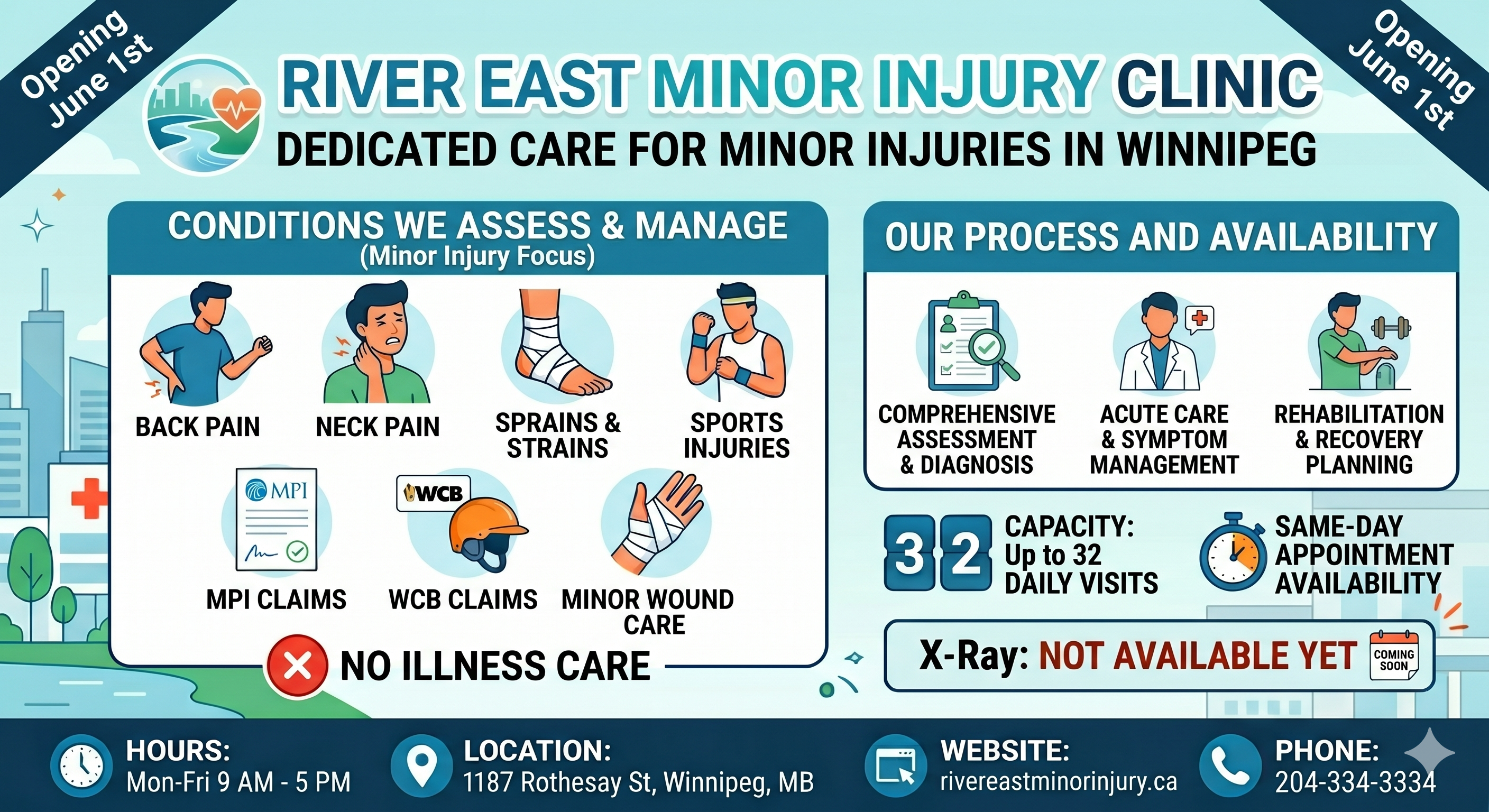
River East Minor Injury Clinic is dedicated exclusively to the assessment and treatment of physical injuries. We do not treat systemic illnesses.
By separating injury care from illness care, we can maintain a streamlined, highly efficient clinic environment. Patients with physical injuries do not have to sit in a waiting room surrounded by cold and flu viruses, and our practitioners can focus entirely on providing comprehensive, evidence-based musculoskeletal care. If you are experiencing symptoms of an illness, please visit your primary care provider, a walk-in medical clinic, or an urgent care centre.
Contact River East Minor Injury Clinic
Location: 1187 Rothesay Street, Winnipeg, MB
Hours: Monday to Friday, 9:00 AM – 5:00 PM
Booking: Secure a same-day or next-day appointment online at www.
When you sustain a minor injury—whether it is a rolled ankle on a morning run, a strained lower back from lifting, or a wrist injury from a weekend tournament—prompt care is essential. However, the prospect of waiting for hours in a crowded, uncomfortable clinic waiting room often deters people from seeking the immediate professional assessment they need.
At River East Minor Injury Clinic, we have implemented a streamlined, scheduled approach to minor injury care. Here is exactly how our same-day and next-day booking system works.
The Shift from “Walk-In” to “Scheduled” Care
Traditional walk-in models are designed to triage a massive variety of unpredictable health concerns, from minor illnesses to severe infections. Because we exclusively treat minor physical injuries—and do not treat illnesses like the flu or chronic medical conditions—we can accurately predict our clinical flow.
By utilizing a dedicated online scheduling system, we eliminate the uncertainty of the waiting room. You receive a guaranteed appointment time, allowing you to rest comfortably at home until it is time to be seen by our team.
Step-by-Step: Securing Your Appointment
Visit Our Online Portal: Head to our website at http://www.rivereastminorinjury.ca. Our booking platform is accessible 24/7 from your smartphone or computer.
Select Your Time: Choose from our available same-day or next-day appointment slots that fit your schedule.
Provide Preliminary Details: You will be prompted to fill out a brief, secure intake form detailing the nature of your injury. This allows our clinical team to prepare for your specific needs before you even arrive.
Receive Confirmation: Once booked, you will receive a clear confirmation of your time and directions to our facility.
What to Expect When You Arrive
When you arrive at 1191 Rothesay Street for your scheduled appointment, our goal is to move you directly into the assessment phase.
You will be evaluated by our multidisciplinary team, which may include registered nursing assessment, physiotherapy, and chiropractic care. Because your time is reserved exclusively for you, our practitioners can conduct a thorough, unhurried physical examination. We will explain your diagnosis clearly, discuss the evidence-based treatment options available, and work with you to develop a customized recovery plan.
Efficient Care for an Active Community
An unexpected sprain or minor fracture disrupts your daily life. The process of getting it assessed should not cause further frustration. By offering convenient same-day online booking, River East Minor Injury Clinic ensures that Winnipeg residents have access to prompt, professional musculoskeletal care exactly when they need it most.
Whether you are stepping awkwardly off a curb, tweaking your lower back on the golf course, or rolling an ankle during a weekend hockey game, sudden physical setbacks happen. When they do, you are often left wondering: Is this an emergency, or is it something I can just walk off?
At River East Minor Injury Clinic, we aim to bridge the gap between standard home care and the hospital emergency room. To help you make the best decision for your health, let us break down exactly what constitutes a “minor” injury and explore the key differences between two of the most common issues we treat: sprains and strains.
Defining a “Minor” Injury
In the medical field, a minor injury refers to a non-life-threatening physical trauma that involves the musculoskeletal system—meaning your bones, joints, muscles, ligaments, and tendons. These are the acute injuries that cause immediate pain and limit your mobility, but do not require complex emergency interventions like surgery or advanced trauma care.
Examples of minor injuries include:
Sprains and strains
Minor fractures (possibly broken bones that have not pierced the skin)
Sports-related joint injuries
Workplace or Motor Vehicle Accidents
What is NOT a minor injury? It is equally important to understand what a minor injury clinic does not handle. We are exclusively dedicated to physical injuries. We do not treat illnesses. If you are experiencing symptoms like a fever, cough, cold, flu, or an infection, you should seek care from your primary care provider, an urgent care centre, or a minor illness clinic.
Sprains vs. Strains: What is the Difference?
People often use the words “sprain” and “strain” interchangeably, but they actually refer to damage to two entirely different types of soft tissue in the body.
The Sprain (Ligament Damage)
A sprain occurs when you stretch or tear a ligament. Ligaments are the tough, fibrous bands of tissue that connect bone to bone, acting as the stabilizing anchors for your joints.
How it happens: Sprains typically occur from sudden twisting motions, pivoting, or landing awkwardly. The classic example is a rolled ankle, but wrist and knee sprains are also incredibly common.
Symptoms: You will generally experience immediate pain, localized swelling, bruising, and a noticeable restricted range of motion. You might even hear a “pop” at the moment of injury.
The Strain (Muscle or Tendon Damage)
A strain, on the other hand, involves the stretching or tearing of a muscle or a tendon. Tendons are the thick cords of tissue that connect your muscles to your bones.
How it happens: Strains are often the result of sudden, heavy lifting, overstretching, or explosive movements. Pulling a hamstring while sprinting or throwing out your lower back while doing yard work are classic strains.
Symptoms: Strains are characterized by muscle spasms, cramping, weakness in the affected area, swelling, and sharp pain when attempting to move the muscle.
Why You Shouldn’t “Just Walk It Off”
When a sprain or strain happens, the standard advice is often to apply ice and rest. While the R.I.C.E. method (Rest, Ice, Compression, Elevation) is a great first step, trying to tough out a musculoskeletal injury without professional assessment can lead to long-term issues.
Without a proper diagnosis, you might be walking on a minor fracture disguised as a sprain, or you might develop compensatory movement habits that lead to chronic joint instability. Getting a prompt, professional assessment allows you to understand the exact nature of the damage and begin a targeted recovery plan immediately.
Same Day or Next Day Care
River East Minor Injury Clinic was designed to provide you with rapid, professional care on your schedule.
Our Nurse Practitioner is here to assess, diagnose, and treat your sprains and strains efficiently. We offer scheduled same-day and next-day appointments, meaning you get the focused care you need exactly when you need it, with zero walk-in waiting.
Ready to start your recovery? 📍 Find us at: 1191 Rothesay Street, Winnipeg
River East Minor Injury Clinic is officially open!
We provide dedicated, multidisciplinary assessment and treatment for minor physical injuries. If you have experienced a recent sprain, strain, minor fracture, or sports-related injury, our team of healthcare professionals is here to help you begin your recovery.
What we treat:
Sprains and strains
Minor fractures
Sports and activity injuries
Workplace and Motor Vehicle Injuries
What we do not treat:(Please visit your primary care provider, an emergency room, or a minor illness clinic for the following)
Coughs, colds, or flu
Fevers or infections
Chronic health conditions or illnesses
To ensure you receive timely care without the uncertainty of walk-in wait times, we offer scheduled same-day and next-day appointments.
Carpal Tunnel Syndrome (CTS) is the leading cause of numbness to the middle three fingers and thumb and affects millions of Americans each year. There are MANY potential causes of CTS, and these causes can be unclear or multi-factorial. We have discussed the importance of night splints and what chiropractic can do for CTS in the recent past. This month, let’s look at what YOU can do for CTS.
“Self-help” concepts are VERY important as they empower YOU to gain control of your condition’s signs and symptoms, thus placing less reliance on those of us who manage (in this case) CTS. There is a time for “PRICE” or, Protect, Rest, Ice, Compress, Elevate, such as when most activities make symptoms worse. This is the time for splinting, reducing activities of daily living (which sometimes includes work restrictions), and the use of ice cupping or massage. Patients should initiate movement or exercise-based approaches as soon as such activities can be tolerated. Here are four different exercises you can do:
1. Fist / “Bear Claw” / Open Wide Hand: This is a three-step exercise, and you can start or stop on any of the three “steps.” A. FIST: Make a fist and squeeze as tightly as tolerated; B. BEAR CLAW: Starting from the fist position (A), open only the palm of the hand (keep your thumb and fingers bent but straighten the big knuckle joints at the base of the fingers); C. OPEN WIDE: Straighten and spread ALL your finger joints by opening up your hand as much as possible and feel for a good stretch in the palm. HOLD each position for one to five seconds (vary the “speed” of moving between the three positions – fast, medium, and slow; emphasize what feels best if you have a preference). Repeat five to ten times or until your hands feel looser.
2. “Church Steeple”: Place your hands together in front of you (“prayer position”) touching the pads of the thumbs and all four fingertips together and spread your fingers as wide as possible. Next, separate your palms as far as you can while applying pressure against your finger/thumb tips and repeat. Alter the speed and number of repetitions until your hands feel stretched out.
3. “Shake and Flick”: Simply shake your hands as if you just washed them and you’re shaking the water off to “air dry” them. Again, alter the speed and reps until they feel loosened up.
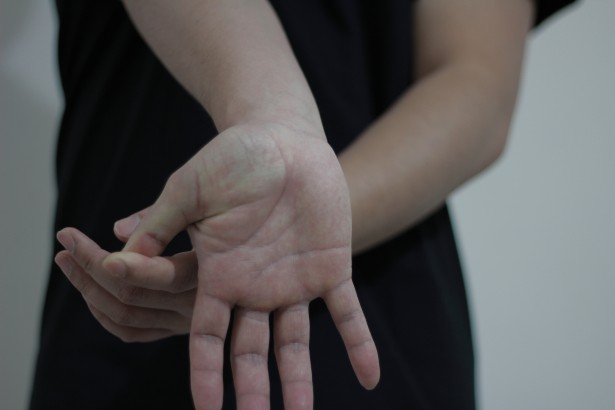
4. Forearm Stretches: Place one arm out in front, elbow straight, and fingers pointed straight, palm up (first set). Reach with the opposite hand and pull the fingers, hand, and wrist down and back towards you until you feel a strong “pull” in your forearm muscles. Hold until the forearm muscles feels stretched (5-10 seconds). Repeat this with the palm facing down for the second set to stretch the opposite (extensor) forearm muscles.
Do these on each side two to three times each (even the “good” side) EVERY HOUR (or as often as possible). Think about what you do on a daily basis and if you work in a repetitive manner (on the job or a hobby at home), try to do these exercises DURING THE REPETITIVE ACTIVITY to help keep your symptoms from getting out of control. If you can alter the position or speed of a work or avocational activity, do so for long-term prevention purposes!
If you cannot gain control of your CTS condition, you may need additional treatment options of which chiropractic offers a safe, non-surgical approach.
We realize you have a choice in whom you consider for your health care provision and we sincerely appreciate your trust in choosing our service for those needs. If you, a friend, or family member requires care for Carpal Tunnel Syndrome, we would be honored to render our services.