
Whiplash Injury? Get Help Now!


Should I seek treatment for whiplash right away?
Even though whiplash or whiplash associated disorders (WAD) is very common, it remains poorly understood. Recent studies report that up to 60% of people may still have pain six months after their injury. Why is that?
Investigations have shown there are changes in the muscle and muscle function in the neck and shoulder regions in chronic WAD patients. Symptoms often include balance problems as well as increased sensitivity to a variety of stimuli including pressure, light vibration, and temperature.
Interestingly, this hypersensitivity not only occurs in the injured area, but also in areas away from the neck such as the front of the lower leg or the shin bone. This can only be explained by some type of neurobiological processing of pain within the central nervous system, which includes the spinal cord and brain.
It’s not surprising that when pain continues for lengthy time frames, people with these symptoms may also experience psychological distress. The confusing thing is that not every WAD injury case has this “central sensitization” and when it’s present—its intensity is highly variable.
Current research into WAD is focused on the following: 1) developing better treatments in the early or acute whiplash injury stage with the goal to PREVENT development of these chronic symptoms; 2) determining what factors can PREDICT slower recovery following a WAD injury; 3) investigation into how the stress response associated with motor vehicle crashes influence pain, other symptoms and recovery, and how to best address and MANAGE the stress response; 4) research into the effect a WAD injury has on daily life function; and 5) developing improved assessment methods for healthcare providers so that EARLY treatments can be more targeted and effective.
A Swedish study is currently looking at the importance of reducing the acceleration of the occupant during an automobile collision by redesigning the body of the vehicle and its safety systems. In rear-end crashes, the main issue is to design a seat and head restraint that absorbs energy in a controlled way and gives support to the whole spine. In frontal crashes, the air bag, seat belt pretensioner, and load limiter must work together in a coordinated way to reduce the acceleration between the vertebrae of the spine and occupant.
What is known is that a “wait and watch” approach may NOT be appropriate in a lot of cases. It appears there is a relatively short window of time, the first three months, when treatment seems to be most effective. Doctors of chiropractic are trained to identify and treat these types of injuries, so PLEASE, don’t delay your initial visit—time is truly of the essence. Don’t waste it!
Which Low Back Pain Treatment Is Best?
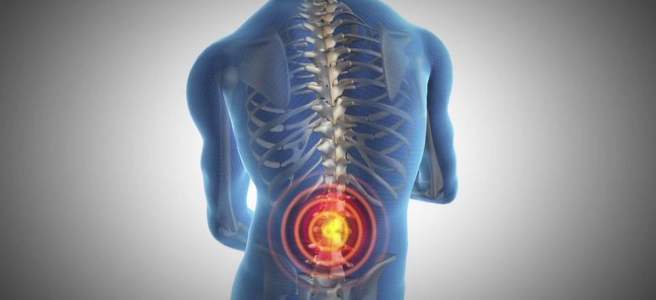

For patients with chronic low back pain (cLBP), treatment guidelines recommend a non-surgical approach as the FIRST-LINE treatment. Ideally, the goal would be to avoid an initial surgery unless it’s absolutely indicated. That means, unless there is loss of bowel or bladder control or retention (which represents a medical emergency) or if there is progressive neurological motor and sensory loss, one can safely avoid surgery and conservatively manage the condition.
Interestingly enough, a systematic review of the results from three randomized controlled studies carried out in Norway and the United Kingdom found the outcomes or results between the surgical fusion vs. non-surgical treatment of patients with cLBP showed NO DIFFERENCE at an 11-year follow-up!
Studies have shown chiropractic to be highly beneficial for acute and chronic low back pain cases.
In one study, researchers reviewed data on 72,326 cLBP patients in the Medicare system who received one of four possible treatment combinations between 2006 and 2012: 1) chiropractic only; 2) chiropractic followed by conventional medical care (CMC); 3) CMC followed by chiropractic; 4) CMC alone.
The research team found that chiropractic care alone (group 1) resulted in the lowest costs, and these patients had lower rates of back surgery and shorter episodes of care.
The group receiving CMC alone (group 4) had the highest costs, with the second and third groups being similar—both costing less and being more effective than CMC alone.
The conclusion of the study reads, “These findings support initial CMT [chiropractic manipulative therapy] use in the treatment of, and possibly broader chiropractic management of, older multiply-comorbid cLBP patients.”
http://ow.ly/i/zdkUO
Collisions and Concussions
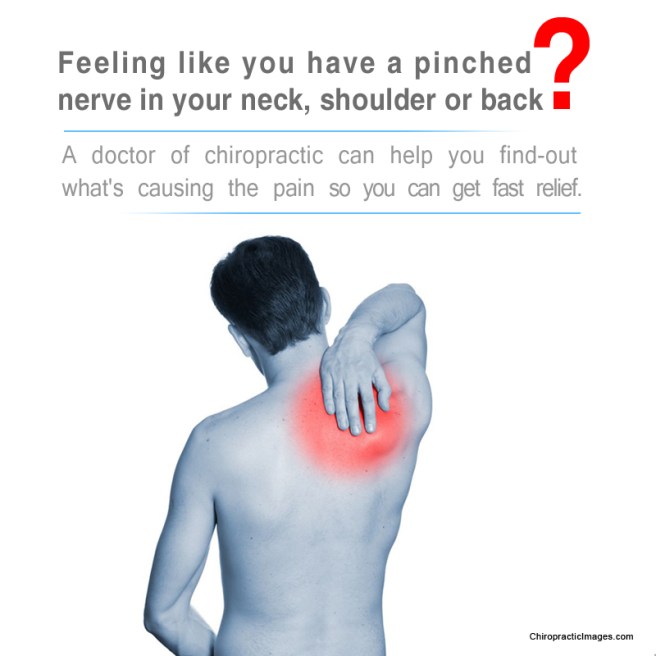
Similar to back pain, neck pain affects almost all of us at some point in life, and the severity can range from a mild stiffness to complete incapacitation. Chiropractic care offers a non-drug, non-surgical method of #treatment that MANY neck pain sufferers utilize and benefit from. The following is a description of what you can expect when treated with an evidence-based chiropractic approach.
Let’s first discuss the different types of #neckpain. One classification system divides neck pain into two main groups: acute and chronic. In the acute group, there is an onset of pain that comes on quickly and resolves in less than three months. Chronic neck pain represents the patients who continue to have neck pain longer than three months.
Studies show that patients experience immediate benefits—including pain reduction and mobility/range of motion (ROM) improvement—following cervical spinal manipulation, especially when administered on the same side as the neck pain. Short and medium-term benefits include pain reduction and ROM improvement when administered bilaterally (on both sides).
Multiple #manipulations may be better than unsupervised stretching alone. However, studies show that stretching the neck muscles both before and after manipulation can improve a patient’s outcome. The combination of three-point traction and multiple manipulations can improve pain in the medium and long-term as well.
Other approaches commonly used by chiropractors that immediately improve pain include mobilization, traction, trigger-point therapy (applying pressure over myofascial trigger points for 90 seconds), cervical pillows, and some modalities that include electric stimulation, ultrasound, low-powered #laser, and pulsed electromagnetic field.
Active care or care that can be taught to patients includes exercise intended to improve #pain and ROM in the medium and long-term. Exercises that emphasize strength and endurance can also be beneficial. Ongoing light and intensive exercise improves pain in the long-term and intensive #exercise is favored in the medium-term.
Who Are We? What Do We Do?
http://ow.ly/i/zdkE7
Happy Thanksgiving everyone! Have a safe
Happy Thanksgiving everyone! Have a safe and happy holiday Monday and we will see you tomorrow at 9am!
.
.
.
.
.
.
.
.
.
.
.
.
.
.
#Thanksgiving
#Canada
#Winnipeg
#Fall
#Dinner http://ow.ly/i/zdjTr
Stay safe while keeping your house in or
Stay safe while keeping your house in order! Here are a few housekeeping safety tips! http://ow.ly/i/zdjsG
Happy Thanksgiving! http://ow.ly/i/zdkpM
Happy Thanksgiving! http://ow.ly/i/zdkpM

